One of the methods I have adopted in tracing the movement of Human migration and the Sanatana Dharma is to check the geographical locations mentioned in the Hindu Texts and cross checking them with the geographical locations available to-day.
Another was linguistics.
Yet another approach as through the Cultural practices and religious landmarks, signs.
I have posted quite a few articles on this basis to show that it was Sanatana Dharma that was practiced in the world, with no exceptions.
In the middle of this quest it struck me to check these facts through the Deities worshiped by Sanatana Dharma, that too the Deities that are not so popular as Rama , Krishna, Shiva or Murugan.
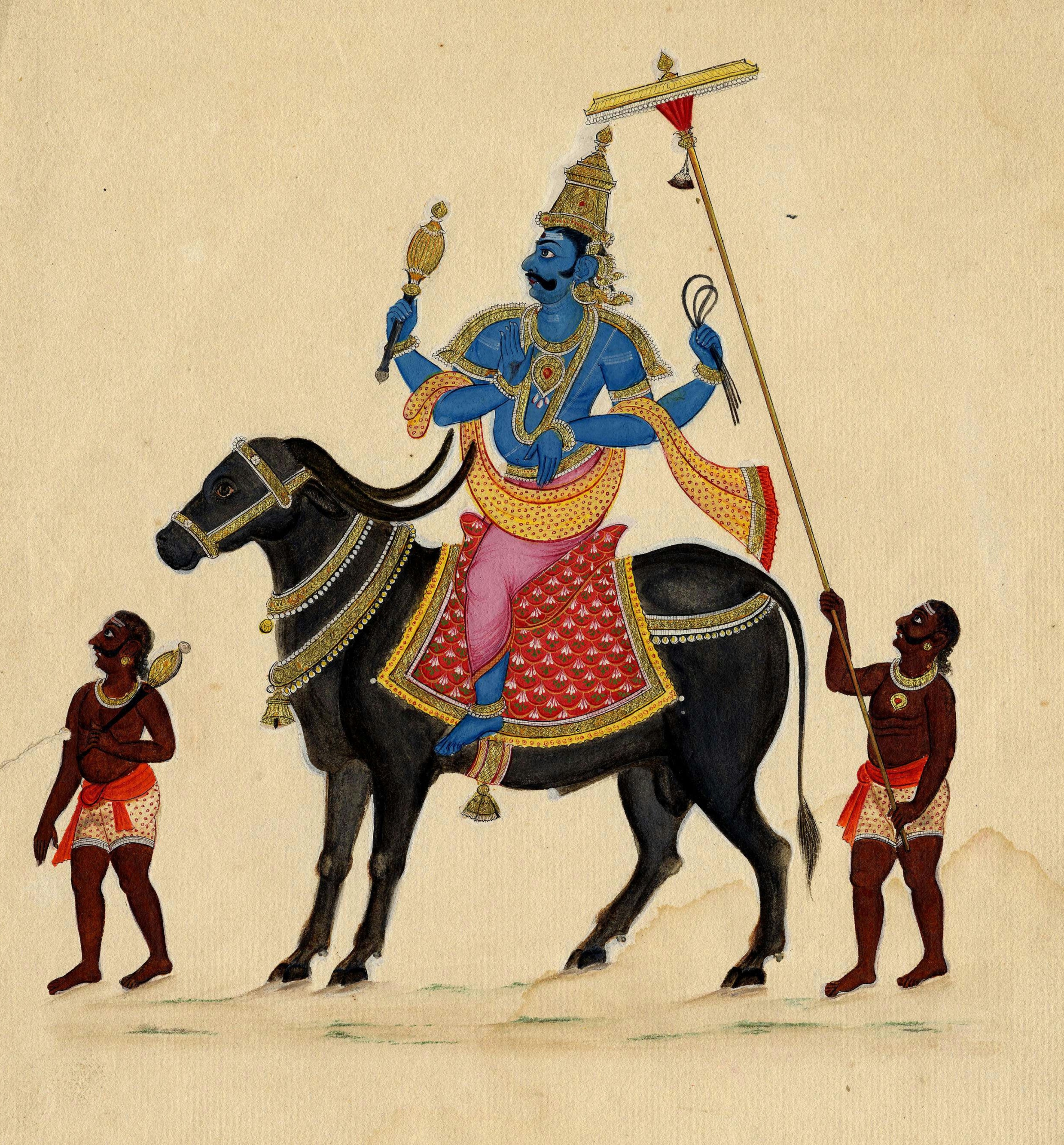
One such Deity is the God of Death Yama.
Yama is the son of Surya, the Sun God and He is the personification of Dharma ho discharges His functions with out fear or favour.
The famous Temple of Yama is in Srivanchiyam Tamil Nadu.
Worship of Yama in the world in other cultures.
In the Pali canon, the Buddha states that a person who has ill-treated their parents, ascetics, holy persons, or elders is taken upon his death to Yama.Yama then asks the ignoble person if he ever considered his own ill conduct in light of birth, deterioration, sickness, worldly retribution and death (mrtyu). In response to Yama’s questions, such an ignoble person repeatedly answers that he failed to consider the kammic consequences of his reprehensible actions and as a result is sent to a brutal hell “so long as that evil action has not exhausted its result…
In Chinese mythology, Yan (Chinese: t: 閻, s: 阎, p: Yán) is the god of death and the ruler of Diyu. From Vedic Sanskrit Yama Rājā (यम राज, “King Yama”), he is also known asYanluowang (t: 閻羅王, s: 阎罗王, p: Yánluówáng, w: Yan2-lo2-wang2 and t: 閻, s: 阎, p: Yán). In both ancient and modern times, Yan is portrayed as a large man with a scowling red face, bulging eyes, and a long beard. He wears traditional robes and a judge’s cap or a crown which bears the character 王, “king.” He typically appears on Chinese hell money in the position reserved for political figures on regular currency.
Some said common people like Bao Zheng, Fan Zhongyan, Zhang Binglin became the Yama at night or after death.
These Chinese beliefs subsequently spread to Korea and Japan. In Japan, he is called Enma (閻魔, prev. “Yenma”), King Enma (閻魔王, Enma-ō), and Great King Enma (閻魔大王, Enma Dai-Ō). In Korea, Yan is known as Yeomna (염라) and Great King Yeomna (염라대왕, Yŏmna Daewang). In Vietnam these Buddhist deities are known as Diêm vương and are venerated as a council of all ten kings who oversee underworld realm of địa ngục.
Emma is depicted with a civil servant’s hat that is similar to the Chinese adapted notion of the Yan who is a judge, whereas the earlier Yama of the Sainokawara folktales are more akin to demons of the Underworld and therefore resemble most the Indo-Iranian / Saka and Tibetan versions.
“Enma face” (閻魔顔 Enma-gao?) is an idiom used to describe someone with a fearsome face.
“If you lie, Lord Enma will pull out your tongue” (嘘をつけばと閻魔さまに舌を抜かれる?) is a superstition often told to scare children into telling the Truth.
Yama in Iran.
A parallel character in Iranian mythology and Zoroastrianism is known as Yima Xšaēta, who appears in the Avesta. The pronunciation “Yima” is peculiar to the Avestan dialect; in most Iranian dialects, including Old Persian, the name would have been “Yama”. In the Avesta, the emphasis is on Yima’s character as one of the first mortals and as a great king of men. Over time, *Yamaxšaita was transformed into Jamšēd or Jamshid, celebrated as the greatest of the early shahs of the world.
Yama in German.
In a disputable etymology, W. Meid (1992) has linked the names Yama (reconstructed in Proto-Indo-European as *yemos) and the name of the primeval Norse frost giant Ymir, which can be reconstructed in Proto-Germanic as *umijaz or *jumijaz, in the latter case possibly deriving from PIE *ymyos, from the root yem “twin”. In his myth, however, Ymir is not a twin, and only shares with Yama the characteristics of being primeval and mortal. However, Ymir is a hermaphrodite and engenders the race of giants.
Yama in Java.
There is Yamadipati in Javanese culture, especially in wayang kulit shadow puppet shows. The word adipati means ruler or commander. When Hinduism first came to Java, Yama was still the same as Yama in Hindu myth.
In Mesopotamia.
Mesopotamian (Anatolian/Middle-eastern semitic) lord of the Underworld
“Nergal (arrow shooting god of II Kings 17:30) a Babylonian god and king of the Underworld “Lord of the great dwelling.” When ejected from heaven he invaded the underworld with fourteen demons. … Nergal is also the god of plague with Namtar (evil god, negative aspect of fate, disease bringer), his symbols are a sword and a lion’s head. From the contract tablets found by Rassam at Tel-Ibrahim it appears that the ancient name of Cuthah was Gudua or Kuta. Its ruins were 3,000 feet in circumference and 280 feet high. In it was a sanctuary dedicated to Ibrahim (Abraham). Both the city and its great temple, the later dedicated to Nergal, appear to date back to Sumerian times. Nergal (Heb. nereghal, a Babylonian deity of destruction and disaster, associated with the planet Mars (god of war and agriculture — See also Hercules, Ares -son of Zeus, Zivis, Zio, Tiwas, Tiw).
Yama was also worshiped in Russia.
Citation.


Leave a Reply to ramanan50Cancel reply