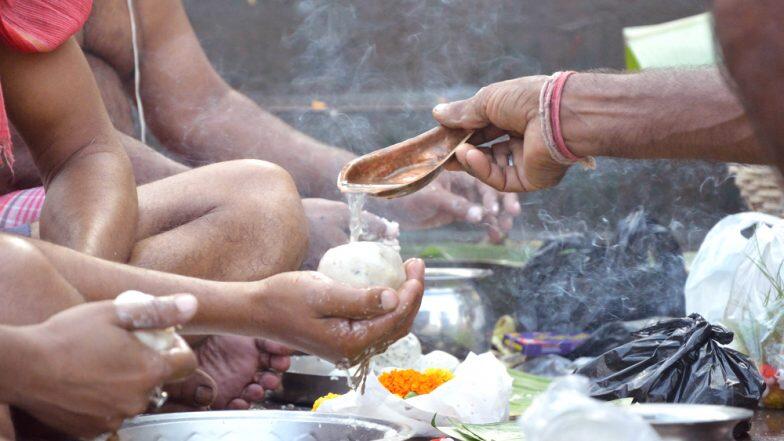
The term Swahaa or Svahaa is used in performing Homas, Sacrificial fire offering in Hinduism.
No Ahuthi, the offering of things in the Fire is complete with out this term..
Swaha means I consume, gulp.
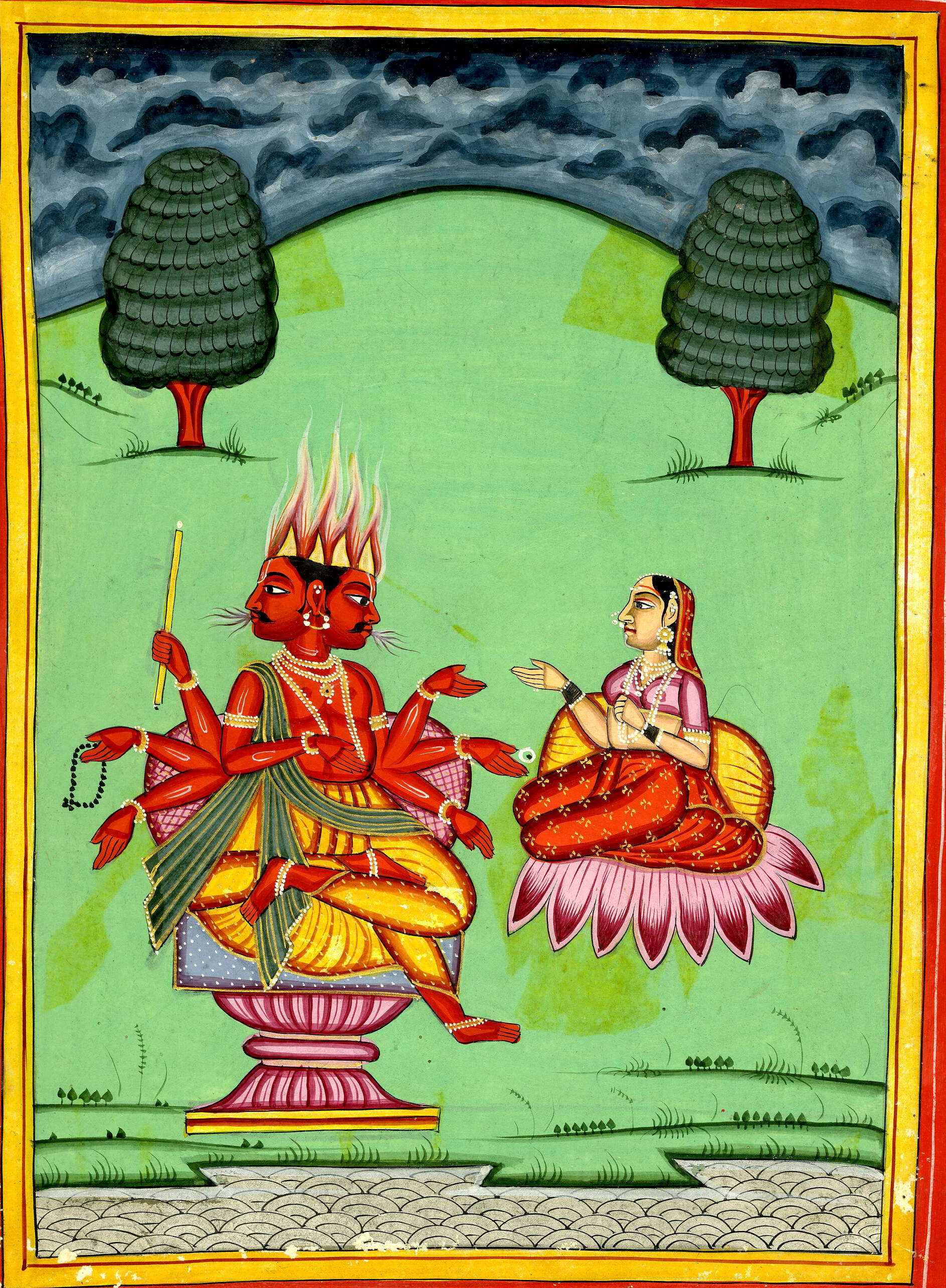
It is believed that the offerings made to God is carried to the Gods, Deities by Agni, Lord of Fire.
The Rig Veda, the oldest literature known to Man begins with,
“Agni Mele Purohitham’
He caries the offering to the Gods specified in the Mantras, who in turn shall grant one’s desires according to his actions.
There two different kinds of performing Fire offering, in terms of attitude to wards the offering.
One is Yaga, which has a specific purpose in Mind and another,
is Yagna, were it is offered with no specific purpose, but done because it ought to be done.
However in both the cases, the Statement , Ithanna Mama-this is not mine,Not done b Me, thus performing action without attachment, Karma Yoga.
For nothing in the world is ours,
We offer what is already there , we do not own anything.
Agni carries this with the same attitude.
The term Swaha is to enable Agni to perform this function b calling him out.
Who is this Swaha?
“In Hinduism and Buddhism, the Sanskrit lexical item svāhā (Romanized Sanskrit transcription; Devanagari: स्वाहा, chi. 薩婆訶 sà pó hē, jp.sowaka, tib. སྭཱཧཱ་ soha) is an interjection, approximately “hail!” in mantras indicating the end of the mantra.
In the Tibetan language, “svaha” is translated as “so be it” and is often pronounced and orthographically represented as “soha”.
Whenever fire sacrifices are made, svāhāis chanted. Etymologically, the term is probably from su “well” and the root ah “to call”.
As a feminine noun, svāhā in the Rigveda may also mean “oblation” (to Agni or Indra), and as oblation personified, Svāhā is a minorgoddess, and the wife of Agni. She was originally a nymph[citation needed] but became immortal after marrying Agni. In some versions, she is one of the many divine mothers of Karttikeya.
She is also the mother of Agneya (Aagneya) – the daughter of Agni. She is considered to be a daughter of Daksha.
She is thought to preside over burnt offerings. Her body is said to consist of the four Vedas and her six limbs are the six Angas of the Vedas.
It is said that the gods to whom offerings are being made through yagna refuse the offerings unless the word ‘svaha’ is uttered during the sacrifice.”
At times Svaha is identified with Uma and Parvathi.
Their sons are Pavak, Pavaman and Suchi. According to Vayu Purana, Pavak stands for electric fire, Pavaman, fire produced by friction and Suchi, the solar fire.
Goddess Svaha Devi is invoked during all homam, yagas and yajnas.
It is believed that during fire sacrifices and yagnas if the word ‘svaha’ is not uttered, the gods will refuse to accept the offerings.
Hence Swaha is given prime importance similar to Lord Agni Deva during Yagas and Homams. Fire sacrifice is done by a couple.
This suggests that the husband-wife duo is to be appeased together and reflects a rarely researched proximity between the two.
The body of the goddess is said to consist of four Vedas and her six limbs are regarded as the 6 Angas of the Vedas.
She is considered as one of the many divine mothers of Skanda. She is also considered to be the daughter of Daksha.
In her extreme manifestation, she is considered to be the wife of Rudra. Various deities of the Hindu pantheon are identified with Svaha, including Siva, Skanda, Krishna, Shri and Saraswati.
BRAHMAVANTARA PURANA:
Svaha is a form of Prakriti, Shakti power without which Agni cannot burn.
The three three children are the three household fires, Dakshina, Garhaptya and Ahavaniya.
The offerings are ineffective if the word ‘svaha’ is not uttered.
In the Mahabaratha, the three sons are described as Kama Agni, the embodiment of beauty, Amogha Agni, the invicible fire and Uktha, the means of salvation.
From Uktha was born Panchajanya, another agni.
MAHABARATHA: The Kritikas are women happily married to the Seven Stars called Saptha Rishis.
They are Kashyapa, Atri, Bharadhvaja, Vishvamitra, Gauthama, Jamadagni and Vashishta.
Their relationship becomes sour when Agni, the God of Fire, caught sight of the beautiful Kritikas.
He proposed to each of the women but they all turned them down. Hurt by the rejection, Lord Agni hide in the forests to plan his next move.
There he was seen by Brihaspati’s daughter, Goddess Svaha who could take the form of a star.
She is also known as Manyauti or Manyanti and is present in all matters.
Svaha fell in love with Agni but just as Kritika rejected Agni, Agni rejected Svaha.
Not willing to give up, Goddess Svaha disguised herself as one of the Kritika and seduced Agni.
Pleased with her success, she went on to disguise herself as each of the other six Kritikas.
However when the seventh time, she tried to make love to Agni, the fire god realised it was a trick.
It was not realised by GoddessSvaha that the seventh Kritika was extremely devoted to the husband.
But when the truth became known, he saluted Svaha, “Thanks to you, I have quenched my thirst without breaking the sacred laws of marriage and
without incurring the wrath of the sapta rishis.” Agni accepted Svaha as his consort and declared that he would not accept any oblation unless her name was chanted during the offering. During a yagna ceremony, the priests says, “Svaha,” every time he pours milk or butter into the fire.
The myth also tells that Goddess used a unique form of contraception.
She collected Agni’s sperm during the six occasions, carried them in the form of a bird, the Suparni and kept them in a cave.
So she did not get pregnant despite the six times she made love. The cave gave birth to a boy called Skanda.
The child born of Agni’s union with Svaha was named Agneya; he was a divine warrior with the strength of seven men.
Rumours spread that the six Kritikas were Skanda’s mother, the Rishis divorced their wives.
They were sent to another part of the night sky.
It must be noted that in the story of Skanda as son of Shiva, it is Agni who carries the fiery semen of Shiva to Ganga who deposits in the forest and where
Skanda is born as six babies looked after by Krittika Nakshatra. The six babies are later joined together by Goddess Parvati.
BHAGAVATA PURANA: A similar instance occurred when, after the creation of worldly and heavenly beings, the perplexing question remained of the latter’s sustenance.
While creatures of the earth could partake of the food available there, no provision had still been made for the gods.
Brahma, the creator, then decreed that the offerings poured into the sacrificial fires (on the earth), would be the food of gods.
Towards this end, they worshipped the Great Goddess, who appeared before them in the form of goddess ‘Svaha.’
The assembled deities then addressed her: “O Goddess, Let yourself become the burning power of fire; who is not able to burn anything without thee.
At the conclusion of any mantra, whoever taking thy name (Svaha), will pour oblations in the fire, he will cause those offerings to go directly to the gods. Mother, let yourself, the repository of all prosperity, reign over as the lady of his (fire’s) house.”
Later, Agni, the deity of fire, approached her with some fear, and worshipped her as the Mother of the World.
Then, with the chanting of sacred mantras, they were tied in the knots of holy matrimony.
From then, it is believed, that whosoever pours libations in the sacrificial fire accompanied by the sacred name ‘Svaha,’ has all his dreams immediately fulfilled: Devi Bhagavata Purana: 9.43.
The Vedvani, the sound of all the four and “Swaha” is eternal.
The printed Vedas are not Vedvani, it is called Samhita and Samhita can be destroyed whereas Vedvani is eternal.
(2) “Sushikshit vani”. Sushikshit means = Su + Shikshit.
Besides all these, Swaha has many other meanings and some of these which may be deliberated upon are—-
1. SU + AHA i.e., beautiful, eloquent vani.
2. Yajurveda mantra 38/11 explains it to be an action impregnated with truth i.e., when one offers ghee and other materials (combination of antibiotics + fragrant + sweet + nutritive materials) through one’s own hand into the pious fire of havan.