Tag: Maurya Empire

  • Greeks Followed Buddhism Ashokas  Edicts

    Greeks Followed Buddhism Ashokas Edicts

    I have been planning to write on Buddhism and Jainism, the two Great Religions of India apart from Hinduism.

    To begin with let me share information about the propagation of Buddhism around the world.

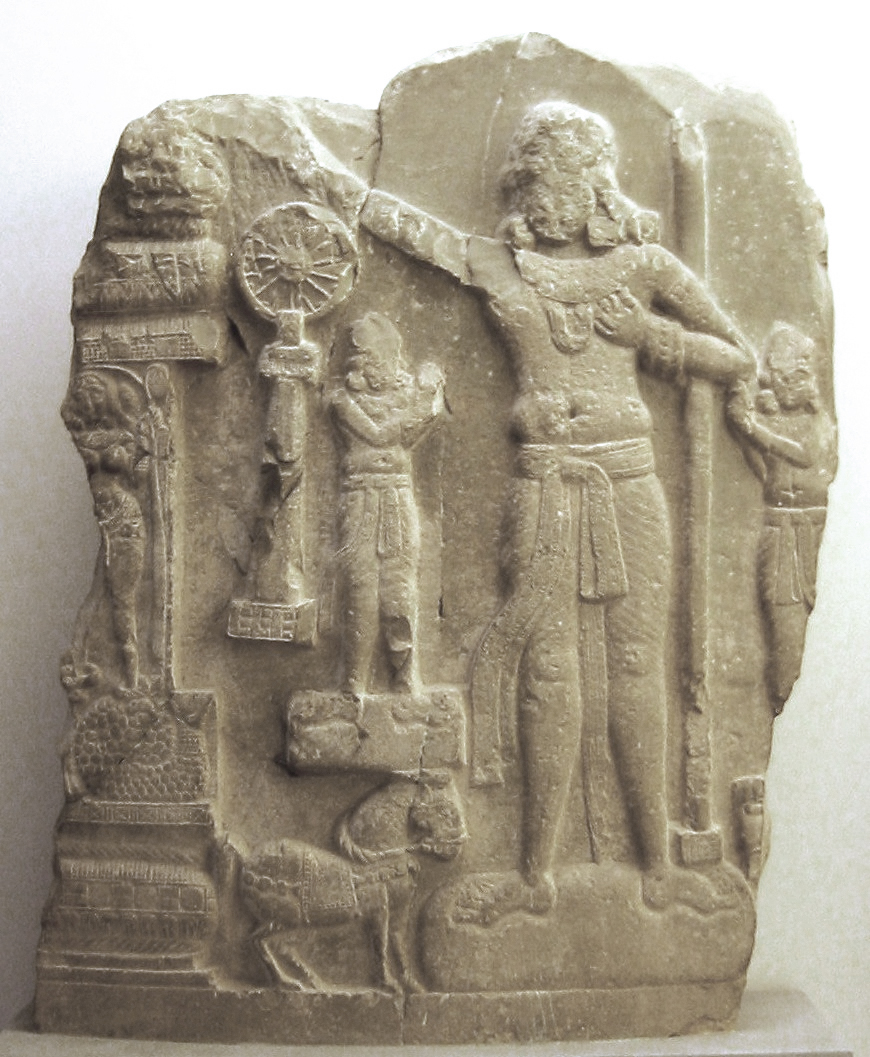
    Ashoka Maurya (/əˈʃkə/; Sanskrit: अशोक मौर्य; 304–232 BCE), commonly known as Ashoka and also as Ashoka the Great, was an Indian emperor of the Maurya Dynasty who ruled almost all of the Indian subcontinent from circa 269 BCE to 232 BCE.[1] One of India’s greatest emperors, Ashoka reigned over a realm that stretched from the Hindu Kush mountains in the west to Bengal in the East and covered the entire Indian subcontinent except parts of present day Tamil Nadu and Kerala. The empire’s capital wasPataliputra (in Magadha, present-day Bihar), with provincial capitals at Taxila and Ujjain.


    Buddhism in the world during Asoka's Reign.image.jpg
    Spread of Buddhism during Asoka’s period

    Asoka took to Buddhism with great zest and propagated it around the world by sending out preachers.

    He had recorded this in his edicts.

    Emperor Asoka's Edicts.image.jpg
    Emperor Asoka’s Edicts Locations.

    The Ashoka inscriptions represent the first tangible evidence of Buddhism. The edicts describe in detail the first wide expansion of Buddhism through the sponsorship of one of the most powerful kings of Indian history. According to the edicts, the extent of Buddhist proselytism during this period reached as far as the Mediterranean, and many Buddhist monuments were created.

    The inscriptions proclaim Asoka’s beliefs in the Buddhist concept of dhamma and his efforts to develop “dhamma” throughout his kingdom. Although Buddhism and the Buddha are mentioned, the edicts of Asoka tend to focus on social and moral precepts rather than religious practices or the philosophical dimension of Buddhism.

    The inscriptions revolve around a few repetitive themes: Ashoka’s conversion to Buddhism, the description of his efforts to spread Buddhism, his moral and religious precepts, and his social and animal welfare program.

    Ashoka explains that he converted to Buddhism out of remorse for his conquest of the Kalingas around 264 B.C.E. in eastern India (near the present-day state of Orissa):

    Beloved-of-the-Gods, King Piyadasi, conquered the Kalingas eight years after his coronation. One hundred and fifty thousand were deported, one hundred thousand were killed and many more died (from other causes). After the Kalingas had been conquered, Beloved-of-the-Gods came to feel a strong inclination towards the Dhamma, a love for the Dhamma and for instruction in Dhamma. Now Beloved-of-the-Gods feels deep remorse for having conquered the Kalingas (Rock Edict Nb13, S. Dhammika).

    Following his conversion, Ashoka traveled throughout India and visited sacred Buddhist locations, where he would typically erect a pillar bearing his inscriptions:

    Twenty years after his coronation, Beloved-of-the-Gods, King Piyadasi, visited this place and worshipped because here the Buddha, the sage of the Sakyans, was born. He had a stone figure and a pillar set up and because the Lord was born here, the village of Lumbini was exempted from tax and required to pay only one eighth of the produce (Minor Pillar Edict Nb1, S. Dhammika).

    Ashoka’s concept of “Dhamma” seems to be synonymous with righteousness. In order to propagate the Buddhist faith, Ashoka explains he sent emissaries to the Hellenistic kings as far as the Mediterranean, and to the peoples throughout India, claiming they were all converted to the Dharma as a result. He names the Greek rulers of the time, inheritors of the conquest of Alexander the Great, from Bactria to as far as Greece and North Africa, displaying an amazingly clear grasp of the political situation at the time.

    Buddhist proselytism at the time of kingAshoka (260-218 B.C.E.).

    Now it is conquest by Dhamma that Beloved-of-the-Gods considers to be the best conquest. And it (conquest by Dhamma) has been won here, on the borders, even six hundred yojanas away, where the Greek king Antiochos rules, beyond there where the four kings named Ptolemy, Antigonos, Magas and Alexander rule, likewise in the south among the Cholas, the Pandyas, and as far as Tamraparni (Rock Edict Nb13, S. Dhammika).

    The distance of 600 yojanas (a yojanas being about 7 miles), corresponds to the distance between the center of India and Greece (roughly 4,000 miles).

    • Antiochos refers to Antiochus II Theos of Syria (261-246 B.C.E.), who controlled the Seleucid Empire from Syria to Bactria, in the east from 305 to 250 B.C.E., and was therefore a direct neighbor of Ashoka.
    • Ptolemy refers to Ptolemy II Philadelphos of Egypt (285-247 B.C.E.), king of the dynasty founded by Ptolemy I, a former general of Alexander the Great, in Egypt.
    • Antigonos refers to Antigonus II Gonatas of Macedon (278-239 B.C.E.)
    • Magas refers to Magas of Cyrene (300-258 B.C.E.)
    • Alexander refers to Alexander II of Epirus (272-258 B.C.E.)

    Citation.

    http://www.newworldencyclopedia.org/entry/indian_inscriptions


    http://en.wikipedia.org/wiki/Ashoka

  • Rama Evacuates Ayodhya By Pushpaka Vimana

    As I understand from the Ramayana, Lord Rama completed his last Journey on the earth , after the demise of Lakshmana, by entering the Sarayu River.

    I have come across information that Rama evacuated Ayodhya from the banks of by a Pushpaka Vimana flying North.

    Rama proceeded first with his Royal entourage and the people of Ayodhya followed suit.

    This process took three days.

    Rama and Sita in Pushpaka Vimana.jpg
    Rama and Sita in Pushpaka Vimana.

    His last thoughts before boarding the craft was that of Hanuman whom he had not seen the whole day!

    He advised his son Lava to rule the kingdom from Shrawasti (Sahet-Mahet ) as capital and till the period of Buddha, this place continued to be the capital of Kaushal estate. Subsequently, in the Maurya period as well this Kaushal estate (province of Magadh empire) was the capital.


    The city of Kushawati, which is in  the Vindhya region, was established for the rule of the  other son Kush and thereafter till date it is famous as  Mahakaushal…

    “It has also been mentioned in the Ramayana that after Lord Sri Rama, Ayodhya would again be  inhabited during the times of Rishabh.

    He was the first Tirthkar of Jains and is also known as Adinath.

    Citation.


    How the Rama Empire Disappeared.


     http://jayasreesaranathan.blogspot.in/2010/10/history-of-ram-janma-bhumi-temple-at.html

    “It is so believed amongst the Hindus that the credit for inhabitance of Ayodhya for third time, goes to Vikramaditya, king of  Ujjain.

    It appears from paper no. 107C-1/10, 107C-1/28,

    107C-1/35, 107C-1/55 filed in this suit that he had built 360 temples in Ayodhya.


    https://ramanisblog.in/2012/10/13/last-days-of-rama-date-of-death/

  • Vikramaditya Date His World Kingdom

    There are quite a number of theories that undermine the History of India by interpolating in the Indian texts,Misinterpreting them deliberately, as Max Mueller had done,honest misinterpretations and deliberate falsehood .


    They are.

    1.Sanatana Dharma dates to 5000 BC.

    2.Vedas are non sensical sound bytes.

    3.The Puranas and the Ithihasas are pure fantasy.

    4.Aryans entered from Khyber Pass, invaded India and enriched it.

    5.Dravida Desa, the South of India were peopled by barbarians.

    6.The south indians called Dravidians were constantly engaged at war with the Aryans of the North.

    7.The Arynas were a superior race.

    8.The Sanatana Dharma was resisted and in fact the southerners fought against them, especially the Tamils.

    9.Hindus were primitive and did not have any basic idea of Science.

    10.Denying the existence of great Indian Kings and where it is not possible, assigning them later dates in History.

    Vikramadiya's Empire.jpg
    King Vikramaditya’s Empire.


    All these are falsehoods to undermine Hinduism and I have posted articles on each of them.


    They are filed under Hinduism, Tamils,Astrophysics, Science.


    One such mischief is the date of Vikramadiya, whose existence is dismissed as fiction.


    Here are the facts about King Vikramaditya and his Kingdom.


    “In the Rajatarangini Kalhana mentions that Vikramaditya, the emperor of India, whose capital was Ujjain sent Metrigupta to be the ruler of Kashmir, which was included in the empire of the former…

    King Vikramadiya efernce in Bhavishya Purana.jpg
    King Vikramadiya efernce in Bhavishya Purana. Click to enlarge.


    The above slokas mean to this effect:- “After the completion of three thousand years in Kali (101 B.C.),for the destruction of the Sakas and the propagation of the Aryan Dharma, by the command of Siva, from the abode of the Guhyakas in Kailasa, a personage will be born (to Gandharva Sena, the king of Ujjain). The father gave the child the name of Vikramaditya and rejoiced. Even as an infant he was very wise and gladdned the hearts of the parents. At an early age of five years. he retired to a forest to do penance,. Having spent twelve years in meditation, he achieved spiritual eminence and returned to his city called “Ambavati” or Ujjain. On the eve of his ascending the throne adorned with thirty two golden statues, came a learned Brahmin and he delayed the coronation ceremony with a purpose to teach the king a history consisting of several episodes, wherein the rights and duties of a monarch are enumerated. Then the Brahmin taught the prince all the rights and responsibilities he owed to himself and to his subjects and gave him a befitting and an efficient training worthy of an adventurous Sovereign. Afterwards, in Kali 3020 year or B.C. 82 Vikramaditya was crowned king. Then he expelled the Sakas and drove them as far as Bactria, conquered the whole of Bharata country from Setu to the Himalayas, and received tribute from the feudatory kings…


    Vikramadiya's Empire in Bhavishya Purana.jpg
    Description of Vikramadiya’s Empire in Bhavishya Purana.

    In the west the other bank of the Sindhu River; in the South the Setu; Badarinarayana in the Himalayas formed the North limit and the city of Kapilavastu, the boundary in the East. These were the limits of Vikramaditya’s Empire.

    Another sloka states,
    “By the grace and command of Siva, Gandharvasena’s son, Vikramaditya reigned as Emperor, for hundred years. His son “Devabhakta” after ruling for ten years, was killed in a battle by the cruel Sakas.”(Kali 3130 or 29 A.D.)..


    Vikramaditya.


    Parthian invaded Sub-Continent in around 55 BC which brought Vikramaditya Vardhan’s Invasion in entire West Asia (Modern Day Middle East).

    The victories of Babylon, Persia, Turks led him again to the Arabia and sounded the hour for attack on Arabia. When he conquered Arabia, he did so to cheers from the Jewish and Arab  Community, who welcomed him as a liberator. He showed great forbearance and respect towards the religious beliefs and cultural traditions of other races. These qualities earned him the respect and homage of all the people over whom he ruled.

    The victory over Arabia expressed all the facets of the policy of conciliation which Vikramaditya had followed until then. He presented himself not as a conqueror, but a liberator and the legitimate successor to the crown. He took the title of “King of Aryavrata and Liberator of the Arabs, Turks and Jews”. Vikramditya had no thought of forcing conquered people into a single mould, and had the wisdom to leave unchanged the institution of each kingdom he attached to the Aryavrata Crown. Vikramaditya was upright, a great leader of men, generous and benevolent.  He spread the Vedic Culture in the land of Arabia. He also reconstructed the temple of Brahma and Mahesh and placed a Jiyotarlinga there. Several other Vedic Temples were made in Babylon, Persia and Turkistan.  For the first time they got a King that cared for the inhabitants of his Empire. Arabs, Kurds and Persians saw him as ‘the annointed of the Lord’.

    After the 4 year of Wars that saw whole west Asia under the belt of Vikramaditya Empire he stayed for a year in Arabia till the Mahadev Temple was not completely reconstructed.

    He built admirable highways, and developed an excellent postal system both of which allowed him to receive rapidly information from his provinces. He accepted Perisans as Aryans and called them as long lost cousins. During the Vikramaditya’s regions persians felt like they felt under the region of Cyrus. He also bulit several monuments in the respect of Chandargupt Maurya and Cyrus. Another project undertaken by Vikramaditya was the royal road, the world’s longest, extending 1,700 miles. Due to an extensive network of relays, postmen could travel the road in six to nine days, whereas normal travel time was three months. The motto of the Vedic postal service became memorable: stopped by neither snow, rain, heat or gloom of night. The US postal service also adopted this motto and the famous Pony Express mail delivery resembled the original Vedic design. Vikramaditya laid the foundation of Vardhan Dynasty. His empire controlled many parts of Modern day China, Entire Middle East and Many Parts of South East Asia. After his death his descendents and Parthians controlled Iran. By 102 AD descendents of Vikramaditya lost control over Iran and Parthians established there empire in Iran and Babylon.

    Citation.

    http://trueindianhistory-kvchelam.blogspot.in/2010/01/date-of-emperor-vikramaditya.html

    http://www.geocities.ws/historyofiran/vedicera.html

    http://ramanisblog.in/2014/07/04/chandra-gupta-megasthanes-never-met-history-faked/

  • Kings List India By Puranas Validated

    Indians believe the Timeline of India’s History as explained by William Jones and his followers, though their theory on the dates assigned to events and persons have been proved to be incorrect by many references and most importantly by archeology.


    If one were to mistrust the Hindu scriptures, the Nastika System of jainism which denies the authorit of the Vedas, has provided informationwhich tallies with the timeline and events portayed by the Puranas.


    Secondly the Archeological finds dispprove the dates assined by William Jones and others and show that the events and people had happened/lived much before the dates indicated by them


    Our history textbooks tell us that Magadha (not Ayodhya) was one of India’s first kingdoms and that Buddha and Mahavira were contemporaries who lived in/ around Magadha around 600 BCE. However, when we visit the sites of India’s so-called earliest centres of civilization (e.g., Sarnath where the Buddha preached his first sermon), we see evidence from the Jain tradition that its earlier Tirthankaras8 were already living in that city hundreds of years ago.9 On top of this, the Jains appear to share the same hoary past as the Hindus do, with their first Tirthankara (Rishabhadeva) believed to be the king of Ayodhya more than 20 generations before Mahavira.

    In addition to the Jain tradition, the history preserved in our native chronicles – the Puranas – appears to have some support from archaeology as well. Although most of the sites described in the Puranas are now populated and hence cannot be excavated, the few non-inhabited sites (e.g., Dwaraka) exhibit evidence of ancient civilizations. This begs the question as to whether we should truly discard the traditions preserved in India’s native chronicles or take the trouble to re-examine them in a new light. This essay presents the chronology of India as preserved by its native historians and tests the validity of this chronology when compared to independent accounts of ancient India.


    The accepted chronology of ancient India is based on William Jones’s identification of Sandrocottus with Chandragupta Maurya, the first king of the Mauryan empire. This identification serves as the basis for determining the era of Buddha, the dates of the subsequent kings of Magadha and of other kingdoms of India. According to this chronology, Chandragupta Maurya ascended the throne of Magadha around 315 BCE. However, the Puranas as well as Megasthenes’s account of the milieu he lived in present a compelling case for debunking this identification and associating Sandrocottus with Chandragupta I, the founder of the Imperial Guptas. According to the Puranas, Chandragupta Maurya was crowned in 1538 BCE, Ashoka was crowned in 1489 BCE, and Chandragupta I ascended the throne of Pataliputra around 315 BCE in time to be the monarch referred to as Sandrocottus when Megasthenes arrived in Pataliputra in 302 BCE. This essay presents the evidence for this Puranic chronology and aims to resolve other conundrums in Indian history, such as the age of Vikramaditya and Adi Sankara, with this revised timeline.”


    Then one has the astronomical data.


    This authenticates the Puranic Data.


    The problem with the astronomical data is that celestial events occur repeatedly at a fixed intervals and as such the difficulty lies in matching a particular astronomical event with the events described by our Puranas.


    Then one has Kalpas, a Kalpa being one day f Lord Brahma, the Creator and He creates 14 Manvantaras.


    This crestes additional dificulties to identify the Manvanatara, Kalpa and a particular event.


    This one can resove by referring to the Sankalpa being used by the Hindus for every religious  event.


    Please read my post Geo Tagging, Sankalpa.


    I became curious to check all these because i has found a refernce stating that Satyavrata Manu , the ancestor of Lord Rama migrate from the South to North because of a Tsunami.


    He went to Ayodhya and founded the Dynasty called Ikshvaku.


    There are five floods recoreded in Indian legends, both in Sanskrit and Tamil.


    This we can resolve by matching this information with references found in other texts and by archeology.


    The following verified information spurred me to search and arrive at a Kings List of India according to Puranas ans Tamil Classics.


    1.Lord Rama’s Date of Birth, Marriage,Exile, Ramayana War.

    2.Mahabharata War.

    3.Agasthya’s crossing over to South through the Vindhyas.

    4.Tamil Classics’s refernce to Tsunamis.

    5.The ancestry of Tamil Cholas to Manu and of Pandyas antiquity.

    6.The feeding of the armies of Kauravas and Pandavas by a Tamil King, Udiyan Neduncheralaathan.

    7.The artifacts and archeological finds of the remnants of Sanatana Dharma throuhout the world.


    And the Bhagavata reference to Satyavrata Manu leaving th south for the North because of a Tsunami.


    I have posted articles on all these issues,under Hinduism.


    List of Kings.


    India Kings List.jpg
    List of Indian Kings according to Puranas after primay creation. Click to enlarge.


    Kings,descendants of Vivasvat.jpg
    List of kings in the Vaivasvata (descendants of Vivasvat) Manvantara as stated in the Vishnu Purana.Click to enlarge.


    Indian Kings list upto Mahabharata War.jpg.
    List upto Mahabharata War.List of kings in the Vaivasvata Manvantara until the Great War as stated in the Vishnu Purana.Click to enlarge
    Kings List after Mahabharata War.jpg
    List of Kings in Kali Yuga(present Yuga). List of kings in the Kaliyuga (after the Great War) as stated in the Vishnu Purana.Click to enlarge
    Second List of Kings after Mahabharata War.jpg
    List of kings in the Kaliyuga (after the Great War) as stated in the Vishnu Purana. The Vidisha list is from the Vayu Purana.Click to enlarge.


    One may note that the Solar and Lunar dynasties married among themselves.

    The list incldes the names of Bimbisara, father of Ashoka.

    Reference and citations.

    http://bharatbhumika.blogspot.in/2014/08/puranic-chronology-of-india.html


    http://ramanisblog.in/2014/12/03/world-history-timeline-by-rigveda/

  • Maurya Sunga Dynasty Forecast Vishnu Puran

    The Puranas of The Hindus list the rulers of Bharatavarsha, which includes those in the Kali Yuga.

    The normal Perception is that the Puranas stop with probably with the Death of Lord Krishna in the Dwapara Yuga .

    And the Kalki Purana, Bhavishya Purana lists the Future Discoveries and the behaviour of people since The Mahabharata..

    But while studying the Puranas in the original one comes to know that the Puranas list the Rulers ,Dynasties, the Class of people who are to Rule the Bharata Varsha.

    A look.

    Vishnu Purana.

    The Dwapara Youga endedsha with Kheshemaka of the Lunar, Pandavas Dynasty and the Surya Dynasty with Sumitra of Ikshvaku (the successors of Lord Rama‘s Dynasty)

    Yadava’s Dynasty, of Lord Krishna’s ends with Ribunjaya.

    After this Kali Yuga dawns.

    Ribhunjaya’s Minister would kill Ribunjaya and crown his son Prathyodana and Praydyothana’s Family shall Rule for 838 years.

    After this Bharata varsha will be ruled by Sisunabhan,Kakavarnan upto Mahanandi for 362 Years.

     Kshatriyas’ Rule will come to an end with Maha Nandi marrying a low-caste woman and shall beget Nanda,, later this Dynasty shall be known as the maurya Dynasty.

    Nanda will kill many kshatriya Kings and will be like Parasu Rama in killing the Kshatriyas.

    This Nanda. aka Maha Padma and his eight sons will exterminate all the Kshtriya Kings and rule for about one hundred years

    These nine will be annihilated by Chandra Gupta, born of Mura, with the help of a Brahmin, Chanakya, aka Vishnu Gupta, Kautilya and Vatsyayan.

    These rulers belong to the fourth caste.

    This Dynasty shall rule for 137 yeras.

    The last king Bruhathratha will be killed by his Senathipathi,General Pushyamitra ans establish Sunga Dynasty.

    This Sunga Dyansty shall rile for 112 years.

    Aer this Kanavas, Andhras and shall rule.

    It will be followed by Foreigners ,those belonging to Vellalars Community(those in charge of maintaining the River Bed ,Canals.( they belong to the top echelon of the Fourth varna.

    The Maurya Rulers , present recorded History.

    The Maurya dynasty ruled over a geographically extensive empire in India from 321 to 185 BC.

    Name Lifespan Reign start Reign end Notes Family Image
    Chandragupta Maurya

     
    345 – 298 BC 322 BC 298 BC He was the follower of Saint Chanakya. He was the son-in-law of Selukos Nikator,general of Alexander,the Great. Mauryan dynasty  
    Bindusara

     
    320 – 272 BC 298 BC 272 BC He spread mauryan empire by defeating 16 kings and added their land to his empire. Mauryan dynasty  
    Ashoka the Great

    • ashoka
    304 – 232 BC 274 BC 232 BC Hero of Kalinga war. Later he became buddhist. Mauryan dynasty  
    Dasaratha

     
    c. 252 – 224 BC 232 BC 224 BC   Mauryan dynasty  
    Samprati

     
      224 BC 215 BC   Mauryan dynasty  
    Salisuka

     
      215 BC 202 BC   Mauryan dynasty  
    Devavarman

     
      202 BC 195 BC   Mauryan dynasty  
    Satadhanvan

     
      195 BC 187 BC   Mauryan dynasty  
    Brihadratha

     
    d. 185 BC 187 BC 185 BC   Mauryan dynasty