Tag: Ashoka

  • Sanskrit Documents On Interstellar Spaceships Found in Lhasa

    The vital difference in acquiring Knowledge between India and the West lies in the fact that while Knowledge is  a Positive Concept in the West, it is Negative Concept in India.

    Anti Gravity Interstellar Ships of Ancient India.Image.jpg
    Anti Gravity Interstellar Ships of Ancient India.

    knowledge, in its fundamental form Awareness, is, not acquisition of some thing new and external to us,but the removal of Ignorance,Misconceptions Avidya.

    Once the false notions are removed Real knowledge shines forth.

    Buddhism and Jainism state the same Truth but there are minor Philosophical differences on this with Hinduism.

    Pure Knowledge is Pure Consciousness, Chit.

    Please read my Post Vedas on Consciousness.

    There are many methods of obtaining this Knowledge.

    Patanjali follows the Raja Yoga  in his Yoga Sutras.

    He describes the process of obtaining this Knowledge in the first Yoga Sutra.

    ‘Yoga:Chitta Vruththi Nirodhithaha’

    Yoga(Union with Reality) is Cessation of Modification of Chitta.

    For detailed explanation please read my post on this.

    On successful completion of the Yoga procedures, or even during the process one shall gain some special powers.

    These are eight in number.

    • Aṇimā: reducing one’s body even to the size of an atom
    • Mahima: expanding one’s body to an infinitely large size
    • Garima: becoming infinitely heavy
    • Laghima: becoming almost weightless
    • Prāpti: having unrestricted access to all place
    • Prākāmya: realizing whatever one desires
    • Iṣṭva: possessing absolute lordship
    • Vaśtva: the power to subjugate all

    Of this Laghima is the power to defy Gravity.

    As Reality is One and as are the Reality, the realized Ones, can alter the perceived objects and bend them to their Will.

    They can regroup the atomic composition of Matter.

    They can make things lighter than air, make things move in a Vacuum.

    All these were documented bu Yogis and Siddhas in their works in the form of Sutras.

    There was a group of Nine Unknown Men during the period of  Emperor Ashoka, who were the guardians of these.

    They were the Illuminati of India.

    Please read my Post on this.

    Such a Manuscript was found in Lhasa, Tibet by the Chinese.

    Read the following.

    ‘The “Nine Unknown Men” wrote a total of nine books, presumably one each. Book number was “The Secrets of Gravitation!” This book, known to historians, but not actually seen by them dealt chiefly with “gravity control.”

    It is presumably still around somewhere, kept in a secret library in India, Tibet or elsewhere (perhaps even in North America somewhere). One can certainly undertand Ashoka’s reasoning for wanting to keep such knowledge a secret, assuming it exists, if the Nazis had such weapons at their disposal during World War II. Ashoka was also aware devastating wars using such advanced vehicles and other ‘futuristic weapons’ that had destroyed the ancient Indian “Rama Empire” several thousand years before.

    Only a few years ago, the Chinese discovered some sanskrit documents in Lhasa, Tibet and sent them to the University of Chandrigarh to be translated. Dr. Ruth Reyna of the University said recently that the documents contain directions for building interstellar spaceships!
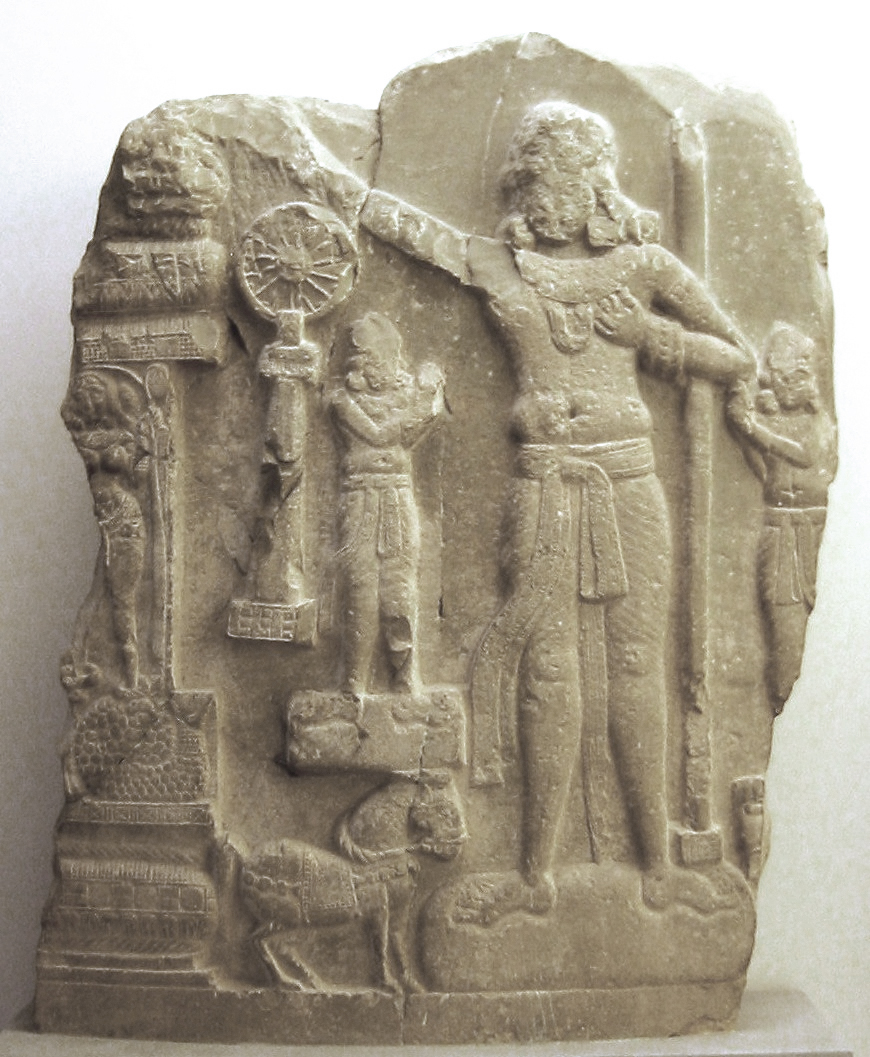
    Flying Machines

    Their method of propulsion, she said, was “anti-gravitational” and was based upon a system analogous to that of “laghima,” the unknown power of the ego existing in man’s physiological makeup, “a centrifugal force strong enough to counteract all gravitational pull.” According to Hindu Yogis, it is this “laghima” which enables a person to levitate.

    Dr. Reyna said that on board these machines, which were called “Astras” by the text, the ancient Indians could have sent a detachment of men onto any planet, according to the document, which is thought to be thousands of years old.

    The manuscripts were also said to reveal the secret of “antima”; “the cap of invisibility” and “garima”; “how to become as heavy as a mountain of lead.”

    Naturally, Indian scientists did not take the texts very seriously, but then became more positive about the value of them when the Chinese announced that they were including certain parts of the data for study in their space program!

    This was one of the first instances of a government admitting to be researching anti-gravity.

    The manuscripts did not say definitely that interplanetary travel was ever made but did mention, of all things, a planned trip to the Moon, though it is not clear whether this trip was actually carried out. However, one of the great Indian epics, the Ramayana, does have a highly detailed story in it of a trip to the moon in a Vimana (or “Astra”), and in fact details a battle on the moon with an “Asvin” (or Atlantean” airship. ..

    According to ancient Indian texts, the people had flying machines which were called “Vimanas.” The ancient Indian epic describes a Vimana as a double-deck, circular aircraft with portholes and a dome, much as we would imagine a flying saucer.

    It flew with the “speed of the wind” and gave forth a “melodious sound.” There were at least four different types of Vimanas; some saucer shaped, others like long cylinders (“cigar shaped airships”).

    The ancient Indian texts on Vimanas are so numerous, it would take volumes to relate what they had to say. The ancient Indians, who manufactured these ships themselves, wrote entire flight manuals on the control of the various types of Vimanas, many of which are still in existence, and some have even been translated into English.

    The Samara Sutradhara is a scientific treatise dealing with every possible angle of air travel in a Vimana. There are 230 stanzas dealing with the construction, take-off, cruising for thousand of miles, normal and forced landings, and even possible collisions with birds.

    In 1875, the Vaimanika Sastra, a fourth century B.C. text written by Bharadvajy the Wise, using even older texts as his source, was rediscovered in a temple in India.

    It dealt with the operation of Vimanas and included information on the steering, precautions for long flights, protection of the airships from storms and lightening and how to switch the drive to “solar energy” from a free energy source which sounds like “anti-gravity.”

    The Vaimanika Sastra (or Vymaanika-Shaastra) has eight chapters with diagrams, describing three types of aircraft, including apparatuses that could neither catch on fire nor break.

    It also mentions 31 essential parts of these vehicles and 16 materials from which they are constructed, which absorb light and heat; for which reason they were considered suitable for the construction of Vimanas.

    This document has been translated into English and is available by writing the publisher: VYMAANIDASHAASTRA AERONAUTICS by Maharishi Bharadwaaja, translated into English and edited, printed and published by Mr. G. R. Josyer, Mysore, India, 1979 (sorry, no street address). Mr. Josyer is the director of the International Academy of Sanskrit Investigation located in Mysore’

    Read my Post on Vaimanika Shastra.

    Citation and Reference.

    http://www.ufoevidence.org/documents/doc173.htm

  • Greeks Followed Buddhism Ashokas  Edicts

    Greeks Followed Buddhism Ashokas Edicts

    I have been planning to write on Buddhism and Jainism, the two Great Religions of India apart from Hinduism.

    To begin with let me share information about the propagation of Buddhism around the world.

    Ashoka Maurya (/əˈʃkə/; Sanskrit: अशोक मौर्य; 304–232 BCE), commonly known as Ashoka and also as Ashoka the Great, was an Indian emperor of the Maurya Dynasty who ruled almost all of the Indian subcontinent from circa 269 BCE to 232 BCE.[1] One of India’s greatest emperors, Ashoka reigned over a realm that stretched from the Hindu Kush mountains in the west to Bengal in the East and covered the entire Indian subcontinent except parts of present day Tamil Nadu and Kerala. The empire’s capital wasPataliputra (in Magadha, present-day Bihar), with provincial capitals at Taxila and Ujjain.


    Buddhism in the world during Asoka's Reign.image.jpg
    Spread of Buddhism during Asoka’s period

    Asoka took to Buddhism with great zest and propagated it around the world by sending out preachers.

    He had recorded this in his edicts.

    Emperor Asoka's Edicts.image.jpg
    Emperor Asoka’s Edicts Locations.

    The Ashoka inscriptions represent the first tangible evidence of Buddhism. The edicts describe in detail the first wide expansion of Buddhism through the sponsorship of one of the most powerful kings of Indian history. According to the edicts, the extent of Buddhist proselytism during this period reached as far as the Mediterranean, and many Buddhist monuments were created.

    The inscriptions proclaim Asoka’s beliefs in the Buddhist concept of dhamma and his efforts to develop “dhamma” throughout his kingdom. Although Buddhism and the Buddha are mentioned, the edicts of Asoka tend to focus on social and moral precepts rather than religious practices or the philosophical dimension of Buddhism.

    The inscriptions revolve around a few repetitive themes: Ashoka’s conversion to Buddhism, the description of his efforts to spread Buddhism, his moral and religious precepts, and his social and animal welfare program.

    Ashoka explains that he converted to Buddhism out of remorse for his conquest of the Kalingas around 264 B.C.E. in eastern India (near the present-day state of Orissa):

    Beloved-of-the-Gods, King Piyadasi, conquered the Kalingas eight years after his coronation. One hundred and fifty thousand were deported, one hundred thousand were killed and many more died (from other causes). After the Kalingas had been conquered, Beloved-of-the-Gods came to feel a strong inclination towards the Dhamma, a love for the Dhamma and for instruction in Dhamma. Now Beloved-of-the-Gods feels deep remorse for having conquered the Kalingas (Rock Edict Nb13, S. Dhammika).

    Following his conversion, Ashoka traveled throughout India and visited sacred Buddhist locations, where he would typically erect a pillar bearing his inscriptions:

    Twenty years after his coronation, Beloved-of-the-Gods, King Piyadasi, visited this place and worshipped because here the Buddha, the sage of the Sakyans, was born. He had a stone figure and a pillar set up and because the Lord was born here, the village of Lumbini was exempted from tax and required to pay only one eighth of the produce (Minor Pillar Edict Nb1, S. Dhammika).

    Ashoka’s concept of “Dhamma” seems to be synonymous with righteousness. In order to propagate the Buddhist faith, Ashoka explains he sent emissaries to the Hellenistic kings as far as the Mediterranean, and to the peoples throughout India, claiming they were all converted to the Dharma as a result. He names the Greek rulers of the time, inheritors of the conquest of Alexander the Great, from Bactria to as far as Greece and North Africa, displaying an amazingly clear grasp of the political situation at the time.

    Buddhist proselytism at the time of kingAshoka (260-218 B.C.E.).

    Now it is conquest by Dhamma that Beloved-of-the-Gods considers to be the best conquest. And it (conquest by Dhamma) has been won here, on the borders, even six hundred yojanas away, where the Greek king Antiochos rules, beyond there where the four kings named Ptolemy, Antigonos, Magas and Alexander rule, likewise in the south among the Cholas, the Pandyas, and as far as Tamraparni (Rock Edict Nb13, S. Dhammika).

    The distance of 600 yojanas (a yojanas being about 7 miles), corresponds to the distance between the center of India and Greece (roughly 4,000 miles).

    • Antiochos refers to Antiochus II Theos of Syria (261-246 B.C.E.), who controlled the Seleucid Empire from Syria to Bactria, in the east from 305 to 250 B.C.E., and was therefore a direct neighbor of Ashoka.
    • Ptolemy refers to Ptolemy II Philadelphos of Egypt (285-247 B.C.E.), king of the dynasty founded by Ptolemy I, a former general of Alexander the Great, in Egypt.
    • Antigonos refers to Antigonus II Gonatas of Macedon (278-239 B.C.E.)
    • Magas refers to Magas of Cyrene (300-258 B.C.E.)
    • Alexander refers to Alexander II of Epirus (272-258 B.C.E.)

    Citation.

    http://www.newworldencyclopedia.org/entry/indian_inscriptions


    http://en.wikipedia.org/wiki/Ashoka

  • Kings List India By Puranas Validated

    Indians believe the Timeline of India’s History as explained by William Jones and his followers, though their theory on the dates assigned to events and persons have been proved to be incorrect by many references and most importantly by archeology.


    If one were to mistrust the Hindu scriptures, the Nastika System of jainism which denies the authorit of the Vedas, has provided informationwhich tallies with the timeline and events portayed by the Puranas.


    Secondly the Archeological finds dispprove the dates assined by William Jones and others and show that the events and people had happened/lived much before the dates indicated by them


    Our history textbooks tell us that Magadha (not Ayodhya) was one of India’s first kingdoms and that Buddha and Mahavira were contemporaries who lived in/ around Magadha around 600 BCE. However, when we visit the sites of India’s so-called earliest centres of civilization (e.g., Sarnath where the Buddha preached his first sermon), we see evidence from the Jain tradition that its earlier Tirthankaras8 were already living in that city hundreds of years ago.9 On top of this, the Jains appear to share the same hoary past as the Hindus do, with their first Tirthankara (Rishabhadeva) believed to be the king of Ayodhya more than 20 generations before Mahavira.

    In addition to the Jain tradition, the history preserved in our native chronicles – the Puranas – appears to have some support from archaeology as well. Although most of the sites described in the Puranas are now populated and hence cannot be excavated, the few non-inhabited sites (e.g., Dwaraka) exhibit evidence of ancient civilizations. This begs the question as to whether we should truly discard the traditions preserved in India’s native chronicles or take the trouble to re-examine them in a new light. This essay presents the chronology of India as preserved by its native historians and tests the validity of this chronology when compared to independent accounts of ancient India.


    The accepted chronology of ancient India is based on William Jones’s identification of Sandrocottus with Chandragupta Maurya, the first king of the Mauryan empire. This identification serves as the basis for determining the era of Buddha, the dates of the subsequent kings of Magadha and of other kingdoms of India. According to this chronology, Chandragupta Maurya ascended the throne of Magadha around 315 BCE. However, the Puranas as well as Megasthenes’s account of the milieu he lived in present a compelling case for debunking this identification and associating Sandrocottus with Chandragupta I, the founder of the Imperial Guptas. According to the Puranas, Chandragupta Maurya was crowned in 1538 BCE, Ashoka was crowned in 1489 BCE, and Chandragupta I ascended the throne of Pataliputra around 315 BCE in time to be the monarch referred to as Sandrocottus when Megasthenes arrived in Pataliputra in 302 BCE. This essay presents the evidence for this Puranic chronology and aims to resolve other conundrums in Indian history, such as the age of Vikramaditya and Adi Sankara, with this revised timeline.”


    Then one has the astronomical data.


    This authenticates the Puranic Data.


    The problem with the astronomical data is that celestial events occur repeatedly at a fixed intervals and as such the difficulty lies in matching a particular astronomical event with the events described by our Puranas.


    Then one has Kalpas, a Kalpa being one day f Lord Brahma, the Creator and He creates 14 Manvantaras.


    This crestes additional dificulties to identify the Manvanatara, Kalpa and a particular event.


    This one can resove by referring to the Sankalpa being used by the Hindus for every religious  event.


    Please read my post Geo Tagging, Sankalpa.


    I became curious to check all these because i has found a refernce stating that Satyavrata Manu , the ancestor of Lord Rama migrate from the South to North because of a Tsunami.


    He went to Ayodhya and founded the Dynasty called Ikshvaku.


    There are five floods recoreded in Indian legends, both in Sanskrit and Tamil.


    This we can resolve by matching this information with references found in other texts and by archeology.


    The following verified information spurred me to search and arrive at a Kings List of India according to Puranas ans Tamil Classics.


    1.Lord Rama’s Date of Birth, Marriage,Exile, Ramayana War.

    2.Mahabharata War.

    3.Agasthya’s crossing over to South through the Vindhyas.

    4.Tamil Classics’s refernce to Tsunamis.

    5.The ancestry of Tamil Cholas to Manu and of Pandyas antiquity.

    6.The feeding of the armies of Kauravas and Pandavas by a Tamil King, Udiyan Neduncheralaathan.

    7.The artifacts and archeological finds of the remnants of Sanatana Dharma throuhout the world.


    And the Bhagavata reference to Satyavrata Manu leaving th south for the North because of a Tsunami.


    I have posted articles on all these issues,under Hinduism.


    List of Kings.


    India Kings List.jpg
    List of Indian Kings according to Puranas after primay creation. Click to enlarge.


    Kings,descendants of Vivasvat.jpg
    List of kings in the Vaivasvata (descendants of Vivasvat) Manvantara as stated in the Vishnu Purana.Click to enlarge.


    Indian Kings list upto Mahabharata War.jpg.
    List upto Mahabharata War.List of kings in the Vaivasvata Manvantara until the Great War as stated in the Vishnu Purana.Click to enlarge
    Kings List after Mahabharata War.jpg
    List of Kings in Kali Yuga(present Yuga). List of kings in the Kaliyuga (after the Great War) as stated in the Vishnu Purana.Click to enlarge
    Second List of Kings after Mahabharata War.jpg
    List of kings in the Kaliyuga (after the Great War) as stated in the Vishnu Purana. The Vidisha list is from the Vayu Purana.Click to enlarge.


    One may note that the Solar and Lunar dynasties married among themselves.

    The list incldes the names of Bimbisara, father of Ashoka.

    Reference and citations.

    http://bharatbhumika.blogspot.in/2014/08/puranic-chronology-of-india.html


    http://ramanisblog.in/2014/12/03/world-history-timeline-by-rigveda/

  • Ashokas Secret Society Nine Men Unfounded

    While we extol the virtue of  India, it harms the cause to credit unique information that is not founded on facts or on sound authority.


    Ashoka's Secret Society of Nine Unknown Men,
    Ashoka’s Secret Society of Nine Unknown Men, Image Credit. http://didyk.info/nine-unknown-men-of-ashoka-ancient-secret-society-of-india/


    I have been posting information on Sanatana Dharma on the richness of Hinduism, its scientific basis and its far reasearch in nearly all the fields of Knowledge.


    While I am a firm believer of the Vedas and am, based on authentic texts in original and reputed unbiased translations I am posting articles on the subjects.


    They are verified and if there are some doubts I voice them, for example on the legend that Lord Narasimha‘s Avatar is in Ahobilam.


    When I find a seeming contradiction I voice them, as in the mention of Lord Rama in the Vedas.


    If the information provided me is incorrect, I publish comments which provide this information with authentic sources/links.


    My desire is that information relating to India, as , in view, has been distorted, be presented from authentic, verified sources, validated by archeology and other scientific methods.


    At the same time I do not want to present information, which, in my opinion, is not well founded , not based on authentic sources.


    One such information , I came across , is that Emperor Ashoka founded a Secret Society of Nine Unknown Men in 270 BC, to store and guard higher wisdom and prevent them reaching the public lest it might fall into the wrong hands.


    The subjects covered are,


    1. Propaganda and Psychological warfare
    2. Physiology, including secrets concerning the “touch of death
    3. Microbiology
    4. Alchemy
    5. Communication, including communication with extraterrestrials
    6. Gravity, and anti-gravity devices (Vimanas, the “ancient UFOs of India”)
    7. Cosmology, including hyperspace and time-travel
    8. Light, and a technology capable of modifying the speed of light and
    9. Sociology, including rules predicting the rise and fall of empires.

    To me this information seems to be  unauhentic.


    It is based on a serial in Adventure Magazine,.


    The Nine Unknown is a 1923 novel by Talbot Mundy. Originally serialised in Adventure magazine,[1] it concerns the “Nine Unknown Men“, a secret society founded by theMauryan Emperor Asoka around 270 BC to preserve and develop knowledge that would be dangerous to humanity if it fell into the wrong hands. The nine unknown men were entrusted with guarding nine books of secret knowledge.’


    This information does not find  a reference in Hindu Texts.


    If the information possessed by these Nine men, they should have come to them from the ancient texts.


    But there is no such reference ..


    If it relates to the information of these subjects in the ancient texts, I should they that these men were unsuccessful as they are available even now.


    I am posting articles based on them.


    I see this crediting of the information to Ashoka and his men as unfounded.


    Citaion.

    http://www.sanskritimagazine.com/history/ashokas-secret-society-of-nine-men/