Tag: Purana

  • Did Rama Worship Shiva Rameswaram?Valmiki Purana References

    Did Rama Worship Shiva Rameswaram?Valmiki Purana References

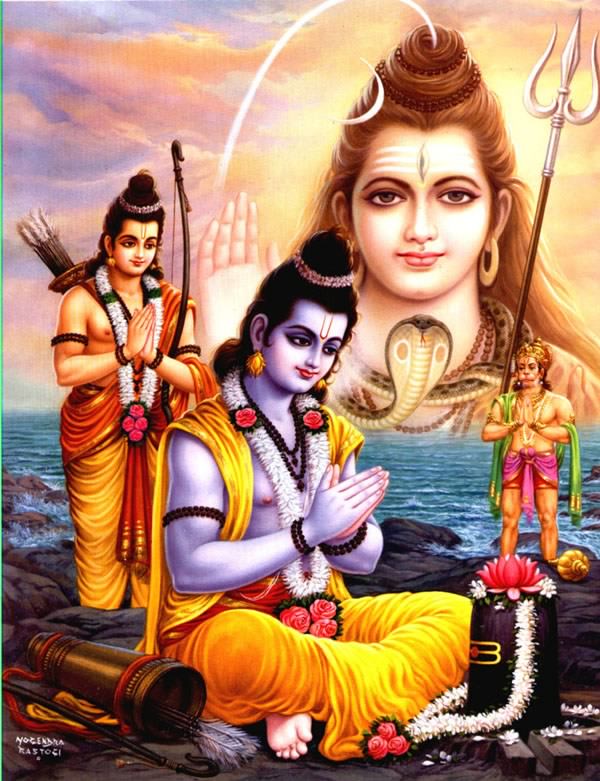
    There is uncertainty about the information whether Lord Rama worshipped Lord Shiva and installed Shiva Lingam at Rameswaram.

    Valmiki Ramayana does not specify to the fact directly.

    But it states Rama worshipped Shiva at Rameswaram.

    That Rama installed a Shiva lingam is referred to in Adhyatma Ramayana,Shiva Purana,Linga Purana,Skanda Purana, Padma Purana,Ramacharitamanas by Tulsidas and Shiva Daridra Dahana Stotra.

    etat = this; (is the island); kukShau = located in the middle; samudrasya = of the ocean; skandhaavaara niveshanam = where my troops were stationed; atra = at this place; puurvam = formerly; prabhuH = the Lord; mahaadevaH = Shiva (the supreme deity); akarot = bestowed; prasaadam = his grace; (on me).

    “See this island, located in the middle of the ocean, where my troops were stationed. At this place, the lord Shiva (the supreme deity) formerly bestowed his grace on me.”

    Valmiki Ramayana,Yuddha Kanda,Sarga 123,Sloka 19.

    https://ramanisblog.in/2017/02/28/lord-rama-worshiped-shiva-valmiki-ramayana/

    Here is how Yuddha Kanda of Adhyatma Ramayana of Brahmanda Purana narrates the event:

    सेतुमारभमाणस्तु तत्र रामेश्वरं शिवम् ।
    संस्थाप्य पूजयित्वाह रामो लोकहिताय च ॥ १॥
    प्रणमेत्सेतुबन्धं यो दृष्ट्वा रामेश्वरं शिवम् ।
    ब्रह्महत्यादिपापेभ्यो मुच्यते मदनुग्रहात् ॥ २॥
    सेतुबन्धे नरः स्नात्वा दृष्ट्वा रामेश्वरं हरम् ।
    सङ्कल्पनियतो भूत्वा गत्वा वाराणसीं नरः ॥ ३॥
    आनीय गङ्गासलिलं रामेशमभिषिच्य च ।
    समुद्रे क्षिप्ततद्भारो ब्रह्म प्राप्नोत्यसंशयम् ॥ ४॥

    During the construction of bridge, Rama installed Mahadev and worshipped him calling by the name Rameshwar Mahadev. He described his glory, “If someone visits the bridge (setubandh), and prostrates to Rameshwar mahadev he is liberated of the severest of sin of killing Brahmins.” Rama stated, “One should bathe here in sea, and having darshan of Rameshwar Mahadev, he should go to kashi, to fetch ganga water. Offering the Ganga water of Kashi over Rameshwar Mahadev, he should throw the pot in sea. Thus, he is bound to get salvation.

    One may get confused whether Rama installed idol form or Linga form. But it is Linga form and Lord Rama himself states it in Padma Purana Patala Khanda chapter 104:

    विभिषणः कथमसौबद्धः श्रृंखलयानृभि: । मत्स्थापितंशिवलिङ्गंदृष्ट्वारामेश्वरंत्वहो ।।

    Oh, how is it that Vibhisana seeing the Linga of Shiva, (called) Ramesvara and installed by me, is bound with chains.

    In the above verse Rama tells “Mat Sthapitam Shiva Linga”… ie. That Shiva Linga installed by me.

    https://hinduism.stackexchange.com/questions/14349/what-is-the-story-of-rameshwaram-jyotirlinga/14350#14350

    In the Chapter 3 of Brahma Kund (3rd Canto of Skanda Purana)

    “Describing how Sri Ram had installed Rameshwar linga, Sutji said–‘ After killing Ravan, Sri Ram enthroned Vibhishan as the king of Lanka. While returning to Ayodhya he made a brief stop at Gandhamadan mountain. Since the thought of having killed a brahmin (Ravan) kept on tormenting him, he decided to atone for his sins. In consultation with sages, Sri Ram decided to perform the ‘Pratishtha’ of Shiva Linga at the most auspicious ‘Muhurat’ and commissioned Hanuman to bring the Linga from Maha Deva at Kailasa Mountain. But Unfortunately however Hunuman could not meet the deadline of the Muhurat for the Consecration of the Linga and Devi Sita had to prepare a Sand Linga that was set up as a temporary stop-gap but in reality that became the real Linga . Meanwhile Hanuman returned from Kailasa but was highly disappointed and felt that all his efforts proved futile. Sri Rama consoled Hanuman also did the Pratishtha of the Linga brought by Hanuma.”

    Rama instructed that Hanuma lingam should be worshipped first since it was brought by Lord Hanuman – the tradition continues even today.

    In Chapter 18 of Koti Rudra Samhita of Shiva Purana It is said that

    “Lord Rama After reaching Rameswaram beach and he was thirsty. When he was drinking water there he heard a celestial voice “you are drinking water here without worshipping me”’. Rama recognized that voice was of Lord Siva. Then he made a Sivalingam with beach sand and worshipped Lord Siva. He prayed Lord Siva to bless him to win the war, and vanquish Ravana. Lord Siva blessed Rama accordingly. He also prayed Lord Siva to reside eternally at Rameswaram so that entire mankind should benefit from it. Lord Siva agreed to Rama’s prayer and manifested Himself as Ramanatha Jyothirlingam and stayed there for eternity.”

    According to a legend from Linga Purana,

    “on the advice of Rishis, Rama wanted to consecrate at Rameswaram a shrine for Lord Siva to wash off the Brahmahatsya dosha – the sin of killing Ravana, a Brahmin. An auspicious time for the ceremony was fixed. Rama rushed Hanuman to Kasi to bring a Sivalingam. The auspicious time for the installation had neared, but Hanuman had not returned, Sita made a Sivalingam out of sand and the puja was performed to this Lingam at the stipulated time. It was consecrated as Ramalinga. Meanwhile, Hanuman returned from Kasi with two Lingams. He was disappointed that the ceremony was already over. In anger, he tried to uproot the sand Sivalingam with his tail, but in vain. Rama pacified Hanuman and installed one of the Lingams brought by Hanuman from Kasi to the left of Ramalinga, and ordered that all pujas be first performed for this Sivalingam, called Kasilingam or Viswanathalingam.”

    This priority in puja is followed even today.

    Reference in Shiva Daridra Dahana Stotram” composed by Rishi Vasistha.

    “Ramapriyaya Raghu nada Vara Pradhaya,” meaning “Who is dear to Rama ,Who granted boons to Rama’

    सैल बिसाल आनि कपि देहीं। कंदुक इव नल नील ते लेहीं।।
    देखि सेतु अति सुंदर रचना। बिहसि कृपानिधि बोले बचना।।
    परम रम्य उत्तम यह धरनी। महिमा अमित जाइ नहिं बरनी।।
    करिहउँ इहाँ संभु थापना। मोरे हृदयँ परम कलपना।।
    सुनि कपीस बहु दूत पठाए। मुनिबर सकल बोलि लै आए।।
    लिंग थापि बिधिवत करि पूजा। सिव समान प्रिय मोहि न दूजा।।
    सिव द्रोही मम भगत कहावा। सो नर सपनेहुँ मोहि न पावा।।
    संकर बिमुख भगति चह मोरी। सो नारकी मूढ़ मति थोरी।।

    The monkeys brought huge mountains, which were received like playballs by Nala and Nila. When the All-merciful saw the exceedingly beautiful construction of the bridge, He smiled and observed thus: ìThis is a most delightful and excellent spot; its glory is immeasurable and cannot be described in words. I will install (an emblem of) Lord Sambhu here: it is the crowning ambition of My heart. Hearing this the lord of the monkeys despatched a number of messengers, who invited and fetched all the great sages. Having installed an linga of Lord Shiva and worshipped It with due solemnity, He said, “No one else is so dear to Me as Shiva. An enemy of Shiva although he calls himself a devotee of Mine, cannot attain to Me even in a dream. He who is opposed to Shankara and yet aspires for devotion to Me, is doomed to perdition, stupid and dull-witted as he is.”

    Then the 2nd Doha states:

    संकर प्रिय मम द्रोही सिव द्रोही मम दास।
    ते नर करहि कलप भरि घोर नरक महुँ बास।।2।।

    Men, who, though devoted to Shankara, are hostile to Me and even so those who are enemies of Shiva but votaries of Mine shall have their abode in the most frightful hell till the end of creation.

    Then the Chaupai of 2nd Doha states:

    जे रामेस्वर दरसनु करिहहिं। ते तनु तजि मम लोक सिधरिहहिं।।
    जो गंगाजलु आनि चढ़ाइहि। सो साजुज्य मुक्ति नर पाइहि।।
    होइ अकाम जो छल तजि सेइहि। भगति मोरि तेहि संकर देइहि।।
    मम कृत सेतु जो दरसनु करिही। सो बिनु श्रम भवसागर तरिही।।


    राम बचन सब के जिय भाए। मुनिबर निज निज आश्रम आए।।
    गिरिजा रघुपति कै यह रीती। संतत करहिं प्रनत पर प्रीती।।
    बाँधा सेतु नील नल नागर। राम कृपाँ जसु भयउ उजागर।।
    बूड़हिं आनहि बोरहिं जेई। भए उपल बोहित सम तेई।।
    महिमा यह न जलधि कइ बरनी। पाहन गुन न कपिन्ह कइ करनी।।

    They who will behold Lord Ramesvara will, on quitting the body, go direct to My sphere in heaven. And a man who takes the water of the Gangå and pours it on the Lord will attain liberation in the form of absorption into My being. Again, whosoever adores the Lord in a disinterested spirit and without guile, will be blessed by Sankara with devotion to Me. And he who sees the bridge erected by me will be able to cross the ocean of worldly existence without any exertion. Ramas words gladdened the heart of all and the great sages returned each to his own hermitage. Girijå, (says Sankara,) such is the way of the Lord of the Raghus: He ever loves those who take refuge in Him. The clever Nala and Nila constructed the bridge and by Råma’s grace their renown spread far and wide. Those very rocks that not only sink themselves but cause even other things to sink alongwith them floated like so many rafts. This is, however, not ascribed to any miraculous power of the ocean, nor to a virtue of the rocks themselves, nor again to any skill of the monkeys.

    Source.The Lanka Kanda 1st Dohas

    https://hinduism.stackexchange.com/questions/14405/what-are-the-salient-features-of-rameswaram-shivalinga-mentioned-in-ramacharitmasalient-features-of-rameswaram-shivalinga-mentioned-in-ramacharitma

  • My Posts On Sanatana Dharma Spread Reply To Crticis

    I have been publishing articles on Sanatna Dharma, also called Hinduism, trying to validate with the help of available Archaeological evidence,Astronomy,Etymology.Cultural Language similarity,references in Indian and foreign literature and Architectural similarities if not identities.

    For my post ‘World’s Oldest Temple, Gobekli Tepe,built By Brahmins, I have received a lot  adverse comments, though they were out numbered by  positive comments.

    Bhimbetka rock painting .jpg
    Bhimbetka rock painting showing man riding on horse.30,000 Years old. “Bhimbetka rock paintng1”. Licensed under CC BY-SA 3.0 via Wikimedia Commons – http://commons.wikimedia.org/wiki/File:Bhimbetka_rock_paintng1.jpg#/media/File:Bhimbetka_rock_paintng1.jpg

    The Major thrust of the adverse comments are.

    1.The facts I have quoted are not scientific.

    2.The Gobekli site is 11000 Years old and since the Ramayana is dated around 5114!

    And the archaeological investigation is not complete.

    Hence, what I have written, as one reader put it, making it up.

    3.The dating is wrong and people will accept only Carbon dating and scientific dating methods.

    My clarification.

    ‘The facts I have quoted are not scientific’.

    I have  and am providing sources for every single article I write from reliable sources.

    In some cases I draw inferences by linking various elements,like the archaeological findings,Astronomical events, Etymology, Cultural behavior,Language and architectural affinity.

    So they stand as a theory till such time some additional evidence comes along.

    But till new evidence comes along my theory is an improvement on the  existing data.

    And is more  accurate than the existing ones.

    History is the process of trying to reconstruct events by cross referencing, linking various elements as mentioned above.

    I do not indulge in misinformation as it is the prerogative of the West.

    I do not put on my Blinkers when an Indian source presents itself and refuse to accept it because it is not by a Western Scholar(?)

    ‘The Gobekli site is 11000 Years old and since the Ramayana is dated around only that period.’

    And the archaeological investigation is not complete.

    Hence, what I have written, as one reader put it, making it up.”

    True that the Gobelki is 11000 years old and Ramayana is dated around 5000 BC.

    Rig Veda is also dated at 5000 BC.

    Both the dates were by the Western scholars.

    Are they assigning Rig Veda and Ramayana the same date?

    What about Mahabharata?

     EXACT DATE OF MAHABHARAT WAR
    16TH OCTOBER 5561 YEAR B.C.

    Does it mean That Ramayana took place just 500 Years before Mahabharata?

    We have references to Ramayana and Mahabharata  in Sanskrit Texts and Tamil.

    Both these languages are so old it is impossible to date them accurately within the time frame as we know of..

    I am providing excerpts on India in Paleolithic age.9Material provided thowards the close of the Post)

    People have lived in India 50,000 -75000 Years ago.

    I have articles on the age of Tamil Sangam Vedas Puranas and the Temples of India.

    So it is possible that the Events in the Puranas have happened earlier than Gobekli Tepe and there are strong possibilities that Sanatana Dharma spread there .

    I have provided more evidence that Tamils/Sanatana Dharma was the root for Mayas, Aztecs,Sumerian, Minoan.

    People may  check the relevant posts.

    On the fact that the archaeological  is incomplete, what is wrong in providing links to the references  found in Indian texts to arrive at a conclusion?

    One does not expect a Westerner to know of these references from India.

    What is wrong in providing this to enhance knowledge?

    While these archaeological  evidence is available on the web, the specific information on Indian references is not for it requires knowledge of ancient Indian Texts exposure to Modern dating technic.

    DNA evidence leads to Madurai.

    Carbon dating is ideal.

    The issue in Carbon dating is,

    If you are verifying a vessel, it can date only the material and does not tell you the date when the artifact was made.

    In Astronomy also the astronomical events repeat themselves over and over.

    So which one do we take reference to?

    Hence my attempt has been to synthesize all the elements and provide a theory for people to work on.

    I do not manufacture history like the west.

    I trust Indian and western sources with skepticism, check them and formulate my view.

    “The history of India begins with evidence of human activity of Anatomically modern humans, as long as 75,000 years ago, or with earlier hominids including Homo erectus from about 500,000 years ago.[..

    Isolated remains of Homo erectus in Hathnora in the Narmada Valley in central India indicate that India might have been inhabited since at least the Middle Pleistocene era, somewhere between 500,000 and 200,000 years ago.[20][21] Tools crafted by proto-humans that have been dated back two million years have been discovered in the northwestern part of the subcontinent.[22][23] The ancient history of the region includes some of South Asia’s oldest settlements[24] and some of its major civilisations.[25][26] The earliest archaeological site in the subcontinent is the palaeolithic hominid site in the Soan River valley.[27] Soanian sites are found in the Sivalik region across what are now India, Pakistan, and Nepal.[28]

    The Mesolithic period in the Indian subcontinent was followed by the Neolithic period, when more extensive settlement of the subcontinent occurred after the end of the last Ice Age approximately 12,000 years ago. The first confirmed semipermanent settlements appeared 9,000 years ago in the Bhimbetka rock shelters in modern Madhya Pradesh, India. Early Neolithic culture in South Asia is represented by theBhirrana findings (7500 BCE) in Haryana, India & Mehrgarh findings (7000–9000 BCE) in Balochistan, Pakistan.[29][30][31]

    Traces of a Neolithic culture have been alleged to be submerged in the Gulf of Khambat in India, radiocarbon dated to 7500 BCE.[32]However, the one dredged piece of wood in question was found in an area of strong ocean currents. Neolithic agriculture cultures sprang up in the Indus Valley region around 5000 BCE, in the lower Gangetic valley around 3000 BCE, and in later South India, spreading southwards and also northwards into Malwa around 1800 BCE. The first urban civilisation of the region began with the Indus Valley Civilisation

    Citations.

    http://en.wikipedia.org/wiki/History_of_India#Stone_Age

    http://www.hindunet.org/hindu_history/ancient/mahabharat/mahab_vartak.html

  • Gondswana Proves How Sanatana Dharma Spread

    I posted an article on how the Varaha, the Boar incarnation of Lord Vishnu, fits the first Mammals of the Triassic period .

    I also postulated that taking into account,

    1.Places/ events mentioned in the Ithihasa, Ramayana and Mahabharata check out with archeological finds,

    2.The three great Floods mentioned in the Sanskrit and Tamil literature.

    3.There are references to Lord Rama’s ancestor Satyavrata Manu having migrated from the South to North to found Ikshvaku Dynasty in Ayodhya,

    4.That Shiva and Ganesa left for the Arctic through the Middle east,Europe, Africa, Americas .

    5.A Group from the Shiva and Ganesa lineage moved in from the Arctic through Russia and Khyber into India and eventually resettled in the Saraswati Valley.

    6.Tamil Literature speaks of events even before Lord Rama and mention these events along with the Tamil Kings in the sunken lands off  Kanyakumari, extending upto what is now Australia.

    7.The remains of Sanatana Culture are found everywhere around the world.

    I checked up geology and the Formation of Continents.

    Indian Puranas mention seven Islands ans d seven oceans.

    Jambuu Dweepa; Plaksha Dweepa; Saalmalii Dweepa; Kusa Dweepa; Krouncha Dweepa; Saaka Dweepa and Pushkara Dweepa.

    There are three views on the Lost continents.

    There was Atlantis, described by Plato,


    Another is that there was a super continent linking Africa and Australia,Lemuria


    “About 1875 the scientists Haeckel and Blanford suggested that the distribution of lemurs and their relatives could best be explained by a former land bridge connecting Africa, Madagascar, and the East Indies. P. L. Sclater proposed the name Lemuria for this land, and the word came into general use among geologists. But more recent investigations show that the vanished continent of Lemuria is not necessary to explain the distribution of lemurs, and in fact fails to do so. Lemuria was conceived to be part of a much larger continent, Gondwanaland, which was supposed to have reached three-quarters of the way around the Southern Hemisphere, with a gap in the Pacific. Scientifically, these continents have little to do with Atlantism, and even Gondwanaland is considered speculative, although it is still widely accepted.


    Gondwana Super Continent which contained Lemuria .


    At the end of the Jurassic Age Gondwanaland began to break up and, during the Tertiary Age approximately 20 million years ago, Antarctica completely broke away from South America. Due to its isolation, an ocean current formed around the continent, fed by conductive motions caused by water masses of different temperatures, favored by cyclonic type atmospheric circulation , and influenced by the Earth’s rotation.

    The breaking up of Gondwanaland, the dispersion of the various continental blocks, the drifting of the Antarctic continent towards polar latitudes and its isolation, are all relatively recent events by the scale of geological time.

    The geographical situation of Antarctica, in an isolated polar position and covered with ice, is the consequence of a long and complex geological evolution, which is still taking place and which, at least in part, should be understood and reconstructed. Up until the Jurassic Age 140 million years ago, Antarctica formed part of the supercontinent of Gondwanaland, In the Jurassic Age 140 million years ago, Antarctica formed part of the supercontinent of Gondwanaland, which also included Africa, Arabia, India, Ceylon, Australia, New Zealand and South America, and occupied temperate latitudes.

    Gondswana Continent.jpg
    Gondswana.

    The descriptions found  in the Puraná about the descriptions of the Land Masses, check out.

    This could explain why the Sanatana Dharma remains are found everywhere.

    It was not difficult for Sanatana Dharma to spread.

    By looking at the position of India in the map, one can understand how the Tsunami devoured India and how Sanatana Dharma was right in describing geographical details .

    Citation.

    http://www.crystallotus.com/Lemuria/01.htm

    http://www.naturalhistorymag.com/picks-from-the-past/12467/lost-continents?page=3

  • Puranas As Body Parts Of Vishnu List

    Puranas, compiled by Veda Vyasa are said to be the body pats of Lord Vishnu.


    Here is the description.


    1.Brahma Purana    –  Head


    2.Padma Purana        –  Heart.


    3.Vishnu Purana         Right Hand.


    4.Shiva Purana                Left Hand.


    5.Bhagavatha Purana-   Thighs.


    6.Naradha Purana-          -Navel.


    7.Markandeya Purana- Right Foot.


    8.Agni Purana                     -Left Foot.


    9.Bhavishya Purana           -Right Knee.


    10.Brahma Vaivarta Purana-Left Knee.


    11.Linga Purana                          -Right Testicle.


    12.Varaha Purana                       -Left Testicle.


    13.Kanda Purana                            -Body Hair.


    14.Vamana Purana                        -Skin.


    15.Kurma Purana                         -Back.


    16.Matsya Purana                         -Body Fat.


    17.Garuda Purana                          -Bone marrow and


    18.Brahmanda Purana                  -Bones.


    Source.Padma Purana.


  • Reality Orders Trimurthis Are Not Brahman Matsya Purana

    Reality is the core of Vedas.


    That the Reality is non dual is Advaita, qualified non dualism Visishtadvaita and Dualism is Dwaita.


    Normally one does not find Brahman given more importance in the Puranas as each Purana extolls the virtues of the God on whose name the Purana is named.


    Matsya Purana, Purana meant to extol the Virtues of Vishnu speaks of Brahman ordering and assigning jobs to the Trimurti.


    What is interesting is that this chapter (Chapter 6)  does not state that a particular God, Shiva, Vishnu as the embodiment of Brahman.


    Instructions by Brahman.


    To Narayana.


    Marry Lakshmi, destroy the wicked and protect the Righteous by taking Avatars.


    To Shiva.

    Marry Parvati,be present in Holy places, bless people and perform Creation, Sustenance and Destruction.


    To Brahma.

    Determine the fate of every one based on their Actions.


    On this basis, Vishnu is present as Naranarayana in Badrinath,Madhava in Prayag,Sri Hari in Haridwar,Renganatha in Srirangam,Venkateswara in Tirupati,and as Krishna in Dwaraka.


    Shiva is present as,

    Somanatha in Saurashtra,Mallikarjuna in Srisailam,Mahakala in Ujjain,Rameswara in  Sethu (Rameswaram) and as in all Dwadasa Kshetras as Jyotir Linga.


    Parvati blesses as Sakthi

    in 18 Sakthipeetas,

    and as village deity in villages.

    Source.Matsya Purana