Tag: Chandragupta Maurya

  • Chandragupta Maurya 1500BC Megasthanes Chandragupta 302 BC William Jones Fraud

    Chandragupta Maurya 1500BC Megasthanes Chandragupta 302 BC William Jones Fraud

    Incredible fraud perpetrated by William Jones by Inventing non existent record!Read On.

    If one were to mistrust the Hindu scriptures, the Nastika System of jainism which denies the authorit of the Vedas, has provided information which tallies with the timeline and events portrayed by the Puranas.


    Secondly the Archeological finds disapprove the dates assigned by William Jones and others and show that the events and people had happened/lived much before the dates indicated by them


    Our history textbooks tell us that Magadha (not Ayodhya) was one of India’s first kingdoms and that Buddha and Mahavira were contemporaries who lived in/ around Magadha around 600 BCE. However, when we visit the sites of India’s so-called earliest centres of civilization (e.g., Sarnath where the Buddha preached his first sermon), we see evidence from the Jain tradition that its earlier Tirthankaras8 were already living in that city hundreds of years ago.9 On top of this, the Jains appear to share the same hoary past as the Hindus do, with their first Tirthankara (Rishabhadeva) believed to be the king of Ayodhya more than 20 generations before Mahavira.

    In addition to the Jain tradition, the history preserved in our native chronicles – the Puranas – appears to have some support from archaeology as well. Although most of the sites described in the Puranas are now populated and hence cannot be excavated, the few non-inhabited sites (e.g., Dwaraka) exhibit evidence of ancient civilizations. This begs the question as to whether we should truly discard the traditions preserved in India’s native chronicles or take the trouble to re-examine them in a new light. This essay presents the chronology of India as preserved by its native historians and tests the validity of this chronology when compared to independent accounts of ancient India.


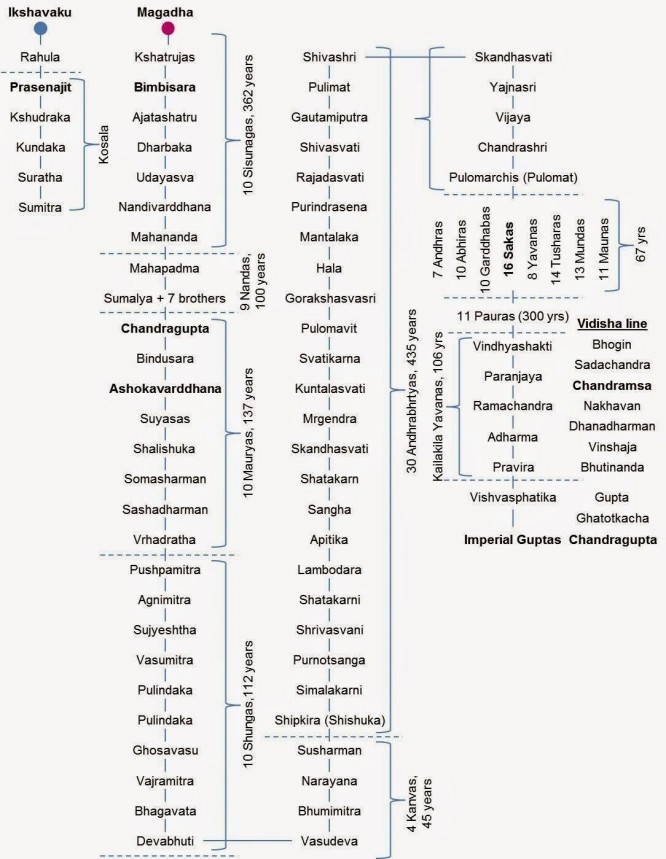
    The accepted chronology of ancient India is based on William Jones’s identification of Sandrocottus with Chandragupta Maurya, the first king of the Mauryan empire. This identification serves as the basis for determining the era of Buddha, the dates of the subsequent kings of Magadha and of other kingdoms of India. According to this chronology, Chandragupta Maurya ascended the throne of Magadha around 315 BCE. However, the Puranas as well as Megasthenes’s account of the milieu he lived in present a compelling case for debunking this identification and associating Sandrocottus with Chandragupta I, the founder of the Imperial Guptas. According to the Puranas, Chandragupta Maurya was crowned in 1538 BCE, Ashoka was crowned in 1489 BCE, and Chandragupta I ascended the throne of Pataliputra around 315 BCE in time to be the monarch referred to as Sandrocottus when Megasthenes arrived in Pataliputra in 302 BCE

    https://ramanisblog.in/2014/12/27/kings-list-india-by-puranas-validated/

    Indian history is so muddled up by some western Scholars and homegrown Liberal historians of India (?) One is fed a series of lies and misinformation.This has resulted in Indian history remains mired in controversy.If we take the trouble to read Indian texts in Sanskrit and other Languages of India, like Tamil, Telugu and others we shall what real history is.And cross reference the information with Epigraphs in Sanskrit, Brahmi ( Sanskrit Brahmi, Tamil/ Kannada Brahmi):check Sthala puranas of temples;Read inscriptions found in ancient Archelogical sites both in India and abroad;read Ithihasas, Ramayana, Mahabharata; Eighteen Purans.

    You will know what I am talking about. In addition, check ancient classic writers from foreign countries like Strabo,Arrian and others. Also refer researched by Russians.You shall know how ancient Indian history is.

    Sanatana Dharma and Tamil run parallel. One compliments the other by corroborating statements of each other.

    I have been exploring Indian history Sanatan Dharma and Tamil/s History for the past twelve years and sharing information I have found, through this blog.You shall find many dates of Kings,Events updated.

    The so-called scholars get exposed when we scrutinize their statements. Megasthanes, the Greek Historian, is not always correct , especially when he writes on the History of India, lying North of Vindhyas.While most of his writings are constrained to narrate events to show Alexander in heroic proportions. This is evident when one checks his recording details about Ambi , in connection with Purushottam.Ambi was descendant of Sakuni of Mahabharata.And to cap it all, for all his detailed description of Alexander and his conquests, he had never met Alexander in person!

    The Chandragupta Maurya he mentions is not the Chandragupta who was married to Selecus Nicator’ s daughter.And the date of this Chandragupta, who, Megasthanes calls as Sandracottus is different from Chandragupta mentioned in puranas . Sandracottus was Chandragupta Vijayaditya.

    The statements of Jones and the fiction of Sandracottus.

    Sir William Jones, President of the Asiatic Society of Bengal, gave his tenth anniversary discourse on February 28, 1793. The topic was, “Asiatic history, civil and natural,” and it was published in the fourth volume of the Asiatic Researches, first printed in 1807, reprint 1979. This was his third attempt to destroy the culture and the history of Bharatvarsh by mutilating the historic dates.

    Jones says in his speech,

    “I cannot help mentioning a discovery which accident threw in my way, (I) thought my proofs must be reserved for an essay which I have destined for the fourth volume of your Transactions. To fix the situation of that Palibothra which was visited and described by Megasthenes, had always appeared a very difficult problem.”

    “…but this only difficulty was removed, when I found in a classical Sanscrit book, near 2000 years old, that Hiranyabahu, or golden-armed, which the Greeks changed into Erannoboas, or the river with a lovely murmur was in fact another name for the Son itself, though Megasthenes, from ignorance or inattention, has named them separately. This discovery led to another of greater moment; for Chandragupta, who, from a military adventurer, became, like Sandracottus, the sovereign of Upper Hindostan, actually fixed the seat of his empire at Patliputra, where he received ambassadors from foreign princes; and was no other than that very Sandracottus who concluded a treaty with Seleucus Nicator; so that we have solved another problem, to which we before alluded, and may in round numbers consider the twelve and three hundredth years before Christ.” (pp. xxv to xxvii)

    He tells in his speech that he has found a classical Sanskrit book of about 2,000 years old. The other thing he says is that Chandragupt was no other than the very Sandracottus who is described by Megasthenes to have made a treaty with Seleucus around 312 BC; and, to establish that that Chandragupt belonged to the Maurya dynasty, he mentions about some poem by Somdev which tells about the murder of Nand and his eight sons by Chandragupt in order to usurp the kingdom. In this way Jones created a fictitious connection between Chandragupt Maurya and Sandracottus. He says in his speech,

    “A most beautiful poem by Somadev, comprising a very long chain of instructive and agreeable stories, begins with the famed revolution at Patliputra, by the murder of King Nanda with his eight sons, and the usurpation of Chandragupta; and the same revolution is the subject of a tragedy in Sanscrit, entitled the Coronation of Chandra.” (p. xxviii)

    These were the basic points of his speech that was called the discovery of the identity of Chandragupt Maurya as Sandracottus. Anyone could see that these people were adamantly prone to fabricating false statements all the time just to demean our culture and to destroy the genealogy of our religious history. All the things referred to in this speech are absolutely wrong and outrageous.

    Finally, Somdev was just a story writer of fun and frolics. Yet he never described Chandragupt Maurya as the usurper of the kingdom and never connected him to the period of Seleucus Nicator and Alexander;and: there was never a written book in India that lasted for 2,000 years, and there is no such statement in our religious writings to show that Chandragupt Maurya was in 312 BC.

    The scriptures, in ancient times, were written on bhoj patra (a paper thin bark of a Himalayan native tree) which never lasted in a readable condition for more than 500 to 800 years even with extreme care. These books were written for teaching and learning purposes so they were constantly in use (not like writing and hiding them in a cave as Dead Sea scrolls). When one book was worn out, another one was rewritten by the learned scholars under the guidance of the Master. Thus, the knowledge of the scriptures uninterruptedly continued. Now we know that there was no such book that was 2,000 years old. Moreover, Jones never produced or showed that book to anyone, even to his close associates. It was simply his word of mouth to relate the fake story of a 2,000 year old book.

    As regards the period of King Chandragupt Maurya, the Puranas give a detailed genealogical account of all the kings of the Magadh kingdom, starting from the Mahabharat war (3139 BC) and up to the Andhra dynasty. Accordingly, the period of Chandragupt Maurya comes to the 1500’s BC. In no way could it be pushed forward to 312 BC. But those people (the British diplomats) were determined to do it that way because they wanted to squeeze the entire history of India within the time frame of their Aryan fiction story.

    Everyone who has read Megasthenes knows that his writings are most unreliable. But Jones found an excuse to quote the writings of Megasthenes where he describes the treaty of Seleucus with Sandracottus, the king of Magadh.

    One thing we must mention, that there were two different dynasties that had similar names of their first king: the Maurya dynasty and Gupt dynasty. The first king of the Maurya dynasty, called Chandragupt Maurya, was in BC 1500’s, and the first king of the Gupt dynasty, called Chandragupt Vijayaditya, was in BC 300’s. The second king of Gupt dynasty and the son of Chandragupt Vijayaditya was Samudragupt Ashokaditya. He was the ruler of Magadh between 321 and 270 BC.

    Chandragupt Maurya, who was the legitimate heir, was enthroned by a brahman, Chanakya. After cleverly killing Nand and his eight sons, Chanakya coronated him to the throne of Magadh. Chandragupt Maurya was not ambitious of conquering the other states of India and he did not receive foreign ambassadors because there were only trade relations of India with the foreign countries in those days (1500’s BC) not political relations. So his kingdom was much smaller as compared to the kingdom of Chandragupt Vijayaditya of Gupt dynasty.

    Chandragupt Vijayaditya, who was the son of Ghatotkach Gupt of Shreegupt Family, was made the commander-in-chief of the large army of Chandrashree of Andhra dynasty. After the accidental death of Chandrashree, his minor son, Prince Puloma, under the guardianship of Chandragupt, ruled for seven years. But Chandragupt finally terminated Puloma, usurped the kingdom and became the crowned king. In this way the kingship of Magadh was transferred from the Andhra dynasty to the Gupt dynasty. There were seven kings in the Gupt dynasty (called Abhir in the Bhagwatam) who ruled for 245 years between 328 to 83 BC. Chandragupt ruled from 328 to 321 BC and his son Samudragupt Ashokaditya from 321 to 270 BC. Chandragupt was an ambitious king. He invaded the neighboring states, conquered them and extended his kingdom up to Punjab. For his constant victories, he was titled vijayaditya, which means the sun of victory.

    Thus, taking into account the above facts, it becomes clear that Sandracottus of Megasthenes could only be Samudragupt of Gupt dynasty, historically and also according to the phonetic similarity of both of the names. (1) It was Chandragupt, father of Samudragupt, who was a military adventurer and usurper of the kingdom, not Chandragupt Maurya who was made the king of Magadh in his young age by a brahman, Chanakya. (2) Chandragupt Maurya was in the 1500’s BC, not 300’s BC. (3) In the writings of Megasthenes the word “Maurya” was never used with the name of Sandracottus, and (4) there is absolutely no mention of Chanakya (Vishnugupt) who was the most important person in Chandragupt’s life. Encyclopedia of authentic Hinduism

    life.https://encyclopediaofauthentichinduism.org/articles/33_two_more.htm
  • Chandragupta II Chalukya Defeated Umayyad Second Caliphate

    On Emperor Vikramaditya, there is a lot of controversy.

    There are atleast two Vikramadityas. One belongs to the Maurya Dynasty.Chandragupta Maurya,son of Samudra Gupta ,was called Vikramaditya. His date is around 105 BC.

    There is another Vikramaditya who belongs to Chalukya Dynasty and his date is around 715 AD.

    There are more Vikramadityas in Chalukya Dynasty and I have traced. upto Vikramaditya VI.

    The term Vikramaditya means ‘ one who is a Conqueror of Sun’ meaning like Sun whose rays pervade the earth.

    So the epithet was applied to Emperors of India who were conquerors and righteous.

    Hence we come across many Vikramadityas.

    Now to the subject of this article,

    ‘Who Conquered Arabia ?

    Was it the Chandragupta Maurya or Vikramaditya of Chalukya Dynasty?

    This assumes importance because there is a lot of controversy over the point that Arabia was conquered by Indian Kings.

    I had written in detail about the conquest of Emperor Vikramaditya,that is Chandragupta Maurya, of Arabia and his establishment of Hinduism there.

    Even before this, Hinduism was established there during ancient times, the connections emanating from Tamils and Sanatan Dharma.I have written some articles on this. I shall be writing more on this angle.

    The established Hinduism and it’s Practices were destroyed when Prophet Muhammad overran Mecca.

    In the process, over 360 idols of Hindu pantheon was destroyed and one idol was rumoured to have been smuggled out to Somnath,India.This idol was that of Durga,which was called Mannat by Arabs.To recover this idol, Mohammad Ghazini invaded and looted Somnath eighteen times.

    It was not only the Chandra Gupta Maurya who fought the Arabs and Conquered Arabia.

    Vikramaditya of Chalukya Dynasty also defeated the Second Caliphate.

    Yet history is mum on whether Vikramaditya ,after conquering the Caliph proceeded to Arabia.

    Am checking this from Foreign neutral sources and will update

    ‘The Umayyad Caliphate (661–750 CE;  al-Khilāfah al-ʾUmawīyah) was the second of the four major caliphates established after the death of Muhammad.. https://en.m.wikipedia.org/wiki/Umayyad_Caliphate

    Between 724 and 810 CE, a series of battles took place between the Arabs and the north Indian King Nagabhata I of the Gurjara-Pratihara dynasty, the south Indian King Vikramaditya II of the Chalukya dynasty, and other small Indian kingdoms. In the north, Nagabhata of the Gurjara Pratihara Dynasty defeated a major Arab expedition in Malwa. From the South, Vikramaditya II sent his general Pulakesi, who defeated the Arabs in Gujarat.Later in 776 CE, a naval expedition by the Arabs was defeated by the Saindhava naval fleet under Agguka I.

    The Arab defeats led to an end of their eastward expansion, and later manifested in the overthrow of Arab rulers in Sindh itself and the establishment of indigenous Muslim Rajput dynasties (Soomras and Sammas) there.

    Source. https://en.m.wikipedia.org/wiki/Umayyad_campaigns_in_India#CITEREFMajumdar1977

  • Which Is Older Kannada Or Tamil

    When one tries to trace the real history of India, one has to tread carefully and doubly careful in the use of terms about the various ancient Kingdoms and languages of India.

    Unlike the other countries of the world our history goes back to Millions of years.

    Sathavahanas Dynasty.jpg Sathavahana Dynasty LLocation. Image credit. “SatavahanaMap”. Licensed under Public Domain via Commons – https://commons.wikimedia.org/wiki/File:SatavahanaMap.jpg#/media/File:SatavahanaMap.jpg

    While unravelling them,based on Archeology, references in the Indian Epics,Puranas and Indian literature, one finds it nearly impossible to determine which preced the other, say for instance Tami or Kannada.

    I have, in my article, Karnataka 2 Million years Old Rama’s Brother in law in Karnataka, I had inadvertently slipped a word that,

    ‘before the advent of the Sathavahanas, Karnataka was ruled by North Indian Kings and Tamil Kings”

    I received a comment,, which I am reproducing below.

    “Well Mr. Ramanan, with due regards to your article, there is no history to suggest that Karnataka was ruled by Tamil rulers, before Satavahanas. Although the two languages owe a lot to Brahmi script and according to latest findings, Kannada speaking population was widely spread in south, central, and deccan India. Professor Iravatham mahadevan’s recent findings show that Tamil borrowed from old Kannada and not the other way round.
    The impact of kingdoms of Karnataka origin have been felt over other parts of India also. The Chindaka Nagas of central India, Gangas of Kalinga (Odisha),[1] Rashtrakutas of Manyakheta,[2] Chalukyas of Vengi,[3] Yadava Dynasty of Devagiri were all of Kannada origin[4] who later took to encouraging local languages. The Senas of Bengal, the Solankis of Gujarat etc.’

    In such a situation, I should have simple left saying nothing at all.

    For the atmosphere in India has been so vitiated on the basis of langauge and territories that even a slight mention, raises one’s hackles.

    The Divide and Rule Policy started by the British about 300 years ago still lingers , currently being fueled by the politicians who have no idea of our Past History and our traditions.

    Having written about the early histories of Tamil in detail and a couple of Posts on the antiquity of Kannada,I would like to tread carefully, though evidence is available on these subjects.

    When I take up the ancient history of the other areas, bengal, Maharashtra, Gujarat, Central India, there might me surprises in store.

    I will be refrained in my choice of description as my site might be used to wrangle over which langauge or Kings were  more ancient.

    The purpose of my Blog is to bring out the history and achievements of Sanatana Dharma, which has been distorted and misinformation had been spread about it.

    By writing on the subjects I have mentioned here, I might be sidetracked.

    One thing is certain.

    We have a hoary past with Sanskrit and Sanatana Dharma as the Pillars.

    Other languages like Tamil, Kannada have a hand in it, not to forget Telugu,the Godavari Valley has a rich ,ancient History.

    While much evidence has been found on Tamil, about its antiquity relatively it is less in the other languages.

    Another point is that the Tamil Kingdom was located in Lemuria.

    They seem to have developed a culture on their own, they were also followers of Sanatana Dharma.

    History of Karanataka and Tamil are gleaned only from respective literaray works of these languages.

    For Karnataka, the past before Chandra Gupta Maurya is hazy, while Tamil has literary references in the form of Sangam literature.

    Karnataka was not called as such, thanks to linguistic division of states, and it was under the Mauryan Empire.

    And Chanra Gupra Mauraya breathed his last near Sravanabelagola in 230 BC.

    However after the death of Chandra Gupta, Karnataka resisted the Mauryan domination.

    The Tamils were allies of Chandra Gupta .

    The Sathavahanas , the first recorded Dynasty,rose after Chandra Gupta.

    Interesting point is that the Sathavahanas were ruling from Amravathi, , AP, now Capital of Andhra!

    ‘The Sātavāhana Empire was an Indian dynasty based from Dharanikota and Amaravati in Andhra Pradesh as well as Junnar(Pune) and Prathisthan (Paithan) in Maharashtra.The territory of the empire covered much of India from 230 BCE onward. Although there is some controversy about when the dynasty came to an end, the most liberal estimates suggest that it lasted about 450 years, until around 220 CE. The Satavahanas are credited for establishing peace in the country, resisting the onslaught of foreigners after the decline of the Mauryan Empire.’

    The Sātavāhanas were vassals to the Mauryan dynasty until the decline of the latter. They are known for their patronage ofHinduism. The Sātavāhanas were early issuers of Indian state coinage struck with images of their rulers. They formed a cultural bridge and played a vital role in trade and the transfer of ideas and culture to and from the Indo-Gangetic Plain to the southern tip of India.

    They had to compete with the Shungas and then the Kanvas of Magadha to establish their rule. Later, they played a crucial role to protect a huge part of India against foreign invaders like the Sakas, Yavanas and Pahlavas. In particular their struggles with theWestern Kshatrapas went on for a long time. The great rulers of the Satavahana Dynasty Gautamiputra Satakarni and Sri Yajna Sātakarni were able to defeat the foreign invaders like the Western Kshatrapas and stop their expansion. In the 3rd century CE the empire was split into smaller states. According to ancient Sangam literature the Satavahana rulers were allied with the Tamilrulers of the Chera dynasty, Chola dynasty and Pandyan Dynasty to defeat the foreign invaders like the Scythians…

    ‘The name Karnataka is derived from “Karunadu” which means Loftyland (High plateau), derived from the community’s location on the Deccan Plain. The name can also mean “Land of black soil” (Kari – Black; Nadu – Area or Region) in Kannada. The history of Karnataka goes back to epics “Ramayana” and “Mahabharatha”. The capital of “vaali” and “Sugriva” of the epic, Ramayana, is said to be Hampi. Karnataka finds its mention in Mahabharatha in the form of “Karnata Desha”. In olden times the region was also called “Kuntala Rajya”.[1] Karnataka was also part of the Dakshinapatha (southern region) which finds its mention in many Indian epics. Vatapi, associated with sage Agastya is obviously Badami in Bijapur district.[2] Karnataka is situated on the western edge of theDeccan plateau and has for its neighbours Maharashtra and Goa on the north, Andhra Pradesh on east, Tamil Nadu and Kerala on the south. On the west it opens out on the Arabian sea.’

    In the case of Tamils, Tamil Kings were referred to during the Damayanthi Swayamvara, Sita and Draupadi Swayamvara apart from the fact that Lord Krishna married  Pandyan Princess, had a daughter Pandiah, Parashuarama, Arjuna and Sahadeva had been visiting Tamil areas.

    Lord Krishna was an attendee to the Tamil Sangam.

    Please refer my post on these subjects.

    ‘The Pandyas were one of the three ancient Tamil dynasties (Chola and Chera being the other two) who ruled the Tamil country from pre-historic times until the end of the 15th century. They ruled initially from Korkai, a sea port on the southernmost tip of the Indian peninsula, and in later times moved to Madurai. Pandyas are mentioned inSangam Literature (c. 100 – 200 CE) as well as by Greek and Roman sources during this period.

    Archeological finds.

    A Million year old site belonging to advanced Tamil Civilization has been found in Chennai.

    We also have a ver ancient site belonging to Prehistoric times in Karnataka.

    And we have the Tamil Brahmi script found in Harappa. and Indus Valley.


    ‘Kaar Nadu means…Kaar, in Tamil, means regions rich with rainfall collecting mountains and associated regions and Nadu means country…Tamil word is used to refer a region with a particular geographic location…I have asked to my Kannada friends to find the meaning in Kannada language – they have few explanations which are vague for example, some Kannada language speakers think Kar (black) coloured soil region is referred as Kaarnataka – if that is true Karnataka should be less than 20% of the land it has now, because only 15% of the region has black soil in the pesent day state of Karnataka. In ancient Tamil kingdoms the land and the people were classified based on Geography that relate to their specific rich lifestyle and occupation. There are several ancient Tamil literature referring to Tulu naadu, kodagu nadu and kaaarnadu.
    The discovery of a Neolithic stone celt, a hand-held axe, with the Indus script on it at Sembian-Kandiyur in Tamil Nadu is, according to Iravatham Mahadevan, “a major discovery because for the first time a text in the Indus script has been found in the State on a datable artefact, which is a polished neolithic celt.” He added: “This confirms that the Neolithic people of Tamil Nadu shared the same language family of the Harappan group, which can only be Dravidian. The discovery provides the first evidence that the Neolithic people of the Tamil country spoke a Dravidian language.” Mr. Mahadevan, an eminent expert on the subject, estimated the date of the artefact with the Indus script between 2000 B.C. and 1500 B.C’

    • A broken storage jar with inscriptions in Tamil Brahmi script in Quseir-al-Qadim, (Leukos Limen) Egypt, 1st century BCE. Two earlier Tamil Brahmi inscription discoveries at the same site, 1st century CE.]The inscriped text is “பானை ஒறி” (paanai oRi) which means ‘pot suspended in a rope net’.
    • An inscribed amphora fragment in Tamil at the ancient PtolemicRoman settlement of Berenice Troglodytica, Egypt, 1st century BCE- 1st century CE.
    • Tamil-Brahmi inscription on pottery found in Phu Khao Thong,Thailand, 2nd century CE. Touchstone (uraikal) engraved in Tamil in the Tamil-Brahmi script at Khuan Luk Pat, 3rd-4th century CE.
    • Potsherds with Tamil Brahmi inscriptions found in Poonagari, Jaffna, 2nd century BCE.
    • Black and red ware potsherd with Tamil Brahmi inscriptions in Ucchapanai, Kandarodai, Jaffna, 3rd century BCE.
    • Tamil Brahmi inscriptions on a pot rim at Pattanam, central Kerala, 2nd century CE.
    • Four Tamil-Brahmi inscriptions, 3rd century CE, found on Edakal cave, Ambukuthi hill, Kerala. One contained the word ‘Chera’ (‘kadummipudha chera’), the earliest inscriptional evidence of the dynasty Chera.
    • Potsherd with Tamil-Brahmi script found in Oman. The script reads “nantai kiran” and it can be dated to the 1st century CE.
    • A fragment of black and red ware flat dish inscribed in Tamil in theTamil Brahmi script excavated at the earliest layer in southern eastern town of Tissamaharama in Sri Lanka. It is dated to approximately 200 BC by German scholars who undertook the excavation.
    • Tamil Brahmi script dating to 500 BC found at Kodumanal, Chennimalai near Erode
    • Tamil-Brahmi script dating to 500 BC found at Porunthal site is located 12 km South West of Palani
    • Tamil-Brahmi script found on Tirupparankundram hill, Madurai it read as “Muu-na-ka-ra” and “Muu-ca-ka-ti, 1st century BCE.
    • Fifth ‘hero’ stone found with Tamil Brahmi inscriptions at Porpanakkottai
    • Tamil-Brahmi script dating back to the 3rd century BCE near Thenur, Madurai. Script is written in gold bar.
    • Tamil-Brahmi script dated to the 3rd century AD found preserved in laterite in Karadukka in Kasaragod district, Kerala

    Which is Old, Kannada or Tamil

    Pre-old Kannada (or Purava HaleGannada) was the language of Banavasi in the early Common Era, theSatavahana and Kadamba periods and hence has a history of over 2000 years.The Ashoka rock edict found at Brahmagiri (dated to 230 BC) has been suggested to contain words in identifiable Kannada.

    A possibly more definite reference to Kannada is found in the ‘Charition mime’ of the 1st or 2nd century AD. The farce, written by an unknown author was discovered in the early 20th century at Oxyrynchus in Egypt. The play is concerned with a Greek lady named Charition who has been stranded on the coast of a country bordering the Indian Ocean. The king of this region, and his countrymen, sometimes use their own language, and the sentences they spoke include Koncha madhu patrakke haki (lit having poured a little wine into the cup separately) and paanam beretti katti madhuvam ber ettuvenu (lit having taken up the cup separately and having covered it, I shall take wine separately). The language employed in the papyrus indicates that the play is set in one of the numerous small ports on the western coast of India, between Karwar andMangalore’

    • 150,000-100,000 BCE – Evidence for presence of Hominins with Acheulean technology in north Tamil Nadu.
    • c. 30,000 BCE-Paleolithic industries in north Tamil Nadu
    • c. 80003000 BCE-Pre-pottery microlithic industries
    • c. 30001000 BCE-Neolithic and fine microlithic industries

    Pre-Sangam period

    • c. 1000300 BCE-Megalithic age
    • c. 600 BCE-Tamil-Brahmi prevalent as the Tamil script
    • c. 300 BCE- Greek ethnographer Megasthenes visits Pandyan capitol Madurai.,
    • c. 250 BCE-Asoka’s inscription recording the four kingdoms (Chera, Cholas, Pandya and Satyaputra) of the ancient Tamil country
    • c. 200 BCE-Elara, a Tamil prince and contemporary of Dutte Gamini, rules Lanka

    Sangam age

    • c. 200 BCE-200 CE-Sangam age during which books of Sangam Literature are created
    • c. 150 BCE-Kharavela of Kalinga records his conquest of a federation of Tamil kings in his Hathigumpha inscription [10]
    • c. 13– Greek historian Nicolaus of Damascus met an ambassador sent by Pandyan King to Caesar Augustus, Strabo XV.1-73.
    • c. 1-100 – The Periplus of the Erythraean Sea gives a detailed description of early Chera and Pandya kingdom and mentions Tamil country as ‘Damirica’
    • c. 77 and 140 Greco-Roman writers Pliny the Elder and Ptolemy mention Madurai ruled by Pandyan.
    • Considering he vast stretches of time involved, it is difficult to determine which influenced the other, Tamil or Kannada,despite fanatics claiming one way or the other.

    In my opinion,as I said to Bharathitheertha Swami of Sringeri Peeta, our Father Tongue is Sanskrit mother tongue based of geographical location and it is best we enjoy these languages and follow Sanatana Dharma.

    Squabbles are for the Immature.

    I am yet to study Telugu and Godavari Valley.

    I am sure more surprises will be in store.

    Citation.

    https://en.wikipedia.org/wiki/Satavahana_dynasty

    https://en.wikipedia.org/wiki/History_of_South_India

    https://www.quora.com/Which-is-the-oldest-language-between-Kannada-and-Tamil-What-is-the-proof

    https://en.wikipedia.org/wiki/Kannada

    https://en.wikipedia.org/wiki/Chronology_of_Tamil_history

  • Balarama Is Hercules, Megasthenes

    All of us are aware of Megasthenes of Chandragupta period.

    The Greek geographer and explorer Megasthenes arrived at the court of the Indian emperor Chandragupta Maurya at Pataliputra (modern Patna). He was sent as an ambassador by Seleucus Nicator of the Seleucid dynasty, with whom Chandragupta Maurya had entered into a treaty and matrimonial alliance. During his stay in India, Megasthenes compiled the book Indica – a commentary on the geography, social traditions, and religious customs of India.

    Balarama,brother of Lord Krishna.gif
    Balarama,Balarama with four hands, holding the club, plough, conch and sword, with a serpent coiled on his head. Illustration by Sourindo Mohun Tagore, 1880. Source: Wikimedia Commons. – See more at: http://bibhudev.blogspot.in/2014/03/hercules-and-balarama-symbolic-and.html#sthash.M2YLC9mO.dpuf


    Hercules.jpg
    Herakles crowned with a laurel wreath, wearing the lion-skin and holding a club and a bow, c. 460–450 BC. Source: Wikimedia Commons / Marie-Lan Nguyen –

    Indica, the book by Megasthanes is not available now.

    Later Greek Historians ,Arrian and Diodorus Siculus refer to his works.


    Arrian (c.86 AD – 160 AD) writes on Hercules and Balarama.( Arrian’s Book is also named as Indica)


    “The Hercules who penetrated so far, the Indians tell us, was a native of their country. He is particularly worshipped by the Suraseni (Shurasena), who have two great cities, Methora (Mathura) and Cleisoborus (Surapura), and the navigable river Jobares (Yamuna), passes through their territories. This Hercules, as Megasthenes asserts, and the Indians themselves assure us, uses the same habit with the Theban Hercules. Many male children, but only one daughter was born to him in India, for he married many women. The daughter’s name was Pandaea, and the land where she was born, and over which Heracles placed her as ruler, was named Pandaea after her.”

    One may note that Balarama was of white complexion unlike Krishna who was black.


    Diodorus Siculus (c.50 BC) on Balarama and Hercules in his Book ‘Bibliotheca Historica.’


    “Hercules was born amongst the Indians, and like the Greeks, they furnish him with a club and lion’s hide. In strength he excelled all men, and cleared the sea and land of monsters and wild beasts. He had many sons, but only one daughter. He built Palibothra (Pataliputra i.e. Patna) and divided his kingdom amongst his sons. ”


    There is some light needed here as regards Pandea, the daughter of Balarama whom he placed as a ruler in Madurai.

    I posted an article, based on the evidence in Tamil Epic Silappadikaram and Puranas that Krishna married a Pandyan Princess, had a daughter Pandea and she was a Princess of Pandya Kingdom in Madurai.

    Lord Krishna is recorded to have gifted 100 Yadava Families as Dowry for His daughter’s marriage and they were charged with the task of supplying Milk and Curds to Krishna’s Daughter nad hr heirs at Madurai.

    Now this reference by Megasthanes followers refers Pandea as he daughter of Balarama.

    I shall  do a little more research and update on this.

    * There are some scholas who subscribe to the view that Krishna wa Hercules.


    Other references.

    Roman philosopher Cicero (106 BC-43BC) had mentioned that, “the Indian Hercules is denominated Belus”, and he used the term Hercules Belus to refer to him. Captain Francis Wilford wrote in the Asiatic Researches (1799) that this Belus was none other than Balarama, the brother of Krishna:


    “The Indian Hercules, according to Cicero, was called Belus. He is the same with Bala, the brother of Crishna, and both are conjointly worshipped at Mutra; Indeed, they are considered as one Avatara or incarnation of Vishnu. Bala is represented as a stout man, with a club in his hand. He is also called Bala-Roma… As Bala sprung from Vishnu, or Heri, he is certainly Heri-cula, Heri-culus, and Hercules. Diodorus Siculus says that the posterity of Hercules reigned for many centuries in Palibothra (Patna), but that they did nothing worthy of being recorded”- Captain Francis Wilford wrote in the Asiatic Researches,1799.


    ““How invaluable such remnants of ancient race of Harikula! How refreshing to the mind yet to discover, amidst the ruins on the Yamuna, Hercules (Baldeva, god of strength) retaining his club and lion’s hide, standing on his pedestal at Baldeo, and yet worshipped by Suraseni! This was the name (Baldeo) given to a large tract of country round Mathura, or rather round Surpura, the ancient capital founded by Surasena, the grandfather of the Indian brother-deities, Krishna and Baldeva, Apollo and Hercules. The title would apply to either; though Baldeva has the attributes of ‘god of strength’. Both are lords (es) of the race (kula) of Hari (Hari-kula-es), of which the Greeks might have made the compound Hercules. Might not a colony after the Great War have migrated westward?” -James Tod in his Book  ‘Annals and Antiquities of Rajasthan (1829)’


    Balarama’s Plough and Hercules.

    Balarama is associated with Plough.

    A popular name of Hercules in Romanian legends is “Iorgovan”, a name which corresponds to the Greek form Georgos, meaning “the one who ploughs”.On an Imperial medallion issued by the Roman emperor Commodus, the emperor is shown dressed as Hercules, ploughing out the “original furrow” of Rome (in order to establish a sacred area for the foundation of the city) with two oxen. In one hand he holds the mace, and in the other he is guiding the plough.

    Citation.

    http://bibhudev.blogspot.in/2014/03/hercules-and-balarama-symbolic-and.html

  • Vikramaditya Date His World Kingdom

    There are quite a number of theories that undermine the History of India by interpolating in the Indian texts,Misinterpreting them deliberately, as Max Mueller had done,honest misinterpretations and deliberate falsehood .


    They are.

    1.Sanatana Dharma dates to 5000 BC.

    2.Vedas are non sensical sound bytes.

    3.The Puranas and the Ithihasas are pure fantasy.

    4.Aryans entered from Khyber Pass, invaded India and enriched it.

    5.Dravida Desa, the South of India were peopled by barbarians.

    6.The south indians called Dravidians were constantly engaged at war with the Aryans of the North.

    7.The Arynas were a superior race.

    8.The Sanatana Dharma was resisted and in fact the southerners fought against them, especially the Tamils.

    9.Hindus were primitive and did not have any basic idea of Science.

    10.Denying the existence of great Indian Kings and where it is not possible, assigning them later dates in History.

    Vikramadiya's Empire.jpg
    King Vikramaditya’s Empire.


    All these are falsehoods to undermine Hinduism and I have posted articles on each of them.


    They are filed under Hinduism, Tamils,Astrophysics, Science.


    One such mischief is the date of Vikramadiya, whose existence is dismissed as fiction.


    Here are the facts about King Vikramaditya and his Kingdom.


    “In the Rajatarangini Kalhana mentions that Vikramaditya, the emperor of India, whose capital was Ujjain sent Metrigupta to be the ruler of Kashmir, which was included in the empire of the former…

    King Vikramadiya efernce in Bhavishya Purana.jpg
    King Vikramadiya efernce in Bhavishya Purana. Click to enlarge.


    The above slokas mean to this effect:- “After the completion of three thousand years in Kali (101 B.C.),for the destruction of the Sakas and the propagation of the Aryan Dharma, by the command of Siva, from the abode of the Guhyakas in Kailasa, a personage will be born (to Gandharva Sena, the king of Ujjain). The father gave the child the name of Vikramaditya and rejoiced. Even as an infant he was very wise and gladdned the hearts of the parents. At an early age of five years. he retired to a forest to do penance,. Having spent twelve years in meditation, he achieved spiritual eminence and returned to his city called “Ambavati” or Ujjain. On the eve of his ascending the throne adorned with thirty two golden statues, came a learned Brahmin and he delayed the coronation ceremony with a purpose to teach the king a history consisting of several episodes, wherein the rights and duties of a monarch are enumerated. Then the Brahmin taught the prince all the rights and responsibilities he owed to himself and to his subjects and gave him a befitting and an efficient training worthy of an adventurous Sovereign. Afterwards, in Kali 3020 year or B.C. 82 Vikramaditya was crowned king. Then he expelled the Sakas and drove them as far as Bactria, conquered the whole of Bharata country from Setu to the Himalayas, and received tribute from the feudatory kings…


    Vikramadiya's Empire in Bhavishya Purana.jpg
    Description of Vikramadiya’s Empire in Bhavishya Purana.

    In the west the other bank of the Sindhu River; in the South the Setu; Badarinarayana in the Himalayas formed the North limit and the city of Kapilavastu, the boundary in the East. These were the limits of Vikramaditya’s Empire.

    Another sloka states,
    “By the grace and command of Siva, Gandharvasena’s son, Vikramaditya reigned as Emperor, for hundred years. His son “Devabhakta” after ruling for ten years, was killed in a battle by the cruel Sakas.”(Kali 3130 or 29 A.D.)..


    Vikramaditya.


    Parthian invaded Sub-Continent in around 55 BC which brought Vikramaditya Vardhan’s Invasion in entire West Asia (Modern Day Middle East).

    The victories of Babylon, Persia, Turks led him again to the Arabia and sounded the hour for attack on Arabia. When he conquered Arabia, he did so to cheers from the Jewish and Arab  Community, who welcomed him as a liberator. He showed great forbearance and respect towards the religious beliefs and cultural traditions of other races. These qualities earned him the respect and homage of all the people over whom he ruled.

    The victory over Arabia expressed all the facets of the policy of conciliation which Vikramaditya had followed until then. He presented himself not as a conqueror, but a liberator and the legitimate successor to the crown. He took the title of “King of Aryavrata and Liberator of the Arabs, Turks and Jews”. Vikramditya had no thought of forcing conquered people into a single mould, and had the wisdom to leave unchanged the institution of each kingdom he attached to the Aryavrata Crown. Vikramaditya was upright, a great leader of men, generous and benevolent.  He spread the Vedic Culture in the land of Arabia. He also reconstructed the temple of Brahma and Mahesh and placed a Jiyotarlinga there. Several other Vedic Temples were made in Babylon, Persia and Turkistan.  For the first time they got a King that cared for the inhabitants of his Empire. Arabs, Kurds and Persians saw him as ‘the annointed of the Lord’.

    After the 4 year of Wars that saw whole west Asia under the belt of Vikramaditya Empire he stayed for a year in Arabia till the Mahadev Temple was not completely reconstructed.

    He built admirable highways, and developed an excellent postal system both of which allowed him to receive rapidly information from his provinces. He accepted Perisans as Aryans and called them as long lost cousins. During the Vikramaditya’s regions persians felt like they felt under the region of Cyrus. He also bulit several monuments in the respect of Chandargupt Maurya and Cyrus. Another project undertaken by Vikramaditya was the royal road, the world’s longest, extending 1,700 miles. Due to an extensive network of relays, postmen could travel the road in six to nine days, whereas normal travel time was three months. The motto of the Vedic postal service became memorable: stopped by neither snow, rain, heat or gloom of night. The US postal service also adopted this motto and the famous Pony Express mail delivery resembled the original Vedic design. Vikramaditya laid the foundation of Vardhan Dynasty. His empire controlled many parts of Modern day China, Entire Middle East and Many Parts of South East Asia. After his death his descendents and Parthians controlled Iran. By 102 AD descendents of Vikramaditya lost control over Iran and Parthians established there empire in Iran and Babylon.

    Citation.

    http://trueindianhistory-kvchelam.blogspot.in/2010/01/date-of-emperor-vikramaditya.html

    http://www.geocities.ws/historyofiran/vedicera.html

    http://ramanisblog.in/2014/07/04/chandra-gupta-megasthanes-never-met-history-faked/