Tag: Dwaraka

  • ‘  I have never seen anything of the kind.” Vladimir Putin. ON Krishna’s Sons City Por-Bazhyn, Siberia

    ‘  I have never seen anything of the kind.” Vladimir Putin. ON Krishna’s Sons City Por-Bazhyn, Siberia

    Russian president Vladimir Putin visited the mysterious island with Prince Albert of Monaco and said that:

     “I have been to many places, I have seen many things, but I have never seen anything of the kind.”

    Russia had been the Home of Sanatana Dharma.

    The Rig Veda was composed in the Arctic.

    Russia has a Veda ,’Santees,’

    It was also called ,

    The Book of Veles considered to be the Russian Vedas’

    Russia was called Sthree Varsha.( Kingdom of Women).

    It was run by women and it was a Republic.

    Indra’s ( chief of devas) City Amravathi is Baikal

    Baikal the Vaikanasa Thertha,Sacred Pond.

    Zhetysu (Kazakh: Жетісу, pronounced [ʒi̯ɘtɘsʊw] meaning “seven rivers”; also transcribed ZhetisuJetisuwJetysuJeti-suJity-su,ЖетысуДжетысу, etc.) is a historical name of a part of Central Asia, corresponding to the South-Eastern part of modern Kazakhstan. It owes its name, meaning “seven rivers” (literally “seven waters”) in Kazakh, to the rivers which flow from the south-east into Lake Balkhash.’

    Seven Sacred Rivers of India.

    Ganga,

    Yamuna,

    Godavari,

    Sarasvathi,

    Narmada,

    Sindhu and

    Kaveri.

    Gange ca Yamuneschaiva Godavari Sarasvati,

    Narmadhe Sindhu Kaveri Jalesmin Sannidhim Kuru.

    (Kalash Mantra)

    Narada’s Mountain Narodnaya is Narada’s Mountain in the Urals.

      was Rig Vedic Mandala City.

    Siberians worship Ayur Devathas of Hinduism.

    Yama,the God of Death,Time built a Temple in Arkaim Russia.

    ‘Arkaim Yama temple.

    In Russia’s more mystical quarters there is intense interest in the ancient town, seeing it as the city temple built by the legendary King Yama, ruler of the Aryans in the Golden Age, which will once again become the centre of the world.6

    However, the discovery of the settlement has opened a historical aperture onto far more than the battles and conquests of an aggressive Indo-European people waged across Eurasia and south into the Mediterranean lands, where their war chariots shattered the peace of Old Europe. What the Land of Cities has revealed in its very structure and history is above all the still earlier past of the Ural-Altaic peoples – a past of such enormous antiquity that it presents more mysteries than it solves.

    Built in the unique architectural mould of nordic Asgard, the most sacred shrine of the Aesir of which the Prose Edda relates that “men call it Troy,” Arkaim may have been a shrine dedicated to the Aryan Sun religion, yet the roots of its dedication would have lain ultimately in the far older cult of the Pole star. Essentially, this was the religion of the shaman, the wizard, the medicine-man and other wonder-workers in touch with the spirits of nature.

    Thus the swastika, thought to be the exclusively Aryan symbol of sun-worship misappropriated by the Nazis,7 and found depicted on many of the clay pots unearthed in Arkaim, is an older religious and metaphysical symbol than that attached to the Aryan Sun God, its roots lying in totemic shamanism. René Guénon, the eminent French esotericist, points out that the swastika, symbolising eternal motion around a motionless centre, is a polar rather than a solar symbol, and as such was a symbol central to the Pole star cult, originally dedicated to a planetary deity connected to Ursa Major, the Great Bear. This centre, Guénon stresses, “constitutes the fixed point known symbolically to all traditions as the ‘pole’ or axis around which the world rotates…” The swastika is therefore known world-wide as the ‘sign of the pole.’8′

    Port Baijn or Bazhyn was built by Pradhyumna,son of Lord Krishna.

    As per various ancient Indian sources, Sri Krishna’s son Pradyamna is known to have extended the Yadhu Empire north of what is present day India. He had attacked the city of Vajrapura and defeated King Vajranabha. Later a truce was called and Pradyamna married the king’s daughter Prabhavati. The poetic versions of this war say that Pradyumna is transported by geese to a land far far away.’

    ‘Some historians identify this kingdom as Kyrgistan, a Central Asian Republic. This identification is based on the Mahabharata epic which describes a Kuru warrior Bhishmaabducting three brides from the Kasi kingdom for making them wives of his half-brother Vichitravirya. This same custom of abduction of brides by bridgegroom or his allies for marrying them, still prevails in Kyrgistan. At some point during the reign of Pururavas-Aila (the first king mentioned in the line of lunar dynasty of Indian kings) Uttara Kuru and the Kurus of India could have belonged to the same Kuru Empire. Arjuna collected tribute from Uttara Kuru during his northern military campaign for Yudhisthira’s Rajasuya sacrifice. The epics also mention that they followed a republican constitution with no monarchy.’

    • There is the fact that Lord Krishna fled Dwaraka because of the repeated attacks by Jarasandha and built a fortress amid the sea to escape him.
    • I do not subscribe to the view that there were seven Dwarakas and what is found off Gujarat coast was the latest of Krishna because if you want to escape from an enemy you do not settle very near to where you had been attacked.
    • And the construction of the Por-Bazhyn is of of an Indian fortress and temple.
    • And it is surrounded by water.

    Loot at this video of Dwaraka fortress that reminds of Por-Bazhyan.Check this video with Por-Bazhyn videos of Port Baizhyn and Krishna’s Dwaraka,excavated off the coast of Gujarat India.

    Watch the Sudashan Chakra of Krishna,carved in Stone ,lying amidst ruins.

    Following video from History Channel.


    Dwaraka and Port Baijn were Islands.

    Krishna built Dwaraka amidst an Island with heavy fortifications to save the city from Jarasandha.

    Even though Por-Bajin is believed to date back at least 1,300 years, many of the walls are intact and extremely well-preserved. The main structure on the island—positioned in the inner courtyard—is separated into two parts and is covered by a tiled roof walkway which is held by 36 massive wooden columns placed on stone bases.

    The Island, its design, its purpose, and practically everything about it is a mystery.

    Experts have no idea why it was built, but an even greater mystery is why it was abandoned.

    Scientists have noticed that there is a lack of heating on the island, even though it is located in Siberia and endures periods of extremely harsh weather. The Island is located over 7,000 above sea level.

    As noted by the Siberian Times, “…what puzzles the experts, however, is the lack of rudimentary heating systems, particularly given that Por-Bajin sits at 2,300 meters above sea level and endures harsh Siberian weather.”’ ( source of this quote, http://www.ancient-code.com/a-1300-year-old-island-in-siberia-shocked-vladimir-putin-i-have-never-seen-anything-like-it/

    Dwaraka is now being dated around 30,000 years back!

  • Krishna’s Palace In Siberia Sanskrit Inscription Por-Bazhyn

    Krishna’s Palace In Siberia Sanskrit Inscription Por-Bazhyn


    The walls of the Por-Bazhin Fortress were 10 metres high. The unique monument has been put on the list of Russia’s historical and cultural heritage objects. Taking part in a wide-scale scientific expedition today are more 200 people. After the excavations are over the work to restore the fortress with the use of local clay and wood – the materials it was made of – will begin.

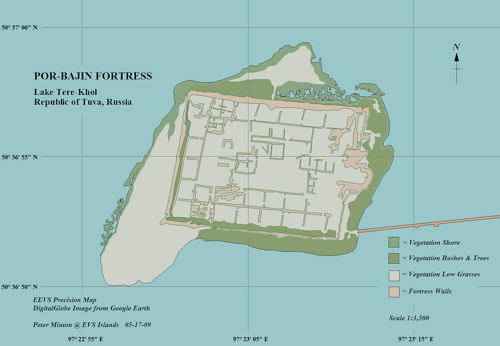
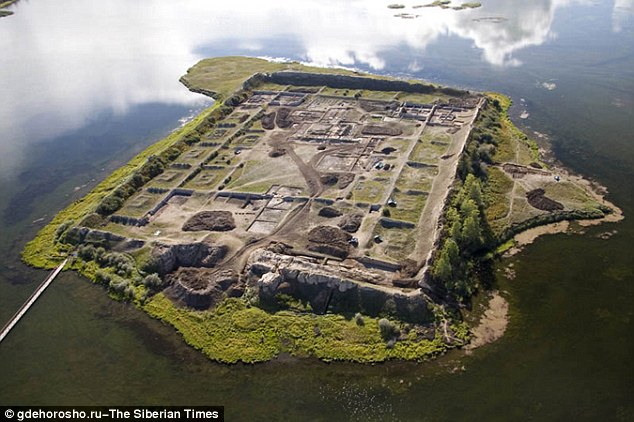
    • The Por-Bazhyn Fortress covers an area of 3.5 ha. Rising majestically skywards on the border of Mongolia in Siberia, at the headwaters of the great Yenisei, on the island of the picturesque Lake Tere-Khol, are the remains of some fortress walls. To this day they shield the mysterious Por-Bazhyn fortress, erected more than 1200 years ago in the time of the Uighur Kaganate. Why was it built? Who lived behind its walls? Are there hidden in the vaults of Por-Bazhyn the teeming treasures spoken of in local legends? How did the ancient builders manage to erect thousands of tonnes of clay and body bricks? For the fortress walls attain a height of ten metres and contained inside is a whole labyrinth of buidings. Por-Bazhyn is still enveloped by tales and legends. Academics believe that the fortress was built in the 8th century AD. The central palace, which stood on an elevated platform, belonged to the Uyghur Khan Moyun-Churu. The enigmatic ruins on the tiny island in the lake have long attracted the attention of travellers and academics. The first research of the fortress was carried out in 1891 by Dmitry Klements, an employee of the Minusky museum. In his archaeological diary he noted that this Tuvan monument “is the first among antiquities”. Klements also found external similarities between the ruins on Lake Tere-Khol and the remains of the ancient town of Kara-Balgasun on the River Orkhon in Mongolia. Academics resumed their research of the monument only at the end of the 1950s and 60s. An expedition led by Sevyan Vainshten closed in on the secrets of the fortress. Inside the fortress walls, archaeologists discovered 27 residential and servants’ quarters. In the central part of Por-Bazhyn the remains of two buildings were found which had apparently perished in a fire. Today, as a result of natural processes the ancient walls of Por-Bazhyn is gradually disappearing into the waters of Lake Tere-Khol, while the island territory is permanently shrinking. It is the opinion of specialists that in 3-4 years’ time this unique monument of history and culture could vanish forever.

    The idea to conduct a full-scale archaeological excavation of the Por-Bazhyn Fortress was first voiced in October 2006 by the head of the Russian Ministry for Emergency Situations Sergei Shoigu at a meeting with students from the Tuva State University and received wide support from the very beginning. In order to implement the project, the Por-Bazhyn Fortress Cultural Fund was set up in January 2007. The Fund carries out work to select participants for archaeological expeditions and prepare and ship scientific equipment. On the Board of Guardians for the project are famous state, political and public figures. A Scientific Council was created within the structure of the Cultural Fund for the purpose of providing systematic supervision of the scientific work to investigate and preserve the historical heritage of the Por-Bazhyn fortress. The Council is headed by the academic Anatoly Derevyanko, director of the Institute of Archaeology and Ethnography of the Siberian division of the Russian Academy of Sciences. In conjunction with the Russian Academy of Sciences, a professional team of archaeologists, Orientalists and restorers was put together. Taking part in the expedition will be specialists from leading scientific institutions – the Russian Academy of Sciences, the State Museum of the East, the State Historical Museum, Moscow State University, the Tuva Institute of Humanitarian Research and many other Russian scientific research organizations. The summer of 2007 saw the beginning of a comprehensive archaeological survey of the Por-Bazhyn fortress. The scientific investigation employs a full arsenal of modern methods. The academics are assisted by over 600 students from Tuva, Moscow, St. Petersburg and Kazan State Universities as well as Krasnoyarsk State Pedagogical University. A special competitive selection process was set up at the universities for those wishing to take part. All the candidates underwent a psychological test carried out by employees of the Centre of Emergency Psychological Assistance under the Russian Ministry for Emergency Situations. Thanks to the efforts of the specialists, prior to the start of the archaeological works it was possible to draw up a detailed topographical plan of the fortress and carry out laser scanning and a geomagnetic survey of the monument. On the basis of the data obtained, a 3-D computer model of the island was created to render in the minutes detail the relief and a map of the anomalies of Por-Bazhyn was drawn. The monument has been divided into six provisional excavations, each including various sites and objects. Several specialist archaeologists are working at each of the excavation sites, actively helped by the students. As early as the first stage the academics came to the conclusion that Por-Bazhyn was built under the strong influence of traditional Chinese architecture. Technologies widely in use during the time of the Tan dynasty were employed in the construction of the fortress. Images of large-eared Chinese dragons, which protected Por-Bazhyn from evil spirits, were found during the excavations. One more interesting find: not far from the fortress a rock quarry was discovered. Clearly, the lake looked quite different during the construction process. The rock quarry was situated right by the fortress and granite was delivered from there to the building site overland. Academics believe that the granite was used to build the foundation of the fortress. The project was planned to last more than one year. According to the results of the archaeological research a project to preserve the fortress will be drawn up. It is planned that the next few years will see the creation of a museum educational centre and national park. But the scientific community is already united in the opinion that the investigation and preservation of the Por-Bazhyn fortress, a monument of historical and cultural significance, is one of the most large-scale projects in modern archaeology.

    Source. http://en.tuvaonline.ru/2007/10/20/4959_exhib-por-bazh.html

    I have written on  Port Baijn,Siberia,also spelled Por Bazhyn was conquered by Pradhyumna,Son of Lord Krishna.

    This city was surrounded by sheet of water and the construction is that of a fortress.

    This was discovered by a team of archeologists.

    Por Bazhyn archeological find. Image.
    Por-Bazhyn Siberia remains.

    Por-Bazhyn has been known since the 18th century, and was explored in 1891 for the first time. In 1957–1963, the Russian archaeologist S.I. Vajnstejn excavated in several areas of the site. Large-scale fieldwork was undertaken in 2007–2008 by the Fortress Por-Bajin Foundation, with scholars and scientists from the Russian Academy of Sciences, the State Oriental Museum, and Moscow State University.

    Por Baijn site. Image
    Por-Bazhyn surrounded by water

    Since the end of the 19th century, Por-Bazhyn has bueen linked to the Uyghurs because of its location, the date of finds from it, and the similarity of its lay-out to the palace complex of Karabalgasun, the capital of the Uyghur Khaganate. Vajnstejn identified Por-Bazhyn as the ‘palace .. at the well’ built, according to the runic inscription on the Selenga stone, by Khagan Moyanchur (also known as Bayanchur Khan, AD 747-759), after his victory over local tribes in AD 750. Moyanchur involved the Uyghur Khaganate in internal power struggles in China, and married a Chinese princess.Other identifications of the site included a border fortress, a monastery, a ritual site, and an astronomical observatory; these are found in older literature published before the conclusion of modern fieldwork in 2008. (  https://en.m.wikipedia.org/wiki/Por-Bazhyn )


    However vast area remains unexplored in this complex of  3.5 hectares.

    Currently the thinking by archaeologists is that ,

    ‘In conclusion, the excavators suggest that this was a summer palace built by Khagan Bögü which, after damage to the palace by an earthquake and the Khagan’s conversion to Manichaeism, was converted into a Manichaean monastery. Following his death and the abolition of Manichaeism, the monastery was abandoned. The empty site was later destroyed by one or more earthquakes and extensive fires in the central complex and elsewhere on the site.'( wiki)

    I postulate that it is much older than the time assigned because,

    1. Siberia means  the beautiful land’. Siberia translates as ‘the beautiful land’ from Sanskrit. In Sanskrit ‘Su’ (सु) means ‘good’ or ‘beautiful’ and ‘Pura’ (पुरा), ‘Puri’ (पुरी) or ‘puram’ (पुरम) all mean ‘land’ or ‘city,
    2. Rig Veda was composed in the Arctic,
    3. Siberians worship Vedic Ayur Devathas even today,
    4. Baikal was Indra’Amravathi,
    5. Lake Baikal was called Vaikanasa Theertha,
    6. Narodnaya mountain in the Urals,where Uyghurs lived was called Narada mountain,
    7. Arkaim was built on Rig Vedic Mandala design,
    8. Yama,Hindu God of Death built a temple in Arkaim,
    9. Uyghurs were living during the period of Lord Rama,
    10. Seven sacred rivers of India mentioned in ancient Hindu texts are found in Russia,
    11. Lord Krisna’s son Pradhyumna conquered this land,
    12. Land north of Himalayas was called Uttara Kuru.

    ‘As per various ancient Indian sources, Sri Krishna’s son Pradyamna is known to have extended the Yadhu Empire north of what is present day India. He had attacked the city of Vajrapura and defeated King Vajranabha. Later a truce was called and Pradyamna married the king’s daughter Prabhavati. The poetic versions of this war say that Pradyumna is transported by geese to a land far far away.’

    ‘Some historians identify this kingdom as Kyrgistan, a Central Asian Republic. This identification is based on the Mahabharata epic which describes a Kuru warrior Bhishmaabducting three brides from the Kasi kingdom for making them wives of his half-brother Vichitravirya. This same custom of abduction of brides by bridgegroom or his allies for marrying them, still prevails in Kyrgistan. At some point during the reign of Pururavas-Aila (the first king mentioned in the line of lunar dynasty of Indian kings) Uttara Kuru and the Kurus of India could have belonged to the same Kuru Empire. Arjuna collected tribute from Uttara Kuru during his northern military campaign for Yudhisthira’s Rajasuya sacrifice. The epics also mention that they followed a republican constitution with no monarchy.’

    • There is the fact that Lord Krishna fled Dwaraka because of the repeated attacks by Jarasandha and built a fortress amid the sea to escape him.
    • I do not subscribe to the view that there were seven Dwarakas and what is found off Gujarat coast was the latest of Krishna because if you want to escape from an enemy you do not settle very near to where you had been attacked.
    • And the construction of the Por-Bazhyn is of of an Indian fortress and temple.
    • And it is surrounded by water.

    Loot at this video of Dwaraka fortress that reminds of Por-Bazhyan.Check this video with Por-Bazhyn video at the beginning of the article.

    Sanskrit inscription,yet to deciphered is found near Baikal.

    Look at the image below. It was recovered at Por-Bazhyn..

    Reminds me of Krishna’s Sudarshana chakra.

    Por-Bazhyn artifact.Siberia.image.
    Por-Bazhyn artifact. Reminds of Sudarshana chakra.


    It is probable that Krishna built Por-Bazhyn to escape Jarasandha and further excavations and cross referencing with local history shall prove me theory.


    ‘Then transfer to the MRS village (an old name which stands as Russian abbreviation for Malomorskii Fishing Farm) 45 km) and crossing Olkhon Vorota (Olkhon Gates) strait to the Olkhon island while heading for  Nikita Bebcharov’s guest– house  managed  by a private family in Huzhir village.  Then you’ll have an excursion to the Burhan cape where you will visit the well – known Shamanka rock  – one of the 9 Asian sacred places called “ Rock Temple” in the past.

    ‘The Burkhan Cape Shaman Rock Temple was once visited by the Dalai-Lama who had carried on special service near the Altar-of-Rock in a small cave inside the Craig that has some inscriptions in Sanskrit. By the shamanist believers the Cape is regarded to be home of the major of 13 sky deities – Khan Hate– Baabai who came to our Land as a fortune ruler. ‘
    Then we drive to the “Chanchur” retreat lodge on the eastern coast of the Baikal. to get prepared for Siberian Banya (steam bath), which is also a wide-spread tradition the Russians keenly preserve and like especially on the eve of New Year when one is supposed to sweat out and wash away all past problems in the Banya in order to  enter the New Year clean and released of any burden of the last year.  Before you start sweating-out in the Banya, you will get our special instructions and all explanations required to ensure you have Siberian steam bath spent in a proper and most pleasant way (our special birch and fir besoms shall also be prepared for you and our Banya-expert on your request shall provide special “besom massage”). During your stay in the Banya you will be offered our special tea and home made soft drinks and freshen-ups. You will feel yourself as just delivered after this Siberian Sauna!

    ( source. http://www.baikal-discovery.ru/en/index.php?option=com_content&task=view&id=23&Itemid=42

    References and Citations.

    http://siberiantimes.com/science/casestudy/features/f0009-who-built-this-siberian-summer-palace-and-why/

    https://ramanisblog.in/2015/02/07/krishnas-son-pradhyumnas-city-in-por-bajin-siberia/

    http://archive.archaeology.org/1011/etc/letter.html


  • Kannadigas From Yadava Tribe Agastya,Kapila.Tamil

    The History of Sanatana Dharma is very deep and extensive.To have an idea of what it was one has to know Sanskrit, Hinduism and the Indian Regional languages.

    I am handicapped in this respect in that I am conversant only in two languages,Sanskrit and Tamil, though I can speak Kannada.

    Amriteswara temple, Karnataka.jpg Amriteswara temple, Karnataka.

    If I know the other languages I might be able to get a better idea of the Sanatana Dharma for it was spread throughout the world and embedded deeply in all the regions of India.

    Available records speak of Pali, Sanskrit and Tamil as the oldest.

    Scholars from the other regional languages may send in their information on this,

    One request is that this site is for Sanatana Dharam and not a ground for Linguistic war for that is the shortest cut to destroying Sanatana Dharama.

    To me Sanskrit is my Father Tongue and Tamil Mother tongue.

    This, I hope, might apply to all of us in various regions of India, the Mother Tongue being the one determined by region in which one is born or picks up from his mother.

    Earliest historical evidence to Kanndigas is found in Brahmagiri , Karnataka.

    Brahmagiri is an archaeological site located in the Chitradurga district of the state of Karnataka, India. Legend has it that this is the site where age Gautama Maharishi (also spelt Gauthama Maharshi) and his wife Ahalya lived. He was one among seven noted Hindu saints (Saptharshi mandalam). This site was first explored by Benjamin L. Rice in 1891, who discovered rock edicts of Emperor Ashoka here. These rock edicts indicated that the locality was termed as Isila and denoted the southernmost extent of the Mauryan empire.[1][2] The Brahmagiri site is a granite outcrop elevated about 180 m. above the surrounding plains and measures around 500 m east-west and 100 m north-south. It is well known for the large number of megalithic monuments that have been found here.The earliest settlement found here has been dated to at least the 2nd millennium BC

    As this date is 2 BC I searched for earlier connections with Sanatana Dharama.

    References are found in the Tamil Classics on this and in Legends.

    Tamil Purananuru, says the people of Karnataka were from the Yadavas of  Dwaraka.

    Now there are references in the Puranas of seven Dwarakas.

    This reference about Kannadigas probably refers to the second Dwaraka, when the tribes left for the middle east and elsewhere because of Flood.

    One group led by Agastya and Kapila, who compiled Purananuru settled in Karnataka, on the banks of Kaveri River.

    Sangam Tamil poets composed over 2000 poems. Purananuru is an encyclopaedia of Tamil culture. It has got less than 400 verses. Purananuru verse 201 was composed by Kapilar two thousand years ago. This is a very important verse in Purananuru. It throws much light on early Indian History. Kapilar talks about 49th generation of Irungovel. Famous Tamil Commentator Nachinarkiniyar , who lived several hundred years ago, gave a very interesting story about this verse.

    Nachinarkiniyar said that Agastya brought 12 tribes from Dwaraka ruled by Lord Krishna. Another city in the name of Dwaraka was founded in Karnataka (Mysore) state in the twelfth century. There is an interesting story about how and who founded this city. Hoychalas were the kings who ruled from this city. Hoychala is translated into Tamil asPulikadimal which is found in verse 201.

    Chala was a king belonging to Yadu dynasty. While he was hunting in the Western Ghats, he saw a hare heroically fighting with a tiger. This made him to think that this place must have some special importance. When he followed the fighting tiger and hare, an ascetic who was doing penance ordered king Chala to kill the tiger. The ascetic’s order in Sanskrit was “Hatham Hoy Chala”. So from that day on wards the king and his descendants were called Hoychalas. If the verse 201 refers to this anecdote then it must have happened 2000 years ago.

    This is reinforced by the Temples dedicated to Hindu Gods by the Hoysalas in Karnataka

    More to follow on this.

    http://tamilandvedas.com/2012/04/04/karnataka-indus-valley-connection/

  • Dwadasa Jyotir Lingas Twevle Lingas of Fire

    Fire is the Chief Deity in the Vedas.

    Fire is regarded as very sacred in Hinduism.

    12 Jyotir Lingas.image.jpg
    Dwadas Lingas, 12 Jyotir Lingas.

    What Air can not purify Water can, what Water and Air can not, Fire shall.

    It is the Ultimate purifier.

    The warmth in mother’s womb sustains the child and the same Fire destroys the Human body.

    Fire is both the Sutainer and Destroyer.

    So is Lord Shiva.

    He is the cause of All and the withdrawer of the Universe.

    The Distinction between Shiva and Rudra is to be understood.

    The meaning of the word Shiva is ‘Auspiciousness’

    He is the Chief among the Trinity.

    His Amsa,one of His manifestaions, is Rudra.

    He is one of the Ganas of Shiva.

    He destroys the Universe only to be hidden by Shiva to enable them to manifest them later.

    While Shiva has three attributes or functions, Srushti(Creation,) Sthithi( Sustanance),Samhaara(Dissolution), Thirodhaana(Hiding) and Anugraham( Blessings)

    Rudra represents one aspect of Shiva, Destruction and this is eveident from the first sentence from the Sri Rudram.

    Om Namao Bhagavathe Rudraaya,

    Namsthe Rudramanyave’

    My prostrations to Rudra,

    My prostraions to His anger”

    Implied is the fact that anger leads to desruction.

    Now to Shiva.

    Being the Ultimate Reality Shiva is with out Attributes.

    However attribute is rewuired for Human Beings to connect and worship as concentraing ona vacuum is impossible .

    So Fire has been associated with Shiva, both for its sustaning qualities and for destrution.


    Twelve Jyotir Lingas , Puranas.


    Brahma (the God of creation) and Vishnu (the God of Preservation) had an argument over supremacy of creation. To test them, Shiva pierced the three worlds as a huge endless pillar of light, the jyotirlinga. Vishnu and Brahma split their ways to downwards and upwards respectively to find the end of the light in either directions. Brahma lied that he found out the end, while Vishnu conceded his defeat. Shiva appeared as a second pillar of light and cursed Brahma that he would have no place in ceremonies while Vishnu would be worshipped till the end of eternity. The jyotirlinga is the supreme partless reality, out of which Shiva partly appears. The jyothirlinga shrines thus are places where Shiva appeared as a fiery column of light.[2][3] Originally there were believed to be 64 jyothirlingas while 12 of them are considered to be very auspicious and holy.[1] Each of the twelve jyothirlinga sites take the name of the presiding deity, each considered a different manifestation of Shiva. At all these sites, the primary image is lingam representing the beginningless and endless Stambha pillar, symbolizing the infinite nature of Shiva. The twelve jyothirlinga are Somnath in Gujarat, Mallikarjuna atSrisailam in Andra Pradesh, Mahakaleswar at Ujjain in Madhya Pradesh, Omkareshwar in Madhya Pradesh, Kedarnath inHimalayas, Bhimashankar in Maharashtra, Viswanath at Varanasi in Uttar Pradesh, Triambakeshwar in Maharashtra, Vaidyanath Jyotirlinga at Deogarh in Jharkhand , Aundha Nagnath at Aundha Nagnath in Maharashtra, Rameshwar at Rameswaram in Tamil Nadu and Grishneshwar at Ellora near Aurangabad, Maharashtra. Kedarnath and Pashupatinath (Nepal) are considered half jyotirlingas counted together as one.  -Shiva Purana


    Saurashtra Somnatham Cha Shrishaile Mallikarjunam ||
    Ujjainyam Mahakalomkare Mammaleshwaram ||
    Parlyam Vaijnatham Cha Dakinyam Bheem Shankaram ||
    Setu Bandhe Tu Ramesham Nagesham Daruka Vane ||
    Varanasya Tu Vishwesham Tribakam Gautamitate ||
    Himalaye Tu Kedaram Ghurmesham Cha Shivalaye ||
    Aetani Jyotirlingani Sayam Prataha Pathennaraha ||
    Sapta Janma Kritam Papam Smaranen Vinashyati ||

    One who recites these 12 names regularly in the morning and evening he washes all the sins committed in the previous 7 births and attains all the powers and Siddhis.


    Location of the Jyotir Lingas.


    # Jyotirlinga Image State Location
    1 Somnath Somnath.JPG Gujarat Prabhas Patan,Saurashtra
    2 Mallikārjuna Swāmi Srisailam-temple-entrance.jpg Andhra Pradesh Srisailam
    3 Mahakaleshwar Mahakal Temple Ujjain.JPG Madhya Pradesh Ujjain .
    4 Omkareshwar Omkareshwar Temple 01.jpg Madhya Pradesh Island in theNarmada River,Omkareshwar
    5 Kedarnath Kedarnath Temple.jpg Uttarakhand Kedarnath
    6 Bhimashankar Bhimashankar.jpg Maharashtra Bhimashankar
    7 Kashi Vishwanath Temple Kashi Vishwanath temple.jpg Uttar Pradesh Varanasi
    8 Trimbakeshwar Shiva Temple Trimbakeshwar Shiva Temple, Trimbak, Nashik district.jpg Maharashtra Trimbakeshwar, near Nashik
    9 Vaidyanath Temple Baba dham.jpg Jharkhand Deoghar
    10 Nageshvara Jyotirlinga Nageshwar.JPG Gujarat Dwaraka
    11 Rameshwar Ramanathar-temple.jpg Tamil Nadu Rameswaram
    12 Grishneshwar Ghushmeshwar mahadev.jpg Maharashtra Aurangabad


    Citation.

    Jyotir Linga


  • Lost Cities Photo Essay

    Lost City of Peru.
    Machu Picchu, Peru. Located on a mountain ridge above the Urubamba Valley, Machu Picchu was the ‘Lost City of the Incas’, inhabited in the 15th and 16th century. Archaeologists believe that the mountain estate was built for the Inca emperor, Pachacuti, but was abandoned because of the Spanish Conquest. The inhabitants were also believed to have been wiped out by smallpox introduced by Spanish conquistadors. The actual ruins were discovered centuries later, in 1911, by American historian, Hiram Bingham.
    Petra Lost city of Jordan.
    Petra, Jordan. Petra is a historical marvel dating back to the 6th century BC. It was the capital city of the Nabataeans, center of trade routes and used by the civilization to control the water supply in the desert city, and was built on the slope of Mount Hor. It was first discovered in 1812 by Swiss explorer Johann Ludwig Burckhardt. Oh, and you might recognize it from a little movie called Indiana Jones and the Last Crusade.
    The City of Pompeii,Italy.
    Pompeii, Italy. Pompeii and its inhabitants were the unfortunate victims of the catastrophic volcanic eruption in 79 AD. Spanning two days, Mount Vesuvius’ eruption completely buried the Roman city under ash and pumice. It remained lost for over 1700 years until a farmer stumbled upon the ruins in 1749.
    Lost City of Memphis.
    Memphis, Egypt. Memphis – a city located south of Cairo – was founded around 3000 BC by the pharaoh Menes. It used to be the ancient capital of Lower Egypt and thrived as a cultural, commercial, religious and trading hub. The city was abandoned as the Roman Empire came into prominence, and consequently, the site fell into disrepair.
    Troy,Turkey.
    Troy, Turkey. Home of the legendary decade-long Trojan War described in Homer’s Illiad and Odyssey – involving a wooden horse, a beautiful queen Helen, a heroic Agamemnon and Achilles’ heel – Troy was the center of all ancient civilizations. Though the authenticity of the Trojan War legend is sketchy, the city of Troy was inhabited from the third millennium BC to the 4th century AD. It was rebuilt over 10 times, occupied by different civilizations (including the Hittite), appears as Ilium after Roman rule, and eventually declined during the Byzantine era. The ruins were found in 1822 and excavated from 1870-1890.
    Babylon,Iraq.
    Babylon, Iraq, Located south of Baghdad, and home to one of the Seven Wonders of the Ancient World – the Hanging Gardens of Babylon – Babylon was one of Mesopatomia’s first cities. The city housed an advanced civilization with well-developed literature, medicine, religion and legal system dating back to the third millennium BC. The term “eye for an eye” also stems from this ancient city, uttered by King Hammurabi who created the Babylonian empire. The city eventually collapsed in the 7th century AD, after centuries of foreign domination.
    Persepolis, Iran
    Founded by King Darius, Persepolis was one of the four capitals of the Persian Empire. Building began around 518 BC and the city reflected the wealth and grandeur of the Archaemid Dynasty, before it was burnt to the ground in 330 BC by Alexander the Great.
    Dwaraka, India.
    Dwaraka,ehere Lord Krishna Ruled, about 3500 years ago,India

    Source:

    http://all-that-is-interesting.com/post/6612396313/the-seven-lost-cities-of-the-world/2

    ASI,India.