Tag: Somnath

  • Ghazni Muhammad Destroyed Somnath For Manat Arabia,A Hindu Goddess?

    Ghazni Muhammad Destroyed Somnath For Manat Arabia,A Hindu Goddess?

    I have often wondered why Ghazni Muhammad should single out the Somnath Temple,an Abode and Temple of Shiva in Gujrat.

    An idol of her was also likely among the 360 idols in the Kaaba. According to Ibn al-Kalbi, when worshipers would circumambulate the Kaaba, they would chant her name along with that of her sisters, al-Lat and al-Uzza, seeking their blessings and interception.[12]


    The attack on Somnath temple in India in 1024 by Mahmud of Ghazni may have been inspired by the belief that an idol of Manat had been secretly transferred to the temple.[20] According to the Ghaznavid court poet Farrukhi Sistani, who claimed to have accompanied Mahmud on his raid, Somnat (as rendered in Persian) was a garbled version of su-manat referring to the goddess Manat. According to him as well as a later Ghaznavid historian Abu Sa’id Gardezi, the images of the other goddesses were destroyed in Arabia but the one of Manat was secretly sent away to Kathiawar (in modern Gujarat) for safe keeping. Since the idol of Manat was an aniconic image of black stone, it could have been easily confused with a lingam at Somnath. Mahmud is said to have broken the idol and taken away parts of it as loot and placed so that people would walk on it. In his letters to the Caliphate, Mahmud exaggerated the size, wealth and religious significance of the Somnath temple, receiving grandiose titles from the Caliph in return’

    Source.

    https://en.m.wikipedia.org/wiki/Manat_(goddess)

    Manat was also thought to watch over graves, as indicated by a tomb inscription reading “And may Dushara and Manat and Qaysha curse anyone who sells this tomb or buys it or gives it in pledge or makes a gift of it or leases it or draws up for himself any document concerning it or buries in it anyone apart from the inscribed above”.[2]

    • 1025: Somnath: Mahmud sacks the temple and is reported to have personally hammered the temple’s gilded Lingam to pieces, and the stone fragments are carted back to Ghazni, where they are incorporated into the steps of the city’s new Jama Masjid (Friday Mosque) in 1026. He places a new king on the throne in Gujarat as a tributary. His return detours across the Thar Desert to avoid the armies of Ajmerand other allies on his return.( https://en.m.wikipedia.org/wiki/Mahmud_of_Ghazni )

    Islamic sources indicate that Ghazni Muhammad believed that an Idol of Manat was spirited away to Somnath ,India from Mecca when the idols at Mecca’s were destroyed at the behest of The Prophet.

    The information.


    Contrary to what we have been taught,Arabia indeed had Religion and street culture before the advent of The Prophet.

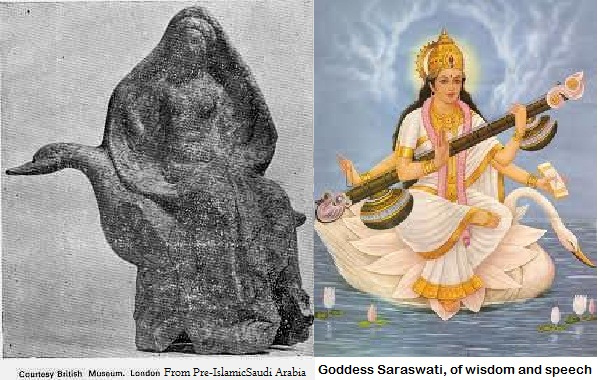
    The Pre Islamic Arabia had a Religion and they had a Pantheon of Gods ,whose legends have been borrowed from Hinduism.

    Arabia was influenced by Sumrerian Culture and Religious practices.

    Sumerian culture in turn was influenced by Vedic and Tamil culture.

    Among the host of Goddesses were three,Al-Uzza,Al-Lat and Manat.

    Three Arabian Goddesses.image

    Pre Islamic Goddesses Al-Lat, Al-Uzza, Manat

    Image Credit. https://www.booksfact.com

    The Prophet Muhammad destroyed around 300 Idols in Mecca.

    These included the Navagrahas and Saraswathi.

    The three Goddesses mentioned above are from the Hindu Trinity of Goddesses Saraswathi,Lakshmi and Durga.

    Please read my articles on Mithraism around the world.

    Will be writing on these  Arabian Gods and Goddesses in detail.

    The Goddesses Al-Uzza, Al-Lat and Menat formed a triad in pre-Islamic Arabia. They were widely worshipped: from Nabatean Petra in the North to the legendary Kingdoms of Arabia Felix in the South, including Saba, the Biblical Sheba; as far east as Iran and Palmyra; and the three of them were very popular Goddesses in Mecca at the time of Mohammed. From left they are: Al-Uzza, whose name means “The Mighty One”, the Goddess of the Morning Star; Al-Lat, the Mother, whose name means simply “The Goddess”, as Al-Lah simply means “The God”; and Manat, Crone-goddess of Fate or Time. Sometimes the three of them are referred to as the daughters of Al-Lah; sometimes Manat and Al-Lat are considered daughters of Al-Uzza.(. Image and quote from. http://www.thaliatook.com/AMGG/arabtriple.php )

    The pre-Islamic Arabs believed Manāt to be the goddess of fate. The followers prayed to her for rains and victory over enemies. She was considered the wife of Hubal.There are also connections with Chronos of Mithraism and Zurvan mythology. The Book of Idols describes her:

    The most ancient of all these idols was Manāt. The Arabs used to name [their children] ‘Abd-Manāt and Zayd-Manāt. Manāt was erected on the seashore in the vicinity of al-Mushallal in Qudayd, between Medina and Mecca. All the Arabs used to venerate her and sacrifice before her. The Aws and the Khazraj, as well as the inhabitants of Medina and Mecca and their vicinities, used to venerate Manāt, sacrifice before her, and bring unto her their offerings… The Aws and the Khazraj, as well as those Arabs among the people of Yathrib and other places who took to their way of life, were wont to go o

    n pilgrimage and observe the vigil at all the appointed places, but not shave their heads. At the end of the pilgrimage, however, when they were about to return home, they would set out to the place where Manāt stood, shave their heads, and stay there a while. They did not consider their pilgrimage completed until they visited Manāt.

    — Book of Idols, pp 12–14

    The attack on Somnath Temple in India in AD 1024 by Mahmud of Ghazni may have been inspired by the belief that an idol of Manat had been secretly transferred to the temple.According to the Ghaznavid court poet Farrukhi Sistani, who claimed to have accompanied Mahmud on his raid, Somnat (as rendered in Persian) was a garbled version of su-manat referring to the goddess Manat. According to him as well as a later Ghaznavid historian Gardizi, the images of the other goddesses were destroyed in Arabia but the one of Manat was secretly sent away to Kathiawar (in modern Gujarat) for safe keeping. Since the idol of Manat was an aniconic image of black stone, it could have been easily confused with a Shiva lingam at Somnath. Mahmud is said to have broken the idol and taken away parts of it as loot and placed so that people would walk on it. In his letters to the Caliphate, Mahmud exaggerated the size, wealth and religious significance of the Somnath temple, receiving grandiose titles from the Caliph in return.

    Reference and citation.
    Thapar, Romila (2004), Somanatha: The Many Voices of a History, Penguin Books India, pp. 45–51, ISBN 1-84467-020-1

    https://en.m.wikipedia.org/wiki/Manāt#cite_ref-10

    • Ibn al-Kalbī; (author) and Nabih Amin Faris (translator & commentary) (1952): The Book of Idols, Being a Translation from the Arabic of theKitāb al-Asnām. Princeton University Press. LCCN 52-6741.
    • Grunebaum, G. E. von (1970). Classical Islam: A History 600 A.D. – 1258 A.D.. Aldine Publishing Company. ISBN 978-0-202-15016-1.
  • Jyotir Lingas Form Fibonacci Spiral

    I have written quite a number of articles on  advanced  concepts in all subjects,Physics, Chemistry,Biology,medicine,Astronomy……..and mathematics in Hinduism/sanatana dharma.

    These concepts, either individually or severally are used in self realization either y integrating them in mental disciplines like yoga or Bhakti or in the construction of Temples in India.

    Jyotir Linga Locations.Image.jpg
    Jyotir Linga Locations
    Jyotir Lingaas in Fibonacci Grid.India
    Jyotir Lingaas in Fibonacci Grid.

    Many of the Hindu temples were constructed on the principles of astronomy and mathematics.

    Fibonacci Spiral Image.png
    Fibonacci Spiral

    Please read my articles on these issues.

    Not only this.

    Advanced concept of Fibonacci numbers is found in Sri Krishna Stuthi.

    Value of Pi is found secreted in Krishna Stuthi.

    ‘gopi bhagya madhuvrata

    srngiso dadhi sandhiga
    khala jivita khatava
    gala hala rasandara

    While this verse is a type of petition to Krishna, when learning it one can also learn the value of pi/10 (i.e. the ratio of the circumference of a circle to its diameter divided by 10) to 32 decimal places. It has a self-contained master-key for extending the evaluation to any number of decimal places.

    The Krishna Stuthi. Value pf Pi t0 31 Decimal places.

    ‘I have read an interesting academic paper on Mathematics involving Higher Mathematics of Numbers and was struck by its findings and the Truths expressed in hinduism Five Thousand years ago intuitively.

    Language of Gods Mathematics Hinduism

    Now, let us look at the Jyotir Linghas of Shiva.

    They are twelve in number.

    Somnath : Somnath is located at Prabhas Patan in Saurashtra in Gujarat.

    Rameshwaram : This vast temple in the island of Rameswaram, in Southern Tamilnaduenshrines Ramalingeswarar.

    Srisailam : Srisailam new Kurnool enshrines Mallikarjuna in an ancient temple rich in architectural and sculptural wealth.

    Ghrishneshwar : Jyotirlinga shrine, in Aurangabad Maharashtra, is located near the rock-cut temples of Ellora.

    Ujjain : The ancient and historic city of Ujjain or Avanti in Madhya Pradesh is home to the Jyotirlinga shrine of Mahakaleshwar.

    Varanasi : Varanasi – The most celebrated pilgrimage site in India. The Vishwanath temple inBanarasin Uttar Pradesh is the goal of the thousands of pilgrims that visit this ancient city.

    Dwarka : Dwarka, in Gujrat, is one of the 12 Jyotirlinga shrines of Shiva.

    Bhimsankar : Bhimsankar is located in the Sahyadri hills of Maharashtra, accessed from Pune.

    Trimbakeshwar : The origin of the river Godavari is intimately linked with this Jyotirlinga shrine nearNasik in Maharashtra.

    Omkareshwar : Omkareshwar, an island in the course of the river Narmada in Madhya Pradesh, is home to the Omkareshwar Jyotirlinga shrine and the Amareshwar temple.

    Vaidyanath : Vaidyanath is located in the Santal Parganas area of Jharkhand.

    Kedarnath : Kedarnath nestled in the snow clad Himalayas. It is accessible only on foot, six months in a year.

    No what is special about these locations?

    They form a Fibonacci grid!

    Fibonacci Series: A series of numbers in which each number ( Fibonacci number ) is the sum of the two preceding numbers. The simplest is the series 1, 1, 2, 3, 5, 8….

    They appear in Nature.

    Fibonacci sequences appear in biological settings, in two consecutive Fibonacci numbers, such as branching in trees, arrangement of leaves on a stem, the fruitlets of a pineapple, the flowering of artichoke, an uncurling fern and the arrangement of a pine cone, and the family tree of honeybees. However, numerous poorly substantiated claims of Fibonacci numbers or golden sections in nature are found in popular sources, e.g., relating to the breeding of rabbits in Fibonacci’s own unrealistic example, the seeds on a sunflower, the spirals of shells, and the curve of waves’

    Fibonacci Series in Nature.Image.jpg
    Fibonacci Series in Nature

    The trees and shrubs look random but they are not. Each tree according to its kind has sequences of leaves and branches based on the Fibonacci sequence. The fact that our bodies, and that of animals, birds, fish, insects, micro-organisms, plants and trees are all shaped by specific  mathematical formula shows that they have been specially created, each species having its own  proportions based on the Golden ration and the Fibonacci sequence.

    The Fibonacci spiral: an approximation of the golden spiral created by drawing circular arcs connecting the opposite corners of squares in the Fibonacci tiling; this one uses squares of sizes 1, 1, 2, 3, 5, 8, 13, 21, and 34.

    Location of Jytoir Lingas   follow a Fibonacci spiral or the Golden Spiral. Dwadash Jyotirlingas.

    References and Citations.

    http://allindiaroundup.com/news/fibonacci-series-on-india-map/

    https://en.wikipedia.org/wiki/Fibonacci_number#List_of_Fibonacci_numbers

    https://bhaskarpthakur.wordpress.com/tag/dwadash-jyotirlingas/

  • Dwadasa Jyotir Lingas Twevle Lingas of Fire

    Fire is the Chief Deity in the Vedas.

    Fire is regarded as very sacred in Hinduism.

    12 Jyotir Lingas.image.jpg
    Dwadas Lingas, 12 Jyotir Lingas.

    What Air can not purify Water can, what Water and Air can not, Fire shall.

    It is the Ultimate purifier.

    The warmth in mother’s womb sustains the child and the same Fire destroys the Human body.

    Fire is both the Sutainer and Destroyer.

    So is Lord Shiva.

    He is the cause of All and the withdrawer of the Universe.

    The Distinction between Shiva and Rudra is to be understood.

    The meaning of the word Shiva is ‘Auspiciousness’

    He is the Chief among the Trinity.

    His Amsa,one of His manifestaions, is Rudra.

    He is one of the Ganas of Shiva.

    He destroys the Universe only to be hidden by Shiva to enable them to manifest them later.

    While Shiva has three attributes or functions, Srushti(Creation,) Sthithi( Sustanance),Samhaara(Dissolution), Thirodhaana(Hiding) and Anugraham( Blessings)

    Rudra represents one aspect of Shiva, Destruction and this is eveident from the first sentence from the Sri Rudram.

    Om Namao Bhagavathe Rudraaya,

    Namsthe Rudramanyave’

    My prostrations to Rudra,

    My prostraions to His anger”

    Implied is the fact that anger leads to desruction.

    Now to Shiva.

    Being the Ultimate Reality Shiva is with out Attributes.

    However attribute is rewuired for Human Beings to connect and worship as concentraing ona vacuum is impossible .

    So Fire has been associated with Shiva, both for its sustaning qualities and for destrution.


    Twelve Jyotir Lingas , Puranas.


    Brahma (the God of creation) and Vishnu (the God of Preservation) had an argument over supremacy of creation. To test them, Shiva pierced the three worlds as a huge endless pillar of light, the jyotirlinga. Vishnu and Brahma split their ways to downwards and upwards respectively to find the end of the light in either directions. Brahma lied that he found out the end, while Vishnu conceded his defeat. Shiva appeared as a second pillar of light and cursed Brahma that he would have no place in ceremonies while Vishnu would be worshipped till the end of eternity. The jyotirlinga is the supreme partless reality, out of which Shiva partly appears. The jyothirlinga shrines thus are places where Shiva appeared as a fiery column of light.[2][3] Originally there were believed to be 64 jyothirlingas while 12 of them are considered to be very auspicious and holy.[1] Each of the twelve jyothirlinga sites take the name of the presiding deity, each considered a different manifestation of Shiva. At all these sites, the primary image is lingam representing the beginningless and endless Stambha pillar, symbolizing the infinite nature of Shiva. The twelve jyothirlinga are Somnath in Gujarat, Mallikarjuna atSrisailam in Andra Pradesh, Mahakaleswar at Ujjain in Madhya Pradesh, Omkareshwar in Madhya Pradesh, Kedarnath inHimalayas, Bhimashankar in Maharashtra, Viswanath at Varanasi in Uttar Pradesh, Triambakeshwar in Maharashtra, Vaidyanath Jyotirlinga at Deogarh in Jharkhand , Aundha Nagnath at Aundha Nagnath in Maharashtra, Rameshwar at Rameswaram in Tamil Nadu and Grishneshwar at Ellora near Aurangabad, Maharashtra. Kedarnath and Pashupatinath (Nepal) are considered half jyotirlingas counted together as one.  -Shiva Purana


    Saurashtra Somnatham Cha Shrishaile Mallikarjunam ||
    Ujjainyam Mahakalomkare Mammaleshwaram ||
    Parlyam Vaijnatham Cha Dakinyam Bheem Shankaram ||
    Setu Bandhe Tu Ramesham Nagesham Daruka Vane ||
    Varanasya Tu Vishwesham Tribakam Gautamitate ||
    Himalaye Tu Kedaram Ghurmesham Cha Shivalaye ||
    Aetani Jyotirlingani Sayam Prataha Pathennaraha ||
    Sapta Janma Kritam Papam Smaranen Vinashyati ||

    One who recites these 12 names regularly in the morning and evening he washes all the sins committed in the previous 7 births and attains all the powers and Siddhis.


    Location of the Jyotir Lingas.


    # Jyotirlinga Image State Location
    1 Somnath Somnath.JPG Gujarat Prabhas Patan,Saurashtra
    2 Mallikārjuna Swāmi Srisailam-temple-entrance.jpg Andhra Pradesh Srisailam
    3 Mahakaleshwar Mahakal Temple Ujjain.JPG Madhya Pradesh Ujjain .
    4 Omkareshwar Omkareshwar Temple 01.jpg Madhya Pradesh Island in theNarmada River,Omkareshwar
    5 Kedarnath Kedarnath Temple.jpg Uttarakhand Kedarnath
    6 Bhimashankar Bhimashankar.jpg Maharashtra Bhimashankar
    7 Kashi Vishwanath Temple Kashi Vishwanath temple.jpg Uttar Pradesh Varanasi
    8 Trimbakeshwar Shiva Temple Trimbakeshwar Shiva Temple, Trimbak, Nashik district.jpg Maharashtra Trimbakeshwar, near Nashik
    9 Vaidyanath Temple Baba dham.jpg Jharkhand Deoghar
    10 Nageshvara Jyotirlinga Nageshwar.JPG Gujarat Dwaraka
    11 Rameshwar Ramanathar-temple.jpg Tamil Nadu Rameswaram
    12 Grishneshwar Ghushmeshwar mahadev.jpg Maharashtra Aurangabad


    Citation.

    Jyotir Linga


  • Footprints Of Lord Krishna,Vrindavan Somnath Assam

    The footprints of Lord Rama and Krishna  are found in India.


    Lord Rama’s feet is found near Rameswaram and in some other places.


    Lord Krishna‘s are found in Vrindavan,Asvakranta (Assam) and in Asvakranta temple in Assam.


    The legends associated with these places seem to be in agreement with the Puranas.


    Krishna's Footprints,Charan Pahari.
    Lord Krishna Footprint,Vrindavan.In Charan Pahari, Lord Krishna’s footprints are enshrined. According to the locals there is the impression of Krishna’s left and right footprints at this place. It is said that Krishna was playing His flute at this place and that the hill started to melt. The impressions of Krishna’s footprints could then be seen on the stone here. It has been told that Lord Caitanya, Lord Nityananda, Advaita Acarya, Madhavendra Puri, Madhvacarya, Vallabhacarya and the Goswamis have come to this place to have darshan of Krishna’s footprints.
    Krishna's Footprint,Somnath.jpg
    Krishna’s Footprint,Somnath.The footprint of Bhagvan Shree Krishna is carved here to mark the divine memory of Shree Krishna Neejdham Prasthan Leela. Baldevji, the elder brother of Shree Krishna also took his last journey from here in his original serpent form. This is marked by an ancient holy cave called “Dauji-ni-Gufa”

    The temple of Asvakranta in Assam is situated in NorthGuwahati. An important and one of the greatest Vishnu shrines of Assam, Asvakranta is located on a rocky stratum touching the waterfront of the Brahmaputra. Asvakranta pilgrimage tours can be covered by motor boats that are available at Suklesvar Ghat (Guwahati). Asvakranta is favoured for its scenic beauty. From here one can enjoy the east-west expanse of Guwahati situated on the other bank of the river.

    Asvakranta literally means ‘ascended by horses’. It is here that Sri Krishna camped with his army before he defeated and killed Narakasur.

    Aswakranta is associated with Krishna-Rukamini episode. It is said that Krishna’s Asva (horse) was encircled (akranta) by the enemies at this place. It is also believed by some people that the place should be caged as Asvaklanta indicating that Krishna on his way from Kundil Nagar to Dwaraka had to rest here as his horse became tired (klanta).

    Airport : The nearest airport is Guwahati. From here you can easily reach Asvakranta by road.

    Railhead : The nearest railhead is situated at Guwahati.

    Road Transport : Asvakranta is linked by road transport via the Saraighat Bridge across the Brahmaputra. Other option is Guwahati, which is well connected with regular bus services from all the major cities in and around the state.

    Water Transport : Regular ferry services are available to Asvakranta from Guwahati.

    Staying in Asvakranta
    Accommodation facilities are available at reasonable prices in Guwahati with options varying from luxury to budget hotels.

    Citation.


    http://www.north-east-india.com/assam/asvakranta-temples.html

  • Free Pilgrimage For Senior Citizens IRCTC

    The IRCTC of Government of India’s Railway Travel Services  arm offers plans for Pilgrimage to Senior citizens, who have completed 65 years of Age.

    Government of Rajasthan,Madhya Pradesh and Chattisgarh has finalized plans with free Pilgrimage for Senior Citizens and the Government of Tamil Nadu is finalizing the arrangements.

    Features.

    IRCTC, India
    IRCTC

    1.Should have completed 65 years of age.

    2. Pilgrimage spots as of now.

    For the Hindus.

    Kasi, Gaya, Hardwar, Rishikesh, Allahabad, Somnath, Dwaraka, and Ayodhya.

    For the Christians.

    Goa and

    for the Muslims,it is Ajmer.

    3.One place of pilgrimage can be chosen.

    4.The  Collectors will be selecting the Pilgrims.

    5. Proof of Age and address . Aadhaar, Electoral ID ,Ration Card(any one of these)

    Why Buddhists and Sikhs have been left out?

    Related Articles