Tag: Siberia hinduism

  • Sanskrit Inscription Olkhon Island Baikal Lake Russia.

    Sanskrit Inscription Olkhon Island Baikal Lake Russia.

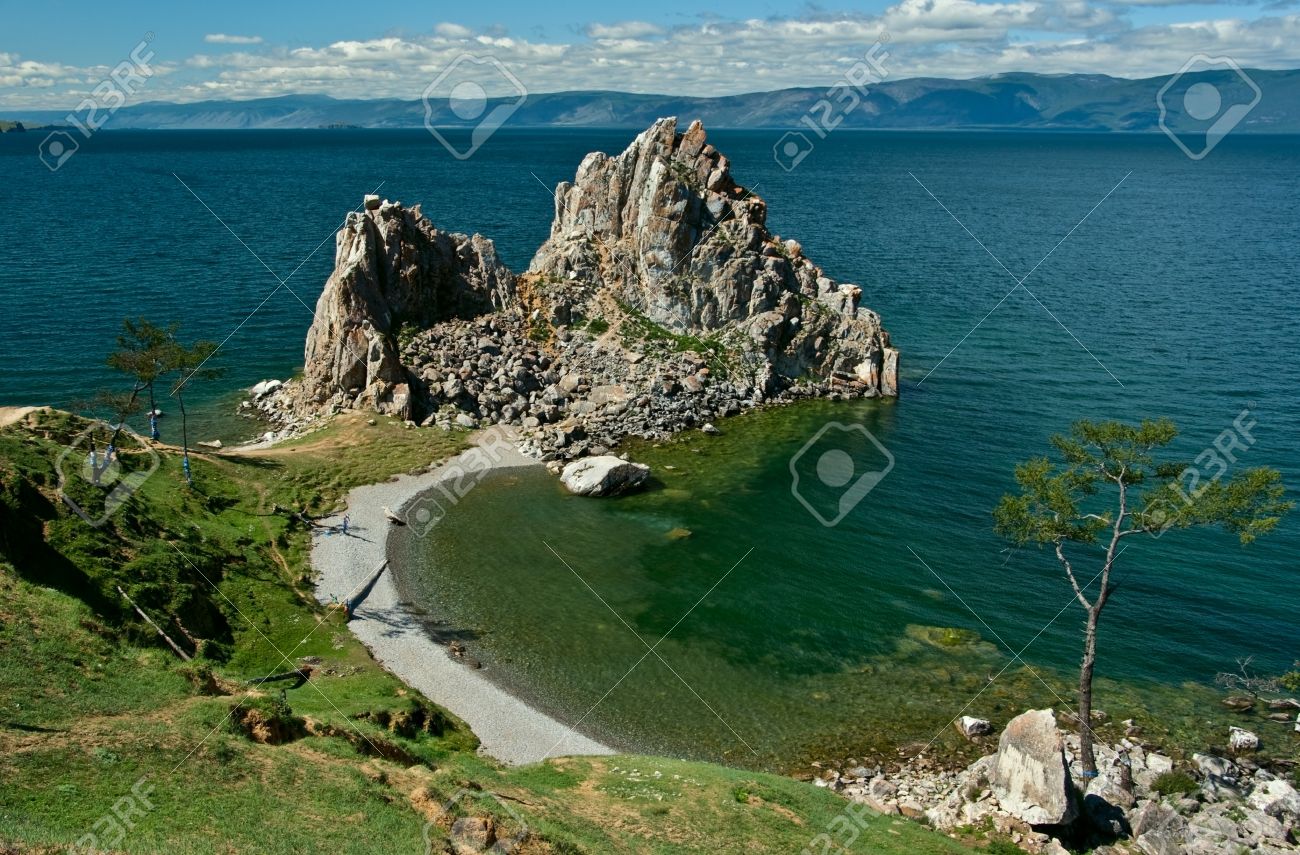
    The image above is Shaman rock and cape Burhan on Olkhon Island, Baikal Lake, Russia.

    I had written in my earlier article that there is a Sanskrit Inscription in Baikal area.

    As the article was about Krishna’s palace in Por-Byzhyn,I did not detail on the inscription.

    There is a Sanskrit inscription in Rock Shaman.

    Cape Burkhan is one of the most interesting place of Olkhon. It ends by a sacred Rock Shaman. At the foot of the Rock Shaman. At the foot of the rock there is a mysterious picture and an inscription in Sanskrit.

    Rock Shaman is one of 9 shrines of Asia (earlier it was called “Stone – Temple”) It,s located not far from Khuzhir settlement, and it,s a symbol of Baikal, one of the most famous sight of the lake – almost each film or photo – album about Baikal contains it,s picture! Rock Shaman is a two – summits rock covered with thick red lichen. In the nearest to the shore rock there is a through cave, especially worshipped by Buryats. In the ancient times it was a plase for special shaman,s rituals, and later it was Buddha,s altor.

    The name of the Rock was changed, when Buddhism came to Buryatia. It was renamed “Burkhan” –God, Buddha. Native people say, that in the beginning of xx century hundreds of Buddhish Lamas came from datsans (temples) of Zabaikalie to pray. Lamas used to say that a Mongolian God, who had moved from Mongolia many years ago looking for a shelter; lived there in the cave of the Rock; and Lamas from all 34 Buryat datsans come to the Rock to pray.’ (http://www.olhon-tur.com/en/sham.php)

    Christianity wiped out nearly all earlier practices in the area.

    However the remains of  Shamanism and Buddhism are present now.

    As communism also had a major role in destroying Religion,the evidence is is difficult to come by.

    Yet there is enough material to suggest that Shamanism is a primitive aspect of Hinduism.

    Mongolian flag.image
    Mongolian flag

    Shamana might have its origin in the Sanskrit word ‘Shramana’

    Śramaṇa (Sanskrit: श्रमण, Samaṇa in Pali) means “seeker, one who performs acts of austerity, ascetic”. The term refers to several Indian religious movements parallel to but separate from the historical Vedic religion.

    ‘Shramana’ and ‘Brahmin’ to illustrate bitter opponents whose differences came from varying religious models. Part of the Shramana tradition remained outside the Hindu fold by rejecting the authority of the Vedas; with the Jains, Buddhists, Ajivikas, and other religious groups developing as a result of this rejection. Part of the Shramana tradition was absorbed into Hindu dharma literature with a place for a renunciate sanyasi in it, in the four stages (ashramas) of life.’

    ( source.  http://www.chinabuddhismencyclopedia.com/en/index.php/Shramana)

    So the presence of Sanskrit is not surprising.

    I will be writing on Hinduism and Shamanism in detail.

    And there is mention of sky Gods,including Adhiti being worshiped alongn with 23 more deities.

    ‘Then transfer to the MRS village (an old name which stands as Russian abbreviation for Malomorskii Fishing Farm) 45 km) and crossing Olkhon Vorota (Olkhon Gates) strait to the Olkhon island while heading for  Nikita Bebcharov’s guest– house  managed  by a private family in Huzhir village.  Then you’ll have an excursion to the Burhan cape where you will visit the well – known Shamanka rock  – one of the 9 Asian sacred places called “ Rock Temple” in the past. The Burkhan Cape Shaman Rock Temple was once visited by the Dalai-Lama who had carried on special service near the Altar-of-Rock in a small cave inside the Craig that has some inscriptions in Sanskrit. By the shamanist believers the Cape is regarded to be home of the major of 13 sky deities – Khan Hate– Baabai who came to our Land as a fortune ruler. ‘
    ( source.  http://www.baikal-discovery.ru/en/index.php?option=com_content&task=view&id=23&Itemid=42 )

    Adhiti.

    The ancient Indian Hindu Mother Goddess, Aditi, is the daughter of Daksha and Veerni. She is the unbounded Sky Goddess, honored as the mother creator of life because she gave birth to the planets and the stars.

    She had twelve children that are called the twelve sovereign principles: Mitra (solidarity), Varuna (fate), Aryaman (chivalry), Daksa (ritual skill), Bhaga (the inherited share), Amsa (the gods’ given share), Tvastr (craftsmanship), Savitr (the magic power of words), Pusan (prosperity), Sakra (courage), Vivasvat (social laws), and Vishnu (cosmic law. Aditi’s children help protect humankind.

    Aditi’s name means “unbound, unlimited, and unfettered.” Aditi is revered as the unbounded love found in motherhood.

    Aditi is the guardian of all life and the supporter of all creatures. She is also the keeper of light that illuminates all life and ensures consciousness.

    Aditi is an ancient goddess, the mother of all the Indian gods. She is the Hindu mother goddess that can help you free yourself of real and perceived bounds on your happiness and joy. She can help you find a path that will bring you the happiness that you are searching for and the care that you need from a mother.

    Asvini kumaras.

    Asvini Devas,twins, are the sons of Sangya, Goddess of Clouds, daughter of Viswakarma,The Divine Architect and Surya, the Sun God, in His Avatar as Vivasvat.

    Another version says it is Chaya,Shadow, is their mother,father is Surya.

    They are Healers and given the world Narana Mantra to cure all diseases.

    Narayana Mantra

    The Shaman head is the head healer primarily.

    Genghis Khan was a Hindu and had a Vedic Flag

    In Chuan Chou, there was a Sivan Temple. In that temple, an image of Siva was consecrated under the ‘Firman’ – royal orders of ‘Sekasai Khan’.
                    This was done for the health of ‘Sekasai Khan’.
                    ‘Sekasai Khan’ in this inscription is the name of Kublai Khan himself.
                    His full name was Kublai Sekcen Khan.
                    Sekcen Khan became Sekasai Khan in Tamil.
                    The Sivan Temple was known as ThiruKathaleesvaram and the Lord of the temple was known as ThiruKathaleesvaram udaiya Naayanaar.
                    The person who executed the order was Thava ChakkaravarththikaL Sampandha PerumaL.
                    It was done on the Chithra Paurnami day of Saka Era 1203 – 1281 AD.

    Source. https://ramanisblog.in/2015/08/06/kublai-khan-consecrated-shiva-chuan-chou-hinduism-in-china/

    The Thirteen Buddhas.

    The Thirteen Buddhas (十三仏 Jūsanbutsu?) is a Japanese grouping of Buddhist deities, particularly in the Shingon sect of Buddhism. The deities are, in fact, not only Buddhas, but include bodhisattvas and Wisdom Kings.[1] In Shingon services, lay followers recite a devotional mantra to each figure, though in Shingon practice, disciples will typically devote themselves to only one, depending on what the teacher assigns. Thus the chanting of the mantras of the Thirteen Buddhas are merely the basic practice of laypeople.

    The Thirteen Buddhas are also an important part of a traditional Japanese Buddhist funeral service, with each deity having a corresponding memorial service for the deceased.[2] The thirteen in Japanese and Sanskrit and the corresponding date of their service after the death are:

    1. Fudo (Acala), 7th day
    2. Shaka (Sakyamuni), 14th day
    3. Monju (Manjushri), 21st day
    4. Fugen (Samantabhadra), 28th day
    5. Jizo (Ksitigarbha), 35th day
    6. Miroku (Maitreya), 42nd day
    7. Yakushi (Bhaisajyaguru), 49th day
    8. Kannon (Avalokitesvara), 100th day
    9. Seishi (Mahasthamaprapta), 1st anniversary
    10. Amida (Amitabha), 2nd anniversary
    11. Ashuku (Akshobhya), 6th anniversary
    12. Dainichi (Vairocana), 12th anniversary
    13. Kokuzo (Akasagarbha), 32nd anniversary

    Source. https://en.m.wikipedia.org/wiki/Thirteen_Buddhas

    Buddhism came later to Sanatana Dharma and many Buddhist practices,especially Esoteric Buddhism follows,though with modifications Tantra.

    So it comes as no surprise to me that there is Sanskrit inscription in Lake Baikal area.


  • Krishna’s Palace In Siberia Sanskrit Inscription Por-Bazhyn

    Krishna’s Palace In Siberia Sanskrit Inscription Por-Bazhyn


    The walls of the Por-Bazhin Fortress were 10 metres high. The unique monument has been put on the list of Russia’s historical and cultural heritage objects. Taking part in a wide-scale scientific expedition today are more 200 people. After the excavations are over the work to restore the fortress with the use of local clay and wood – the materials it was made of – will begin.

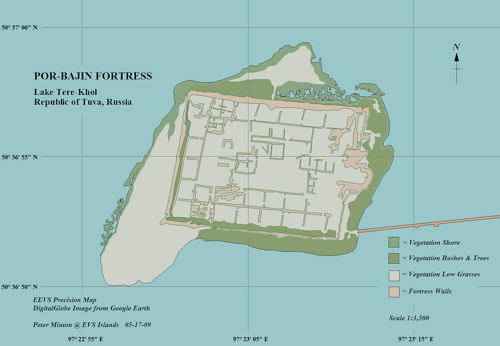
    • The Por-Bazhyn Fortress covers an area of 3.5 ha. Rising majestically skywards on the border of Mongolia in Siberia, at the headwaters of the great Yenisei, on the island of the picturesque Lake Tere-Khol, are the remains of some fortress walls. To this day they shield the mysterious Por-Bazhyn fortress, erected more than 1200 years ago in the time of the Uighur Kaganate. Why was it built? Who lived behind its walls? Are there hidden in the vaults of Por-Bazhyn the teeming treasures spoken of in local legends? How did the ancient builders manage to erect thousands of tonnes of clay and body bricks? For the fortress walls attain a height of ten metres and contained inside is a whole labyrinth of buidings. Por-Bazhyn is still enveloped by tales and legends. Academics believe that the fortress was built in the 8th century AD. The central palace, which stood on an elevated platform, belonged to the Uyghur Khan Moyun-Churu. The enigmatic ruins on the tiny island in the lake have long attracted the attention of travellers and academics. The first research of the fortress was carried out in 1891 by Dmitry Klements, an employee of the Minusky museum. In his archaeological diary he noted that this Tuvan monument “is the first among antiquities”. Klements also found external similarities between the ruins on Lake Tere-Khol and the remains of the ancient town of Kara-Balgasun on the River Orkhon in Mongolia. Academics resumed their research of the monument only at the end of the 1950s and 60s. An expedition led by Sevyan Vainshten closed in on the secrets of the fortress. Inside the fortress walls, archaeologists discovered 27 residential and servants’ quarters. In the central part of Por-Bazhyn the remains of two buildings were found which had apparently perished in a fire. Today, as a result of natural processes the ancient walls of Por-Bazhyn is gradually disappearing into the waters of Lake Tere-Khol, while the island territory is permanently shrinking. It is the opinion of specialists that in 3-4 years’ time this unique monument of history and culture could vanish forever.

    The idea to conduct a full-scale archaeological excavation of the Por-Bazhyn Fortress was first voiced in October 2006 by the head of the Russian Ministry for Emergency Situations Sergei Shoigu at a meeting with students from the Tuva State University and received wide support from the very beginning. In order to implement the project, the Por-Bazhyn Fortress Cultural Fund was set up in January 2007. The Fund carries out work to select participants for archaeological expeditions and prepare and ship scientific equipment. On the Board of Guardians for the project are famous state, political and public figures. A Scientific Council was created within the structure of the Cultural Fund for the purpose of providing systematic supervision of the scientific work to investigate and preserve the historical heritage of the Por-Bazhyn fortress. The Council is headed by the academic Anatoly Derevyanko, director of the Institute of Archaeology and Ethnography of the Siberian division of the Russian Academy of Sciences. In conjunction with the Russian Academy of Sciences, a professional team of archaeologists, Orientalists and restorers was put together. Taking part in the expedition will be specialists from leading scientific institutions – the Russian Academy of Sciences, the State Museum of the East, the State Historical Museum, Moscow State University, the Tuva Institute of Humanitarian Research and many other Russian scientific research organizations. The summer of 2007 saw the beginning of a comprehensive archaeological survey of the Por-Bazhyn fortress. The scientific investigation employs a full arsenal of modern methods. The academics are assisted by over 600 students from Tuva, Moscow, St. Petersburg and Kazan State Universities as well as Krasnoyarsk State Pedagogical University. A special competitive selection process was set up at the universities for those wishing to take part. All the candidates underwent a psychological test carried out by employees of the Centre of Emergency Psychological Assistance under the Russian Ministry for Emergency Situations. Thanks to the efforts of the specialists, prior to the start of the archaeological works it was possible to draw up a detailed topographical plan of the fortress and carry out laser scanning and a geomagnetic survey of the monument. On the basis of the data obtained, a 3-D computer model of the island was created to render in the minutes detail the relief and a map of the anomalies of Por-Bazhyn was drawn. The monument has been divided into six provisional excavations, each including various sites and objects. Several specialist archaeologists are working at each of the excavation sites, actively helped by the students. As early as the first stage the academics came to the conclusion that Por-Bazhyn was built under the strong influence of traditional Chinese architecture. Technologies widely in use during the time of the Tan dynasty were employed in the construction of the fortress. Images of large-eared Chinese dragons, which protected Por-Bazhyn from evil spirits, were found during the excavations. One more interesting find: not far from the fortress a rock quarry was discovered. Clearly, the lake looked quite different during the construction process. The rock quarry was situated right by the fortress and granite was delivered from there to the building site overland. Academics believe that the granite was used to build the foundation of the fortress. The project was planned to last more than one year. According to the results of the archaeological research a project to preserve the fortress will be drawn up. It is planned that the next few years will see the creation of a museum educational centre and national park. But the scientific community is already united in the opinion that the investigation and preservation of the Por-Bazhyn fortress, a monument of historical and cultural significance, is one of the most large-scale projects in modern archaeology.

    Source. http://en.tuvaonline.ru/2007/10/20/4959_exhib-por-bazh.html

    I have written on  Port Baijn,Siberia,also spelled Por Bazhyn was conquered by Pradhyumna,Son of Lord Krishna.

    This city was surrounded by sheet of water and the construction is that of a fortress.

    This was discovered by a team of archeologists.

    Por Bazhyn archeological find. Image.
    Por-Bazhyn Siberia remains.

    Por-Bazhyn has been known since the 18th century, and was explored in 1891 for the first time. In 1957–1963, the Russian archaeologist S.I. Vajnstejn excavated in several areas of the site. Large-scale fieldwork was undertaken in 2007–2008 by the Fortress Por-Bajin Foundation, with scholars and scientists from the Russian Academy of Sciences, the State Oriental Museum, and Moscow State University.

    Por Baijn site. Image
    Por-Bazhyn surrounded by water

    Since the end of the 19th century, Por-Bazhyn has bueen linked to the Uyghurs because of its location, the date of finds from it, and the similarity of its lay-out to the palace complex of Karabalgasun, the capital of the Uyghur Khaganate. Vajnstejn identified Por-Bazhyn as the ‘palace .. at the well’ built, according to the runic inscription on the Selenga stone, by Khagan Moyanchur (also known as Bayanchur Khan, AD 747-759), after his victory over local tribes in AD 750. Moyanchur involved the Uyghur Khaganate in internal power struggles in China, and married a Chinese princess.Other identifications of the site included a border fortress, a monastery, a ritual site, and an astronomical observatory; these are found in older literature published before the conclusion of modern fieldwork in 2008. (  https://en.m.wikipedia.org/wiki/Por-Bazhyn )


    However vast area remains unexplored in this complex of  3.5 hectares.

    Currently the thinking by archaeologists is that ,

    ‘In conclusion, the excavators suggest that this was a summer palace built by Khagan Bögü which, after damage to the palace by an earthquake and the Khagan’s conversion to Manichaeism, was converted into a Manichaean monastery. Following his death and the abolition of Manichaeism, the monastery was abandoned. The empty site was later destroyed by one or more earthquakes and extensive fires in the central complex and elsewhere on the site.'( wiki)

    I postulate that it is much older than the time assigned because,

    1. Siberia means  the beautiful land’. Siberia translates as ‘the beautiful land’ from Sanskrit. In Sanskrit ‘Su’ (सु) means ‘good’ or ‘beautiful’ and ‘Pura’ (पुरा), ‘Puri’ (पुरी) or ‘puram’ (पुरम) all mean ‘land’ or ‘city,
    2. Rig Veda was composed in the Arctic,
    3. Siberians worship Vedic Ayur Devathas even today,
    4. Baikal was Indra’Amravathi,
    5. Lake Baikal was called Vaikanasa Theertha,
    6. Narodnaya mountain in the Urals,where Uyghurs lived was called Narada mountain,
    7. Arkaim was built on Rig Vedic Mandala design,
    8. Yama,Hindu God of Death built a temple in Arkaim,
    9. Uyghurs were living during the period of Lord Rama,
    10. Seven sacred rivers of India mentioned in ancient Hindu texts are found in Russia,
    11. Lord Krisna’s son Pradhyumna conquered this land,
    12. Land north of Himalayas was called Uttara Kuru.

    ‘As per various ancient Indian sources, Sri Krishna’s son Pradyamna is known to have extended the Yadhu Empire north of what is present day India. He had attacked the city of Vajrapura and defeated King Vajranabha. Later a truce was called and Pradyamna married the king’s daughter Prabhavati. The poetic versions of this war say that Pradyumna is transported by geese to a land far far away.’

    ‘Some historians identify this kingdom as Kyrgistan, a Central Asian Republic. This identification is based on the Mahabharata epic which describes a Kuru warrior Bhishmaabducting three brides from the Kasi kingdom for making them wives of his half-brother Vichitravirya. This same custom of abduction of brides by bridgegroom or his allies for marrying them, still prevails in Kyrgistan. At some point during the reign of Pururavas-Aila (the first king mentioned in the line of lunar dynasty of Indian kings) Uttara Kuru and the Kurus of India could have belonged to the same Kuru Empire. Arjuna collected tribute from Uttara Kuru during his northern military campaign for Yudhisthira’s Rajasuya sacrifice. The epics also mention that they followed a republican constitution with no monarchy.’

    • There is the fact that Lord Krishna fled Dwaraka because of the repeated attacks by Jarasandha and built a fortress amid the sea to escape him.
    • I do not subscribe to the view that there were seven Dwarakas and what is found off Gujarat coast was the latest of Krishna because if you want to escape from an enemy you do not settle very near to where you had been attacked.
    • And the construction of the Por-Bazhyn is of of an Indian fortress and temple.
    • And it is surrounded by water.

    Loot at this video of Dwaraka fortress that reminds of Por-Bazhyan.Check this video with Por-Bazhyn video at the beginning of the article.

    Sanskrit inscription,yet to deciphered is found near Baikal.

    Look at the image below. It was recovered at Por-Bazhyn..

    Reminds me of Krishna’s Sudarshana chakra.

    Por-Bazhyn artifact.Siberia.image.
    Por-Bazhyn artifact. Reminds of Sudarshana chakra.


    It is probable that Krishna built Por-Bazhyn to escape Jarasandha and further excavations and cross referencing with local history shall prove me theory.


    ‘Then transfer to the MRS village (an old name which stands as Russian abbreviation for Malomorskii Fishing Farm) 45 km) and crossing Olkhon Vorota (Olkhon Gates) strait to the Olkhon island while heading for  Nikita Bebcharov’s guest– house  managed  by a private family in Huzhir village.  Then you’ll have an excursion to the Burhan cape where you will visit the well – known Shamanka rock  – one of the 9 Asian sacred places called “ Rock Temple” in the past.

    ‘The Burkhan Cape Shaman Rock Temple was once visited by the Dalai-Lama who had carried on special service near the Altar-of-Rock in a small cave inside the Craig that has some inscriptions in Sanskrit. By the shamanist believers the Cape is regarded to be home of the major of 13 sky deities – Khan Hate– Baabai who came to our Land as a fortune ruler. ‘
    Then we drive to the “Chanchur” retreat lodge on the eastern coast of the Baikal. to get prepared for Siberian Banya (steam bath), which is also a wide-spread tradition the Russians keenly preserve and like especially on the eve of New Year when one is supposed to sweat out and wash away all past problems in the Banya in order to  enter the New Year clean and released of any burden of the last year.  Before you start sweating-out in the Banya, you will get our special instructions and all explanations required to ensure you have Siberian steam bath spent in a proper and most pleasant way (our special birch and fir besoms shall also be prepared for you and our Banya-expert on your request shall provide special “besom massage”). During your stay in the Banya you will be offered our special tea and home made soft drinks and freshen-ups. You will feel yourself as just delivered after this Siberian Sauna!

    ( source. http://www.baikal-discovery.ru/en/index.php?option=com_content&task=view&id=23&Itemid=42

    References and Citations.

    http://siberiantimes.com/science/casestudy/features/f0009-who-built-this-siberian-summer-palace-and-why/

    https://ramanisblog.in/2015/02/07/krishnas-son-pradhyumnas-city-in-por-bajin-siberia/

    http://archive.archaeology.org/1011/etc/letter.html