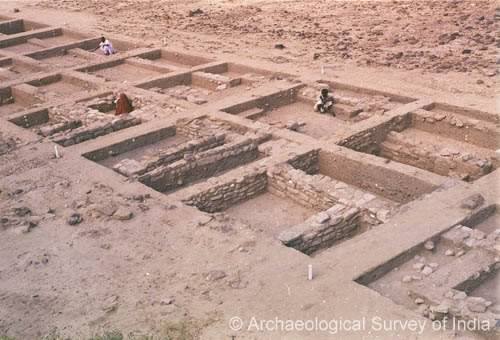
Tag: Mohenjo Daro

  • 5000 Year Dholavira Planned City Water Harvesting Astronomically Aligned

    5000 Year Dholavira Planned City Water Harvesting Astronomically Aligned

    The Ancient History of India is amazing,not merely for the accuracy of facts ,including Geographical but for the skill of the people in building not only temples but well planned cities.

    The myth that early Indians built only temples and were called ‘Barbaric’ these  barbarians built massive temple structures,where the shadow of the building falls in its base,was built in an area where no granite was available,80 tons monolithic block was hoisted at a height of around 180 feet,when pulleys were not supposed to have been known (Thanjavur),

    Temple where the pillar does not rest on the ground,(Lepakshi’

    Where the rays of the Sun fall at a specific time at a specific period;falls at the feet of the Deity..

    There are many temples of this kind.

    There are astronomically aligned temples.

    I have written on most of them.

    Please check under Temples/ Hinduism Category.

    Not only this.

    The ancient Indians built cities in concentric circles with temple at the center,Water tanks,fortification,sewage system,centralised granary,Disaster shelters..

    These were specialized by the Dravida Kings.

    The Kings of North did not lag behind.

    They matched their counterparts in the south.

    Even during Vedic period well planned cities were built.

    Treatise on Town Planning of the Vedic period is found.

    Please read my article on this.

    Now the Harappan period of Dholavira had an advanced town planning system.

    Excavations at Dholavira,Gujarat,India confirm this.

    The city had,

    16 Gates,

    4 Stadia,

    Water harvesting,

    Drainage system,

    Brick Masonry and Ceramic used.

    The city was built with mathematical precision and

    It was astronomically aligned.


    For details,I am producing excerpts from Archeological Survey of India Report.

    Fourteen field seasons of excavation through an enormous deposit caused by the successive settlements at the site for over 1500 years during all through the 3rd millennium and unto the middle of the 2nd millennium BC have revealed seven significant cultural stages documenting the rise and fall of the Indus civilization in addition to bringing to light a major, a model city which is remarkable for its exquisite planning, monumental structures, aesthetic architecture, amazing water harvesting system and a variety in funerary architecture. It also enjoys the unique distinction of yielding an inscription made up of ten large-sized signs of the Indus script and, not less in importance, is the other find of a fragment of a large slab engraved with three large signs. This paper attempts to give an account of hydro-engineering that is manifest in the structures of the Harappans at Dholavira.

    The ancient site at Dholavira (230 53′ 10″ N; 700 13’E), taluka Bhachau, district Kachchh in state Gujarat, lies in the island of Khadir which, it turn, is surrounded by the salt waste of the Great Rann of Kachchh. The ancient settlement is embraced by two monsoon channels, namely, the Manhar and Mansar. The ruins, including the cemetery covers an area of about 100 hectares half of which is appropriated by the articulately fortified settlement of the Harappans alone.

    Lying between the monsoon channels and being undulating sloping towards the south, the site was ideally suited for a settlement having artificial dams and reservoirs.

    Thee city of Dholavira in its fullest form was a precisely proportionate whole and proportionality resolved configuration following a resolute set of principles of planning and architecture with mathematical precision and, perhaps, with astronomically established orientation. Of the city, at present, three corners with partially eroded towers but fully intact inner corners have been confirmed by excavation. When measured between the inner corners, the E- W length of the city area along the northern defensive wall and N-S one along the western one worked out to 771.10 m and 616.87 m, respectively – thus giving the precise ratio of 5 : 4. Similarly, the other divisions of the city also revealed amazing ratios and proportions. The following table provides revealing information:

     Sl. No.   Division  Width  Length  Ratio
    1 City, internal 616.87 711.10 4 : 5
    2 Castle, internal at available top 92 114 4 : 5
    3 Castle, external (as per present exposure) 118 151 4 : 5
    4 Citadel (castle + bailey), external approximately (including bastions) 140 280 1 : 2
    5 Bailey, internal 120 120 1 : 1
    6 Middle Town + Stadium, internal 290.45 340.5 6 : 7
    7 Middle Town, excluding Stadium, internal 242 340.5 5 : 7
    8 Stadium, internal 47.5 283 1 : 6
    9 Lower Town, built-up area 300 300 1 : 1

    The above table inter alia reveals the proportional relationship between the castle and the city so it does in respect of intra-divisional and inter-divisional measurements. It is interesting to give another illustration: the diagonal drawn between the two opposite angles made by the north-eastern and the south-western corners of the city touched the north-western corner of the castle. While of the remaining two, the south-eastern corner is still missing, or not found out, a line, therefore bisecting the north-western angle also bisected the north-western corner of the middle town and further on cut across a crossing of four streets and finally the north-eastern corner of the castle. This could have been achieved by precise mathematical calculations and drawings which were then translated on the ground that was undulating by 13 m in gradient. It was indeed a great engineering achievement. In the whole scheme, the enwalled area of the castle became 49th (7 X 7) part of the city while its total built-up area was 25th (5 X 5) part.

    Furthermore, it is very significant that the two-thirds of the middle town and the whole of lower town were planned with bold projections and recesses just like those one finds in the layout of an Indian temple of the later ages. As a result, the city divisions were provided with a number of housing sectors and spaces. Some of latter were found to have been used for dumping domestic refuse. Another significant feature is the arterial street that ran across axially from west to east dividing all the above-mentioned units and sub-units into two equal halves, and a north-south street, perhaps somewhat staggered, further subdivided each unit….

    Seventeen gates, all built in the fortification walls with equally interesting add-on components, have been exposed so far. Their number-wise break up is: cattle 5, bailey 2, stadiums 4, middle town 1, annexe 2 and the remaining 3 belonging to the late Harappans of Stage VI. ..

    The other area in which the Harappans of Dholavira excelled spectacularly pertained to water harvesting with the aid of dams, drain, reservoirs and storm water management which eloquently speak of tremendous engineering skill of the builders. Equally important is the fact that all those features were integrated part of city planning and were surely the beauty aids, too, The Harappans created about sixteen or more reservoir of varying sizes and designs and arranged them in a series practically on all four sides. A cursory estimate indicates that the water structures and relevant and related activities accounts for 10 hectares of area, in other words 10% of the total area that the city appropriated within its outer fortification. The 13 m of gradient between high and low areas from east to west within the walls was ideally suited for creating cascading reservoirs which were separated from each other by enormous and broad bunds and yet connected through feeding drains.

    Six of the water tanks, one to east of castle and five of the series to south of it, have been fully or considerably exposed while a few others or other related features are testified in check digs. It was found to be the largest, grandest and best-furnished reservoir of rectangular shape measuring 73.40 m N-S and 29.30 m E-W (ratio 5:2) at the top while above that there should have been a 1 to 1.20 m high embankment as evidenced at four corners.

  • Vedic Civilization Two Million Sq.KM 2000 Sites

    Most of the discoveries relating to ancient India made  remain unknown.

    It is an accepted fact that civilizations flourished on the banks of Rivers, be it in India, or Sumeria, Minoa or Africa.

    In India wee seem to be hearing only bout the civilizations that flourished long the banks of Ganges, Sind and Saraswathy.

    Not much is known or even attempted about the other four River basins of India.

    Seven Rivers are mentioned in Hindu Texts.

    Ganges,

    Yamuna,

    Godavari,

    Sarasvathi,

    Narmada,

    Sindu, and

    Cauvery.

    Of these seven, exhaustive research is being done around Ganges,Sarasvathi and Sind.

    On Yamuna the research seems to have been restricted to sites relation to Mahabharata and Krishna.

    On the Narmada area only Dwaraka seems to have been concentrated upon.

    My research shows we have equally ancient finds around the other river basins..

    Time that we concentrate on these area as well.

    In addition to this, we have references to other ancient rivers like Vigai, near Madurai, Tamil Nadu,Tamraparani, near deep down south Tirunelveli nd there are are references to to other rivers like Pahruli.

    The last one belonged to Tamil Sangam Age which flowed and joined the sea near Madagascar.

    I had written on the fact that Vaiwaswatha Manu, ancestor of Lord Rama meditated  near Madagascar!

    No to the site of Harappa named 4 MSR.

    Two thousand sites unearthed relating to Harappa reveal that the Hindu culture extended for Two Million Square Millions, which included the present Pakistan and Iran.

    Archaeological  Report.

    Sites of ancient India around Harappa.
    Ancient sites of Indian Civilization, Harappa.

    “The purpose of the present excavation at 4MSR is to learn about the Early Harappan deposits, 4MSR’s relationship with other contemporary sites and to fill the gap between the Late Harappan phase and the painted grey ware [PGW] culture. We should know about the early farming phase [that existed in the pre-Harappan period]. It is also important to know the continuity of the sequence from the Late Harappan phase to the PGW culture. That is why we have taken up explorations and excavations in this entire area.”

    At its height, the Harappan civilisation flourished over 2.5 million sq. km in India, Pakistan and Afghanistan. About 2,000 sites have been found, from Sutkagendor in the Makran coast of Balochistan to Alamgirhpur in the east in Uttar Pradesh and from Manda in Jammu to Daimabad in Maharashtra.

    The Harappan civilisation is divided into three phases: Early (3000 BCE-2600 BCE), Mature (2600 BCE -1900 BCE) and Late (1900 BCE-1500 BCE). The PGW culture came later and is datable to circa 1200 BCE and belongs to the early historical period.

    After Partition, big Harappan sites such as Mohenjo-daro, Harappa and Ganweriwala fell on the Pakistani side. Between 1972 and 1974, M.R. Mughal, former Director General of Archaeology and Museums, Pakistan, explored Bahawalpur in the Cholistan region of Punjab, situated on the border with Rajasthan. Mughal found a lot of pottery on the surface there and named it Hakra ware after the Hakra river which flows there and which is called Ghaggar in India. Originating in the Himalayas, the Ghaggar flows through Punjab, Haryana, Rajasthan and Gujarat before joining the Arabian Sea near the Rann of Kutch.

    If the cornucopia of artefacts thrown up from the current excavation is any indication, 4MSR has all the characteristics of having been an Early Harappan and Mature Harappan site like Kalibangan situated 120 km away. There are no indications that a Late Harappan phase existed. “A special feature of 4MSR is the discovery of a perforated jar, a perforated bowl with a hole at the bottom and a perforated pot, confirming its status as a Mature Harappan site,” asserted Pandey. What fascinated him was the discovery of pots with handles. “In a nutshell, our excavations have yielded pre-Harappan Hakra ware, Early Harappan pottery and Mature Harappan ceramics,” he said.

    What stands out in the excavation is the bonanza of Early Harappan pottery with beautifully painted figures of peacocks, a lion, birds, pipal leaves and fish-net designs. Another discovery, a beautiful pot with a pencil mouth, could have been used to keep precious liquids or perfume.

    Other important artefacts obtained from the site are beads made of carnelian, lapis lazuli, steatite, agate and terracotta; copper, shell and terracotta bangles; copper rings and fish hooks; terracotta spindles and whorls; weights made out chert stone; terracotta sling balls, toy-cart frames, figurines of humped bulls, and arrowheads. Two horns of nilgai were found in a trench. Of particular interest is a potsherd with the impression of a fabric. Besides the seal, a sealing (impression of a seal) was found. The centrepiece of the discoveries is a fragment of a gold ornament for the ear. It is rare to find gold ornaments in Harappan sites although tubular gold beads have been found in Khirsara and Lothal, both Harappan sites in Gujarat.

    One trench yielded a skeleton, perhaps that of a female, about 40 years old. The ASI team is in the process of identifying the presence of grave goods in the trench to determine the period to which it belongs.

    What has come as a bonus is the discovery of a fire altar, with a yasti (a shaft) in the middle. “The yasti is an indication that rituals were performed at the altar,” said Manjul. The yasti here is an octagonal, burnt brick. Although bones were found in the upper level of the deposits in this trench, it could not be ascertained whether they were sacrificial bones. The ASI team traced mud and ash layers at the lower level in the trench and also found a bead inside the fire altar. Pandey said fire altars had been found in Kalibangan and Rakhigarhi, and the yastis were octagonal or cylindrical bricks. There were “signatures” indicating that worship of some kind had taken place at the fire altar here.

    Rakhigarhi Rediscovered.

    According to Manjul, an important reason why so many Harappan settlements came up in the then Saraswati valley was its fertile alluvial plains. Besides, raw materials such as chert, clay and copper were available in the nearby areas.

    It was puzzling, Manjul said, that while a lot of pottery belonging to the Mature Harappan period was found at Kalibangan, Baror, Binjor and 4MSR, no pottery belonging to the Late Harappan phase had been found in these and other nearby sites. “The Harappans deserted 4MSR, Binjor and Baror after the Mature Harappan phase. Why?” he asked. Another puzzle was that only the Late Harappan culture existed in the Suratgarh region in Rajasthan. “There is no continuity of the Harappan phases in the Ghaggar river valley. Did a migration take place towards Suratgarh after the Mature Harappan period? We have to find out the reasons why it happened,” Manjul said. (Baror, Binjor and 4MSR are contiguous sites. While Baror is about 20 km from Binjor and 4MSR, Kalibangan is 120 km from 4MSR. Kalibangan is 25 km from Suratgarh).,

    Reference and citation.

    http://www.frontline.in/arts-and-culture/heritage/harappan-surprise/article7053030.ece

    Image credit.

    http://bharatkalyan97.blogspot.in/2013/07/bhirrana-8th-millennium-bce-on-river.html


  • Twenty World Spiritual Sites Same Latitude Seven Hinduism

    As I have stated in the ‘About’ page of this blog, I started blogging because I wanted to share what interests me and what little I know.

    1971105
    Sites connected same Latitude.


    As days went by,it  turned into one of focusing on Hinduism, Sanatana Dharma detailing the fundamentals of the oldest Religion.

    9914358
    How sites in the same Latitude vare connected.


    Again this became into one of concentrating more on Vedas, explanation of hidden meanings of these texts.

    On individual Gods, Devi Upasna got the prime of place.

    1232532_orig
    Golden Triangle.

    Now it is becoming more research oriented on the spread of Sanatana Dharma throughout the world and the validation of Sanatana Dharma and Tamil texts.

    Under this category most of them are proven while some of them exploratory as the one ‘ Shiva Man God or Reality’

    What is special about Sanatana Dharma is that it does not shackle you when you interpret or verify it.

    And it encourages you to question it.

    And ,in Sanatana Dharma nothing is what it seems to be.

    My conviction is that the Indian texts are records of knowledge and Wisdom unearthed by great men whose intention was to enlighten the world .

    And Sanatana Dharma is open to All.

    But this depends on one’s passion and the technology available .

    Unfortunately, the present technology we have at our disposal is inadequate to explain most of what is found in these texts.

    And many relics archaeological finds in the world defy one’s understanding.

    I have explained in my blog such of those that can be explained,like the Fibonacci sequence in the poem on Lord Krishna or the value of Pi in a poem, advanced concepts of Modern Science including Quantum Mechanics in Hinduism.

    Also some curious world facts archaeological finds which can not be explained by others are verifiable with Hindu Texts.

    I have a few readers who update the actual finding from US and Canada and I interpret them with Indian texts.

    One such is the fact that twenty sites in the world lie in the same Latitude and the distance between them represent the Golden Means/ Fibonacci number.

    The Giza Pyramids, The Nazca Lines (large petro glyphs in the vast deserts of southern Peru), Angkor Wat (the magnificent temple complex in Cambodia), and Easter Island are all related. You can draw a straight line connecting each site across the circumference of the earth. This precision is followed within one tenth of a degree of latitude.

    From Easter Island a 25,000 mile line (the exact length of the equator of the earth) can be drawn which connects to: Paracas, Nazca, Ollayantambo, Machu Picchu, Cuzco, Sacsayhuaman, Paratoari, Mali (where the Dogon tribe of the Sirius Mystery originates), Tassili N’Ajjer, Siwa Oasis, Giza, Petra, Ur, Persepolis, Mohenjo Daro, Khajuraho, Pyay, Sukhothai, Angkor Wat, and Preah Visear. This 25,000 mile line also happens to be at a 30 degree angle to the equator. Each of these sites are significant as spiritual centers, capitals, or sites where megalithic structures were built.

    Of these twenty sites Easter Island,Machu Pichu , Nazca,Ankgorvat, PETRA,Mohenjo Daro, Khajuraho,Angkor Wat have Sanatana Dharma connections.

    I have written on  Easter Island, Machu Pichu, Petra having  Shiva Temple.

    The rest , Khajuraho, Mohenjo Daro Angkor vat are in India and I have written extensively on them.

    Add to this the theory that Chidambaram , India being the Magnetic Centre of the Earth, three Shiva Temples  representing thecthree natural principles,in Tamil Nadu,Nataraja’s dancing pose is the exact reproduction of a Super nove Explosioin the distant past,there is some message in the sites I have mentioned.

    My future articles shall examine them.

    Now one more information on these 20 sites.


    ‘Mohenjo Daro, the lost city of the ancient Indus valley, is the site of a possible ancient atomic blast. Radioactive readings have been found there on par with that of the atomic site of Nagasaki in Japan. Some 44 skeletons were found here, flattened to the ground, still holding hands in some cases, as if incinerated in a moment’s notice. From the epicenter everything was crystalized and vitrified in correlation with what may have been an ancient atomic weapon. We can only explain this by vindicating accounts like those of the ancient Vedic texts such as the Mahabharata. And perhaps we are seeing substantial scientific evidence of the spiritual here at this site. The implications of each of these points is history redefining. Mohenjo Daro is also the origin of a still un-deciphered language which is remarkably similar to the language found on the Rongo-rongo boards from Easter Island, literally half the world away. 

    Let’s look deeper at the connecting line between the main ancient sites of Giza, Nazca, Angkor Wat and Easter Island. Mohenjo Daro is located halfway between the Giza Pyramids and Angkor Wat. Mohenjo Daro is also located exactly opposite Easter Island on this same latitudinal line

    . The hummingbird petroglyph of Nazca Peru is located directly opposite of Angkor Wat, Cambodia. You can draw a line from one to the other directly through the center of the earth and it would be off by a mere few tenths of a degree. This is incredible!’


    These sites not only happen to be in a significant line, but in a significant ratio through which the encoded can be revealed. The ratio of the distances between these sites is equivalent to Pi which is shown in the brilliant work of Jim Alison. Alison found that the distance from Prassat Vihear of Angkor Wat, to the Pyramid of Giza is 4,754 miles (first 5 #’s of Fibonacci sequence #359 is 47542). From the Great pyramid, to the hummingbird of the Nazca lines of Peru, the distance is 7,692 miles (first 5 #’s of Fibonacci sequence #360 is 76924). From Nazca across the long side of the earth back to Angkor Wat the distance is 12,446 miles (first 5 #’s of Fibonacci sequence #361 is 12446)!!! This is not the only instance of this important ratio, or by any means the only connection like this. This axiom is found in thousands of sites, and still being uncovered in many more to this day.

    What does this mean? First of all, these numbers indicate completely disconnected cultures somehow just so happened to place their structures on the same latitudinal line, and in a distance apart from each other which reflects Pi. Pi is so accurately reflected that it is maintained up to the first 500 numbers of the Fibonacci sequence.

    What is the relevance of Pi? Pi (3.14159265359…) is a magical number whose decimals never end and never repeat. The Golden Number relates to harmonics, it is a proportion found everywhere in nature, and defines organic growth (2/3-1/3 or 1-1.6180399… and so on.) The golden spiral (the Fibonacci sequence) describes another perpetual sequence. (1, 1, 2, 3, 5, 8, 13, 21, 34, 55, 89, 144 etc.)’

    I shall be posting more on this.

    Citation and reference.


    http://universalhiddeninsight.weebly.com/universal-articles/insights-our-ancient-past-decoded-the-secrets-of-energy-consciousness-and-the-nature-of-reality

  • Rama Used Atom Bomb Against Atlantis Mohenjo Daro

    Mohenjo-daro reveals  the exposure to Atomic Radiation, possibly caused by an Atomic blast.

    Rama's Empire.jpg
    Rama’s Empire.

    The Brahmastra mentioned in Indian Epics and Puranas is capable of this devastating effect.

    To my knowledge Valmiki does not seem to refer to the  extensive use of Brahmastra in the Valmiki Ramayana.

    The instance  was when Indrajit used it against Hanuman and as Hanuman prayed Brahma( and he had a oon from Brahma as well) it did stun him and he was not killed nor the effects to the environment were devastating..

    ‘◾Vishvamitra used it against Vasishta, but the Brahmastra was swallowed by Brahmadanda, Lord Brahma’s countermeasure against the Brahmastra.
    ◾In the Ramayana a Brahmastra is used by Shri Rama several times: once against Jayanta (Indra’s son) when he hurt Sita, against Mareecha in their last encounter, against the Ocean when he did not answer his prayer to allow his army and himself to cross over to Lanka and finally in the last battle with Ravana.
    ◾It is also mentioned in the Vedas that a Brahmastra was aimed by Shri Rama to carve a path out of the sea so that the army of apes could march towards Lanka, however at that moment, Varuna appeared and told Lord Rama about the technical flaws of using the weapon and hence it was later aimed towards Dhrumatulya by Lord Rama, which fell at the place of modern day Rajasthan causing it to become a desert. Also Indrajit aimed a Bhramastra at Lord Lakshman on the final battle between him and Lord Lakshman, however the deadly weapon returned because Lakshman himself was the avatar of Trinity.(How many times Brahmastra was used)

    Though Brahmastra  was not used other than these instances, there seems to have been evidence of Atomic blast in India, in Mohenjo Daro.

    Moheno Daro Atomic Blast. gif Moheno Daro Blast Victims. imge creditshabharanjagupta,wordpress.com

    The Brahmastra was not used in the area mentioned above in the Ramayana, though this is the place where Kara and Dushana came from.

    Atom Bomb result Mohenjo Daro.jpg
    Moheno Daro atomic Blast. At one site, Soviet scholars found a skeleton which had a radioactive level 50 times greater than normal. Other cities have been found in northern India that show indications of explosions of great magnitude. One such city, found between the Ganges and the mountains of Rajmahal, seems to have been subjected to intense heat. Huge masses of walls and foundations of the ancient city are fused together, literally vitrified! And since there is no indication of a volcanic eruption at Mohenjo-Daro or at the other cities, the intense heat to melt clay vessels can only be explained by an atomic blast or some other unknown weapon. The cities were wiped out entirely. Image subhadraranjangupta.wordpress.com

    They came to Dandakaranya and Rama defeated them.

    So the Mohenjo- Daro area was not a victim of Atomic Bomb.

    Nor was it used in the Mahabharata Times.

    The place in question was called Angsa Desa, of which Karna was the King(Karna was anointed as the King of Anga)

    Given the fact that there had been atomic radiation in Mohenj- Daro, how can we account for it since Rama did not seem to have used it, nor any one in the Mahabharata in the area?

    There seems to me one logical answer to this.

    Lord Rama had conquered the whole of world, I had published the Map of Rama Empire.

    If Rama had annexed these area he had to have won over them.

    If so, whom did he defeat?

    I checked world History, Legends,and Folklore.

    I had my link in Atlantis.

    I published an article on Rama’s War with Atlantis

    and another one,

    Rama Atlantis War Kavatam periplus Port Window of Lemuria

    As explained in these articles, there seems to have been Four major civilizations then.

    Rama’s Empire,

    Atlantis Empire,

    Uighur Empire and

    Lemurian Empire.

    Of these Uighur was not very advanced and Lemuria which had been on the wane was trying to recoup.

    They were suppressed by the Atlantis people.

    In the Atlantis, Osiris’ son Horus entered into an alliance with Rama to defeat Seth who was trying to become independent in the Sumerian valley.

    King Atlas (King Of Atlantis) and Prince Osiris (heir to the throne) desired to create secondary domains where they could re-establish the Lemurian Empire . This intention was thwarted by the actions of Osiris’ younger brother, the Emperor Seth. As present ruler of the Libyan/Egyptian Empire (that covered all of Africa), Seth decided that with the fall of Atlantis his Empire (in league with the rebel Sons of Belial) was to be its last stronghold. He made it his goal to re-establish the Atlantean Empire with himself as its all-powerful, ‘divine right’ emperor (of the world).

    ‘conflicting objectives resulted in deadly warfare between Osiris and his brother Seth. Leading Osiris’s Egyptian armies was Osiris’ eldest son Horus. After Osiris’ unfortunate ‘death’, Horus succeeded his father as king of the Libyan/Egyptian Empire. Intuitively, Horus knew what would happen when they landed in Libya. He completely distrusted his uncle. Horus persistently warned his father about Seth’s stubbornness and treachery. Osiris, believing in the goodness of the human heart, initially ignored his son’s advice. Subsequently, Osiris landed in Libya and after Seth’s abdication became Emperor’

    After the demise of Osiris, his son Horus entered into a pact with Rama Empire(Emperor Zata’ar’s eldest son, Prince Rama.) to defeat Seth, the usurper.’

    The Atlantis army met with Rama’s Army in Rishi City, now in Pakistam.

    Now read this.

    Vallmiki ends the Ramayana with Rama’s Coronation, Pattabhisheka and therfore we have no information on Ram’s conquest of the world, after his victory over Ravana.

    In this instance, there are two observations by me.

    Did Rama use Brahmastra?

    In which case the following version does not really support the Atom Bomb theory as Rama seems to have stopped the advancing army by making the army generals drop dead.

    Or was the Astra differnt?

    Or did Rama use his astra as mentioned here(Yogic Posture), after the Atlantis people had used the Brahmastra?

    The latter explanation seems to tally with the state of Mohenjo Daro Radiation.

    I am searching for more information.

    Atlantis Drops A-Bomb on India

    The Lemurian Fellowship (an esoteric group formed in the 1930’s) lessons state:
    During the heyday of Atlantis and Rama, both the Ramayana and the Lemurian Fellowship agree that other advanced civilizations were also in existence. According to the Lemurian Fellowship the Osiris Civilization existed in what is today North Africa and the Mediterranean Basin, and the Uiger Empire ruled over what is today the Gobi Desert. Yet of all of the civilizations, Atlantis and Rama were supposedly the two most developed.

    These two cultures had developed advanced technology, which they shared between themselves and the rest of the world. It had been mainly developed in Atlantis and would seem like science fiction to us today, just as the Ramayana and the Mahabharata seem like science fiction. Not only did they have aircraft such as vimanas and valixi (as the Atlantean craft was called), they had weapons such as fireballs that could destroy a whole city…(etc.).

    According to the Lemurian Fellowship, as Atlantis and Rama reached the height of civilization, war broke out between them. The Atlanteans, a highly technical and war-like culture were bent on conquering the world. Subjugating the Rama Empire was an important step in their plan.

    An interesting episode in the Atlantean history as related by the Lemurian Fellowship involves the Atlanteans sending a well-equipped army to India in order to subjugate the Rama Empire, demanding surrender, tribute and acceptance of Atlantean rulership.

    The Priest-King of Rama stated they didn’t believe in war, and asked them to leave in peace.

    Arrogantly, the Atlanteans did not believe that the Indians had the power to stop them, certainly not by technical means. At dawn, the Atlantean army began their march on the city.
    Sadly, the Priest-King watched the army advance…He raised his arms heavenward and, using a yogi technique, he caused the general and each officer in descending order to drop dead in their ranks, apparently by heart attack. The Atlanteans fled. Of the seige of the Rishi City, not one man from the Rama Empire was lost. (Stranger Than Science, Frank Edwards, 1959).

    The Indian Epics, especially the Mahabharata, pick up the thread of the tale from here and go on to tell of the rest of the horrible story; a story of devasation and destruction. Apparently Atlantis, displeased at it’s humiliating defeat, decided that they were no longer interested in subjugating the Rama Empire, and decided instead to annihilate the major cities using weapons so destructive that the Sanskrit scholars could not comprehend what was being described in the Epics until the dropping of the atomic bombs on Japan.

    These are authentic verses from the Indian Epics:
    “Gurkha, flying a swift and powerful vimana
    hurled a single projectile
    charged with all the power of the Universe,
    An incandescent column of smoke and flame,
    as bright as ten thousand suns,
    rose with all its splendor.

    It was an unknow weapon
    and iron thudnerbolt,
    a gigantic messenger of death,
    which reduced to ashes
    the entire race of Vrishnis and the Andhakas.

    …After a few hours
    all foodstuffs were infected…
    …to escape from this fire
    the soldiers threw themselves in the streams
    to wash themselves and their equipment.”
    The Mahabharata

    “(It was a weapon) so powerful
    that it could destroy the earth in an instant –
    A great soaring sound in smoke and flames –
    And on it sits death..”
    The Ramayana

    Compiled by David Hatcher Childress (A real-life Indiana Jones)
    in conjunction with Sanskrit Scholars

    From a 324 page book, which includes the complete
    translation of the Vimaanika Shastra text.

    “An ancient, heavily populated city in Pakistan was instantly destroyed 2,000 years before Christ by an incredible explosion that could only been caused by an atomic bomb. That’s the mind bogging conclusion of a British researcher, David Davenport, who spent 12 years studying ancient Hindu scripts and evidence at the site where the great city – Mohenjo Daro once stood. What was found at the site of Mohenjo Daro corresponds exactly to Nagasaki, declared Davenport, who published his startling findings in an amazing book, “Atomic Destruction in 2000 B.C.”, Milan, Italy, 1979.

    There was an epicenter about 50 yards wide where everything was crystallized, fused or melted, he said. Sixty yards from the center the bricks are melted on one side indicating a blast. the horrible, mysterious event of 4,000 years ago that leveled Mohenjo Daro was recorded in an old Hindu manuscript called the Mahabharata, “White hot smoke that was a thousand times brighter than the sun rose in infinite brilliance and reduced the city to ashes, the account reads. Water boiled…horses and war chariots were burned by the thousands.. . the corpses of the fallen were mutilated by the terrible heat so that they no longer looked like human beings…”. The description concludes, “it was a terrible sight to see … never before have we seen such a ghastly weapon”.

    Based on his study of many ancient manuscripts, Davenport believes that the end of Mohenjo Daro was tied to a state of war between the Aryans and the Dravidian. Aryans controlled regions where space aliens were mining minerals and exploiting other natural resources, he believes. Because it was a Dravidian city, the aliens had agreed to destroy Mohenjo Daro on behalf of the Aryans. The aliens needed the friendship of the Aryan kings so that they could continue their prospecting and research, explained Davenport. The texts tell us that 30,000 inhabitants of the city were given seven days to get out – a clear warning that everything was about to be destroyed. Obviously, some people didn’t heed the warning, because 44 human skeletons were found there in 1927, just a few years after the city was discovered.

    I shall be writng on the Aliens referred to By Indian Texts with Proof, a series, shortly.

    ** I had written an article earlier on the atomic blast could have been used in the Mahabharatha, based on some other evidence.

    I incline to agree with the view that Rama used the Bomb in Ramayana.

    The issue has to be resolved.

    Citations.

    http://www.alien-ufos.com/ancient-civilizations-archaeology-anthropology/26836-atlantis-drops-bomb-india.html

    http://atlantisonline.smfforfree2.com/index.php/topic,33106.0.html

    https://subharanjangupta.wordpress.com/2011/08/07/evidences-of-neclear-explosion-in-mohenjo-daro/

  • What Did Vedic People Eat ? Indus Sarasvati Harappa Food

    I have noticed that despite the multitude of Languages,Dialects and terrain, the food habits of the people of India , especially of the Brahmin Community seems to be uniform.

    I have made the observation on Brahmins because I am familiar with it.

    During my professional Life, I have covered India extensively and had partaken food with the local people in Kashmir,Punjab,Bengal,Odisha, Gujarat, MP, UP , not to mention the southern states.

    Copper plate from Harappa site.jpg Plate with vertical sides. Copper and bronze plates were probably used exclusively by wealthy upper class city dwellers. Discovered in 1938.

    What struck me was the essential food habits are the same, right from offering water first to the householder eating later.

    Major difference is that in the Northern States Wheat is consumed in place of Rice.

    (Rice is consumed more in the Southern States of Kerala, Tamil Nadu,Karnataka, Andhra,and in th East Bengal and Odisha.)

    Yet for Religious ceremonies Rice is being used and the vegetables that are used all over the country for important ceremonies like Sraddha remain the same.

    Sanatana Dharma, being the unifying factor, I looked into what our ancestors of Sanatana Dharma Hinduism ate.

    Here it is.

    The Harappans grew lentils and other pulses (peas, chickpeas, green gram, black gram). Their main staples were wheat and barley, which were presumably made into bread and perhaps also cooked with water as a gruel or porridge. In some places, particularly Gujarat, they also cultivated some native millets; possibly broomcorn millet, which may have been introduced from southern Central Asia; and by 2000 BC, if not before, African millets. They fed local wild rice to their animals and probably began to cultivate it, though rice does not become an important crop until Post-Harappan times. The Harappans must have eaten a range of fruit, vegetables and spices : these included a variety of brassica, brown mustard greens, coriander, dates, jujube, walnuts, grapes, figs; many others, such as mango, okra, caper, sugarcane, garlic, turmeric, ginger, cumin and cinnamon, were locally available and probably grown or gathered by the Harappans, but the evidence is lacking. Sesame was grown for oil, and linseed oil may also have been used.

    Meat came mainly from cattle, but the Harappans also kept chickens, buffaloes and some sheep and goats, and hunted a wide range of wildfowl and wild animals such as deer, antelopes and wild boar. They also ate fish and shellfish from the rivers, lakes and the sea; as well as being eaten fresh, many fish were dried or salted – many bones from marine fish such as jack and catfish were found at Harappa, far inland.

    Harappan houses had a kitchen opening from the courtyard, with a hearth or brick-built fireplace. Pottery vessels in a range of sizes were used for cooking; in wealthy households metal vessels were also used.

    Few certain agricultural tools have been found. Flint blades were probably used for harvesting. A ploughed field at Early Harappan Kalibangan shows that the plough was in use by the early 3rd millennium BC; its criss-cross furrows allowed two crops to be raised in the same field, a practice that has continued into modern times.

    Richard Meadow
    We have a good deal of evidence for Harappan subsistence. Staple crops varying by region and time period included wheat, barley, millets, rice, and pulses.

    Food in Indus Valley civilization has been predominantly agrarian in which excavations reveal that the Indus valley people were habituated in consuming Barley which was one of the major cereals of the community. While specimens of Barley have been found in the ruins of Mohenjodaro, it has not been proved whether they used to consume rice or not. However the use of rice must have been known to them. Along with Barley the civilisation also cultivated peas and sesamum along with spices of brassica which is very similar to modern day Rai. While these have been major crops of the Indus Valley civilization, the civilisation also reared buffaloes, goat and sheep which prove that milk was major food article for these people. Along with the vegetarian food items the people of Indus valley civilization also consumed meat that was evident from the fact that meat was included in the offerings made for the dead. With the excavation of number of artefacts like sling balls of clay, copper fish hooks, the arrow heads, the flying knives etc strongly prove that these were required to kill and rear animals and birds which were dressed with these instruments and included in their food items after cooking. Their food items as such included beef, mutton, pork and poultry products, the flesh of Gharial or crocodile, turtle and tortoise, flesh of fresh local fishes from nearby rivers and dried fish from sea coasts. The bones and shells in hard form has been found in and around the houses of the Indus valley civilization.

    References, Citations.

    http://a.harappa.com/content/what-kinds-things-did-indus-people-eat

    http://www.indianetzone.com/52/food_indus_valley_civilization.htm

    Fuller, D. (2002) Fifty Years of Archaeobotanical Studies in India: Laying a Solid Foundation in S. Settar and R. Korisettar (eds.) Indian Archaeology in Retrospect, Volume III. Archaeology and Interactive Disciplines, Publications of the Indian Council for Historical Research. New Dehli: Manohar: Pp. 247-364.

    Fuller, D. (2003) African crops in prehistoric South Asia: a critical review in K. Neumann, A. Butler and S. Kahlheber (eds.) Food, Fuel and Fields. Progress in Africa Archaeobotany, Africa Praehistorica 15. Colonge: Heinrich-Barth-Institut: Pp. 239-271

    Fuller, D. (2003) Indus and Non-Indus Agricultural Traditions: Local Developments and Crop Adoptions on the Indian Peninsula, in S. Weber and W. Belcher (eds.) Indus Ethnobiology: New Perspectives from the Field. Lexington Books, Lanham, Maryland: Chapter 10.

    Fuller, D. Q (2005). “Ceramics, seeds and culinary change in prehistoric India.” Antiquity 79 (306): 761-777.

    Fuller, D. Q and E. L. Harvey (2006). “The Archaeobotany of Indian Pulses: identification, processing and evidence for cultivation.” Environmental Archaeology 11(2): 219-246.

    Fuller, D. Q (2006). “Agricultural Origins and Frontiers in South Asia: A Working Synthesis.” Journal of World Prehistory 20: 1-86

    For animals, the domesticates humped cattle, sheep, goat, and perhaps water buffalo were of principle importance for both primary (after death) and secondary (before death) products. See:

    Meadow, R.H. and A.K. Patel (2003) Prehistoric pastoralism in northwestern South Asia from the Neolithic through the Harappan Period. In S. Weber and W. Belcher, eds., Indus Ethnobiology: New Perspectives from the Field. Lanham, MD: Lexington Books (Rowman & Littlefield Publishing Group), pp. 65-93.

    Both wild animal and wild plant resources continued to be important including fish, molluscs, hunted animals, and various wild plants for fodder, food, and medicines. Linen, cotton, and wool were important resources for textile manufacture, and silk was also used., coming from wild silk moths. For the last, see:

    Good, Irene, J.M Kenoyer and R.H. Meadow (2009) “New evidence for early silk in the Indus Civilization.” Archaeometry 51: 457-466.