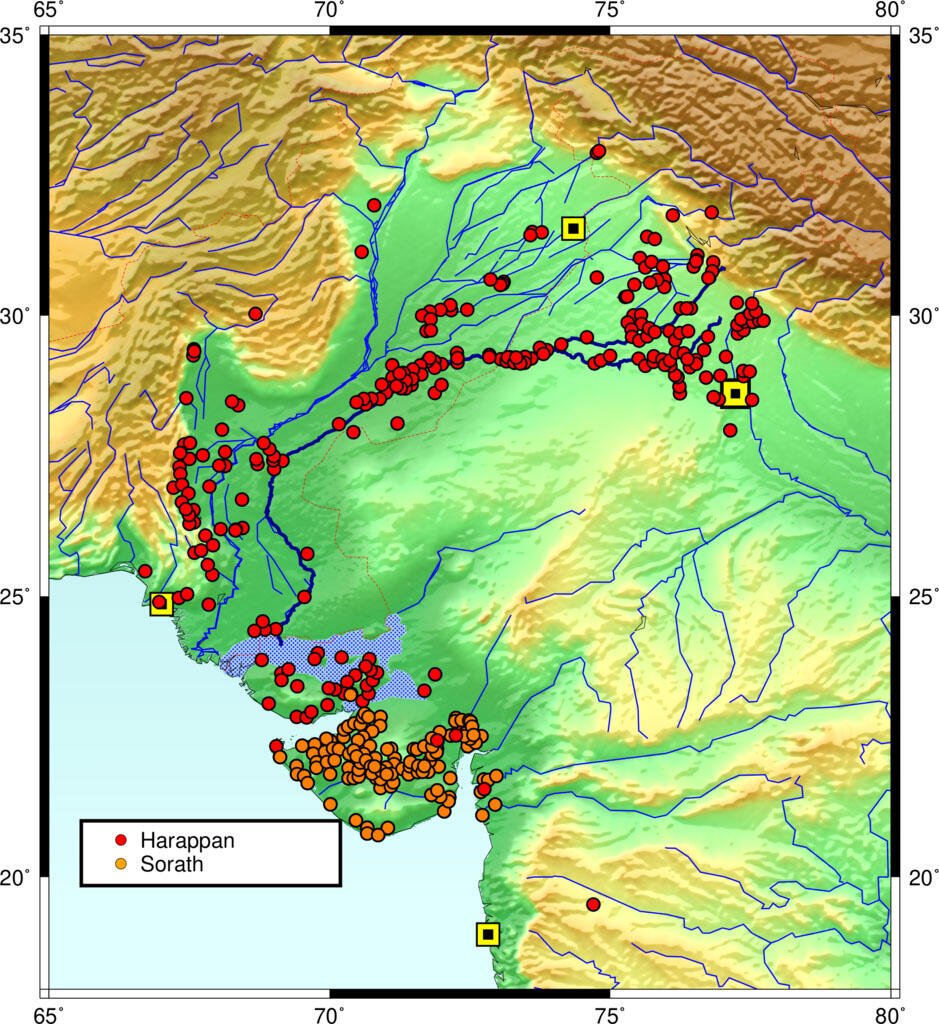
Ancient India, then called Bharata Varsha was spread throughout the ancient world and other world cultures sprang from, borrowed from it. Also, migration to Bharata Varsha from the landmass we call now as India, was not uncommon. When one studies the ancient history of Sumeria, Assyria,Hittie, Incas and other ancient civilizations, one will find similarities between Sanatan Dharma and these civilizations. I had written extensively on these connections.Such being the case , it is natural that people from these areas had moved into the area what we now call India
This migration to Harappa is proved by Isotope studies of Human teeth. Please read excerpts of the study below.
Much of what modern researchers have gleaned about our common ancestors, particularly those from Egypt and Mesopotamia, comes from well-studied tombs and burial sites. Discovering the narrative of peoples from the Greater Indus Valley — which comprises much of modern-day Pakistan and northwest India — is more challenging. The text of the Indus Valley Civilization remains undeciphered, and known and excavated burial sites are rare.
The new study illuminates the lives of individuals buried more than 4,000 years ago in those rare grave sites by providing a novel comparison of the dental enamel and chemical analyses of the water, fauna and rocks of the time, using isotope ratios of lead and strontium.
In its heyday, Harappa held a population of 50,000, although the number of individuals represented by skeletal remains across the entire culture area totals in the hundreds.
The UF research team was led by Benjamin Valentine, now a postdoc at Dartmouth; biological anthropologist John Krigbaum, his dissertation adviser; and geological sciences professor George Kamenov, an isotope geologist.“The idea of isotope analysis to determine the origin of individual migrants has been around for decades. But what people haven’t been doing is looking at the different tooth types, essentially, snapshots of residents during different times of individuals’ lives,” said Valentine. “We didn’t invent the method, but we threw the kitchen sink at it.”
The researchers discovered that the people in the Harappa grave sites weren’t born there, but migrated there from the hinterlands. Said Krigbaum, “Previous work had thought the burial sites represented local, middle-class people. There was no notion that outsiders were welcomed and integrated by locals within the city. It’s not clear why certain young hinterland people were sent to the city.
Most of the discoveries relating to ancient India made remain unknown.
It is an accepted fact that civilizations flourished on the banks of Rivers, be it in India, or Sumeria, Minoa or Africa.
In India wee seem to be hearing only bout the civilizations that flourished long the banks of Ganges, Sind and Saraswathy.
Not much is known or even attempted about the other four River basins of India.
Seven Rivers are mentioned in Hindu Texts.
Ganges,
Yamuna,
Godavari,
Sarasvathi,
Narmada,
Sindu, and
Cauvery.
Of these seven, exhaustive research is being done around Ganges,Sarasvathi and Sind.
On Yamuna the research seems to have been restricted to sites relation to Mahabharata and Krishna.
On the Narmada area only Dwaraka seems to have been concentrated upon.
My research shows we have equally ancient finds around the other river basins..
Time that we concentrate on these area as well.
In addition to this, we have references to other ancient rivers like Vigai, near Madurai, Tamil Nadu,Tamraparani, near deep down south Tirunelveli nd there are are references to to other rivers like Pahruli.
The last one belonged to Tamil Sangam Age which flowed and joined the sea near Madagascar.
I had written on the fact that Vaiwaswatha Manu, ancestor of Lord Rama meditated near Madagascar!
No to the site of Harappa named 4 MSR.
Two thousand sites unearthed relating to Harappa reveal that the Hindu culture extended for Two Million Square Millions, which included the present Pakistan and Iran.
Archaeological Report.
Ancient sites of Indian Civilization, Harappa.
‘
“The purpose of the present excavation at 4MSR is to learn about the Early Harappan deposits, 4MSR’s relationship with other contemporary sites and to fill the gap between the Late Harappan phase and the painted grey ware [PGW] culture. We should know about the early farming phase [that existed in the pre-Harappan period]. It is also important to know the continuity of the sequence from the Late Harappan phase to the PGW culture. That is why we have taken up explorations and excavations in this entire area.”
At its height, the Harappan civilisation flourished over 2.5 million sq. km in India, Pakistan and Afghanistan. About 2,000 sites have been found, from Sutkagendor in the Makran coast of Balochistan to Alamgirhpur in the east in Uttar Pradesh and from Manda in Jammu to Daimabad in Maharashtra.
The Harappan civilisation is divided into three phases: Early (3000 BCE-2600 BCE), Mature (2600 BCE -1900 BCE) and Late (1900 BCE-1500 BCE). The PGW culture came later and is datable to circa 1200 BCE and belongs to the early historical period.
After Partition, big Harappan sites such as Mohenjo-daro, Harappa and Ganweriwala fell on the Pakistani side. Between 1972 and 1974, M.R. Mughal, former Director General of Archaeology and Museums, Pakistan, explored Bahawalpur in the Cholistan region of Punjab, situated on the border with Rajasthan. Mughal found a lot of pottery on the surface there and named it Hakra ware after the Hakra river which flows there and which is called Ghaggar in India. Originating in the Himalayas, the Ghaggar flows through Punjab, Haryana, Rajasthan and Gujarat before joining the Arabian Sea near the Rann of Kutch.
If the cornucopia of artefacts thrown up from the current excavation is any indication, 4MSR has all the characteristics of having been an Early Harappan and Mature Harappan site like Kalibangan situated 120 km away. There are no indications that a Late Harappan phase existed. “A special feature of 4MSR is the discovery of a perforated jar, a perforated bowl with a hole at the bottom and a perforated pot, confirming its status as a Mature Harappan site,” asserted Pandey. What fascinated him was the discovery of pots with handles. “In a nutshell, our excavations have yielded pre-Harappan Hakra ware, Early Harappan pottery and Mature Harappan ceramics,” he said.
What stands out in the excavation is the bonanza of Early Harappan pottery with beautifully painted figures of peacocks, a lion, birds, pipal leaves and fish-net designs. Another discovery, a beautiful pot with a pencil mouth, could have been used to keep precious liquids or perfume.
Other important artefacts obtained from the site are beads made of carnelian, lapis lazuli, steatite, agate and terracotta; copper, shell and terracotta bangles; copper rings and fish hooks; terracotta spindles and whorls; weights made out chert stone; terracotta sling balls, toy-cart frames, figurines of humped bulls, and arrowheads. Two horns of nilgai were found in a trench. Of particular interest is a potsherd with the impression of a fabric. Besides the seal, a sealing (impression of a seal) was found. The centrepiece of the discoveries is a fragment of a gold ornament for the ear. It is rare to find gold ornaments in Harappan sites although tubular gold beads have been found in Khirsara and Lothal, both Harappan sites in Gujarat.
One trench yielded a skeleton, perhaps that of a female, about 40 years old. The ASI team is in the process of identifying the presence of grave goods in the trench to determine the period to which it belongs.
What has come as a bonus is the discovery of a fire altar, with a yasti (a shaft) in the middle. “The yasti is an indication that rituals were performed at the altar,” said Manjul. The yasti here is an octagonal, burnt brick. Although bones were found in the upper level of the deposits in this trench, it could not be ascertained whether they were sacrificial bones. The ASI team traced mud and ash layers at the lower level in the trench and also found a bead inside the fire altar. Pandey said fire altars had been found in Kalibangan and Rakhigarhi, and the yastis were octagonal or cylindrical bricks. There were “signatures” indicating that worship of some kind had taken place at the fire altar here.
Rakhigarhi Rediscovered.
According to Manjul, an important reason why so many Harappan settlements came up in the then Saraswati valley was its fertile alluvial plains. Besides, raw materials such as chert, clay and copper were available in the nearby areas.
It was puzzling, Manjul said, that while a lot of pottery belonging to the Mature Harappan period was found at Kalibangan, Baror, Binjor and 4MSR, no pottery belonging to the Late Harappan phase had been found in these and other nearby sites. “The Harappans deserted 4MSR, Binjor and Baror after the Mature Harappan phase. Why?” he asked. Another puzzle was that only the Late Harappan culture existed in the Suratgarh region in Rajasthan. “There is no continuity of the Harappan phases in the Ghaggar river valley. Did a migration take place towards Suratgarh after the Mature Harappan period? We have to find out the reasons why it happened,” Manjul said. (Baror, Binjor and 4MSR are contiguous sites. While Baror is about 20 km from Binjor and 4MSR, Kalibangan is 120 km from 4MSR. Kalibangan is 25 km from Suratgarh).,
You must be logged in to post a comment.