Tag: Harappa

  • People Migrated To Harappa Teeth Isotope Study Proves

    People Migrated To Harappa Teeth Isotope Study Proves

    Ancient India, then called Bharata Varsha was spread throughout the ancient world and other world cultures sprang from, borrowed from it. Also, migration to Bharata Varsha from the landmass we call now as India, was not uncommon. When one studies the ancient history of Sumeria, Assyria,Hittie, Incas and other ancient civilizations, one will find similarities between Sanatan Dharma and these civilizations. I had written extensively on these connections.Such being the case , it is natural that people from these areas had moved into the area what we now call India

    This migration to Harappa is proved by Isotope studies of Human teeth. Please read excerpts of the study below.

    Much of what modern researchers have gleaned about our common ancestors, particularly those from Egypt and Mesopotamia, comes from well-studied tombs and burial sites. Discovering the narrative of peoples from the Greater Indus Valley — which comprises much of modern-day Pakistan and northwest India — is more challenging. The text of the Indus Valley Civilization remains undeciphered, and known and excavated burial sites are rare.

    The new study illuminates the lives of individuals buried more than 4,000 years ago in those rare grave sites by providing a novel comparison of the dental enamel and chemical analyses of the water, fauna and rocks of the time, using isotope ratios of lead and strontium.

    In its heyday, Harappa held a population of 50,000, although the number of individuals represented by skeletal remains across the entire culture area totals in the hundreds.

    The UF research team was led by Benjamin Valentine, now a postdoc at Dartmouth; biological anthropologist John Krigbaum, his dissertation adviser; and geological sciences professor George Kamenov, an isotope geologist.“The idea of isotope analysis to determine the origin of individual migrants has been around for decades. But what people haven’t been doing is looking at the different tooth types, essentially, snapshots of residents during different times of individuals’ lives,” said Valentine. “We didn’t invent the method, but we threw the kitchen sink at it.”

    The researchers discovered that the people in the Harappa grave sites weren’t born there, but migrated there from the hinterlands. Said Krigbaum, “Previous work had thought the burial sites represented local, middle-class people. There was no notion that outsiders were welcomed and integrated by locals within the city. It’s not clear why certain young hinterland people were sent to the city.

    https://explore.research.ufl.edu/tooth-tales-indus-valley.html
  • Rig Veda 11,000 Years Old. Sarasvati River Research Satellite Images Dhola Vira Site

    Rig Veda 11,000 Years Old. Sarasvati River Research Satellite Images Dhola Vira Site

    The findings by Remote SensingAgency,Hyderabad,India,Computer simulation of Indian coast line and by National Institute of Oceanography,India, studied together make a startling revelation.

    The Vedas,contrary to what is being informed,is, are at least 10,000 years old.

    It is found,by simulation of flood in India,by Dr.Milne of Durham University that the land mass off the coast of Cambay,Gujarat,India,might be between 9000 and 12,000 years old.

    To understand this better one should know that the date of Indus Valley civilization,must be dated back fom the present,500o years ago concept ,which was based on the debunked Aryan Invasion theory..

    (I have written on the Fraud called Aryan Invasion.Shall be writing more on this.)

    The civilization was so advanced that it could be dated back in time.

    The answer lies in Dhola Vira,Rann of Kutch,Gujarat,India.

    Dhola Vira is dated, at least, about 4,500 years ago,according to Archeologist Sri. Bisht

    The well deveoped structures and advanced water storing wells indicate a civilization which has been there for quite sometime.

    The answer lies in the river Saraswathi.

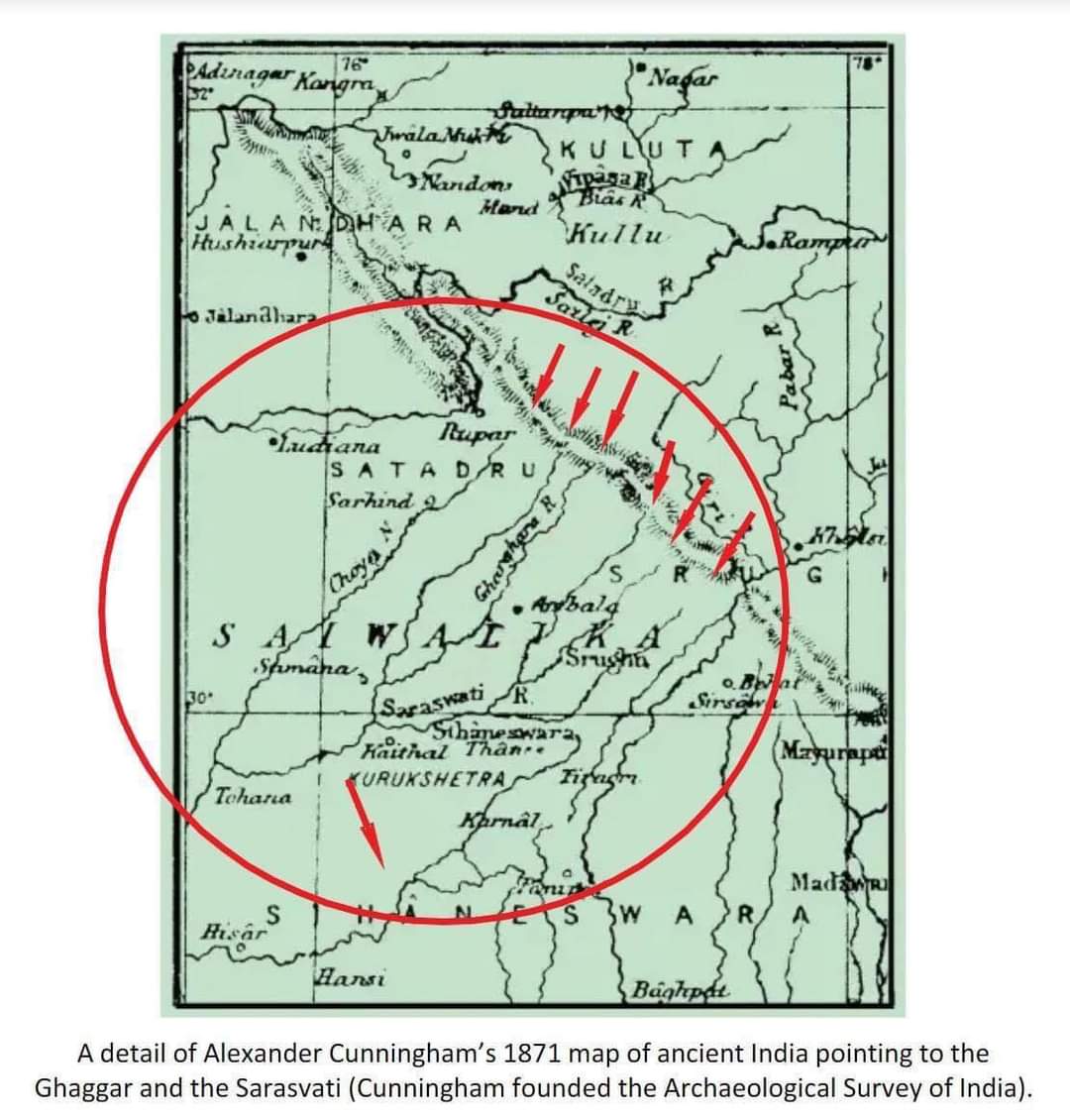
    River Sarasvati.image
    Sarasvati River,India,Satellite Image.

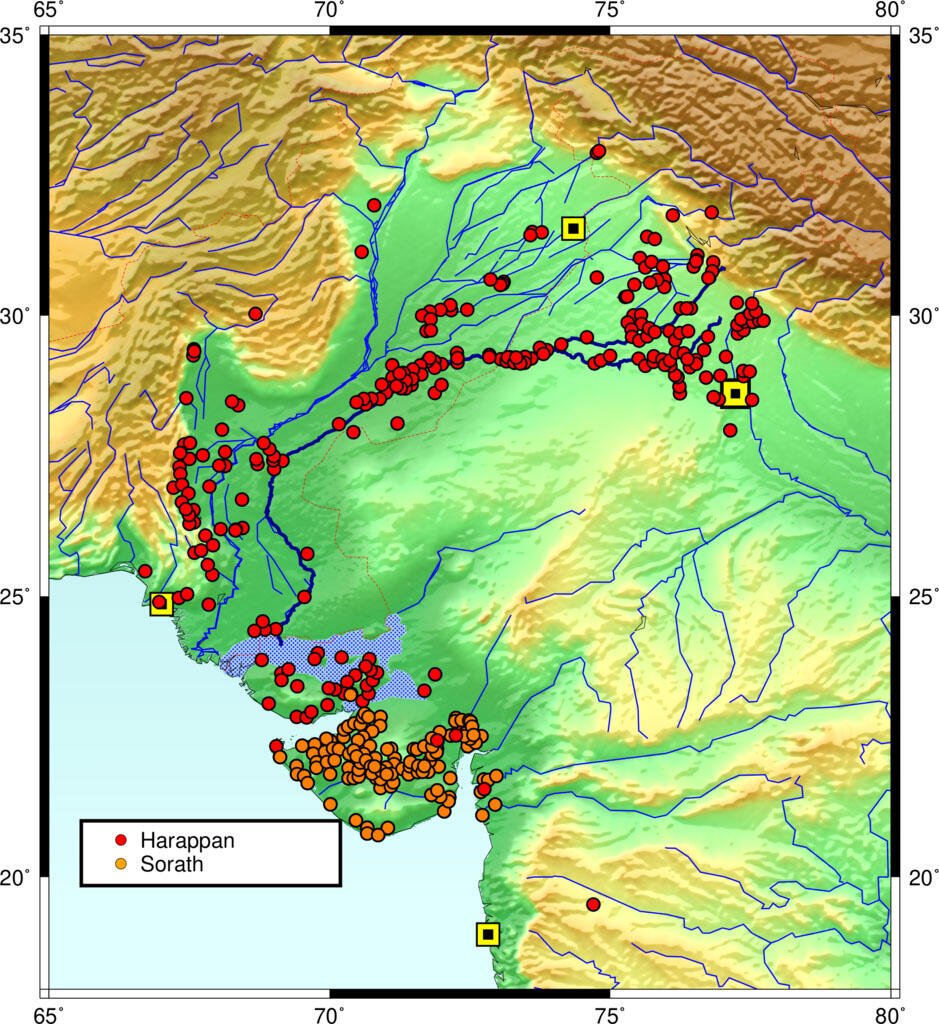
    According to Sri. Gupta, Remote Sensing Agency,Hyderabad,India,the Saraswathi River flowed from the Himalayan Galciers through Gujarat and joined the Arabian Sea in Gujarat.


    The river was 22 km wide!

    It flowed in Parallel to River Indus( Sindhu)

    This was found from the Satellite Images.

    And based on the melting of Himalayan Glaciers,Saraswathi River had flown between 10000 and 6000 years ago.

    Saraswati River Satellite images
    Saraswati River Satellite images

    Read this research paper in Nature.

    Punjab Rivers Satelite images
    Punjab Rivers Satelite images

    ‘The lost Saraswati River mentioned in the ancient Indian tradition is postulated to have flown independently of the Indus River into the Arabian Sea, perhaps along courses of now defunct rivers such as Ghaggar, Hakra and Nara. The persistence of such a river during the Harappan Bronze Age and the Iron Age Vedic period is strongly debated. We drilled in the Great Rann of Kachchh (Kutch), an infilled gulf of the Arabian Sea, which must have received input from the Saraswati, if active. Nd and Sr isotopic measurements suggest that a distinct source may have been present before 10 ka. Later in Holocene, under a drying climate, sediments from the Thar Desert probably choked the signature of an independent Saraswati-like river. Alternatively, without excluding a Saraswati-like secondary source, the Indus and the Thar were the dominant sources throughout the post-glacial history of the GRK. Indus-derived sediment accelerated the infilling of GRK after ~6 ka when the Indus delta started to grow. Until its complete infilling few centuries ago, freshwater input from the Indus, and perhaps from the Ghaggar-Hakra-Nara, probably sustained a productive marine environment as well as navigability toward old coastal Harappan and historic towns in the region.’

    * ka), a unit of time equal to one thousand (103) years.

    The above is an abstract of conclusions in a paper in Nature.

    Author information.

      • Nitesh Khonde

      Present address: Birbal Sahni Institute of Palaeosciences, Lucknow, 266007, India

    Affiliations

    1. Department of Geology, The M. S. University of Baroda, Vadodara, 390002, India

      • Nitesh Khonde
      • , D. M. Maurya
      • & L. S. Chamyal
    2. Physical Research Laboratory, Navrangpura, Ahmedabad, 380009, India

      • Sunil Kumar Singh
      • & Vinai K. Rai
    3. Geology and Geophysics, Woods Hole Oceanographic Institution, Woods Hole, USA

      • Liviu Giosan
      • Source of the article wanted above.

    https://www.nature.com/articles/s41598-017-05745-8

    ThecRig Veda,one of the earliest of the four Indian texts mentions Saraswathi repeatedly.

    • The Sarasvati is praised lavishly in the Rigveda as the best of all the rivers: e.g. in RV 2.41.16

    अम्बितमे नदीतमे देवितमे सरस्वती अपरास्तस्य इव स्मासि प्रशस्तिम् अम्ब नास्कृतिम्

    • Oh Mother Saraswati you are the greatest of mothers, greatest of rivers, greatest of goddesses. Even though we are not worthy, please grant us distinction

    Other verses of praise include RV 6.61.8-13, RV 7.96 and RV 10.17. In some hymns, the Indus river seems to be more important than the Sarasavati, especially in the Nadistuti sukta. In RV 8.26.18, the white flowing Sindhu ‘with golden wheels’ is the most conveying or attractive of the rivers.

    • RV 7.95.2. and other verses (e.g. RV 8.21.18) speak of the Sarasvati pouring “milk and ghee.” Rivers are often likened to cows in the Rigveda, for example in RV 3.33.1,
    Like two bright mother cows who lick their youngling,
    ( source of the Quote.

    https://en.m.wikipedia.org/wiki/Sarasvati_River

    So Rig Veda can be dated at 10,000 Years ago.

    Featured image of Dhola Vira Well. Wiki.

  • How Panchatantra Was Copied by World Literatures Harappan Horse Seal

    How Panchatantra Was Copied by World Literatures Harappan Horse Seal

    Yesterday night,I ,by chance,happened to read an article in a self styled popular magazine of India,which proclaims its Secular outlook,which attacked eminent historians like Romilla Thapar,P.N.Oak,Kalyanaraman for their efforts in trying to clear the misinformation and disinformation of Indian History.

    It took exception to Sri. N.S .Rajaram for his study on Harappan horse Seal.

    The scholar lampooned Sri. Rajaram for doctoring images.

    The article went on to ridicule Historians who are trying to unearth the real Indian history thus,

    The Indus Valley Decipherment Hoax

    MICHAEL WITZEL, a Harvard University Indologist, and STEVE FARMER, a comparative historian, report on media hype, faked data, and Hindutva propaganda in recent claims that the Indus Valley script has been decoded.

    LAST summer the Indian press carried sensational stories announcing the final decipherment of the Harappan or Indus Valley script. A United News of India dispatch on July 11, 1999, picked up throughout South Asia, reported on new research by “noted histo rian, N.S. Rajaram, who along with palaeographist Dr. Natwar Jha, has read and deciphered the messages on more than 2,000 Harappan seals.” Discussion of the messages was promised in Rajaram and Jha’s upcoming book, The Deciphered Indus Script. For nearly a year, the Internet was abuzz with reports that Rajaram and Jha had decoded the full corpus of Indus Valley texts.

    This was not the first claim that the writing of the Indus Valley Civilisation (fl. c. 2600-1900 BCE) had been cracked. In a 1996 book, American archaeologist Gregory Possehl reviewed thirty-five attempted decipherments, perhaps one-third the actual numb er. But the claims of Rajaram and Jha went far beyond those of any recent historians. Not only had the principles of decipherment been discovered, but the entire corpus of texts could now be read. Even more remarkable were the historical conclusions that Rajaram and his collaborator said were backed by the decoded messages.

    The UNI story was triggered by announcements that Rajaram and Jha had not only deciphered the Indus Valley seals but had read “pre-Harappan” texts dating to the mid-fourth millennium BCE. If confirmed, this meant that they had decoded mankind’s earliest literary message. The “texts” were a handful of symbols scratched on a pottery tablet recently discovered by Harvard University archaeologist Richard Meadow. The oldest of these, Rajaram told the UNI, was a text that could be translated “Ila surrounds th e blessed land” – an oblique but unmistakable reference to the Rigveda’s Saraswati river. The suggestion was that man’s earliest message was linked to India’s oldest religious text.1 The claim was hardly trivial, since this was over 2,000 year s before Indologists date the Rigveda – and more than 1,000 years before Harappan culture itself reached maturity.

    Rajaram’s World

    After months of media hype, Rajaram and Jha’s The Deciphered Indus Script2 made it to print in New Delhi early this year. By midsummer the book had reached the West and was being heatedly discussed via the Internet in Europe, India, and the United States. The book gave credit for the decipherment method to Jha, a provincial religious scholar, previously unknown, from Farakka, in West Bengal. The book’s publicity hails him as “one of the world’s foremost Vedic scholars and palaeographer s.” Jha had reportedly worked in isolation for twenty years, publishing a curious 60-page English pamphlet on his work in 1996. Jha’s study caught the eye of Rajaram, who was already notorious in Indological circles. Rajaram took credit for writing most of the book, which heavily politicised Jha’s largely apolitical message. Rajaram’s online biography claims that their joint effort is “the most important breakthrough of our time in the history of Indian history and culture.’

    MICHAEL WITZEL.

    Witzel was born at Schwiebus, then in Germany, now Poland.

    He studied Indology in Germany (from 1965 to 1971) under Paul Thieme, H.-P. Schmidt, K. Hoffmann and J. Narten as well as in Nepal (1972–1973) under the Mīmāmsaka Jununath Pandit. At Kathmandu (1972–1978), he led the Nepal-German Manuscript Preservation Project and the Nepal Research Centre. He has taught at Tübingen (1972), Leiden (1978–1986), and at Harvard (since 1986) and has held visiting appointments at Kyoto (twice), Paris (twice), and Tokyo (twice). He has been teaching Sanskrit since 1972.

    He is noted for his studies of the dialects of Vedic Sanskrit, old Indian history,the development of Vedic religion, and the linguistic prehistory of the Indian Subcontinent.He is editor-in-chief of the Electronic Journal of Vedic Studies (EJVS)and the Harvard Oriental Series. He has been president of the Association for the Study of Language in Prehistory (ASLIP) since 1999, as well as of the new International Association for Comparative Mythology (2006-).He was elected into the American Academy of Arts and Sciences in 2003, and was elected as an honorary member of the German Oriental Society (DMG in 2009. He became Cabot Fellow, Faculty of Arts and Sciences, Harvard U. (2013), recognizing his book on comparative mythology (OUP, 2012).’

    https://en.m.wikipedia.org/wiki/Michael_Witzel)

     I am not a scholar  of standing to comment on these comments.

    But I am born in great country,not ashamed of it,learnt and studied Sanskrit and Vedas for eight years.

    I am not a Phd nor do I make a living out of trying to interpret cultures of which my knowledge is only bookish and limited.

    Nor do I need to satisfy my sponsors.

    But I am presenting facts through this blog what I have unearthed,especially from foreign sources ,anything from Foreign is acceptable secularists,from Plato Strabo,Sumerian,Akkadian,Hittie,Arabic,Persian………

    And sources on Vedic life,Tamils from foreign sources as well.

    How Max Mueller,Robert Caldwell&Co misinformed and disinformed under the cloak of scholarship.

    Though I have published articles dispelling the myths of such ‘Indologists’, I shall present ,periodically,how Indian texts were copied and passed off as their own by the others.

    The first one is Panchatantra.

    Panchatantra,an early Indian Sanskri Nitisastra,moral story,was by Vishnu Sarma.

    The original Sanskrit work, which some scholars believe was composed around the 3rd century BCE ,s attributed to Vishnu Sharma. It is based on older oral traditions, including “animal fables that are as old as we are able to imagine”.

    Panchatantra is dated around 300 BC!

    Panchatantra Latin version.image.png.
    Panchatantra Latin.

    This has been copied by nearly all the cultures, changed and passed off as their own.

    ‘Scholars have noted the strong similarity between a few of the stories in The Panchatantra and Aesop’s Fables. Examples are ‘The Ass in the Panther’s Skin’ and ‘The Ass without Heart and Ears’.”The Broken Pot” is similar to Aesop’s “The Milkmaid and Her Pail”, “The Gold-Giving Snake” is similar to Aesop’s “The Man and the Serpent” and “Le Paysan et Dame serpent” by Marie de France (Fables)[24] Other well-known stories include “The Tortoise and The Geese” and “The Tiger, the Brahmin and the Jackal”. Similar animal fables are found in most cultures of the world, although some folklorists view India as the prime source.[25][26] India is described as the “chief source of the world’s fable literature” in Funk and Wagnalls Standard Dictionary of Folklore Mythology and Legend.

    …there are recorded over two hundred different versions known to exist in more than fifty languages, and three-quarters of these languages are extra-Indian. As early as the eleventh century this work reached Europe, and before 1600 it existed in Greek, Latin, Spanish, Italian, German, English, Old Slavonic, Czech, and perhaps other Slavonic languages. Its range has extended from Java to Iceland… [In India,] it has been worked over and over again, expanded, abstracted, turned into verse, retold in prose, translated into medieval and modern vernaculars, and retranslated into Sanskrit. And most of the stories contained in it have “gone down” into the folklore of the story-loving Hindus, whence they reappear in the collections of oral tales gathered by modern students of folk-stories.’

    Source.https://en.m.wikipedia.org/wiki/Panchatantra

    ‘Another Indian literary product popular in all the European literatures are the body of
    tales known as the Panchatantra. These tales were transmitted through Persian, Arab and
    Greek. The South Slavs have early adaptations from Greek of these tales known by the title
    “Stephanites and Ichnelates” in the literary Slavonic used by Serbs, Macedonians and
    Bulgarians. The originally Greek names are modeled on the Arab ones, which in their turn
    are modeled on the Persian Pahlavi Kalilah and Dinnah, “The Stolid and the Sly.”
    The Persian text was rewritten and expanded in the fifteenth century, connected with the
    name of Pilpay or Bidpai, the sage narrator, and was the basis for later Turkish and French
    versions. A Ragusan by the name of Vincent Bratuti, in the capacity of the official interpreter
    to the Spanish court, made the first Spanish version from the Turkish one in seventeenth
    century, while in the eighteenth the enlightened officer M. A. Relkovic made a Croat version
    from a French one. In the nineteenth century we have the first translations of some Indian
    tales from Sanskrit into Serbo-Croat (by Petar Budmani) and into Slovenian (by Karol
    Glaser); the complete Arab text of “The Stolid and the Sly” has been recently translated into
    Serbo-Croat by the Bosnian orient list Besim Kor- kut. In addition a number of adaptations
    of the Pancha- tantra from French and Russian have been published in the post-war
    Yugoslavia.
    (This Transaction is a resume of a lecture delivered at the Indian Institute of World Culture by Mr.
    Ivan Slamnig, of the Department of Comparative Literature at the Faculty of Arts of the Zagreb University.)

    I shall upload the research paper in the forthcoming article.


    Sri. Rajaram’s reply in Frontline.

    Interview with N.S. Rajaram.

    Following the publication of “Horseplay in Harappa,” N.S. Rajaram wrote a letter to the Editor of Frontline. In the covering note, he offered access to “the original photograph” of the ‘horse seal’ on which the image published in the Jha-Ra jaram book was based. Frontline accepted the offer and received from Rajaram a copy of the photograph, which was identical to the one Rajaram sent Iravatham Mahadevan in 1997. Frontline correspondent Anupama Katakam interviewed Rajar am in Bangalore on November 2 on the provenance of the image of the ‘horse seal,’ the ‘computer enhancement,’ the ‘decipherment,’ and other aspects of Rajaram’s work and views. Excerpts from the tape-recorded interview:

    Where did the image of the ‘horse seal’ come from?

    Jha had a photograph taken of the image from Mackay’s book – Mohenjodaro. This attribution is in the index of his book. Jha lives in a small town. He may not have had access to high-tech equipment, which explains the low quality of the image.

    Why does he believe it to be a horse?

    I looked at the original [photograph], which is very small. In Mackay’s book. Of course, Frontline gave a much better picture because they have better facilities. To me it looks more like a horse. I am convinced it is a horse.

    The shape of the under-belly. If you look at the unicorn bull’s genital area, it is very prominent [referring to Frontline‘s cover]. It is not so in the horse. The tail is also quite different. And another thing is – the tapering back is a feature of all fast-running animals.

    What is the significance of the ‘horse’?

    I feel the importance of the horse is blown out of proportion. We have a great deal of much more important evidence that we have to explain. They are making it the central issue… It was just a footnote in our book…

    As far as identification is concerned, we are sure it is a horse! And we can demonstrate that horses existed.

    I believe the debate should be on a whole range of issues.

    What is the old-style-telephone-like object in front of the animal?

    Do you find it in our book? You see what has happened is this writing [pointing to the annotation] has got scrambled in the scanning. This writing which has got scrambled resembles this telephone-like thing which they refer to as a [feeding] trough. Noth ing is behind that label. This is not in the original seal.

    Who annotated or labelled it?

    Jha must have. To keep the file number… This is the photo I received and I have checked it with the original… But I didn’t have such a good print. The original seal is in Mackay’s book. This [points to the image numbered M-772A, published on p. 9 of the Frontline issue of October 13] they say has been flipped horizontally. It is probably the same seal, but you see there is more damage here. But I am not going to look at this one. You see when Parpola took this photograph, it was about 30 year s later. This has been computer-manipulated. As far as I am concerned, I will go with the oldest.

    In any case, it is irrelevant as they may be the same image. See, the writing is the same… As far as the trough goes – it is a distortion of the letters.

    On the why and how of the ‘computer enhancement’

    I never said computer enhancement in my book. When they kept pressing me, I said it might have been computer-enhanced. That is what I mentioned in a particular note to these people. I had no idea. I think it was scanned by the publisher. The best way of finding out is if you look at what copy the publisher has and mine. Then you will know what went into the book. This has not been scanned by me. I xeroxed it and I either sent a smaller photograph to improve the resolution, or a contraction of it taken o n a xerox machine.

    If I had this quality [pointing to a clear image of the broken seal published in Frontline], there would be no problem. My point is if ‘computer enhancement’ was said, it may have been said under pressure. I have never done any computer enhancemen t.

    Clearly he [Jha] has, or somebody has, taken the photograph from a publication. And I either sent a photocopy of it… And I remember what I said to the publisher. I said, “see if something can be made out of this.”

    Sources to Harappan Horse Seal materia.

    http://www.frontline.in/static/html/fl1723/17231220.htm

    http://www.frontline.in/static/html/fl1720/17200040.htm

    Featured Image Credit.

    http://blogs.swarajyaonline.in/2013/12/24/indus-script-the-no-script-theory-is-a-non-starter/

  • 5000 Year Dholavira Planned City Water Harvesting Astronomically Aligned

    5000 Year Dholavira Planned City Water Harvesting Astronomically Aligned

    The Ancient History of India is amazing,not merely for the accuracy of facts ,including Geographical but for the skill of the people in building not only temples but well planned cities.

    The myth that early Indians built only temples and were called ‘Barbaric’ these  barbarians built massive temple structures,where the shadow of the building falls in its base,was built in an area where no granite was available,80 tons monolithic block was hoisted at a height of around 180 feet,when pulleys were not supposed to have been known (Thanjavur),

    Temple where the pillar does not rest on the ground,(Lepakshi’

    Where the rays of the Sun fall at a specific time at a specific period;falls at the feet of the Deity..

    There are many temples of this kind.

    There are astronomically aligned temples.

    I have written on most of them.

    Please check under Temples/ Hinduism Category.

    Not only this.

    The ancient Indians built cities in concentric circles with temple at the center,Water tanks,fortification,sewage system,centralised granary,Disaster shelters..

    These were specialized by the Dravida Kings.

    The Kings of North did not lag behind.

    They matched their counterparts in the south.

    Even during Vedic period well planned cities were built.

    Treatise on Town Planning of the Vedic period is found.

    Please read my article on this.

    Now the Harappan period of Dholavira had an advanced town planning system.

    Excavations at Dholavira,Gujarat,India confirm this.

    The city had,

    16 Gates,

    4 Stadia,

    Water harvesting,

    Drainage system,

    Brick Masonry and Ceramic used.

    The city was built with mathematical precision and

    It was astronomically aligned.


    For details,I am producing excerpts from Archeological Survey of India Report.

    Fourteen field seasons of excavation through an enormous deposit caused by the successive settlements at the site for over 1500 years during all through the 3rd millennium and unto the middle of the 2nd millennium BC have revealed seven significant cultural stages documenting the rise and fall of the Indus civilization in addition to bringing to light a major, a model city which is remarkable for its exquisite planning, monumental structures, aesthetic architecture, amazing water harvesting system and a variety in funerary architecture. It also enjoys the unique distinction of yielding an inscription made up of ten large-sized signs of the Indus script and, not less in importance, is the other find of a fragment of a large slab engraved with three large signs. This paper attempts to give an account of hydro-engineering that is manifest in the structures of the Harappans at Dholavira.

    The ancient site at Dholavira (230 53′ 10″ N; 700 13’E), taluka Bhachau, district Kachchh in state Gujarat, lies in the island of Khadir which, it turn, is surrounded by the salt waste of the Great Rann of Kachchh. The ancient settlement is embraced by two monsoon channels, namely, the Manhar and Mansar. The ruins, including the cemetery covers an area of about 100 hectares half of which is appropriated by the articulately fortified settlement of the Harappans alone.

    Lying between the monsoon channels and being undulating sloping towards the south, the site was ideally suited for a settlement having artificial dams and reservoirs.

    Thee city of Dholavira in its fullest form was a precisely proportionate whole and proportionality resolved configuration following a resolute set of principles of planning and architecture with mathematical precision and, perhaps, with astronomically established orientation. Of the city, at present, three corners with partially eroded towers but fully intact inner corners have been confirmed by excavation. When measured between the inner corners, the E- W length of the city area along the northern defensive wall and N-S one along the western one worked out to 771.10 m and 616.87 m, respectively – thus giving the precise ratio of 5 : 4. Similarly, the other divisions of the city also revealed amazing ratios and proportions. The following table provides revealing information:

     Sl. No.   Division  Width  Length  Ratio
    1 City, internal 616.87 711.10 4 : 5
    2 Castle, internal at available top 92 114 4 : 5
    3 Castle, external (as per present exposure) 118 151 4 : 5
    4 Citadel (castle + bailey), external approximately (including bastions) 140 280 1 : 2
    5 Bailey, internal 120 120 1 : 1
    6 Middle Town + Stadium, internal 290.45 340.5 6 : 7
    7 Middle Town, excluding Stadium, internal 242 340.5 5 : 7
    8 Stadium, internal 47.5 283 1 : 6
    9 Lower Town, built-up area 300 300 1 : 1

    The above table inter alia reveals the proportional relationship between the castle and the city so it does in respect of intra-divisional and inter-divisional measurements. It is interesting to give another illustration: the diagonal drawn between the two opposite angles made by the north-eastern and the south-western corners of the city touched the north-western corner of the castle. While of the remaining two, the south-eastern corner is still missing, or not found out, a line, therefore bisecting the north-western angle also bisected the north-western corner of the middle town and further on cut across a crossing of four streets and finally the north-eastern corner of the castle. This could have been achieved by precise mathematical calculations and drawings which were then translated on the ground that was undulating by 13 m in gradient. It was indeed a great engineering achievement. In the whole scheme, the enwalled area of the castle became 49th (7 X 7) part of the city while its total built-up area was 25th (5 X 5) part.

    Furthermore, it is very significant that the two-thirds of the middle town and the whole of lower town were planned with bold projections and recesses just like those one finds in the layout of an Indian temple of the later ages. As a result, the city divisions were provided with a number of housing sectors and spaces. Some of latter were found to have been used for dumping domestic refuse. Another significant feature is the arterial street that ran across axially from west to east dividing all the above-mentioned units and sub-units into two equal halves, and a north-south street, perhaps somewhat staggered, further subdivided each unit….

    Seventeen gates, all built in the fortification walls with equally interesting add-on components, have been exposed so far. Their number-wise break up is: cattle 5, bailey 2, stadiums 4, middle town 1, annexe 2 and the remaining 3 belonging to the late Harappans of Stage VI. ..

    The other area in which the Harappans of Dholavira excelled spectacularly pertained to water harvesting with the aid of dams, drain, reservoirs and storm water management which eloquently speak of tremendous engineering skill of the builders. Equally important is the fact that all those features were integrated part of city planning and were surely the beauty aids, too, The Harappans created about sixteen or more reservoir of varying sizes and designs and arranged them in a series practically on all four sides. A cursory estimate indicates that the water structures and relevant and related activities accounts for 10 hectares of area, in other words 10% of the total area that the city appropriated within its outer fortification. The 13 m of gradient between high and low areas from east to west within the walls was ideally suited for creating cascading reservoirs which were separated from each other by enormous and broad bunds and yet connected through feeding drains.

    Six of the water tanks, one to east of castle and five of the series to south of it, have been fully or considerably exposed while a few others or other related features are testified in check digs. It was found to be the largest, grandest and best-furnished reservoir of rectangular shape measuring 73.40 m N-S and 29.30 m E-W (ratio 5:2) at the top while above that there should have been a 1 to 1.20 m high embankment as evidenced at four corners.

  • Dental Surgery Ancient India Indus Valley 9000 Years

    I have written quite a few articles on the Advanced Scientific Concepts in ancient India.

    On,

    Mathematics, Physics,Chemistry,Botany,Zoology,Biology,Molecular Biology,Molecular Physics,Astronomy,Quantum Theory,Cloning,Aeroplane construction,Space travel,Surgery..

    Dental drilling Vedic India.image.
    Dentistry Ancient India,Indus valley.

    Now evidence of Dentistry being practiced in Vedic India has come to light in the form of finds in Meghrab,Pakistan.

    The period assigned to this is around 9000 years ago.

    I date the Vedic period much,much earlier.

    Please read my articles on this.

    Dentistry in Indus Valley Report.

    Man’s first known trip to the dentist occurred as early as 9,000 years ago, when at least 9 people living in a Neolithic village in Pakistan had holes drilled into their molars and survived the procedure.

    The findings, to be reported Thursday in the scientific review Nature, push back the dawn of dentistry by 4,000 years to around 7000 B.C. The drilled molars come from a sample of 300 individuals buried in graves at the Mehrgarh site in western Pakistan, believed to be the oldest Stone Age complex in the Indus River valley.

    “This is certainly the first case of drilling a person’s teeth,” said David Frayer, professor of anthropology at the University of Kansas and the lead author of the report. “But even more significant, this practice lasted some 1,500 years and was a tradition at this site. It wasn’t just a sporadic event.”

    The earliest previously known evidence of dental work done in vivo was a drilled molar found in a Neolithic graveyard in Denmark dating from about 3000 B.C.

    All 9 of the Mehrgarh dental patients were adults — 4 females, 2 males, and 3 individuals of unknown gender — and ranged in age from about 20 to over 40. Most of the drilling was done on the chewing surfaces of their molars, in both the upper and lower jaws, probably using a flint point attached to a bow that made a high-speed drill, the researchers say. Concentric ridges carved by the drilling device were found inside the holes.

    The drilling may have been done to relieve the pain and damage of tooth rot, but only 4 of the total of 11 teeth showed signs of decay associated with the holes. The scientists say it is clear that the holes were not made for aesthetic reasons, given their position deep in the mouth and on the erosion-prone surface of the teeth.

    While there is no evidence of fillings, the researchers believe something was used to plug the holes because some of them were bored deep into the teeth. What that filler substance was is unknown. The holes ranged in depth from a shallow half-a-millimeter to 3.5 millimeters, deep enough to pierce the enamel and enter the sensitive dentin.

    Dental health was poor at Mehrgarh, though the problems were less often tooth decay than brutal wear and tear. Roberto Macchiarelli, professor of paleoanthropology at the University of Poitiers, France, and the report’s lead anthropological researcher, attributed the bad teeth to the Neolithic diet, which included newly domesticated wheat and barley.

    “A lot of abrasive mineral material was introduced when grains were ground on a stone,” Professor Macchiarelli said, “and as these people moved to a grain diet, their teeth wore down, dentin was exposed, and the risk of infection rose.”

    The Mehrgarh complex, occupied for 4,000 years, sits beside the Bolan River in Baluchistan, on a plain that was repeatedly buried in alluvial deposits that not only destroyed mud-brick buildings but crushed many skeletons in the graveyard. The excavation of 300 individuals was begun by a French team in the 1980’s; international groups followed until 2001, when it became too dangerous to work in Baluchistan.

    None of the individuals with drilled teeth appears to have come from a special tomb or sanctuary, indicating that the oral health care they received was available to anyone in the society.

    Professor Frayer said that, given the position of the holes and the angles of the drilling, “we’re pretty sure these were not self-induced.” That the patients lived to tell the tale of their dental visit is proved, he says, by subsequent wearing down of their teeth and by deliberate smoothing and widening of the holes later on.

    The dentists may have been highly skilled artisans at Mehrgarh, where beads of imported lapis lazuli, turquoise, and carnelian were found drilled with holes even smaller than the ones in the nine individuals. Discovered among the beads were finely tipped drill heads.

    “The drilling of teeth is very rare in the anthropological record,” said Professor Macchiarelli, noting that work similar to that done at Mehrgarh does not recur until much later, among the Anasazi Indians of the southwest United States around 1100 A.D., and in Europe around 1500 A.D.

    [The 1,500-year-long tradition of drill work at Mehrgarh appears not to have been passed down to later cultures. There is no evidence that the Chalcolithic, or Copper Age, people who next lived there ever visited the dentist. Why the practice came to a halt is not known.