Tag: Harappa

  • Sanatana Dharma Tamil Coexisted in Indus Valley Tamil Towns

    The relationship between Tamil and Sanatana Dharma is intriguing.

    Their relationship is one of cordiality , mutual respect and admiration for each other.

    The Tamil Kings are spoken of highly in the Vedas and Puranas.

    They were invited to the Swayamvara of. Damayanthi, who predates Lord Rama, Rama Sita marriage, Draupadi Swayamvara and Yudhistra’s Rajasuya Yaga.

    Tamil King Udiyan Cherallathan provided food for both the Pandava and Kaurava armies during the Mahabharata War.

    Sananat Dharma spread around he world
    Vedic India

    Madurai Meenakshi’s father Malayathdwaja participated in the Mahabharata war fighting along side the Pandavas.

    Lord Krishna was invited to Tamil Poets ‘Conclave at Madurai(probably the Thenmadurai, now sunk) and he participated in it.

    Krishna and Arjuna married Pandyan Princesses;Krishna had a daughter and had her married to a Pandyan Prince, while Arjuna had a son.

    Krishna’s elder brother Balarama visited south and worshiped Lord Subrahmanya.

    And of course Parashurama, who established the present Kerala.

    Sage Viswamitra’s descendant  Apasthamba wrote the Veda Sutra called Apasthama Sutra by integrating Tamil practices like Thaali, Mangalya, which is not found in the Vedas.

    Brahmins in the south of India follow Apasthamba sutra even today.

    Rama’ ancestor Vaivaswatha Manu migrated from the south to Ayodhya to found Ikshvaku Dynasty.

    Manu migrated to Ayodhya because of a Tsunami recorded in Tamil Classic, Sangam Literature.

    So there should have been no presence of any dynasty in the north if we go by this hypothesis .

    However there was a Chola king, who ruled from North, much before the great Flood.

    He was King Sibi and Cholas call themselves the descendants of Kashyapa.

    This Sibi is mentioned in Tamil Literature  and in Puranas a belonging to Suryavansh.

    He built a temple near Srirangam in Tamil Nadu for Lord Vishnu.

    It is the Thiruvellarai Pundareekakshar temple, about 20km from Srirangam

    Sibi is reported to have fought an army of Asuras here.

    Asuras mean powerful, yet evil intentioned.

    King Sibi ruled from Pakistan?

    And we have a a site of about a Million years in Chennai which belongs to advanced Tamil civilization.

    Another one is at Adhichanallur which dates back to 11000 years.

    Thee site  refer to Sanatana Dharma.

    And Sanatana Dharma refer Tamils!

    Tamil Brahmi is found in Harappa.

    Tamil Sangam period Towns,harbor names are found in Indus Valley Civilization.

    Thee names are.

    Vanji, capital of Chera Kingdom,

    Gorkai, in Afghanistan

    a Pandya harbor, Matrai(Madurai), Urai(Uraiyur capital of Cholas), Koodal kat(kodal, name for Madurai),in Pakistan,

    ‘சிந்துவெளி மற்றும் அரப்பாவில் ”கொற்கை, வஞ்சி, தொண்டி வளாகம்”
    சிந்துவெளியில் சங்கத் தமிழரின் துறைமுகங்கள், தலைநகரங்கள் மற்றும் ஊர்களின் பெயர்கள்
    பாகிஸ்தானிலுள்ள கொற்கை (Gorkai. Gorkhai), வஞ்சி (Vanji), தொண்டி(Tondi), மத்ரை (Matrai), உறை (Urai), கூடல் கட் (Kudal Garh) மற்றும் கோளி (Koli); ஆப்கானிஸ்தானிலுள்ள கொற்கை (Korkay. Gorkay). பூம்பகார் (Pumbakar) ஆகிய ஊர்ப் பெயர்கள் சங்க இலக்கியங்களில் குறிப்பிடப்பட்டுள்ள தலைநகரங்கள் மற்றும் துறைமுக நகரங்களின் பெயர்களான கொற்கை. வஞ்சி. தொண்டி. மதுரை. உறையூர். கூடல். கோழி. பூம்புகார் ஆகியவற்றை நினைவுபடுத்துகின்றன.

    Lord Rama, whose name is found in the  Sumerian King List as a King of Sumer,along with Dasaratha and Bharata, fought a war against Atlantis people to help Horus , on of Osiris,.

    Leading Osiris’s Egyptian armies was Osiris’ eldest son Horus. After Osiris’ unfortunate ‘death’, Horus succeeded his father as king of the Libyan/Egyptian Empire. Intuitively, Horus knew what would happen when they landed in Libya. He completely distrusted his uncle. Horus persistently warned his father about Seth’s stubbornness and treachery. Osiris, believing in the goodness of the human heart, initially ignored his son’s advice. Subsequently, Osiris landed in Libya and after Seth’s abdication became Emperor’

    After the demise of Osiris, his son Horus entered into a pact with Rama Empire(Emperor Zata’ar’s eldest son, Prince Rama.) to defeat Seth, the usurper.’

    The Atlantis army met with Rama’s Army in Rishi City, now in Pakistan…..

    There were four ancient empires.

    Rama’s Empire,

    Atlantis Empire,

    Uighur Empire and

    Lemurian Empire.

    Of these Uighur was not very advanced and Lemuria which had been on the wane was trying to recoup.

    They were suppressed by the Atlantis people.

    In the Atlantis, Osiris’ son Horus entered into an alliance with Rama to defeat Seth who was trying to become independent in the Sumerian valley.

    Rama Dropped Atom Bomb Mohenjo daro

    This means that Mohenjo Daro was a flourishing civilization before the Rama War with Atlantis people.

    Yet there was a  Chola King much before the advent of Rama.

    The contention of Dr Parpola and the Dravidian politicians of Tamilnadu is that Tamils have descended form the IVC locations of North India. The verse by poet Kapilar in fact traces the origins of the King IrungoveL to Dwaraka. He says that he belonged to the 49th generation of the king who was born of the Sacrificial Fire conducted by the sage of the North. This king ruled Dwaraka, so says the poet. Reserving the other details of this verse for a future post, I am now concentrating on another description in that song.

    ( There is another interpretation on the interpretatiion of  the term Sacrificial fire

    Kapilar describes Dwaraka as being surrounded by walls made of copper.

    நீயே, வடபால் முனிவன் தடவினுள் தோன்றிச்,
    செம்பு புனைந்து இயற்றிய சேண்நெடும் புரிசை,
    உவரா ஈகைத், துவரை ஆண்டு,
    நாற்பத்து ஒன்பது வழிமுறை வந்த
    வேளிருள் வேளே!
    This means “O king IrungoveL! you were the 49th king in the lineage of the king, who was born of the sacrificial fire conducted by the sage and ruled Dwarka which was surrounded by long / tall walls of copper.”

    From the commentary that Dr U.Ve.Sa found out form the palm leaf manuscripts :-
    “நீ தான் வட பக்கத்து முனிவனுடைய ஓம குண்டத்தின் கண் தோன்றிச் செம்பால் புனைத்து செய்தாலொத்த சேய்மையை உடைத்தாகிய நெடிய மதிலை உடைய துவராவதி என்னும் படை வீட்டை ஆண்டு, வெறுப்பில்லாத கொடையினை உடையராய் நாற்பத்தொன்பது தலைமுறை தொன்றுபட்டு வந்த வேள்களுள் வைத்து வேளாய்உள்ளாய்!”..

     ‘This king was not in Dwaraka when Kapilar met him and sang this verse. He was ruling some part of the western ghats in present day’s Karnataka. This Vel’s kingdom was different from the Tamil lands of the 3 kings (Chera, Chola and Pandya). The next verse was on the same king sung by Kapilar in which he describes his land in the hills.
    This king’s palace was not surrounded by walls of copper. Copper walls were there in the kingdom of his ancestors in Dwaraka.Assuming that 3 kings lived per century, we can say that 1600 years have passed by the time this 49th king had come into being. The period of this king is not exactly known, but can be deciphered from Kapilar’s other connections. Kapilar was a close friend of another VeL king, Paari who was killed by the 3 Tamil kings. Kapilar took care of Parri’s orphaned daughters and approached another Vel king, IrungoveL to request him to marry the two daughters of Paari. This verse contains that request.

    https://ramanisblog.in/2016/01/28/irungovel-tamil-king-and-hoysalas-founder-the-same/

     So there seems to be a Dynasty belonging to Suryavansh in the North and it declined or swallowed by Tsunami from the Arabian Sea, this could have  either the second or the  first Great flood mentioned in the Tamil Classics.

    And we have references to Sage Agastya, settling the people from the sinking Dwaraka  in Tamil Nadu and the present Karnataka.

    Considering all this I proposed that there could have been two Tamil Empires.

    As t whether Tamils came from the Sanatana Dharma people or vice versa, it is difficult t postulate.

    I am providing an abstract from one theory on this.

    Abstract

    Can Sankam corpus, the ancient extant Dravidian literature, be a source to identify the language of the Indus script; a collateral evidence to estimate the ethno-linguistic composition of Indus Civilization? I seek to answer this question in affirmative.

    I have located a group of place names in the Indus –Harappan geographies (modern Pakistan and adjoining regions), which I choose to call as “Korkay, Vanji, Tondi Complex.” This ‘complex’ contains perfect parallels to “Korkai-Vanji-Tondi” and many other geographical names and anthroponyms attested in Sankam Tamil texts.

    I propose that these identical name-heritage complexes of the north-western geographies and the extreme south provide reliable markers for the probable migration of Dravidians following the collapse of Indus Valley Civilization. I call in the evidence of “bone-eating camel” described in Akananooru as a testimony for the earlier presence of Dravidians in the north-western geographies (particularly Gujarat).

    And, I conclude that the Sankam corpus in part represents the ‘carried forward memories’ of a remote past, the coordinates of which can be traced back to the Indus Valley Civilization and late Harappan cultures and relevant geographies.’

    http://new.modernrationalist.com/2013/07/tamil-indus-korkayvanjitondiin-the-north-west-and-a-bone-eating-camel-in-the-cankam-text/

    My view is that there were two cultures, Tamil and Sanatana Dharma coexisting , thugh slightly different in their approach to Life.

    That these two acknowledge their differences yet respected each other i a great lesson for us.

    References and citations.

    https://tamilvaralaru.wordpress.com/2014/12/03/%E0%AE%9A%E0%AE%BF%E0%AE%A8%E0%AF%8D%E0%AE%A4%E0%AF%81%E0%AE%B5%E0%AF%86%E0%AE%B3%E0%AE%BF%E0%AE%AF%E0%AE%BF%E0%AE%B2%E0%AF%8D-%E0%AE%8A%E0%AE%B0%E0%AF%8D%E0%AE%95%E0%AE%B3%E0%AF%8D-%E0%AE%A4/

    http://new.modernrationalist.com/2013/07/tamil-indus-korkayvanjitondiin-the-north-west-and-a-bone-eating-camel-in-the-cankam-text/

    https://ramanisblog.in/2016/10/27/two-tamil-empires-in-india-northwest-south-india-missing-history/


  • Vedic Civilization Two Million Sq.KM 2000 Sites

    Most of the discoveries relating to ancient India made  remain unknown.

    It is an accepted fact that civilizations flourished on the banks of Rivers, be it in India, or Sumeria, Minoa or Africa.

    In India wee seem to be hearing only bout the civilizations that flourished long the banks of Ganges, Sind and Saraswathy.

    Not much is known or even attempted about the other four River basins of India.

    Seven Rivers are mentioned in Hindu Texts.

    Ganges,

    Yamuna,

    Godavari,

    Sarasvathi,

    Narmada,

    Sindu, and

    Cauvery.

    Of these seven, exhaustive research is being done around Ganges,Sarasvathi and Sind.

    On Yamuna the research seems to have been restricted to sites relation to Mahabharata and Krishna.

    On the Narmada area only Dwaraka seems to have been concentrated upon.

    My research shows we have equally ancient finds around the other river basins..

    Time that we concentrate on these area as well.

    In addition to this, we have references to other ancient rivers like Vigai, near Madurai, Tamil Nadu,Tamraparani, near deep down south Tirunelveli nd there are are references to to other rivers like Pahruli.

    The last one belonged to Tamil Sangam Age which flowed and joined the sea near Madagascar.

    I had written on the fact that Vaiwaswatha Manu, ancestor of Lord Rama meditated  near Madagascar!

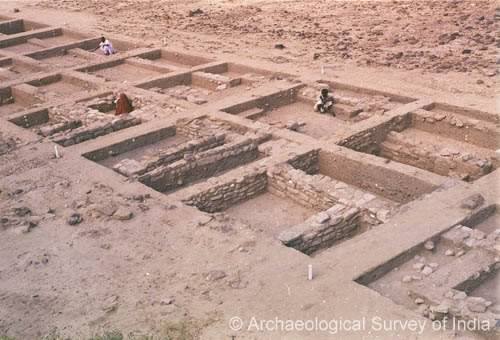
    No to the site of Harappa named 4 MSR.

    Two thousand sites unearthed relating to Harappa reveal that the Hindu culture extended for Two Million Square Millions, which included the present Pakistan and Iran.

    Archaeological  Report.

    Sites of ancient India around Harappa.
    Ancient sites of Indian Civilization, Harappa.

    “The purpose of the present excavation at 4MSR is to learn about the Early Harappan deposits, 4MSR’s relationship with other contemporary sites and to fill the gap between the Late Harappan phase and the painted grey ware [PGW] culture. We should know about the early farming phase [that existed in the pre-Harappan period]. It is also important to know the continuity of the sequence from the Late Harappan phase to the PGW culture. That is why we have taken up explorations and excavations in this entire area.”

    At its height, the Harappan civilisation flourished over 2.5 million sq. km in India, Pakistan and Afghanistan. About 2,000 sites have been found, from Sutkagendor in the Makran coast of Balochistan to Alamgirhpur in the east in Uttar Pradesh and from Manda in Jammu to Daimabad in Maharashtra.

    The Harappan civilisation is divided into three phases: Early (3000 BCE-2600 BCE), Mature (2600 BCE -1900 BCE) and Late (1900 BCE-1500 BCE). The PGW culture came later and is datable to circa 1200 BCE and belongs to the early historical period.

    After Partition, big Harappan sites such as Mohenjo-daro, Harappa and Ganweriwala fell on the Pakistani side. Between 1972 and 1974, M.R. Mughal, former Director General of Archaeology and Museums, Pakistan, explored Bahawalpur in the Cholistan region of Punjab, situated on the border with Rajasthan. Mughal found a lot of pottery on the surface there and named it Hakra ware after the Hakra river which flows there and which is called Ghaggar in India. Originating in the Himalayas, the Ghaggar flows through Punjab, Haryana, Rajasthan and Gujarat before joining the Arabian Sea near the Rann of Kutch.

    If the cornucopia of artefacts thrown up from the current excavation is any indication, 4MSR has all the characteristics of having been an Early Harappan and Mature Harappan site like Kalibangan situated 120 km away. There are no indications that a Late Harappan phase existed. “A special feature of 4MSR is the discovery of a perforated jar, a perforated bowl with a hole at the bottom and a perforated pot, confirming its status as a Mature Harappan site,” asserted Pandey. What fascinated him was the discovery of pots with handles. “In a nutshell, our excavations have yielded pre-Harappan Hakra ware, Early Harappan pottery and Mature Harappan ceramics,” he said.

    What stands out in the excavation is the bonanza of Early Harappan pottery with beautifully painted figures of peacocks, a lion, birds, pipal leaves and fish-net designs. Another discovery, a beautiful pot with a pencil mouth, could have been used to keep precious liquids or perfume.

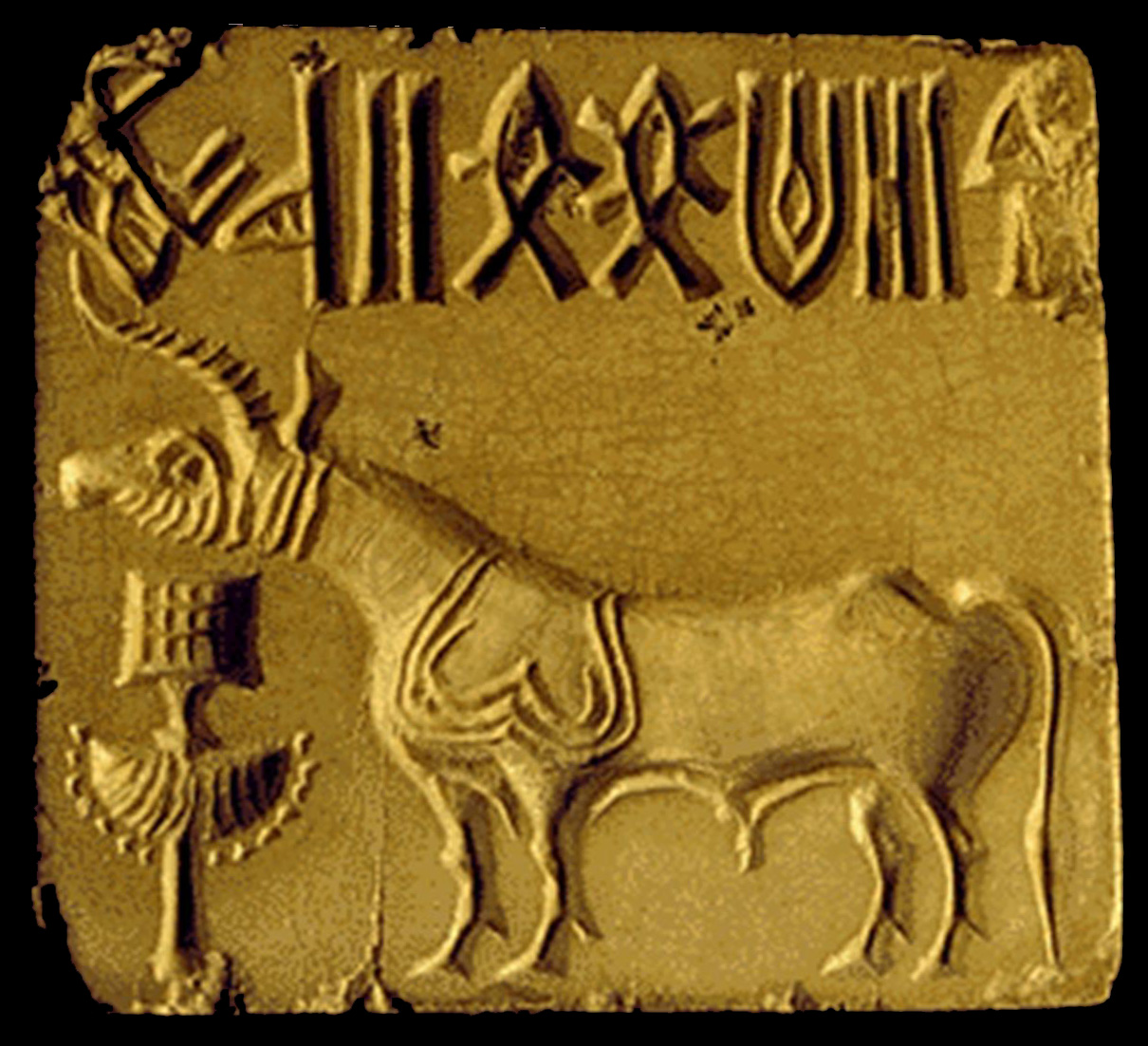
    Other important artefacts obtained from the site are beads made of carnelian, lapis lazuli, steatite, agate and terracotta; copper, shell and terracotta bangles; copper rings and fish hooks; terracotta spindles and whorls; weights made out chert stone; terracotta sling balls, toy-cart frames, figurines of humped bulls, and arrowheads. Two horns of nilgai were found in a trench. Of particular interest is a potsherd with the impression of a fabric. Besides the seal, a sealing (impression of a seal) was found. The centrepiece of the discoveries is a fragment of a gold ornament for the ear. It is rare to find gold ornaments in Harappan sites although tubular gold beads have been found in Khirsara and Lothal, both Harappan sites in Gujarat.

    One trench yielded a skeleton, perhaps that of a female, about 40 years old. The ASI team is in the process of identifying the presence of grave goods in the trench to determine the period to which it belongs.

    What has come as a bonus is the discovery of a fire altar, with a yasti (a shaft) in the middle. “The yasti is an indication that rituals were performed at the altar,” said Manjul. The yasti here is an octagonal, burnt brick. Although bones were found in the upper level of the deposits in this trench, it could not be ascertained whether they were sacrificial bones. The ASI team traced mud and ash layers at the lower level in the trench and also found a bead inside the fire altar. Pandey said fire altars had been found in Kalibangan and Rakhigarhi, and the yastis were octagonal or cylindrical bricks. There were “signatures” indicating that worship of some kind had taken place at the fire altar here.

    Rakhigarhi Rediscovered.

    According to Manjul, an important reason why so many Harappan settlements came up in the then Saraswati valley was its fertile alluvial plains. Besides, raw materials such as chert, clay and copper were available in the nearby areas.

    It was puzzling, Manjul said, that while a lot of pottery belonging to the Mature Harappan period was found at Kalibangan, Baror, Binjor and 4MSR, no pottery belonging to the Late Harappan phase had been found in these and other nearby sites. “The Harappans deserted 4MSR, Binjor and Baror after the Mature Harappan phase. Why?” he asked. Another puzzle was that only the Late Harappan culture existed in the Suratgarh region in Rajasthan. “There is no continuity of the Harappan phases in the Ghaggar river valley. Did a migration take place towards Suratgarh after the Mature Harappan period? We have to find out the reasons why it happened,” Manjul said. (Baror, Binjor and 4MSR are contiguous sites. While Baror is about 20 km from Binjor and 4MSR, Kalibangan is 120 km from 4MSR. Kalibangan is 25 km from Suratgarh).,

    Reference and citation.

    http://www.frontline.in/arts-and-culture/heritage/harappan-surprise/article7053030.ece

    Image credit.

    http://bharatkalyan97.blogspot.in/2013/07/bhirrana-8th-millennium-bce-on-river.html


  • Harappa Rakhigarhi Older By 3000 Years Pre Egypt Babylon.

    Thiruvannamalai is about a Billion years old,Tirupati 2100 Million Years, An archeological site near Chennai containing Advanced Tamil Civilization, Agastya crossed Vindhyas around 5000 BC,

    Tamil language is estimated to be 74, 0000 years old(It should be dated earlier on the available evidence) and they quote the Vedas, they in turn Tamil!

    Yet we would date  the  Rig Veda around 5000 BC!

    Now there is a find in Rakhigarhi, Haryana which is dated around 6000 BC.

    Well, some people might be happy to date Indian History by 1600 AD when the British came to India!

    Rakhigarhi, Haryana, Harappan site,India.jpg Rakhigarhi, Haryana, Harappan site,India.

    Latest research has put the date of the origin of the Indus Valley Civilisation at 6,000 years before Christ, which contests the current theory that the settlements around the Indus began around 3750 BC.

    Ever since the excavations at Harappa and Mohenjo-daro in the early 1920s, the civilisation was considered almost as old as those of Egypt and Mesopotamia.

    The finding was announced at the “International Conference on Harappan Archaeology”, recently organised by the Archaeological Survey of India (ASI) in Chandigarh.

    Based on their research, BR Mani, ASI joint director general, and KN Dikshit, former ASI joint director general, said in a presentation: “The preliminary results of the data from early sites of the Indo-Pak subcontinent suggest that the Indian civilisation emerged in the 8th millennium BC in the Ghaggar-Hakra and Baluchistan area.”

    “On the basis of radio-metric dates from Bhirrana (Haryana), the cultural remains of the pre-early Harappan horizon go back to 7380 BC to 6201 BC.”
    Excavations had been carried out at two sites in Pakistan and Bhirrana, Kunal, Rakhigarhi and Baror in India.

    ..

    The Harappan or Indus Valley Civilisation is one of the three oldest urban civilisations, along with Egypt and Mesopotamia, but it is the least understood. Its script is yet to be deciphered, and the knowledge of social structures and life during that period is scant. Rakhigarhi promises to change this as new discoveries continue to be made. It is one of the few Harappan sites which has an unbroken history of settlement—Early Harappan farming communities from 6000 to 4500 BC, followed by the Early Mature Harappan urbanisation phase from 4500 to 3000 BC, and then the highly urbanised Mature Harappan era from 3000 BC to the mysterious collapse of the civilisation around 1800 BC. That’s more than 4,000 years of ancient human history packed into its rich soil.

    Until now, experts believed that Mohenjo-daro in Pakistan was the largest among the 2,000 Harappan sites known to exist in India, Pakistan and Afghanistan. The archaeological remains at Mohenjo-daro extend around 300 hectares. However, with the discovery of two more mounds, adding to the seven mounds already discovered, the total area of the archaeological site of Rakhigarhi now measures 350 hectares. The two newly-discovered mounds spread over 25 hectares each and are situated to the east and west of the main site. Unfortunately, much of the mounds have been destroyed for cultivation.

    ..

    The Indus Valley Tradition is divided into four eras, and each era can be divided into various phases. A phase is an archaeological unit possessing traits sufficiently characteristic to distinguish it from all other units similarly conceived Each phase can be subdivided into interaction systems.

    Date range (BCE) Phase Era
    7570-6200 Bhirrana (aceramic Neolithic) Early Food Producing Era
    7000-5500 Mehrgarh I (aceramic Neolithic)
    5500-3300 Mehrgarh II-VI (ceramic Neolithic) Regionalisation Era
    5500-2600
    3300-2600 Early Harappan
    3300-2800 Harappan 1 (Ravi Phase)
    2800-2600 Harappan 2 (Kot Diji Phase, Nausharo I, Mehrgarh VII, Rakhigarhi)
    2600-1900 Mature Harappan (Indus Valley Civilization) Integration Era
    2600-2450 Harappan 3A (Nausharo II)
    2450-2200 Harappan 3B
    2200-1900 Harappan 3C
    1900-1300 Late Harappan (Cemetery H); Ochre Coloured Pottery Localisation Era
    1900-1700 Harappan 4
    1700-1300 Harappan 5
    1300-300 Painted Gray Ware, Northern Black Polished Ware (Iron Age) Indo-Gangetic Tradition

    Citations.

    http://www.ancient-origins.net/news-history-archaeology/rakhigarhi-now-biggest-harappan-site-after-two-new-mounds-discovered-001500#ixzz3i1AzFYnE

    https://en.wikipedia.org/wiki/Periodization_of_the_Indus_Valley_Civilization

    http://www.hindustantimes.com/newdelhi/indus-valley-2-000-years-older-than-thought/article1-954601.aspx

    /

  • Mohenjo-Daro Destroyed by Indra Archaeology Hinduism

    Hinduism speaks of  Four types of Pralaya or Dissolution of the Universe.


    They are.


    FromVishnu Purana and Agni Purana,.

    Praakritik Pralaya, which is of 311,040,000,000,000 solar years duration, occurs after the completion of life of Brahma (i.e. 100 Brahma years = 311 trillion and 40 billion earth years = one day of Vishnu = 1 Parama). After the completion of one Brahma life cycle, the complete dissolution of all the entities (i.e. the Pancha Mahabhutha or Universe) takes place in the eternity (God). Praakritik Pralaya is the time for which Vishnu sleeps. The next morning, he again gives birth to a new Lord Brahma and asks him to create new worldly entities. Noticeably, Praakritik Pralaya and the Life of Brahma are of equal duration.

    Naimittika Pralaya, which is of 4,320,000,000 earth years, occurs just after the end of a Kalpa.

    Also, known as the Night of Brahma, it signifies the end of living world.

    In Bhagvata Purana, sage Shukdeva told king Parikshit that if Lord Brahma is supposed to be a child (for example), then in a similar way as a child plays with his toys i.e. making various structures from his toys during day and breaking or dismantling them before he goes to sleep at night; Brahma makes the living world during his day (i.e. Kalpa) and destroys it before going to sleep during night (i.e. Naimittika Pralaya). A new living world is created by Brahma, when he wakes up the next day and so on the cycle continues till Praakritik Pralaya. Again, Naimittika Pralaya and Kalpa are of equal duration.

    Atyantik Pralaya, also termed as Moksha, is the final deliverance or the attainment of salvation by a jivan (soul) and after that the jivan is never again in the clutches of karma; nor bounded by the tight ropes of Samsara. It is therefore a variable time span conditioned or determined by the practise of the different kind of Yogas or Prapatti.

    It is the final immersion of a soul (i.e. atma), thereby completely eliminating its individualism into the eternal almighty (i.e. Paramatma).

    Nitya Pralaya, is the sleep or by an extension thereof, Death.

    <img src="Brahma Life Span.jpg" alt="Brahma Life Span" />
    Life Of Brahma,Brahma Life Span


    In Naimithika Pralaya, that is at the end of the Day of Brahma’ the world is consumed by ferocious fire, people in Boo, Bhuva, Suvah Loka are


    destroyed and the people living in Mahar Loka move over to Jana Loka.


    Then these three worlds are inundated with water.


    Now archaeologists have found in Mohenja0- Daro,


    Mohenjo Daro
    Mohenjodaro .The ruins of Mohenjo-Daro in the Sindh province of Pakistan. Image: Arvind Garg

    ” the one anomaly among several at the site that has caused some researchers to suggest that there might have been forces unleashed in the past that are comparable to modern weapons. Walls, pottery and other items found in the city have been turned into a kind of ceramic glass, indicating that they were exposed to heat close to 1500 degrees Celsius. Evidence of ionizing radiation has also been found in some of the burial sites.

    The oldest myths of the Hindu religion, itself one of the oldest religions in the world, speak of gods flying in vehicles composed of dazzling light and intricately carved platforms calledvimanas, that waged war with one another using energy beams of incredible power. In the Hindu religious text known as the Mahabharata, there is a description of one such vehicle:

    “Gurkha flying in his swift and powerful Vimana hurled against the three cities of the Vrishis and Andhakas a single projectile charged with all the power of the Universe. An incandescent column of smoke and fire, as brilliant as ten thousands suns, rose in all its splendor. It was the unknown weapon, the Iron Thunderbolt, a gigantic messenger of death which reduced to ashes the entire race of the Vrishnis and Andhakas.”

    The thunderbolt is the weapon of Indra:he wields a lightning thunderbolt known as vajra and rides on a white elephantknown as Airavata.

    indra, God of Thunder
    Indra,God of Thunder_

    Indra is the supreme deity and is the twin brother of Agni.

    Many speculations have been forthcoming about what the vimanas were or what the Iron Thunderbolt might have been. Some of the more imaginative examples see UFO’s and alien spacecraft waging war against the backdrop of primitive humanity, leaving behind a mythological image of gods and demons in conflict. Since the old races were unable to comprehend the idea of technologies on such a vast scale, the only alternative was to invest the phenomena that they observed with divine power.

    Rather than presupposing a visitation from a super race of extraterrestrials, it is more probable that natural events – although orders of magnitude beyond what we experience today – imprinted themselves on the psyches of our ancestors and inspired the reports of gods in the sky.”

    Erich Von Daniken believes that extraterrestrials destroyed the earth by Atomic or similar weapons.

    Citation .

    http://www.thunderbolts.info/tpod/


    and

    Enhanced by Zemanta
  • Atomic Explosion Mahabharata Harappa Evidence.

    That the ancient Hindus were adept at modern technologies is evident for any one who can read Sanskrit and the Ithihasa and Puranas.

    You can Hear the Audio towards the close of the posts.

    Indians had described Test Tube Babies, vide description of the birth of the 100 Kauravas(Mahabharata) and Thuchchalai,Sage Agasthya< Mandhadha(Vishnu Purana)

    Of Heavenly Vechicle in The Ramayana (Ravana’s Pushpaka Viman), Arjuna’s Chariot given by Agni , when Arjuna burnt Gandeepa Vana,Mahbharata.

    Narcotic Bombs in the Ramayana when Indrajit used it on Lakshmana(Mohanstra)

    Atom bomb explosions are described when talking about the effects of Brahmastra.

    Neutron Bomb in Pasupataastra.

    Another weapon Narayanastra,used by Aswathama after the Mahbharata War, we can not understand this.

    Atomic explosion.

    About ancient atomic explosions Oppenheimer stated that “In ancient India, we find words for certain measurements of length, one was the distance of light-years and one was the length of the atom. Only a society that possessed nuclear energy would have the need for such words.”..

    Historian Kisai Mohan Ganguli says that Indian sacred writings are full of such descriptions which sound like an atomic blast as experienced in Hiroshima and Nagasaki. He says references mention fighting sky chariots and final weapons. An ancient battle is described in the Drona Parva, a section of Mahabharata. “The passage tells of combat where explosions of final weapons decimate entire armies, causing crowds of warriors with steeds and elephants and weapons to be carried away as if they were dry leaves of trees,” says Ganguli.

    Consider these verses from the ancient epic Mahabharata,

    ““A single projectile charged with all the power of the universe. An incandescent column of smoke and flame as bright as the thousand suns rose in its entire splendor. A perpendicular explosion with its billowing smoke clouds. The cloud of smoke rising after its explosion formed into expanding round circles like the opening of giant parasols. It was unknown weapon, an ironic thunderbolt, A gigantic messenger of death, which reduced to ashes.

    The Devastating Power of a Nuclear Bomb.

    Entire race of the Virshins and the Andhakas were destroyed. The corpses were so burned as to be unrecognizable. The hair and nails fell out, pottery broke without apparent cause,And the birds turned white. After a few hours all foodstuffs were infected. To escape from this fire the soldiers threw themselves in streams to wash themselves and their equipment.” Until the bombing of Hiroshima and Nagasaki, modern mankind could not imagine any weapon as horrible and devastating as those described in ancient Indian texts. Yet they very accurately described the effects of atomic explosion which is not possible unless they have experienced a similar one those days. Radioactive poisoning will make hair and nails fall out. Immersing oneself in water gives some respite, though it is not a cure.

    Excavations at Harappa.

    Other evidences were obtained during the excavations at Harappa and Mohenjo-Daro. These excavations discovered skeletons scattered about the cities, many holding hands and sprawling in streets as if some instant, horrible doom had taken place. People were just lying, unburied, in the streets of the city. Excavations down to the street level revealed 44 scattered skeletons, as if doom had come so suddenly they could not get to their houses. All the skeletons were flattened to the ground. A father, mother and child were found flattered in the street, face down and still holding hands. And these skeletons are thousands of years old, even by traditional archaeological standards. What could cause such a thing? Why did the bodies get decay or eaten by wild animals? Furthermore, there is no apparent cause of physically violent death.

    These skeletons are among the most radioactive ever found on par with those at Hiroshima and Nagasaki.

    Another curious sign of an ancient nuclear war in India is a giant crater near Bombay. The nearly circular 2,154-metre-diameter Lonar crater, located 400 kilometres northeast of Bombay and aged at less than 50,000 years old, could be related to nuclear warfare of antiquity.

     
    Giant Unexplained Crater Near Bombay

    No trace of any meteoric material, etc., has been found at the site or in the vicinity, and this is the world’s only known “impact” crater in basalt. Indications of great shock (from a pressure exceeding 600,000 atmospheres) and intense, abrupt heat (indicated by basalt glass spherules) can be ascertained from the site. David Hatcher Childress in Nexus Magazine:

    Crater near Bombay.
    Unexplained Crater near Mumbai

    “The crater is formed in the basalt rock of thickness 600-700m (2,000 to 2,200 feet). This rock is made of many layers or flows which were laid why volcanic activity at various times, five of such flows are exposed at the crater rim. Thickness of these flows ranges from 5 to 30m.

    The crater is about 150m (500 feet)deep and has average diameter of 1830m (1.4 miles). The elevated rim consists of 25m of bedrock and 5m of ejecta over it. This ejecta blanket is spread over about 1350m (4,400 feet) away from the crater rim and slopes away by 2-6°. The uppermost region of ejecta contains the deposits that were melted due to the impact”.


    “Lonar is a place of obscurities, especially as the only meteoric crater formed in basaltic terrain. It has remained relatively intact due to low degree of erosion by environmental agents, making it an excellent model for study. However, several strange things happen here:

    1. The lake has two distinct regions that never mix — an outer neutral (pH7) and an inner alkaline (pH11) each with its own flora and fauna. You can actually do a litmus paper test here and check this for yourself.

    2. There is a perennial stream feeding the lake with water but there seems to be no apparent outlet for the lake’s water. And it is also a big unsolved mystery where the water for the perennial stream comes from, in a relatively dry region like Buldhana. Even in the driest months of May and June, the stream is perpetually flowing. Lonar generates questions and more questions”. Lilyn Kamath

    The total number of skeletons found at the main site of Mohenjo-Daro, during the initial archeological digging during 1922-1931, was, just 37. Let me quote Prof. G.F.Dales from his “The Mythical Massacre at Mohenjo-Daro“. (He was of course debunking the myth of Aryan invasion, much to the joy of Hindu apologists).

    Nine years of extensive excavations at Mohenjo-daro (1922-31) – a city of three miles in circuit – yielded the total of some 37 skeletons, or parts thereof, that can be attributed with some certainty to the period of the Indus civilizations. Some of these were found in contorted positions and that suggest anything but orderly burials. Many are either disarticulated or incomplete….Where are the burned fortresses, the arrow heads, weapons, pieces of armor, the smashed chariots and bodies of the invaders and defenders? Despite the extensive excavations at the largest Harappan sites, there is not a single bit of evidence that can be brought forth as unconditional proof of an armed conquest and the destruction on the supposed scale of the Aryan Invasion.

    Later excavation unearthed more skeletal remains in other Indus valley ruins like HarappaDholaviraLothal etc., which numbered, more than 300. [I am not sure of the exact number.]

    Source:

    http://twitscope.wordpress.com/2008/07/12/evidence-of-nuclear-explosion-in-ancient-india/

    http://veda.wikidot.com/ancient-city-found-in-india-irradiated-from-atomic-blast


    Ramanisblog

    Multi Lingual Blog English Tamil Kannada Hindi Indian History Verified Vedic Thoughts Hinduism around The World Tamils History