Tag: Tamil Culture

  • PETA Killed Animals Attacks People Terrorist Links Full Story

    ‘Nathan Winograd insists that PETA’s kill rate is due not to poor management but to “something more nefarious.”

    Image of PeTA animal rights groups
    The PETA animal rights group record

    PETA, the animal rights group, is one of the pettitioners, though not the original one,has been vociferous in the call for banning Jallikkattu, one of the symbols of the Tamils, whose History is as old as Ramayana and the Vedas.

    It is time people know about these paragons of virtue who take up the cause of Animals.

    Of course they have a programme Vagan Diet,promoting vegetarianism and it discourages meat eating.

    Well one should find out which corporate engaged in vegetable products is also involved in this.

    Am providing a news item from The Atlantic on how PETA killed animals.

    I do not want to add my comments, the news story is enough.

    PETA Treatment of animals
    Treatment of animals by PETA and Tamils

    In 2011, People for the Ethical Treatment of Animals (PETA) behaved in a regrettably consistent manner: it euthanized the overwhelming majority (PDF) of dogs and cats that it accepted into its shelters. Out of 760 dogs impounded, they killed 713, arranged for 19 to be adopted, and farmed out 36 to other shelters (not necessarily “no kill” ones). As for cats, they impounded 1,211, euthanized 1,198, transferred eight, and found homes for a grand total of five. PETA also took in 58 other companion animals — including rabbits. It killed 54 of them.

    These figures don’t reflect well on an organization dedicated to the cause of animal rights. Even acknowledging that PETA sterilized over 10,500 dogs and cats and returned them to their owners, it doesn’t change the fact that its adoption rate in 2011 was 2.5 percent for dogs and 0.4 for cats. Even acknowleding that PETA never turns an animal away — “the sick, the scarred and broken, the elderly, the aggressive and unsocialized…” — doesn’t change the fact that Virginia animal shelters as a whole had a much lower kill rate of 44 percent. And even acknowledging that PETA is often the first to rescue pets when heat waves and hurricanes hit, that doesn’t change the fact that, at one of its shelters, it kills 84 percent of supposedly “unadoptable” animals within 24 hours of their arrival.

    When I contacted PETA for a comment on these numbers, Amanda Schinke, a spokesperson for the organization, sent a thoughtful and detailed response. In it she explained how “euthanasia is a product of love for animals who have no one to love them.” She called their killing a “tragic reality,” one that forthrightly acknowledges how “sometimes [animals] need the comfort of being put out of their misery — a painless release from a world in which they were abused and unwanted.” Noting that PETA, unlike many “no-kill” shelters, turns no animal away, Schinke added, “we do everything in our power to help these animals.” The harsh reality behind the grim numbers, she noted, should never be forgotten: “Millions of homeless animals are euthanized in animal shelters and veterinary offices across America because of simple math: too many animals and not enough suitable homes.”

    But is this really a simple math problem? Nathan Winograd doesn’t think so. Winograd, a Stanford Law graduate and former corporate lawyer, is the author of Irreconcilable Differences: The Battle for the Heart and Soul of America’s Animal Shelters. When the data on PETA dropped, he posted a scathing article insisting that the organization’s almost 100 percent kill rate was due not to laziness or poor management but to “something more nefarious.” Winograd asserts that PETA’s failure to find homes for impounded companion animals is the result of founder Ingrid Newkirk’s “dark impulses.” Performing a virtual psychological vivisection, Winograd diagnoses Newkirk as a “disturbed person,” a “shameless animal killer,” and the executrix of a “bloody reign” of terror over dogs and cats. At one point, he even compares her to nurses who get a thrill from killing their human patients.’

    Source.

    http://www.theatlantic.com/health/archive/2012/03/petas-terrible-horrible-no-good-very-bad-history-of-killing-animals/254130/


    PETA’ s violence againt people, terrorist links and medical group.

    Excerpt from https://www.activistfacts.com/organizations/21-people-for-the-ethical-treatment-of-animals  below.

    Source Library & Additional Information

    • Click here for audio and video of PETA officers and other animal rights extremists.
    • Click here to see PETA’s cash donation to the terrorist Earth Liberation Front.
    • Click here to see $70,000 in PETA grants to a convicted animal-rights arsonist.
    • Click here to see the money trail between PETA and its phony “physicians committee” front group.
    • Click here to learn about PETA’s hypocritical practice of killing thousands of animals.

    Amidst the dozens of animal rights organizations, PETA occupies the niche of — in Newkirk’s own words — “complete press sluts.” Endlessly seeking media exposure, PETA sends out dozens of press releases every week.

    In the past, PETA has handled the press for the Animal Liberation Front (ALF), a violent, underground group of fanatics who plant firebombs in restaurants, destroy butcher shops, and torch research labs. The FBI considers ALF among America’s most active and prolific terrorist groups, but PETA compares it to the Underground Railroad and the French Resistance. More than 20 years after its inception, PETA continues to hire convicted ALF militants and funds their legal defense. In at least one case, court records show that Ingrid Newkirk herself was involved in an ALF arson.

    PETA has even begun to adopt the tactics of an ALF offshoot known as SHAC (Stop Huntingdon Animal Cruelty). This group is notorious for taking protests outside the boardroom and into the living room, attacking their targets at their homes.

    In 2001, three masked SHAC members brutally bludgeoned a medical researcher outside his home in England. The lead attacker was arrested and sentenced to three years in prison. A few months later, SHAC attacked another research industry employee on his doorstep with a chemical spray to his eyes, leaving him temporarily blinded and writhing in pain. The following year, Newkirk was asked her opinion of SHAC in the Boston Herald. Her response? “More power to SHAC if they can get someone’s attention.”

    By 2003, PETA activists had adopted SHAC’s protest techniques, stalking and harassing fast-food restaurant executives. Not content to write letters and picket the chain restaurant’s offices, PETA’s leaders met with the CEO’s pastor, and visited his country club and the manager of one of his favorite restaurants. PETA activists, one dressed in a chicken suit, even protested at the church of two executives, annoying worshipers by driving a truck with giant screens of slaughterhouse video back and forth along the street.

    In an effort to win more media exposure, PETA has adopted the counter-intuitive tactic of buying stock in restaurant and food companies that serve and sell meat. After buying just enough shares to qualify, PETA’s pattern is to introduce shareholder resolutions that would require animal-rights-oriented practices in the way animals are handled and slaughtered.

    PETA’s goal as a shareholder, of course, is not to turn a profit. Its resolutions, if passed, would increase the cost of doing business and lower the value of everyone’s investment. The group has claimed that it’s “not trying to remove meat from the menu.” But with a stated long-term goal of “total animal liberation,” pushing for animal-welfare changes is just a first step. PETA’s short-term goals are to economically cripple these companies, force them to increase the retail price of meat, and nudge consumers toward eating less of it.

    PETA collected almost $29 million in donations in 2004 alone, but few donors understand exactly where their money is going. During the past ten years, PETA has spent four times as much on criminals and their legal defense than it has on shelters, spay-neuter programs, and other efforts that actually help animals.

    PETA’s Problems

    From both a moral and a legal standpoint, there are far too many objectionable things about PETA to list here in detail. But the following list is a good start:

    1) PETA is not an animal welfare organization.

    PETA spends less than one percent of its multi-million dollar budget actually helping animals. The group euthanized (killed) more than 1,900 animals in 2003 alone — that’s over 85 percent of the animals it received. In fact, from July 1998 through the end of 2003, PETA killed over 10,000 dogs, cats, and other “companion animals” at its Norfolk, Virginia headquarters. That’s more than five animals every day.
    On its 2002 federal income-tax return, PETA claimed a $9,370 expense for a giant walk-in freezer, the kind most people use as a meat locker or for ice-cream storage. But animal-rights activists don’t eat meat or dairy foods. So far, the group hasn’t confirmed the obvious — that it’s using the appliance to store the bodies of its victims.

    2) PETA assaults common decency.

    PETA’s leadership has compared animal farmers to serial killer (and cannibal) Jeffrey Dahmer. They proclaimed in a 2003 exhibit that chickens are as valuable as Jewish Holocaust victims. They announced with a 2001 billboard that a shark attack on a little boy was “revenge” against humans who had it coming anyway. They have branded parents who feed their kids meat and milk “child abusers.” In 2002 PETA organized a campaign to sabotage a popular Thanksgiving hotline, which provides free advice about cooking turkeys. The group has even contemplated (literally) dancing on the grave of Kentucky Fried Chicken’s Colonel Sanders. And in 2003, PETA president Ingrid Newkirk wrote to Yasser Arafat, pleading with him to make certain no animals are harmed in Palestinian suicide-bombing attacks.

    3) PETA peddles its “animal liberation” food agenda through a medical front group that pretends to offer objective nutritional advice.

    A group misleadingly named the Physicians Committee for Responsible Medicine (PCRM) has duped the press into believing that it is an association of conscientious doctors promoting good nutrition. In fact, it is a PETA front group. PCRM and PETA share money, offices, and staff. The American Medical Association calls PCRM a “pseudo-physicians group,” has demanded that PCRM stop its “inappropriate and unethical tactics used to manipulate public opinion,” and argues that PCRM has been “blatantly misleading Americans” and “concealing its true purpose as an animal ‘rights’ organization.”

    Taking a page out of PETA’s press book, PCRM has labeled U.S. school lunches “weapons of mass destruction” because they include meat and milk. PCRM’s president, a psychiatrist named Neal Barnard, recently duped Newsweek into covering his “study” (of seven people) supposedly demonstrating that a vegan diet helped prevent type-2 diabetes. In 2002, PCRM was cited in major newspapers more than 550 times. It was identified as an animal-rights organization in only a handful of those cases.

    4) PETA exploits sick people.

    PETA famously suggested that drinking milk causes cancer, in an advertisement mocking then-NYC Mayor Rudy Guliani with the words “Got Prostate Cancer?” PETA has also erected a billboard reading: “Got Sick Kids? Drinking milk contributes to colic, ear infections, allergies, diabetes, obesity, and many other illnesses.” In 2003 the group held a demonstration in front of a Toronto-area hospital that was under a SARS-related quarantine, spuriously alleging that animal husbandry has something to do with the epidemic’s spread. Upon hearing that Charlton Heston had fallen ill with Alzheimer’s Disease, Ingrid Newkirk suggested that PETA would “toy with the idea that both Alzheimer’s and CJD [Creutzfeldt-Jakob Disease] are related to meat consumption.” According to a profile in The New Yorker, she considered “renting billboards that would display a large picture of a gaunt Charlton Heston foaming at the mouth.”

    5) PETA propagandizes children.

    PETA’s website for kids puts a skull and crossbones next to the logo of Disney’s Animal Kingdom and tells the horror story of a fast food restaurant employee who “had taken a patty into the potty with her, then returned and said she had peed on it.” It hands out trading cards to kids that allege drinking milk will make them fat, pimply, flatulent, and phlegm-ridden. PETA also has a child-themed website, and a kiddie-oriented magazine, called GRRR! Kids Bite Back. The name is significant, as it is intended to prep children to identify with the Animal Liberation Front (ALF), which has long-used the phrase “bite back” in its promotional materials. In fact, as early as 1991, convicted ALF arsonist and PETA grantee Rodney Coronado was calling his own crime spree “Operation Bite Back.” PETA also sends “humane education lecturer” Gary Yourofsky into high schools — and even middle schools — to promote the “animal liberation” agenda. Yourofsky is a convicted ALF criminal who has said he would support burning down medical research labs even if humans were trapped in the flames.’

    Some Sources:

    PETA Killed 95% Of Pets In Its Care In 2011, Watchdog Group Charges
    At PETA’s shelter, most animals are put down; group calls them mercy killings
    Are No-Kill Shelters Good for Cats and Dogs?
    PETA Finds Itself on Receiving End of Others’ Anger
    The Animal Enterprise Terrorism Act
    PETA Takes Heat over Claims it Killed 90% of Animals Dropped off at Virginia Shelter
    PETA killed more than 1,600 cats and dogs at its Virginia headquarters last year – almost 90% of the animals handed over to the charity’s American shelter

    Some source from Gunaamuthan from facebook.

    Reference for the above and image of Respect for Bulls by Tamils and by PETA.

    http://www.aapview.com/who-is-this-peta-what-they-do-to-your-animals/

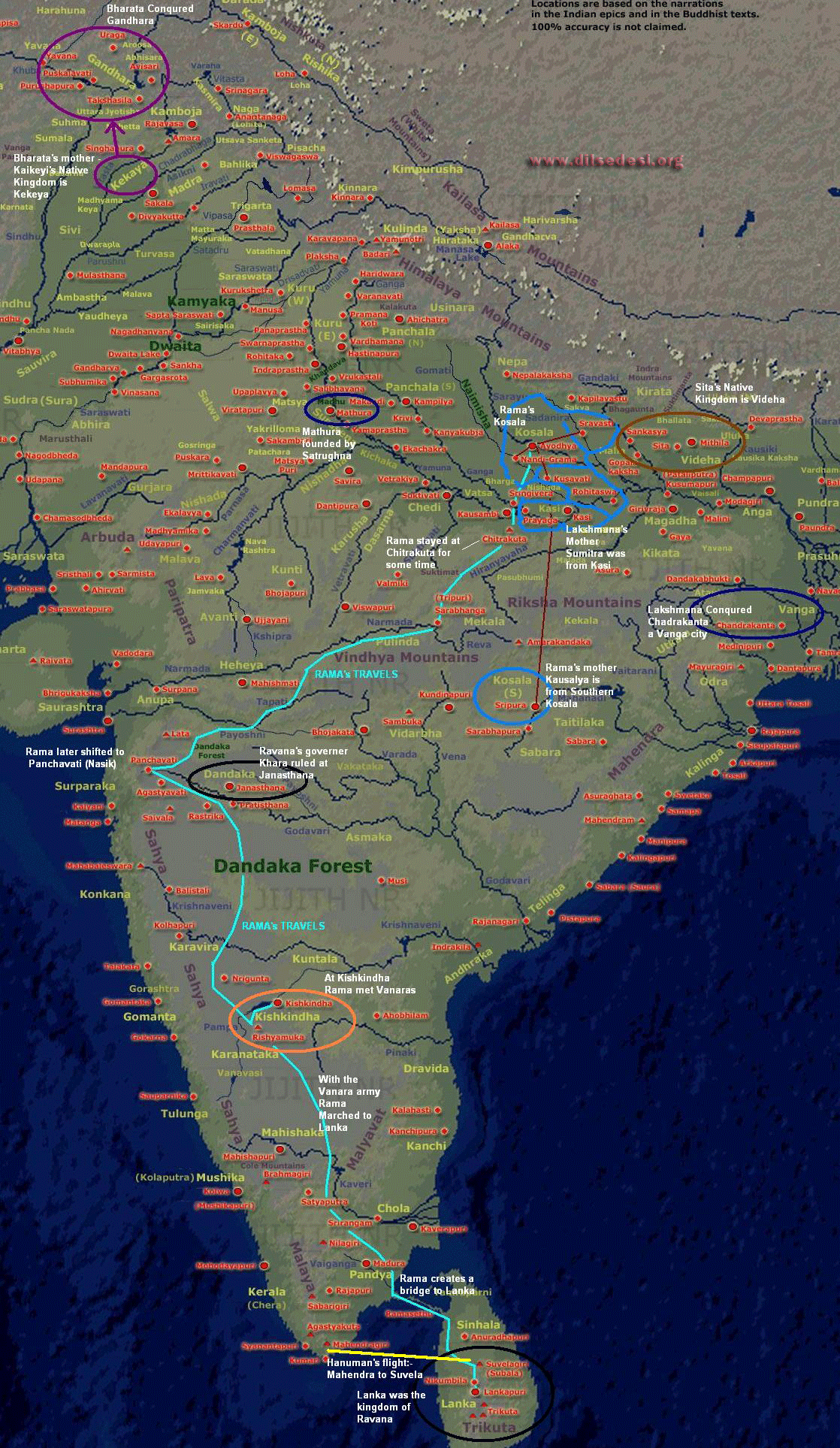
  • Cholas Pandyas in Ramayana Times Cousins From Manu

    Cholas Pandyas in Ramayana Times Cousins From Manu

    The term Pandya means ‘very Old'(பண்டைய) as against Cholas who were classified as new.


    The Pandyas were in close liaison with the Pandavas of the Mahabharata.


    Pandyan Kings took part in the Mahabharata War .(Karna Parav 20.25)


    Arjuna and Krishna married Pandyan princesses and had children through them.


    During the period of Ramayana, Sugriva advises his monkeys to search for Sita in the Kingdoms of Chera, Chola and Pandyas.


    And, O Yudhishthira, in the country of the Pandyas are the tirthas named Agastya and Varuna! And, O bull among men, there, amongst the Pandavas, is the tirtha called the Kumaris. Listen, O son of Kunti, I shall now describe Tamraparni. In that asylum the gods had undergone penances impelled by the desire of obtaining salvation. In that region also is the lake of Gokarna which is celebrated over the three worlds, hath an abundance of cool waters, and is sacred, auspicious, and capable, O child, of producing great merit. That lake is extremely difficult of access to men of unpurified souls. Mahabharatha 3:88[28]

    And similarly, Pandya, who dwelt on the coast-land near the sea, came accompanied by troops of various kinds to Yudhishthira, the king of kings. Mahabharatha 5:19

    Steeds that were all of the hue of the Atrusa flower bore a hundred and forty thousand principle car-warriors that followed that Sarangadhwaja, the king of the Pandyas. Mahabharatha 7.23.


    References abound in Tamil Classics about the relationship between Sanatana Dharma and the Tamil Kings.


    First reference of the Pandyas is the Parantaka Pandya who fought with Karikal Chola.


    The Forty Kings mentioned before Karikala are not found to be recorded.


    Yet references are found in the Ithihasa and Puranas about the Pandyas.


    My inference is that Pandya Kingdom at Then Madurai then, was swallowed by a Tsunami and records might have been lost.


    One surviving record is that Ravana signed a Peace Treaty with a Pandya King.


    Please read my Post on this.


    So, both the Chola and Pandya Dynasties date back to Ramayana period, if not earlier, for there are refernces in the Vedas about Tamil Nadu spices.


    Probably Cholas and Pandyas belong to the same Family Tree of Manu, albeit descended from Cousins.


    * Post On Chea Kings Follows.


    Citation.


    http://en.wikipedia.org/wiki/Pandyan_Dynasty#References


    Image credit.


     http://karuppurojakkal.wordpress.com/category/map-of-india-during-ramayana-time/


  • Caste Sytem Among Early Tamils

    I have recently published an article about the Tamil Culture was a part of Sanatana Dharma and that the Tamils did not have an independent Culture of their own.


    Even at the time of writing I knew that the article would draw a lot of flak from Tamil Arvalars, literal translation of this is-one who is passionate in Tamil-,it is a different  matter that they can not even pronounce the Tamil Zha, La and la properly.


    True to form I have received a communication that my information about Sanatana Dharma and Tamil is wrong and some research paper links were attached with the communication.

    The Tamil Land was divided, it is unique among all the civilizations, into five geographical entities.


    1.Kurinchi (Mountainous Areas)

    Higher castes: Poruppan, Verpan, Silamban, Kodichy

    Lower castes: Kuravar, Kurathiyar, Kanavar

    2.Mullai (Forest regions)

    Higher castes: Nadan, Thonral, Manaivi, Kizathi

    Lower castes: Idaiyar, Idaichiyar, Ayar, Aychiyar

    3.Marutam (Countryside

    Higher castes:Uran, Makiznan, Manaivi, Kizathi

    Lower castes: uzavar, Uzaththiyar, Kadaiyar, Kadaichiyar

    4.Neytal (Seashore)

    Higher castes:Serppan, Thuraivan, Pulamban, Parathi, Nulaichi

    Lower castes: Nulaiyar, Nulaichiyar, Parathar, Parathiar, Alavar, Alathiyar

    5.Palai (Wasteland/arid lands)

    Higher castes:Vidalai, Igulai, Meeli, Eyitri

    Lower castes:Maravar, Eyinar, Eyitriar, Marathiyar”

    The Land of Tamils.jpg.
    The Land of Tamils. Image credit.http://www.harekrsna.com/sun/features/03-06/tamil2.jpg


    To the best of my knowledge these descriptions denote the group of people living in the specific geographical areas and there seems to be no caste implications about this.

    But as I mentioned in my earlier article there is mention of Anthanar, Marayor(Brahmins) in Puranaanuru, the ancient Tamil Work.


    Also there is mention of the six duties of Brahmins as well.

    Therefore it is evident that while these geographical divisions allotted names ad profession  to people in those areas, the Caste system as practiced in the Sanatana Dharma was present.


    Culturally, the megalithic people of the South shared many beliefs and practices with megalithic builders elsewhere in the subcontinent and beyond. Yet certain practices and artefacts were at least compatible with the Vedic world and may well have prepared for a ready acceptance of Vedic concepts�a natural assimilative process still observable in what has been called the �Hinduization� of tribals. Thus several cists surrounded by stone-circles have four vertical slabs arranged in the shape of a swastika.[14] The famous 3.5 metre-high figure of Mottur (in North Arcot district), carved out of a granite slab, is �perhaps the first anthropomorphic representation of a god in stone in Tamil Nadu.�[15] Some megalithic burials have yielded iron or bronze objects such as mother goddess, horned masks, the trishul etc. As the archaeologist I.�K. Sarma observes, such objects are

    intimately connected with the worship of brahmanical Gods of the historical period, such as Siva, Kartikeya and later Amba. The diadems of Adichanallur burials are like the mouth-pieces used by the devotees of Murugan.[16]

    The archaeologist K.�V. Raman also notes�:

    Some form of Mother-Goddess worship was prevalent in the Megalithic period … as suggested by the discovery of a small copper image of a Goddess in the urn-burials of Adichchanallur. More recently, in Megalithic burials the headstone, shaped like the seated Mother, has been located at two places in Tamil Nadu.[17]

    Megalithic culture attached great importance to the cult of the dead and ancestors, which parallels that in Vedic culture. It is also likely that certain gods later absorbed into the Hindu pantheon, such as Aiyanar (or Sastha), Murugan (the later Kartik), Korravai (Durga), Naga deities, etc., were originally tribal gods of that period. Though probably of later date, certain megalithic sites in the Nilgiris were actually dolmen shrines, some of them holding Ganesh-like images, others lingams.[ 18] Megalithic practices evocative of later Hinduism are thus summarized by the British archaeologists Bridget and Raymond Allchin�:

    The orientation of port-holes and entrances on the cist graves is frequently towards the south. … This demands comparison with later Indian tradition where south is the quarter of Yama. Among the grave goods, iron is almost universal, and the occasional iron spears and tridents (trisulas) suggest an association with the god Siva. The discovery in one grave of a trident with a wrought-iron buffalo fixed to the shaft is likewise suggestive, for the buffalo is also associated with Yama, and the buffalo demon was slain by the goddess Durga, consort of Siva, with a trident. … The picture which we obtain from this evidence, slight as it is, is suggestive of some form of worship of Siva.[ 19]

    About the third century BC, cities and towns appear owing to yet little understood factors�; exchanges with the Mauryan and Roman empires seem to have played an important catalytic role, as also the advent of iron. From the very beginning, Buddhist, Jain and Hindu[*] streaks are all clear.

    Among the earliest evidences, a stratigraphic dig by I.�K. Sarma within the garbagriha of the Parasuramesvara temple at Gudimallam,[*] brought to light the foundation of a remarkable Shivalingam of the Mauryan period (possibly third century BC)�: it was fixed within two circular pithas at the centre of a square vastu-mandala. �The deity on the frontal face of the tall linga reveals himself as a proto-puranic Agni-Rudra�[20] standing on a kneeling devayana. If this early date, which Sarma established on stratigraphic grounds and from pottery sherds, is correct, this fearsome image could well be the earliest such representation in the South.

    Then we find �terracotta figures like Mother Goddess, Naga-linga etc., from Tirukkampuliyur�; a seated Ganesa from Alagarai�; Vriskshadevata and Mother Goddess from Kaveripakkam and Kanchipuram, in almost certainly a pre-Pallava sequence.�[21] Cult of a Mother goddess is also noticed in the early levels at Uraiyur,[22] and at Kaveripattinam, Kanchipuram and Arikamedu.[ 23] Excavations at Kaveripattinam have brought to light many Buddhist artefacts, but also, though of later date, a few figurines of Yakshas, of Garuda and Ganesh.[24] Evidence of the Yaksha cult also comes from pottery inscriptions at Arikamedu.[25]”


    “Division of People: After the description of the division of the land, the continuing sutras 22 to 37 vividly giver the details about the division of people according to tinai, their respective duties and avocations. For each tinai, the changed names of tinai (are applicable to the people) are two kinds based on names of clan (kulappeyar) and profession (tozhirpeyar) [22]. Tinai names for males and females are formed as Ayar (shepherd) and Vettuvar (hunters) and there are chiefs (kizhars) for them (23). Similarly, if we analyze the people of other regions, we can observe that the names of clan and profession are applied to each tinai (24). Kakkilai (one sided love) and peruntinai (unequal love) are applicable to adiyor (servants) and vinaivalar (workers) and they are dealt with (in literature accordingly) [25]. The above mentioned servants and workers and enor (others), who are in the position of commanding (or being commanded) are also in the same state (26), i.e, kakkilai and peruntinai are applicable to adiyor, vinaivalar and enor. Thus, the discussion about the seven tinais about the union of man and woman under 1 . kakkilai, 2. mullai, 3. kurunji, 4. marudham, 5. neydhal, 6. palai (aintinai) and 7. peruntinai. As kalavu (love in secret) and karpu (love in open) occur in the regions of mullaiu, kurunji, marudham and neydhal, then palai, i.e, separation is discussed about. As has been already mentioned, each tinai represents the activities of man and woman who live there. Tolkappiyar adapts and adopts the palai as an activating agent in the social processes and interactions of the ancient Tamils. Thus, it is said that education (othal), war or enemity (pagai) and tuthu (diplomacy) are the reasons for separation taking place in life (from the family, lover or wife) [27]. Of the above-mentioned categories, the separation due to education and diplomacy is applicable to uyarnthor i.e, the people at the top or eminent people (among the four categories). The commentator Ilamburanar specifically mentions that it s applicable to andanar (Brahmins) and arasar (Kings). Nachinarkkiniyar, another commentator says that velalars (agriculturists and others) are excluded (it is implied) as uyarnthor is mentioned (28). King can gor for war on his own accord or with others (resulting in separation) [29]. Here, the expression vendan specifically refers to king i.e, arasar (apart from the above mentioned three exigencies learning, war and diplomacy) separation takes place for earning wealth and establishing righteousness among the people of mullai (kurunji, marudham and neydal), so that rituals are conducted to people of other than that of eminence, greatness and exaltation (30). The people, thus who earn money or wealth may be called vanigar (business men). Ilamburanar says that the people other than that of eminence are nothing but devar (= gods), for them pujas and festivals are conducted. The expression padimai may refer to idol of such devar. Thus, the separation for the above exigency (i.e, to establish procedure relating to gods) is applicable to all four categories (31). Iamburanar specifically mentions that the four categories are the four varnas. Here, Nachinarkkiniyar explaind succinctly the difference between enor (others) and nalver (four group of people). As it is mentioned thast nalvarkkum uritte (applicable to four kinds of people), it is evident that besides vanigar as mentioned above, two categories or vellalars are also included. The duties of king can be performed by pinnor (i.e, vanigar and vellalar), who follow him in the order). The duties of king includes guarding, protection and preservation. As the expression Mannar pinnor denotes plural, it includes other kings, agriculturists (Velalar) and the like (32). For the higher group of the above mentioned authorized two (i.ew, vanigar and vellalar), a separation can take place for the purpose of learning / education (33). The above mentioned authorized two groups can perform dutioes for kings are vanigar and velalar of which the higher group is Vanigar. Therefore, it is evident that vanigar can also go for studying (othu). Arasar has already been permitted under sutra 28. therefore, for andanar, arasar and vanigar separation can take place for learning. Nachinarkkiniyar explains that as the place of Othu (learning) takes place after the appearance of Vedas, it is mentioned vothinan (othu refers to Vedas).

    3.1. The duties of Vendar (king) can be performed by those other than king also, where admissible (34). The duty of king is mentioned as diplomacy by the commentator instead of popular meaning ruling / governance. Thus, it is implied that the act of diplomacy is applicable to Vanigar and Vellalar in other words, applicable to all fou categories. Some say enor (others) denotes chieftains. The act of separation is a privilege for them (i.e, vanigar and Vellalar) in connection with wealth (i.e, to earn wealth by trade and commerce) [35]. If uyarnthor have separation for easrning wealth, then that amounts to going away from good conduct or moral values (36). Though specifically the word Andanar or any other expression is not used to denote Brahmins, from the forgoing sutras and their implied conditions and restrictions imposed on the repeatedly mentioned four groups of people read with the commentaries of Ilamburanar, Perasiriyar and Nachinarkkiniyar, it is evident that Uyarnthor here must refer to Andanar i.e, the higher group of the people of society. As has been authorized here among the two causes for separation, i.e, separation by leg (kalir pirivu) and separation by ship (kalattir pirivu) the separation due to ship is not allowed along with the lover or wife (37). Munnir vazhakkam is going by waters of rivers, spring and ocean respectively for education, diplomacy and business or trade. This implies that not only women are prohibited for undertalking voyage, but also Andanar as they are also not supposed to yearn for money or wealth.

    4. Four Divisions of Society: Under the sutra 74 of Tolkappiyam, four divisons of society is mentioned by way of describing their duties. The duties of Parppanar have been divided into six; that of Arasar into five; that of Enor into six; the region of learned who discharges their duties according to established times of past, future and present. For ascetics there are eight duties; for porunar, the duties are connected with warfare; and other duties connected with the above are meant for others; thus the vagaitinai is divided into seven categories by the poets, they say so. The previous verse / sutra 73 clearly says that vagai is just like puram of palai i.e, subject dealing with the aspects of life other than love of the exigencies created during separation for performing their respective duties. Accordingly, one has to improve their avocation and skill with great distinction withot hindrance to others. Therefore each can excel in his / her field / profession / avocation according to their skill, ability and talent. This four divisions and the respective duties mentioned described are exactly in accordance with the laws of Manu. Though Tolkappyar has not mentioned the nature of duties, as the numbers of duties have been specifically mentioned, they can be understood by the contemporary ancient Tamil literature, popularly known as Sangam literature.


    Citation.

    http://www.micheldaninio.voiceofdharma.com


    http://www.mayyam.com


    http://www.swmimiindology.blogspot.in


  • Independent Tamil Culture Myth

    The Myth of an independent,secular(?) Dravidian Culture has been and is propagated.


    Let us see whether the Statement that the Dravidian, more specifically the Tamil Culture was/is independent of Sanatana Dharma, on the basis of historical and archaeological evidence.

    Panyan Coin.jpg.
    Pandyan coin depicting a temple between hill symbols and elephant, Pandyas, Sri Lanka, 1st century CE.


    1.Tamil quotes Vedas right from the Sangam Age.


    2.Vedas and Sanskrit quote Tamil and the land of Tamils, pointedly at Dravida, meaning south of the Vindhyas.


    3.The earliest recorded Tamil Kingdom was Pandya Kingdom.


    Lord Krishna visited the capital of Pandyas , Madurai.


    Arjuna married a Pandyan Princess during his pilgrimage(see my post on this-Arjuna’s Pilgrimage)


    Ancient Chera Kingdom was from 400 BC to 397 AD.


    Sangam Cholas 300 BC to 240 AD.


    Central Pandya  550 BC to 1311 AD.


    The earliest Pandya to be found in epigraph is Nedunjeliyan, figuring in the Minakshipuram record assigned from the 2nd to the 1st centuries BC.

    The record documents a gift of rock-cut beds, to a Jain ascetic.

    Punch marked coins in the Pandya country dating from around the same time have also been found.


    Jainism came after Vedic Period.


    So when Jainism had made inroads the religion that was in existence was Hinduism even in Tamil Nadu.


    This may be known by the gifts made by the Pandya Kings to Brahmins(Vediyar, Anthanar)


    Again we have a reference to a Chera King who participated in the Mahabharata war;he fed both the Kaurava and Pandya Armies.


    “Reference to Perum Chorru Udiyan Cheral Adan, in the second verse of thePurananuru, an earliest text of Sangam literature, is about his feeding the two armies of the Mahabharata battle.


    And PT Srinivasa Iyengar states that Perunchoruudiyan Chealathan had granted 100 Velis (one Veli equals 100 acres) of land to Brahmins on the condition that he should see the smoke from the Homa from the Brahimn Agraharam daily


    He also performed Tharpana, rituals for the dead, to those  who died in the Mahabharata war.


    Hence the religion that was practiced in Tamil Nadu was Sanatana Dharma and not an independent Tamil Culture.


    Based on the Aryan invasion theory, it was assumed that only Apasthamba came to the South that Hinduism was introduced.


    This is incorrect.


    The Five gems of Tamil Valayapathi, Kundalakesi,Seevaka Sinthamani,Silappathiparam and Manimekalai.


    All these epics dating to BC (appx) refer to Vedic practices and Silappathikaram and  Seevaka Sinthamani Manimekalai refer to Buddhism and Jainism as well.


    The canard of an independent Tamil Culture is a Myth.


    How and Why.

    And yet, such statements do not go deep enough, as they still imply a North-South contrast and an unknown Dravidian substratum over which the layer of �Aryan� culture was deposited. This view is only milder than that of the proponents of a �separate� and �secular� Dravidian culture, who insist on a physical and cultural Aryan-Dravidian clash as a result of which the pure �Dravidian� culture got swamped. As we have seen, archaeology, literature and Tamil tradition all fail to come up with the slightest hint of such a conflict. Rather, as far as the eye can see into the past there is every sign of a deep cultural interaction between North and South, which blossomed not through any �imposition� but in a natural and peaceful manner, as everywhere else in the subcontinent and beyond.

    As regards an imaginary Dravidian �secularism� (another quite inept word to use in the Indian context), it has been posited by many scholars�: Marr,[56] Zvelebil[57] and others characterize Sangam poetry as �secular� and �pre-Aryan�[58] after severing its heroic or love themes from its strong spiritual undercurrents, in a feat typical of Western scholarship whose scrutiny always depends more on the magnifying glass than on the wide-angle lens. A far more insightful view comes from the historian M.�G.�S. Narayanan, who finds in Sangam literature �no trace of another, indigenous, culture other than what may be designated as tribal and primitive.�[59] He concludes�:

    The Aryan-Dravidian or Aryan-Tamil dichotomy envisaged by some scholars may have to be given up since we are unable to come across anything which could be designated as purely Aryan or purely Dravidian in the character of South India of the Sangam Age. In view of this, the Sangam culture has to be looked upon as expressing in a local idiom all the essential features of classical �Hindu� culture.[ 60]

    However, it is not as if the Tamil land passively received this culture�: in exchange it generously gave elements from its own rich temperament and spirit. In fact, all four Southern States massively added to every genre of Sanskrit literature, not to speak of the signal contributions of a Shankara, a Ramanuja or a Madhwa. Cultural kinship does not mean that there is nothing distinctive about South Indian tradition�; the Tamil land can justly be proud of its ancient language, culture and genius, which have a strong stamp and character of their own, as anyone who browses through Sangam texts can immediately see�: for all the mentions of gods, more often than not they just provide a backdrop�; what occupies the mind of the poets is the human side, its heroism or delicate emotions, its bouncy vitality, refined sensualism or its sweet love of Nature. �Vivid pictures of full-blooded life exhibiting itself in all its varied moods,� as Raghunathan puts it. �One cannot but be impressed by the extraordinary vitality, variety and richness of the poetic achievement of the old Tamil.�[61] Ganapathy Subbiah adds, �The aesthetic quality of many of the poems is breathtakingly refined.�[62] It is true also that the Tamil language developed its own literature along certain independent lines�; conventions of poetry, for instance, are strikingly original and more often than not different from those of Sanskrit literature.

    More importantly, many scholars suggest that �the bhakti movement began in the Tamil country and later spread to North India.�[63] Subbiah, in a profound study, not only challenges the misconceived �secular� portrayal of the Sangam texts, but also the attribution of the Tamil bhakti to a northern origin�; rather, he suggests, it was distinctly a creation of Tamil culture, and Sangam literature �a reflection of the religious culture of the Tamils.�[64]

    As regards the fundamental contributions of the South to temple architecture, music, dance and to the spread of Hindu culture to other South Asian countries, they are too well known to be repeated here. Besides, the region played a crucial role in preserving many important Sanskrit texts (a few Vedic recensions, Bhasa�s dramas, the Arthashastra for instance) better than the North was able to do, and even today some of India�s best Vedic scholars are found in Tamil Nadu and Kerala.[*] As Swami Vivekananda put it, �The South had been the repository of Vedic learning.�[65]


    Citation .


    www.en.wikipedia.org/wiki/


    www.micheldanino.voiceofdharma.com/tamilculture.html


  • Tamil Culture Part Of Sanatana Dharma

    I had a comment for my post on Skanda, not Muruga, ‘Is not Tamil  Culture a part of Sanatana Dharma?’


    A tricky question indeed.


    My reply was it is both a part and not a part of Sanatana Dharama.


    Map of Tamils area during Vedic period.Image.Jpg.
    Map of Tamils area during Vedic period.


    People who were living North of Vindhyas  were not seemingly unaware of the existence of the Great Culture that was thriving in the Dravida, meaning South, part of India , The South of Vindhya ranges.


    Viswamitra, banished his 52 sons to Dravida for having disobeyed and questioned him to the Dravidian  Region.


    They found a superior culture, if not on par with the Vedic culture to be thriving there.


    They found that , of all the civilizations known then , The Tamils were the only Culture, who were so evolved that they ascribed  five landmasses in their territory, ascribed Gods, birds.Animals, Palnts, Lifestyle to each of these Divisions, this was explained in Agathiyam , Thokappiyam , the ancient Grammatical works of the Tamil language, dated some five thousands years!


    Curious fact is that these Tamil texts quote Vedas and they , in turn, quote, the Tamils!


    Please read my post, Million year Old Tamil quotes Vedas and They quote Tamil.’


    The great Tamil Chera King Nedunchearalaathan was the man who fed both the armies of the Mahabharata War, Kauravas and Pandavas.


    He had been addressed as P’erunchotru Udiyan’ one who fed many number of Stomachs-Nedunchotru Uthiyan Neduncheralaathan was how he was called.


    He donated 100 veli( one veli= 100 acres) of land to Brahmins on the condition that he should see the Homa Smoke in the morning from this area every morning!


    ( source.History of Tamils By PT.Srinivasa Iengar)


    There are references to Arjuna marrying a Princess from Madurai on his pilgrimage.


    Now coming back to Viswamitra’s sons.


    The sons of Viswamitra mingled with the Tamils and followed the Tamil Customs.


    Their descendant , Apasthamaba, combined the best of Tamil practices and the Sanatana Dharma ad compiled the Apashamba Sutra, which is practiced by the Brahmins even to-day(Apasthamba Sutra)


    One notable custom is the inclusion of Mangaya Dharana, Thali in a Marriage, which is not found in Vedic Marriages.


    In Santana Dharma, marriage is complete with the performance of Panigrahana and Sapthapati.


    And the wearing of ‘Metti’, wring worn around the toe of the leg of Man was practiced  among the Tamils, to indicate that he was married.(women were decribed as not looking at Men in the Face!)


    This custom was changed to Women by Apasthamba.


    Read the following information to complicate the issue.


    Evidence indicates that Apsthamba compiled  the practices of the Tamils  and the Sanatana Dharma was unaware of the Tamils Culture.


    Yet Archaeological and other Puranic references indicate that there was  interaction between the two great cultures.


    It seems that there were two different cultures existing side by side at the same time.


    Or is it that both were One and that History is lost in India , as usual with us.


    I tend to agree with the last view.


    The archaeologist K.�V. Raman also notes�:

    Some form of Mother-Goddess worship was prevalent in the Megalithic period … as suggested by the discovery of a small copper image of a Goddess in the urn-burials of Adichchanallur. More recently, in Megalithic burials the headstone, shaped like the seated Mother, has been located at two places in Tamil Nadu.[17]

    Megalithic culture attached great importance to the cult of the dead and ancestors, which parallels that in Vedic culture. It is also likely that certain gods later absorbed into the Hindu pantheon, such as Aiyanar (or Sastha), Murugan (the later Kartik), Korravai (Durga), Naga deities, etc., were originally tribal gods of that period. Though probably of later date, certain megalithic sites in the Nilgiris were actually dolmen shrines, some of them holding Ganesh-like images, others lingams.[ 18] Megalithic practices evocative of later Hinduism are thus summarized by the British archaeologists Bridget and Raymond Allchin�:

    The orientation of port-holes and entrances on the cist graves is frequently towards the south. … This demands comparison with later Indian tradition where south is the quarter of Yama. Among the grave goods, iron is almost universal, and the occasional iron spears and tridents (trisulas) suggest an association with the god Siva. The discovery in one grave of a trident with a wrought-iron buffalo fixed to the shaft is likewise suggestive, for the buffalo is also associated with Yama, and the buffalo demon was slain by the goddess Durga, consort of Siva, with a trident. … The picture which we obtain from this evidence, slight as it is, is suggestive of some form of worship of Siva.[ 19]

    About the third century BC, cities and towns appear owing to yet little understood factors�; exchanges with the Mauryan and Roman empires seem to have played an important catalytic role, as also the advent of iron. From the very beginning, Buddhist, Jain and Hindu[*] streaks are all clear.

    Among the earliest evidences, a stratigraphic dig by I.�K. Sarma within the garbagriha of the Parasuramesvara temple at Gudimallam,[*] brought to light the foundation of a remarkable Shivalingam of the Mauryan period (possibly third century BC)�: it was fixed within two circular pithas at the centre of a square vastu-mandala. �The deity on the frontal face of the tall linga reveals himself as a proto-puranic Agni-Rudra�[20] standing on a kneeling devayana. If this early date, which Sarma established on stratigraphic grounds and from pottery sherds, is correct, this fearsome image could well be the earliest such representation in the South.

    Then we find �terracotta figures like Mother Goddess, Naga-linga etc., from Tirukkampuliyur�; a seated Ganesa from Alagarai�; Vriskshadevata and Mother Goddess from Kaveripakkam and Kanchipuram, in almost certainly a pre-Pallava sequence.�[21] Cult of a Mother goddess is also noticed in the early levels at Uraiyur,[22] and at Kaveripattinam, Kanchipuram and Arikamedu.[ 23] Excavations at Kaveripattinam have brought to light many Buddhist artefacts, but also, though of later date, a few figurines of Yakshas, of Garuda and Ganesh.[24] Evidence of the Yaksha cult also comes from pottery inscriptions at Arikamedu.[25]

    The same site also yielded one square copper coin of the early Cholas, depicting on the obverse an elephant, a ritual umbrella, the Srivatsa symbol, and the front portion of a horse.[ 26] This is in fact an important theme which recurs on many coins of the Sangam age[27] recovered mostly from river beds near Karur, Madurai etc. Besides the Srivatsa (also found among artefacts at Kanchipuram[28]), many coins depict a swastika, a trishul, a conch, a shadarachakra, a damaru, a crescent moon, and a sun with four, eight or twelve rays. Quite a few coins clearly show a yagnakunda. That is mostly the case with the Pandyas� coins, some of which also portray ayubastambha to which a horse is tied as part of the ashvamedha sacrifice. As the numismatist R.�Krishnamurthy puts it, �The importance of Pandya coins of Vedic sacrifice series lies in the fact that these coins corroborate what we know from Sangam literature about the performance of Vedic sacrifices by a Pandya king of this age.�[29]

    Finally, it is remarkable how a single coin often depicts symbols normally associated with Lord Vishnu (the conch, the srivatsa, the chakra) together with symbols normally associated with Lord Shiva (the trishul, the crescent moon, the damaru).[30] Clearly, the two �sects��a very clumsy word�got along well enough. Interestingly, other symbols depicted on these coins, such as the three- or six-arched hill, the tree-in-railing, and the ritual stand in front of a horse, are frequently found in Mauryan iconography.[31]

    All in all, the material evidence, though still meagre, makes it clear that Hindu concepts and cults were already integrated in the society of the early historic period of Tamil Nadu side by side with Buddhist and Jain elements. More excavations, for which there is great scope, are certain to confirm this, especially if they concentrate on ancient places of worship, as at Gudimallam. Let us now see the picture we get from Sangam literature.

    Vedic & Puranic Culture�Literary Evidence
    It is unfortunate that the most ancient Sangam compositions are probably lost for ever�; we only know of them through brief quotations in later works. An early text, the Tamil grammar Tolkappiyam, dated by most scholars to the first or second century AD,[*] is �said to have been modelled on the Sanskrit grammar of the Aindra school.�[32] Its content, says N. Raghunathan, shows that �the great literature of Sanskrit and the work of its grammarians and rhetoricians were well known and provided stimulus to creative writers in Tamil…. The Tolkappiyam adopts the entire Rasa theory as worked out in the Natya Sastra of Bharata.�[33] It also refers to rituals and customs coming from the �Aryans,� a word which in Sangam literature simply means North Indians of Vedic culture�; for instance, the Tolkappiyam �states definitely that marriage as a sacrament attended with ritual was established in the Tamil country by the Aryas,�[ 34] and it uses the same eight forms of marriage found in the Dharmashastras. Moreover, it mentions the caste system or �fourfold jathis� in the form of �Brahmins, Kings, Vaishyas and Vellalas,�[35] and calls Vedic mantras �the exalted expression of great sages.�[36]

    The Tolkappiyam also formulates the captivating division of the Tamil land into five regions (tinai�), each associated with one particular aspect of love, one poetical expression, and also one deity�: thus the hills (kuri�ji�) with union and with Cheyon (Murugan)�; the desert (palai�) with separation and Korravai (Durga)�; the forests (mullai�) with awaiting and Mayon (Vishnu-Krishna)�; the seashore (neytal�) with wailing and Varuna�; and the cultivated lands (marutam) with quarrel and Ventan (Indra). Thus from the beginning we have a fusion of non-Vedic deities (Murugan or Korravai), Vedic gods (Indra, Varuna) and later Puranic deities such as Vishnu (Mal or Tirumal). Such a synthesis is quite typical of the Hindu temperament and cannot be the result of an overnight or superficial influence�; it is also as remote as possible from the separateness we are told is at the root of so-called �Dravidian culture.�

    Expectedly, this fusion grows by leaps and bounds in classical Sangam poetry whose composers were Brahmins, princes, merchants, farmers, including a number of women. The �Eight Anthologies� of poetry (orettuttokai�) abound in references to many gods�: Shiva, Uma, Murugan, Vishnu, Lakshmi (named Tiru, which corresponds to Sri) and several other Saktis.[37] The Paripadal, one of those anthologies, consists almost entirely of devotional poetry to Vishnu. One poem[38] begins with a homage to him and Lakshmi, and goes on to praise Garuda, Shiva on his �majestic bull,� the four-faced Brahma, the twelve Adityas, the Ashwins, the Rudras, the Saptarishis, Indra with his �dreaded thunderbolt,� the devas and asuras, etc., and makes glowing references to the Vedas and Vedic scholars.[39] So does the Purananuru,[40] another of the eight anthologies, which in addition sees Lord Shiva as the source of the four Vedas (166) and describes Lord Vishnu as �blue-hued� (174) and �Garuda-bannered� (56).[41] Similarly, a poem (360) of a third anthology, the Akananuru, declares that Shiva and Vishnu are the greatest of gods[42]

    Not only deities or scriptures, landmarks sacred in the North, such as the Himalayas or Ganga, also become objects of great veneration in Tamil poetry. North Indian cities are referred to, such as Ujjain, or Mathura after which Madurai was named. Court poets proudly claim that the Chera kings conquered North Indian kingdoms and carved their emblem onto the Himalayas. They clearly saw the subcontinent as one entity�; thus the Purananuru says they ruled over �the whole land / With regions of hills, mountains, / Forests and inhabited lands / Having the Southern Kumari / And the great Northern Mount / And the Eastern and Western seas / As their borders….�[43]

    The Kural (second to seventh century AD), authored by the celebrated Tiruvalluvar, is often described as an �atheistic� text, a hasty misconception. True, Valluvar�s 1,330 pithy aphorisms mostly deal with ethics (aram), polity (porul) and love (inbam), following the traditional Sanskritic pattern of the four objects of human life�: dharma, artha, kama, and moksha�the last implied rather than explicit. Still, the very first decade is an invocation to Bhagavan�: �The ocean of births can be crossed by those who clasp God�s feet, and none else�[44] (10)�; the same idea recurs later, for instance in this profound thought�: �Cling to the One who clings to nothing�; and so clinging, cease to cling� (350). The Kural also refers to Indra (25), to Vishnu�s avatar of Vamana (610), and to Lakshmi (e.g. 167), asserting that she will shower her grace only on those who follow the path of dharma (179, 920). There is nothing very atheistic in all this, and in reality the values of the Kural are perfectly in tune with those found in several shastras or in the Gita.[45]

    Let us briefly turn to the famous Tamil epic Shilappadikaram (second to sixth century ad), which relates the beautiful and tragic story of Kannagi and Kovalan�; it opens with invocations to Chandra, Surya, and Indra, all of them Vedic Gods, and frequently praises Agni, Varuna, Shiva, Subrahmanya, Vishnu-Krishna, Uma, Kali, Yama and so forth. There are mentions of the four Vedas and of �Vedic sacrifices being faultlessly performed.� �In more than one place,� writes V. Ramachandra Dikshitar, the first translator of the epic into English, �there are references to Vedic Brahmans, their fire rites, and their chanting of the Vedic hymns. The Brahman received much respect from the king and was often given gifts of wealth and cattle.�[46] When Kovalan and Kannagi are married, they �walk around the holy fire,� a typically Vedic rite still at the centre of the Hindu wedding. Welcomed by a tribe of fierce hunters on their way to Madurai, they witness a striking apparition of Durga, who is addressed equally as Lakshmi and Sarasvati�the three Shaktis of the Hindu trinity. There are numerous references to legends from the Mahabharata, the Ramayana, and the Puranas. After worshipping at two temples, one of Vishnu and the other of Shiva, the Chera king Shenguttuvan goes to the Himalayas in search of a stone for Kannagi�s idol, and bathes it in the Ganges�in fact, the waters of Ganga and those of Cauvery were said to be equally sacred. Similar examples could be given from the Manimekhalai�: even though it is a predominantly Buddhist work, it also mentions many Vedic and Puranic gods, and attributes the submergence of Puhar to the neglect of a festival to Indra.

    Vedic Dharma


    Enhanced by Zemanta