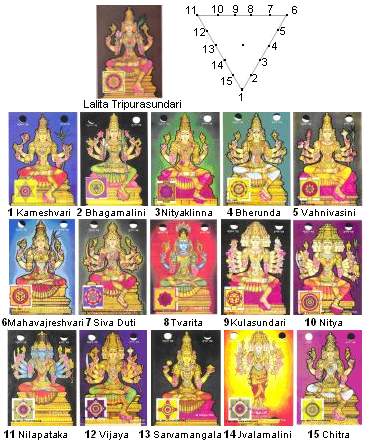
Nithya Devathas, often revered within the Sri Vidya tradition, embody various divine forms that are essential for spiritual growth and understanding. The concept of Nithya Devathas emphasizes the importance of worshipping these deities to achieve higher levels of consciousness and fulfillment.
Importance of Nithya Devathas
Spiritual Connection: Nithya Devathas act as intercessors to unite devotees with the divine. By connecting with these forms, practitioners enhance their spiritual journey.
Energy Flow: Each Nithya Devatha represents unique energies and aspects of the universe, allowing devotees to harness specific vibrations for personal growth and healing.
Ritual Significance: Rituals performed in honor of Nithya Devathas are fundamental in Sri Vidya practices. These rituals are designed to align the practitioner’s energies with the cosmic forces represented by the deities.
Nithya Devathas in Practice
Meditation: Devotees often meditate on the forms of Nithya Devathas to imbibe their qualities and foster profound insight.
Chanting: Recitation of specific mantras associated with Nithya Devathas is believed to invoke their blessings, promoting peace and harmony.
Conclusion
Understanding and embracing the Nithya Devathas within the framework of Sri Vidya can lead to transformative experiences. They serve not only as spiritual guides but also as powerful symbols of inner strength and devotion.
Om Mitraya namah
Om Ravaye namah
Om Suryaya namah
Om Bhanave namah
Om Khagaya namah
Om Pushne namah
Om Hiranyagarbhaya namah
Om Marichaye namah
Om Adityaya namah
Om Savitre namah
Om Arkaya namah
Om Bhaskaraya namah
Om Adityaya namah nanavidha parimala patra pushpani samarpayami.
Om Adityaya namah Adityayam shree padukam poojayami tarpayami namah(3 times).
Om Kesavaya namah
Om Narayanaya namah
Om Madhavaya namah
Om Govindaya namah
Om Vishnave namah
Om Madhusudanaya namah
Om Trivikramaya namah
Om Vamanaya namah
Om Sridharaya namah
Om Hrushikesaya namah
Om Padmanabhaya namah
Om Damodaraya namah
Om Mahavishnave namah
The Navarana Pooja for Devi is considered as Supreme in the worship of Lalitha Devi, Tripura Sundari.
This forms a part of Tantra Shastra of Hinduism.
Avarana means concealment,masking, obstruction.
The attempt to realize self is is paved the path of Obstructions.
This lies with the individuals mind and ego.
Lalitha Tripurasundari
Losing one’s ego and the impediments of the mind clears the way for realization, first the Saguna Brahma,Reality of Name and Form.
Once the level is reached, one is automatically guided to the Ultimate Reality, the Nirguna Brahman.
The Avaranas of are of two kinds.
1.Klesa Avarana.
Klesa means confusion, unable to decide.
Sinful desires, Lust,hankering after Wealth, lead to misery.
These obstruct the individual in spiritual path.
The removal of these obstacles,Klesaprahan is essential.( Gaudapadakarika)
Kama, Krodha, Lobha, Madha, Mathsarya, Dvesha, Moha, Maana are some of the Klesas.
The other in Jneya Avarana.
Here the object of worship is seen as different from the subject, from the one who is worshiping.
The merging of the worshiper and the worshiped is Realization.
There are procedures laid down in the Tantra Shastras for the removal of the Avaranas.
A form of Pooja performed to Goddess Lalitha Devi, Tripura Sundari is called the Navarana Pooja.
This Pooja is performed for the Sri Chakra.
It is essential to understand the construction of Ari Yantra before starting the Pooja.
Five downward pointing triangles representing Devi intersect with four upward pointing triangles representing Siva, forming 43 triangles including the central triangle.
From the five Shakti triangles comes creation and from the four Shiva triangles comes the dissolution.
The union of five Shaktis and four Fires causes the chakra of creation to evolve.
At the centre of the bindu of the Shri Yantra is Kamakala.
It has three bindus. One is red, one is white and one is mixed.
The red bindu is Kurukulla the Female form, the white bindu is Varahi the Male form, and the mixed bindu is the union of Shiva & Shakti – the individual as the potential Shri Cakra. Varahi, the father-form, gives four dhatus to the child and Kurukulla, the mother-form, gives five dhatus to the child. Theses represent the nine dhatus of the human body.
Varahi’s four fires are the 12 (4 x 3) sun Kalasa, the 12 Zodiac constellations. Kurukulla’s five triangles are the 15 (5 x 3) Kalas of the moon, 15 lunar Tithis.
These nine triangles also represent the nine stages of growth of the human child in the womb.
Surrounding the 43 triangles formed by the intersection of the nine triangles is the 16 petals circle.
Surrounding the 16 petal circle is an 8 petal circle.
After that the 3 lines and at the outermost part of the Sriyantra there are 3 lines called the Bhupura.
The 43 triangles constitute the six inner sections called Avaranas, the two circles of petals are two more avaranas and the Bhupura of 3 lines is the last Avarana.
These 9 Avaranas of the Sri Yantra have various presiding Devis.
They are the Devi’s Parivar (retinue) of total 108. In the Srichakra pooja they are systematically worshipped one by one with their names and mantras.
The presiding Deity of Srichakra, Devi, is Known as Lalita Tripura Sundari.
The form of Devi Kamakshi of Kancheepuram is the closest resemblance of the Devi as described in the scriptures.
Lalita means The One Who Plays.
All creation, manifestation and dissolution is considered to be a play of Devi.
Tri-Pura means the three worlds and Sundari means beauty.
She is the transcendent beauty of the three worlds.
She is the ruler of the the three gunas of Satva, Rajas and Tamas; and sun, moon and fire – the zodiac and the planets, and therefore Time itself;
She is also “tripura” as Will (Iccha), Knowledge (Jnana) and Action (Kriya).
She is also “tripura” as intellect, feelings & physical sensation; and She is triple as the three states of the soul – awakening, dreaming and -sleeping states.
Her five triangles also represent the Pancha Tatwas and the Pancha Bhootas. ( ”Panchami pancha bhuteshi pancha sankhyopacharini “. Lalitha Sahasranama)
Lalita holds five flowery arrows, noose, goad and bow. The noose represents attachment, the goad represents repulsion, the sugarcane bow represents the mind and the flowery arrows are the five sense objects.
Names of Devis in Navarana Pooja.
First Line:
Anima Sidhamba, Laghima Sidhamba, Mahima Sidhamba, Isitva Sidhamba, Vasitva Sidhamba, Prakamya Sidhamba, Bhuti Sidhamba, Iccha Sidhamba, Prapti Sidhamba and Sarva Kama Sidhamba.
Second Line: Sri Brahmi Matruka, Maheswari Matruka, Kaumari Matruka, Vaishnavi Matruka, Varahi Matruka, Mahendri Matruka, Chamunda Matruka, and Mahalakshmi Matruka.
You must be logged in to post a comment.