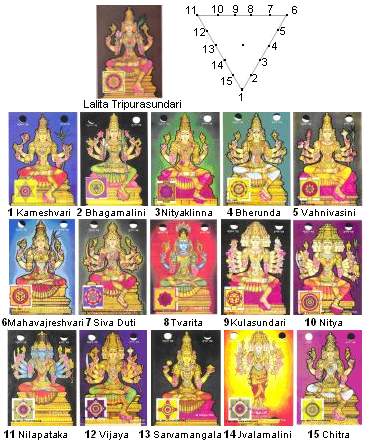
Nithya Devathas, often revered within the Sri Vidya tradition, embody various divine forms that are essential for spiritual growth and understanding. The concept of Nithya Devathas emphasizes the importance of worshipping these deities to achieve higher levels of consciousness and fulfillment.
Importance of Nithya Devathas
Spiritual Connection: Nithya Devathas act as intercessors to unite devotees with the divine. By connecting with these forms, practitioners enhance their spiritual journey.
Energy Flow: Each Nithya Devatha represents unique energies and aspects of the universe, allowing devotees to harness specific vibrations for personal growth and healing.
Ritual Significance: Rituals performed in honor of Nithya Devathas are fundamental in Sri Vidya practices. These rituals are designed to align the practitioner’s energies with the cosmic forces represented by the deities.
Nithya Devathas in Practice
Meditation: Devotees often meditate on the forms of Nithya Devathas to imbibe their qualities and foster profound insight.
Chanting: Recitation of specific mantras associated with Nithya Devathas is believed to invoke their blessings, promoting peace and harmony.
Conclusion
Understanding and embracing the Nithya Devathas within the framework of Sri Vidya can lead to transformative experiences. They serve not only as spiritual guides but also as powerful symbols of inner strength and devotion.
Panchadasakhari as explained in Sree Soundaryalahari is provided here in audio format, Live from one of my classes with my student’s consent.
Kaadhi Vidya Soundaryalahari 32
Consists of fifteen akṣaras.
The three sets of letters ka, ye, ee, la [first four] Vaak Bhava Koota
Ha, sa, ka, ha, la [second five] Kamaraja Koota,Manmatha Koota
Sa, ka, la [third three] Sakthi Koota.
Total 12 letters , with these, add in the end of each set hreem;ka, ye, ee, la, hreem- Ha, sa, ka, ha, la, hreem-Sa, ka, la, hreem.
Panca Dasa akshari maha-mantra called “kaadi vidya” for which the first letter is ‘ka’ is referred indirectly. There are three parts for this called ‘kootaas’.The first is called vaaghbhava kootam for which the mantra is ka, ye, ee, la, hreem;This shines with brilliance of the pralaya kaala agni, starts from mooladhaara and reaches anaahata.The second is called kaamaraaja kootam for which the mantra is ha, sa, ka, ha, la, hreem;This possesses the brilliance of crores of suns, starts from anaahata and reaches aajnaa-cakra.The third is called sakti kootam for which the mantra is sa,ka, la, hreem;This shines with crores of candraprakaasa, starts from aajnaa cakra and widens through to the middle of lalata or forehead.
-Sowbhaagya vardhini of the Kaivalyaasrama refers thus –
‘This sloka also refers to lopaamudraa vidyaa called Haadi vidyaa and And also to durvaasa vidyaa referred by the trayodasa akshari mantra.Lopaamudraa vidya – or haadi vidyaa – Ha sa ka la hreem ha sa ka ha la hreem sa ka la hreemDurvaasa vidyaa or trayodasa akshari [13 letters] mantraHa sa ka la ha sa ka ha la sa ka la hreem.’
More to follow.
Sree Lalithambika in Suvasini Pooja in Secunderabad
śivaḥ – Śiva; śaktiḥ – Śakti; kāmaḥ – Manmatha (Cupid); kṣitiḥ – the Earth; atha – then; raviḥ – Sun; śītakiraṇaḥ – cool rays of Moon; smara – Manmatha (Cupid); haṁsaḥ – swan; śakra – Indra; tad anu ca – once again; parā – Brahmā; māra – Manmatha (Cupid); harayaḥ – Viṣṇu; amī – these (syllables); hṛllekhābhiḥ tisṛbhiḥ – with three hrīṁ-s (ह्रीं); avasāneṣu – at the end; ghaṭitā- connected with; bhajante – worshipping; varṇaḥ te – these syllables of Yours; tava – Yours; janani – Mother; nāma avayavatām – being part of Your names or the parts of your body in Saguna Upasana or the Attributes in Nirguna Aradhana .
Removal of Evil eye, Protection from forces that hinder Spiritual development. Protection from Black magic,Animals. Increases self confidence and self assurance. Clarity of thought.. Above all,Mukthi and Gnana are facilitated.
Date of Rig veda in Ramanisblog According to Ramanisblog, the date of the Rig Veda is subject to considerable debate, with modern scholarly estimates generally ranging between 2000 BCE to 1000 BCE[1]. However, Ramanisblog highlights that Hindu tradition considers the Vedas to be timeless and without a specific beginning[1]. Perspectives on Rig Veda Dating Ramanisblog…
Following in the Ai Generated transcript of the Navavarana Pooja Mantras . Recorded and sent to my Shishyas. This is being made public so that this secret knowledge is not lost to posterity. Those who want to be initiated may contact me through mail at ramanan50@gmail.com. Also they can contact through the comment column. If…
Sounds precede written scripts.Not all sounds can be captured or written down.Language is from Sounds and not the other way around.Sounds express emotions and are spontaneous.Sounds also express the innermost yearnings of Beings. Spiritual feelings too are expressed though sounds.
Siva, Siddha Thirumoolar, records in his Thirumandhiram a Philosophical and Tantric treatise in Tamil states that Siva had created The Fifty one letters of Sanskrit and Tamil to synchronize with the Aksharas of Devi.
The term’ Akshara’ in Sanskrit means Not Limited, conveying the fact that sounds are not limited and depend on one’s level of Spiritual enlightenment.
It is worth noting that Special Aksharas are embedded in Soundaryalahari by Sri Shankaracharya.
Sometimes , sounds are not expressed explicitly in a language but is embedded in it.
Shall be writing on this.
This is the reason certain words are not recommended for usage as they would bring in spiritual downfall and difficulties in daily life.
It may be noted that the first portion of the SoundaryaLahari( was given by Lord Ganesha and the balance was composed by Adi Shankaracharya.
Devi is described as ‘Mathruka Varna Roopini’ Lalitha Sahasranama.
Mantrathmika-Lalitha Sahasranama.
Tantra Roopa Manon mayee-Lalitha Sahsranama
Sarva Mantrathmike, Sarva Yantrathmike -Shyamala Dandakam by Kalidasa.Lalita is also known as Matrika Devi, the Goddess of the Letters of the Alphabet. In Sanskrit there are 36 consonants and 15 vowels. In some arrangements of Her yantra these letters are to be found inscribed in the various triangles and petals of Shri Yantra. The combination of the 15 Vowels (the 15 Nityas) and the consonants (the 36 Tattvas) produces all sound, all mantra, all vibration, all word, and all music.
There are 8 letter groups in the Sanskrit alphabet. These 8 groups are personified as the 8 Little Mothers, worshipped all over India. The 9th group is Lalita Herself. She is beyond language and description. It is little realised ‘that gods and goddesses do not have names, but instead are described. “She who Plays” (Lalita) is not the name of the red goddess, but merely one of Her characteristics. She is beyond Name and Form.
In the first 12 verses (shlokas) of the Vamakeshvara Tantra is given a hymn to the Goddess as the Mother of the Letters:
1. I bow to the Goddess made of mantra, who consists of the (51) Ganeshas, the (9) Planets, the (27) Lunar Constellations, the (6) Yoginis, the (12) Signs of the Zodiac, and the (51) Matrika-Seats.
2. I bow to the great Matrika Devi, the Supreme Lady, who in Time is both a fraction of a second and the end of the Universe, the Destroyer and the Creatrix of Time.
3. Who is the whole perfect measure of the letters of the alphabet, worshipped by the Sun, Garuda, the Moon, the God of Love, by Lord Shankar, the God of Fire, and by Vishnu.
4. I worship the Devi of all Devis, the great Shri Siddha Matrika, whose letters of the alphabet, like moonlight, adorn the three worlds.
5. Who is the great thread of the letters of the alphabet, from which is woven the three worlds, who extends from the top of the head to the base of the spine. I worship you, 0 Siddha Matrika.
6. Who is made up of the 11 adharas (in the body), the universe-seed, the source of the primordial triangle. From the top of the head to the base of the spine you are the Origin of the World.
7. Who is the aggregate of the 8 letter-groups A-Ka-Ca-Ta-Ta-Pa-Ya-Sa, the primordial Source and Many Rayed Dweller in the centre of the heart.
8. Unfolder of the letter I, essence of essences, Most Ultimate One, I bow to you Great Devi, form of the Utmost Bliss.
9. The primordial One, of whom other gods and goddesses have no inkling. Who knows what and from where She creates? O Producer of Form and Formlessness!
10. I worship You, the imperishable letter-form from A to Ksha, O Devi, Supremely Auspicious Being. You are the Expansion Mirror, the Maya of the 36 Tattvas.
11. The aggregate of the eight groups of letters, in whom the eight Little Mothers reside, I worship You, Great Lady of the eight siddhis which originate from the eight letter groups.
12. Dwelling at the Auspicious Sacred Seats (Pithas) of Kamarupa, Purnagiri and Jalandhara, I bow to You Great Shree Tripura, the fourfold abode of the Elements.
Syllables of Vidya.
Vidya is feminine of mantra. Lalita has various forms of mantra, the most popular seeming to be the vidya of 15 syllables which runs Ka E I La Hrim, Ha Sa Ka Ha La Hrim, Sa Ka La Hrim. This is a mantra with three sections which correspond to Moon, Sun and Fire. There is said to be a secret 16th syllable which is the Goddess Herself. This vidya is called Kadi (Ka etc.) because of its initial letter. The Kadi doctrine deals with involution of the yantra, the Hadi vidya with evolution. These 15 syllables correspond to the 15 Kalas of the Moon.
If you refer to the pages on Shri Puja and the Bhavana Upanishad as well as the Shri Yantra figure above and the page on the Nine Mandalas of the Shri Yantra, this text becomes much easier to follow.
Reference article in Tamil, translated into English through Google Translate.
945. ‘
Siddhar Thirumoolar has said that all the ancient eighteen languages of India are subject to the rules of virtue given by Lord Shiva. Siddhar Thirumoolar has said that the original Tamil alphabet had the form of 15 vowels + 35 consonants + 1 Om Pranavam = 51 letters. Siddhar Thirumoolar has repeatedly told about these primitive alphabets in many places in Thirumantra. Siddhar Thirumoolar says that it is from these primordial writings that the Vedas and Agamas originated in South India and therefore South India is the purest place in the world.
The art of life is combined with reading and writing The primordial letter is called fifty and one
You ( Siva) are the one who writes and writes in – Thirumoolar
All Vedas are fifty letters All the Agamas are fifty letters After knowing all fifty letters Fifty syllables are gone and only five syllables remain – Thirumoolar
Original Post in Tamizh.
There are references to these Tamil primordial letters as fifty-one letters in all Siddhar songs such as Akchani Siddhar, Agappey Siddhar, Kongana Siddhar, Bokar, Sivavakkiyar, Pattinathu Siddhar. It is said in Arunagiri Nadar Thirupugaz that there are fifty one letters in Tamil. Tiruvilayadal Puranam written by Sage Paranjothi says that there are 51 Tamil letters… That Tamizh had 31 letters was noted by Thiruvilayaadal Puranam, Siddhas Azhuguni, Agappey, Konganar, Siva vaakiyar, Pattinathaar and Arunagirinaathar. .https://m.facebook.com/story.php?story_fbid=3675863102424784&id=100000033913235
நின்ற பதங்களில் வார்த்திக்கும் ஆகின்ற ஐம்பத்து ஓரெழுத்து உள்நிற்கப் யாகொன்றி நிற்கும் பராபரன் தானே 945‘
பண்டிதர் ஆவார் பதினெட்டு பாடையும்கண்டவர் கூறும் கருத்தறிவார் என்க
பண்டிதர் தங்கள் பதினெட்டு பாடையும்அண்ட முதலான் அறம் சொன்னவாறே-திருமூலர்இந்தியாவின் பண்டைய பதினெட்டு மொழிகளும் சிவபெருமான் சொல்லிய அறம் விதிகளுக்கு உட்பட்டு உள்ளது என்று சித்தர் திருமூலர் சொல்லி உள்ளார்.ஆதி தமிழ் எழுத்து உயிர் எழுத்து 15 + மெய் எழுத்து 35 + 1 ஓம் பிரணவம்=51 எழுத்து வடிவம் கொண்டு இருந்தது என்று சித்தர் திருமூலர் சொல்லி உள்ளார்.இந்த ஆதி எழுத்துகள் பற்றி பல இடங்களில் சித்தர் திருமூலர் மீண்டும் மீண்டும் திருமந்திரத்தில் சொல்லி உள்ளார். இந்த ஆதி எழுத்துகளில் இருந்து தான் வேதங்கள் ஆகமங்கள் எல்லாம் தென்னிந்தியாவில் தோன்றின என்று சொல்லி அதனால் தென்னிந்தியா உலகில் சுத்தமான இடம் என்றும் சித்தர் திருமூலர் சொல்லி உள்ளார்.ஓதும் எழுத்தோடு உயிர்க் கலை மூவைந்தும்ஆதி எழுத்தவை ஐம்பதோடு ஒன்று என்பர்சோதி எழுத்தினில் ஐயிரு மூன்று உளநாத எழுத்திட்டு நாடிக் கொள்ளீரே- திருமூலர்ஐம்பது எழுத்தே அனைத்து வேதங்களும்ஐம்பது எழுத்தே அனைத்து ஆகமங்களும்ஐம்பது எழுத்தேயும் ஆவது அறிந்த பின்ஐம்பது எழுத்தும் போய் அஞ்செழுத்தாமே-திருமூலர்ஈறான கன்னி குமரியே காவிரிவேறாம் நவ தீர்த்தம் மிக்குள்ள வெற்பு ஏழுள்பேறான வேத ஆகமமே பிறத்தலால்மாறாத தென் திசை வையகம் சுத்தமே-திருமூலர்இந்த தமிழ் ஆதி எழுத்துகள் பற்றிய குறிப்புகள் ஐம்பத்தோறு அட்சரங்கள் என்று அழுகணி சித்தர்,அகப்பேய் சித்தர்,கொங்கண சித்தர்,போகர்,சிவவாக்கியர்,பட்டினத்து சித்தர் போன்ற எல்லா சித்தர் பாட்டுகளில் உள்ளன. அருணகிரி நாதர் திருப்புகழில் தமிழில் ஐம்பத்தோறு அட்சரங்கள் என்று சொல்லப்பட்டு உள்ளது.பரஞ்சோதி முனிவர் எழுதிய திருவிளையாடல் புராணம் தமிழ் எழுத்துகள் 51 என சொல்லி உள்ளது…
You must be logged in to post a comment.