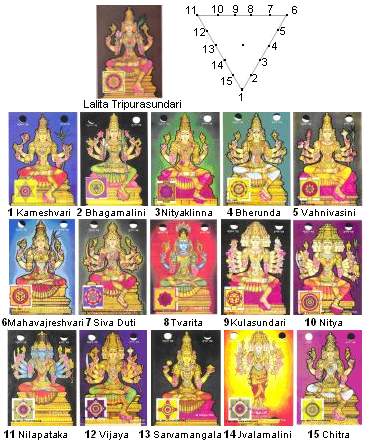
Nithya Devathas, often revered within the Sri Vidya tradition, embody various divine forms that are essential for spiritual growth and understanding. The concept of Nithya Devathas emphasizes the importance of worshipping these deities to achieve higher levels of consciousness and fulfillment.
Importance of Nithya Devathas
Spiritual Connection: Nithya Devathas act as intercessors to unite devotees with the divine. By connecting with these forms, practitioners enhance their spiritual journey.
Energy Flow: Each Nithya Devatha represents unique energies and aspects of the universe, allowing devotees to harness specific vibrations for personal growth and healing.
Ritual Significance: Rituals performed in honor of Nithya Devathas are fundamental in Sri Vidya practices. These rituals are designed to align the practitioner’s energies with the cosmic forces represented by the deities.
Nithya Devathas in Practice
Meditation: Devotees often meditate on the forms of Nithya Devathas to imbibe their qualities and foster profound insight.
Chanting: Recitation of specific mantras associated with Nithya Devathas is believed to invoke their blessings, promoting peace and harmony.
Conclusion
Understanding and embracing the Nithya Devathas within the framework of Sri Vidya can lead to transformative experiences. They serve not only as spiritual guides but also as powerful symbols of inner strength and devotion.
Panchadasakhari as explained in Sree Soundaryalahari is provided here in audio format, Live from one of my classes with my student’s consent.
Kaadhi Vidya Soundaryalahari 32
Consists of fifteen akṣaras.
The three sets of letters ka, ye, ee, la [first four] Vaak Bhava Koota
Ha, sa, ka, ha, la [second five] Kamaraja Koota,Manmatha Koota
Sa, ka, la [third three] Sakthi Koota.
Total 12 letters , with these, add in the end of each set hreem;ka, ye, ee, la, hreem- Ha, sa, ka, ha, la, hreem-Sa, ka, la, hreem.
Panca Dasa akshari maha-mantra called “kaadi vidya” for which the first letter is ‘ka’ is referred indirectly. There are three parts for this called ‘kootaas’.The first is called vaaghbhava kootam for which the mantra is ka, ye, ee, la, hreem;This shines with brilliance of the pralaya kaala agni, starts from mooladhaara and reaches anaahata.The second is called kaamaraaja kootam for which the mantra is ha, sa, ka, ha, la, hreem;This possesses the brilliance of crores of suns, starts from anaahata and reaches aajnaa-cakra.The third is called sakti kootam for which the mantra is sa,ka, la, hreem;This shines with crores of candraprakaasa, starts from aajnaa cakra and widens through to the middle of lalata or forehead.
-Sowbhaagya vardhini of the Kaivalyaasrama refers thus –
‘This sloka also refers to lopaamudraa vidyaa called Haadi vidyaa and And also to durvaasa vidyaa referred by the trayodasa akshari mantra.Lopaamudraa vidya – or haadi vidyaa – Ha sa ka la hreem ha sa ka ha la hreem sa ka la hreemDurvaasa vidyaa or trayodasa akshari [13 letters] mantraHa sa ka la ha sa ka ha la sa ka la hreem.’
More to follow.
Sree Lalithambika in Suvasini Pooja in Secunderabad
śivaḥ – Śiva; śaktiḥ – Śakti; kāmaḥ – Manmatha (Cupid); kṣitiḥ – the Earth; atha – then; raviḥ – Sun; śītakiraṇaḥ – cool rays of Moon; smara – Manmatha (Cupid); haṁsaḥ – swan; śakra – Indra; tad anu ca – once again; parā – Brahmā; māra – Manmatha (Cupid); harayaḥ – Viṣṇu; amī – these (syllables); hṛllekhābhiḥ tisṛbhiḥ – with three hrīṁ-s (ह्रीं); avasāneṣu – at the end; ghaṭitā- connected with; bhajante – worshipping; varṇaḥ te – these syllables of Yours; tava – Yours; janani – Mother; nāma avayavatām – being part of Your names or the parts of your body in Saguna Upasana or the Attributes in Nirguna Aradhana .
Removal of Evil eye, Protection from forces that hinder Spiritual development. Protection from Black magic,Animals. Increases self confidence and self assurance. Clarity of thought.. Above all,Mukthi and Gnana are facilitated.
Date of Rig veda in Ramanisblog According to Ramanisblog, the date of the Rig Veda is subject to considerable debate, with modern scholarly estimates generally ranging between 2000 BCE to 1000 BCE[1]. However, Ramanisblog highlights that Hindu tradition considers the Vedas to be timeless and without a specific beginning[1]. Perspectives on Rig Veda Dating Ramanisblog…
Following in the Ai Generated transcript of the Navavarana Pooja Mantras . Recorded and sent to my Shishyas. This is being made public so that this secret knowledge is not lost to posterity. Those who want to be initiated may contact me through mail at ramanan50@gmail.com. Also they can contact through the comment column. If…
People would like to know the age of children who are to be worshipped in the form of Devi
Bhuvaneswari with Bala in Her Lap.
There are many forms of Devi visualised and mentioned in the third part of the first section of Shrimaddevi Bhagwatham.
The children should not have attained Puberty.
They are as follows.
Two year-old child is called ‘Kumari’. Worshipping them destroys the sorrow and poverty of the devotees and wealth, age, and strength increase.
A three-year-old girl is called ‘Trimurti’. Their worship fulfills religion, objectives, and work. Moreover, prosperity increases and leads to the betterment of children.
A four-year-old girl is called ‘Kalyani’. Their worship brings knowledge, victory, kingdom, and happiness.
A five-year-old girl is called ‘Kalika’. Their worship destroys the enemies.
A six-year-old girl has been called ‘Chandika’. Their worship brings prosperity and wealth.
A seven-year-old girl is called ‘Shambhavi’. Their ritual worship ends fights and any disputes.
An eight-year-old girl is considered to be the form of ‘Durga’. Their worship leads to upliftment and success in spiritual meditation. A nine-year-old girl is called ‘Subhadra’. Their worship destroys complex diseases.
A 10-year-old girl is called ‘Rohini’. Their worship fulfills all the desires in your heart.
Sri Gurubhyo Namaha, Sri Matre Namaha, Sri Jogulamba Saraswatye Namaha. I wanted to share some updates on the temple initiative:
As many of you know, Guruji Sri Jogulamba Saraswati received a **divine vision** in August 2023, followed by further revelations from Devi, calling for the construction of a Shanmatha temple with Sri Lalithambika as the presiding Deity. This persistent vision provided specific instructions, guiding us toward creating a unique temple that will serve all devotees, especially Sri Vidya upasakas. Over time, this temple will also support broader community initiatives.
– This is a vast undertaking, and we are committed to fulfilling Devi’s Will with our utmost effort. Phase 1 of the temple includes the construction of three Parivara Sannidhis and the main Devi Sannidhi. A trust, Sri Bhuvaneshwari Matha Trust under the guidance of Guru Sri Jogulamba Saraswati has been setup. – A distinguished Stapathi from a family with 10 generations of temple-building experience—including two Padma Bhushan awardees—has been appointed to lead the work. – We have acquired a 7.2-acre plot, located 2 km from the Jogulamba temple, a Maha Ashtadasha Shaktipeetha referenced by Bhagavadpadacharya Sri Adi Sankaracharya.https://youtu.be/rZYAFEYq_2A – Shed for workers, Borewell, and temporary structure to support the construction done
Sree Jogulamba temple, Hemalapuram ( Alampur)
Stones Arrive .
Foundation and structural work will follow shortly, with stone procurement and a team of 20 workers set to commence work on the parivara sannidhis, from January 12, 2025.
Write up by my student.
One of the Five Moola Vigrahas in the temple.
Those who would like to participate in this Community initiative, may donate.
Suvasini is also a Marathi term of courtesy for a woman whose husband is alive, or for a woman of good residence. It can also mean “soft spoken”, “nice girl”, or “well-spoken”.
Suvasini Pooja is a ritual that takes place during Sharad Navratri. It is also known as Kumari Pooja.
If you’re looking to delve into the sacred practice of Devi Upasna, Ramanisblog.in is your gateway to insightful content on Indian religious traditions. The website extensively covers a wide array of topics, including the revered Suvasini Pooja and Devdhis.
Ramanisblog.in hosts a variety of resources, including a notable PDF titled “Homa List PDF”, encompassing essential rituals such as the Suvasini and Kannika Pooja. Diving deep into the rich tapestry of Indian culture, the blog sheds light on the significance and intricacies of Devi Upasna and related spiritual practices.
With its comprehensive coverage of ritualistic worship, symbolism, and cultural context, Ramanisblog.in serves as a valuable platform for enthusiasts and practitioners alike to explore the profound realm of Devi Upasna.
The Srividya Upasna is a sacred and intricate practice that holds great significance in the realm of Tantra and Hindu spirituality. It encompasses the worship of the divine mother, Lalita Tripurasundari, and involves intricate rituals, mantras, and meditative techniques. This profound form of worship is steeped in symbolism and seeks to awaken the practitioner’s spiritual consciousness through the devotion to the divine feminine.
Srividya Upasna is revered for its esoteric teachings and its focus on the unity of Shiva and Shakti, representing the cosmic principles of consciousness and energy. Practitioners of Srividya Upasna often undergo rigorous initiation and guidance from a qualified guru to immerse themselves in this profound spiritual practice.
If you’re eager to explore the depths of Srividya Upasna, consider seeking guidance from knowledgeable practitioners or resources that delve into the intricate facets of this revered spiritual tradition. It’s a journey that requires deep reverence, commitment, and a yearning for spiritual awakening.
I have provided an overview of Srividya Upasna, emphasizing its significance in Hindu spirituality and the profound devotion involved. If you need more specific details or a different approach, feel free to ask!
Navavarana in Srividya Upasna
The term “Navavarana” refers to a sacred and intricate aspect of Srividya Upasna, a profound practice central to the realm of Tantra and Hindu spirituality. In the context of Srividya Upasna, Navavarana pertains to the worship of the divine mother, Lalita Tripurasundari, through a structured ritual framework comprising nine enclosures or layers of worship.
These nine enclosures, or “avarana,” symbolically represent the layers of consciousness and energy within the practitioner, offering a transformative journey towards spiritual realization and transcendence. Each avarana is associated with specific deities, yantras (geometrical diagrams), mantras (sacred chants), and symbolic representations, collectively weaving a tapestry of profound spiritual significance.
The worship within Navavarana involves the recitation of esoteric mantras, visualization of divine forms, and meditative immersion into the sacred geometries of the yantras, culminating in the awakening of spiritual energies and the expansion of consciousness. This intricate and reverential practice is often undertaken under the guidance of a qualified guru, signifying a deep commitment to spiritual evolution and the profound teachings of Srividya Upasna.
Exploring the depths of Navavarana in Srividya Upasna unveils a profound journey of spiritual elevation, symbolizing the union of Shiva and Shakti, and the awakening of the practitioner’s divine potential. Delving into the nuances of each avarana and embracing the transformative power of these sacred rituals can lead to a heightened understanding of consciousness, energy, and the divine feminine within the rich tapestry of Hindu spirituality.
Nithya Devathas in Sri Vidya Nithya Devathas, often revered within the Sri Vidya tradition, embody various divine forms that are essential for spiritual growth and understanding. The concept of Nithya Devathas emphasizes the importance of worshipping these deities to achieve higher levels of consciousness and fulfillment. Importance of Nithya Devathas Nithya Devathas in Practice Conclusion…
Sree Durga Sapthasathi,Devi Mahatmiya is the most powerful Mantra of Durga. Palasruthi or the benefits of chanting is listed in the chant above. I shall be uploading all the Slokas and meaning . May Goddess Abhirami and Lalithambika Bless us All. You may download from ध्यानंविध्युद्धाम समप्रभां मृगपति स्कन्ध स्थितां भीषणां।कन्याभिः करवाल खेट विलसद्दस्ताभि रासेवितांहस्तैश्चक्र…
Welcome to a world of limitless possibilities, where the journey is as exhilarating as the destination, and where every moment is an opportunity to make your mark on the canvas of existence. The only limit is the extent of your imagination.
You must be logged in to post a comment.