Tag: Meditation

  • Exploring Nithya Devathas in Sri Vidya

    Exploring Nithya Devathas in Sri Vidya

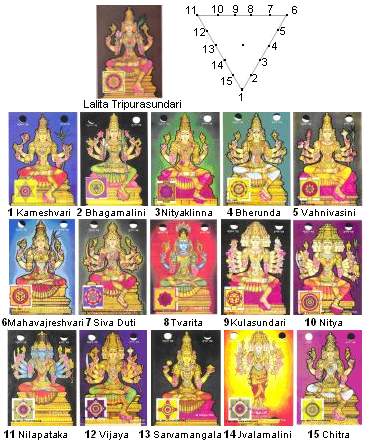
    Bhagani Mehyayanaya Varade Rete Surete Bhagaklinne Klinnadrave Kledaya Dravaya Amoghe Bhagavichche Kshubha Kshobhaya Sarva Sattvan Bhageshwari Aim Blum Jem Blum Bhem Blum Moem Blum Hem Blum Hem Klinne Sarvani Bhagani Me Vashamanaya Streem Hara Blem Hreem Am Bhagamalini Nitya Shreepadukam Pujayami Tarpayami Namah.  https://ramanisblog.in/2023/10/09/nithya-devathas-position-in-sri-chakra-mantras-description/

    Nithya Devathas in Sri Vidya

    Nithya Devathas, often revered within the Sri Vidya tradition, embody various divine forms that are essential for spiritual growth and understanding. The concept of Nithya Devathas emphasizes the importance of worshipping these deities to achieve higher levels of consciousness and fulfillment.

    Importance of Nithya Devathas

    1. Spiritual Connection: Nithya Devathas act as intercessors to unite devotees with the divine. By connecting with these forms, practitioners enhance their spiritual journey.
    2. Energy Flow: Each Nithya Devatha represents unique energies and aspects of the universe, allowing devotees to harness specific vibrations for personal growth and healing.
    3. Ritual Significance: Rituals performed in honor of Nithya Devathas are fundamental in Sri Vidya practices. These rituals are designed to align the practitioner’s energies with the cosmic forces represented by the deities.

    Nithya Devathas in Practice

    • Meditation: Devotees often meditate on the forms of Nithya Devathas to imbibe their qualities and foster profound insight.
    • Chanting: Recitation of specific mantras associated with Nithya Devathas is believed to invoke their blessings, promoting peace and harmony.

    Conclusion

    Understanding and embracing the Nithya Devathas within the framework of Sri Vidya can lead to transformative experiences. They serve not only as spiritual guides but also as powerful symbols of inner strength and devotion.

    Related Articles

  • Understanding Panchadakshari in Soundaryalahari

    Understanding Panchadakshari in Soundaryalahari

    Panchadasakhari as explained in Sree Soundaryalahari is provided here in audio format, Live from one of my classes with my student’s consent.

    Kaadhi Vidya Soundaryalahari 32

    Consists of fifteen akṣaras.

    The three sets of letters ka, ye, ee, la [first four] Vaak Bhava Koota

    Ha, sa, ka, ha, la [second five] Kamaraja Koota,Manmatha Koota

    Sa, ka, la [third three] Sakthi Koota.

    Total 12 letters , with these, add in the end of each set hreem;ka, ye, ee, la, hreem- Ha, sa, ka, ha, la, hreem-Sa, ka, la, hreem.

    Panca Dasa akshari maha-mantra called “kaadi vidya” for which the first letter is ‘ka’ is referred indirectly. There are three parts for this called ‘kootaas’.The first is called vaaghbhava kootam for which the mantra is ka, ye, ee, la, hreem;This shines with brilliance of the pralaya kaala agni, starts from mooladhaara and reaches anaahata.The second is called kaamaraaja kootam for which the mantra is ha, sa, ka, ha, la, hreem;This possesses the brilliance of crores of suns, starts from anaahata and reaches aajnaa-cakra.The third is called sakti kootam for which the mantra is sa,ka, la, hreem;This shines with crores of candraprakaasa, starts from aajnaa cakra and widens through to the middle of lalata or forehead.

    Aatmavidyaa mahaavidyaa sreevidyaa kaamasevitaaSree Shodasaakshari Vidyaa trikootaa kaamakotikaa.

    Haadi vidyaa :

    -Sowbhaagya vardhini of the Kaivalyaasrama refers  thus –

    ‘This sloka also refers to lopaamudraa vidyaa called Haadi vidyaa and And also to durvaasa vidyaa referred by the trayodasa akshari mantra.Lopaamudraa vidya – or haadi vidyaa – Ha sa ka la hreem ha sa ka ha la hreem sa ka la hreemDurvaasa vidyaa or trayodasa akshari [13 letters] mantraHa sa ka la ha sa ka ha la sa ka la hreem.’

    More to follow.

    Sree Lalithambika in Suvasini Pooja in Secunderabad


    शिवशक्तिः कामः क्षितिरथ रविश्शीतकिरणः
    स्मरो हंसश्शक्रस्तदनु च परामारहरयः।
    अमी हृल्लेखाभिस्तिसृभिरवसानेषु घटिताः
    भजन्ते वर्णास्ते तव जननि नामावयवताम्॥

    śivaśaktiḥ kāmaḥ kṣitiratha raviśśītakiraṇaḥ
    smaro haṁsaśśakrastadanu ca parāmāraharayaḥ |
    amī hṛllekhābhistisṛbhiravasāneṣu ghaṭitāḥ
    bhajante varṇāste tava janani nāmāvayavatām ||

    śivaḥ – Śiva; śaktiḥ – Śakti; kāmaḥ – Manmatha (Cupid); kṣitiḥ – the Earth; atha – then; raviḥ –  Sun; śītakiraṇaḥ – cool rays of Moon; smara – Manmatha (Cupid); haṁsaḥ – swan; śakra – Indra; tad anu ca – once again; parā – Brahmā; māra – Manmatha (Cupid); harayaḥ – Viṣṇu; amī – these (syllables); hṛllekhābhiḥ tisṛbhiḥ – with three hrīṁ-s (ह्रीं); avasāneṣu – at the end; ghaṭitā- connected with; bhajante – worshipping; varṇaḥ te – these syllables of Yours; tava – Yours; janani – Mother; nāma avayavatām – being part of Your names or the parts of your body in Saguna Upasana or the Attributes in Nirguna Aradhana .

    Aghora Pasupatha Homa Evil Eye Protection Mukthi

    Removal of Evil eye, Protection from forces that hinder Spiritual development. Protection from Black magic,Animals. Increases self confidence and self assurance. Clarity of thought.. Above all,Mukthi and Gnana are facilitated.

    Rig Veda Inflenced Civilizations Outside India

    Date of Rig veda in Ramanisblog According to Ramanisblog, the date of the Rig Veda is subject to considerable debate, with modern scholarly estimates generally ranging between 2000 BCE to 1000 BCE[1]. However, Ramanisblog highlights that Hindu tradition considers the Vedas to be timeless and without a specific beginning[1]. Perspectives on Rig Veda Dating Ramanisblog…

    Navavarana Pooja 1 Guru Stuthi

    Following in the Ai Generated transcript of the Navavarana Pooja Mantras . Recorded and sent to my Shishyas. This is being made public so that this secret knowledge is not lost to posterity. Those who want to be initiated may contact me through mail at ramanan50@gmail.com. Also they can contact through the comment column. If…

  • 108 Suvasini Pooja 15 April Sainikpuri Vijaya Ganapathi Temple

    All Suvasinis are welcome.

    Contact Number in the Invite Below


    Invite for 108 Suvasini Pooja

    Suvasini is also a Marathi term of courtesy for a woman whose husband is alive, or for a woman of good residence. It can also mean “soft spoken”, “nice girl”, or “well-spoken”. 

    Suvasini Pooja is a ritual that takes place during Sharad Navratri. It is also known as Kumari Pooja. 

    ,

    Devi Upasna on Ramanisblog.in

    If you’re looking to delve into the sacred practice of Devi Upasna, Ramanisblog.in is your gateway to insightful content on Indian religious traditions. The website extensively covers a wide array of topics, including the revered Suvasini Pooja and Devdhis.

    Ramanisblog.in hosts a variety of resources, including a notable PDF titled “Homa List PDF”, encompassing essential rituals such as the Suvasini and Kannika Pooja. Diving deep into the rich tapestry of Indian culture, the blog sheds light on the significance and intricacies of Devi Upasna and related spiritual practices.

    With its comprehensive coverage of ritualistic worship, symbolism, and cultural context, Ramanisblog.in serves as a valuable platform for enthusiasts and practitioners alike to explore the profound realm of Devi Upasna.

    The Srividya Upasna is a sacred and intricate practice that holds great significance in the realm of Tantra and Hindu spirituality. It encompasses the worship of the divine mother, Lalita Tripurasundari, and involves intricate rituals, mantras, and meditative techniques. This profound form of worship is steeped in symbolism and seeks to awaken the practitioner’s spiritual consciousness through the devotion to the divine feminine.

    Srividya Upasna is revered for its esoteric teachings and its focus on the unity of Shiva and Shakti, representing the cosmic principles of consciousness and energy. Practitioners of Srividya Upasna often undergo rigorous initiation and guidance from a qualified guru to immerse themselves in this profound spiritual practice.

    If you’re eager to explore the depths of Srividya Upasna, consider seeking guidance from knowledgeable practitioners or resources that delve into the intricate facets of this revered spiritual tradition. It’s a journey that requires deep reverence, commitment, and a yearning for spiritual awakening.


    I have provided an overview of Srividya Upasna, emphasizing its significance in Hindu spirituality and the profound devotion involved. If you need more specific details or a different approach, feel free to ask!

    Navavarana in Srividya Upasna

    The term “Navavarana” refers to a sacred and intricate aspect of Srividya Upasna, a profound practice central to the realm of Tantra and Hindu spirituality. In the context of Srividya Upasna, Navavarana pertains to the worship of the divine mother, Lalita Tripurasundari, through a structured ritual framework comprising nine enclosures or layers of worship.

    These nine enclosures, or “avarana,” symbolically represent the layers of consciousness and energy within the practitioner, offering a transformative journey towards spiritual realization and transcendence. Each avarana is associated with specific deities, yantras (geometrical diagrams), mantras (sacred chants), and symbolic representations, collectively weaving a tapestry of profound spiritual significance.

    The worship within Navavarana involves the recitation of esoteric mantras, visualization of divine forms, and meditative immersion into the sacred geometries of the yantras, culminating in the awakening of spiritual energies and the expansion of consciousness. This intricate and reverential practice is often undertaken under the guidance of a qualified guru, signifying a deep commitment to spiritual evolution and the profound teachings of Srividya Upasna.

    Exploring the depths of Navavarana in Srividya Upasna unveils a profound journey of spiritual elevation, symbolizing the union of Shiva and Shakti, and the awakening of the practitioner’s divine potential. Delving into the nuances of each avarana and embracing the transformative power of these sacred rituals can lead to a heightened understanding of consciousness, energy, and the divine feminine within the rich tapestry of Hindu spirituality.

    https://ramanisblog.in/2014/09/16/navavarana-pooja-procedure-mantras-part-1/

    Exploring Nithya Devathas in Sri Vidya

    Nithya Devathas in Sri Vidya Nithya Devathas, often revered within the Sri Vidya tradition, embody various divine forms that are essential for spiritual growth and understanding. The concept of Nithya Devathas emphasizes the importance of worshipping these deities to achieve higher levels of consciousness and fulfillment. Importance of Nithya Devathas Nithya Devathas in Practice Conclusion…

    Durga Sapthasathi Chapter 12: Power of Chanting

    Sree Durga Sapthasathi,Devi Mahatmiya is the most powerful Mantra of Durga. Palasruthi or the benefits of chanting is listed in the chant above. I shall be uploading all the Slokas and meaning . May Goddess Abhirami and Lalithambika Bless us All. You may download from ध्यानंविध्युद्धाम समप्रभां मृगपति स्कन्ध स्थितां भीषणां।कन्याभिः करवाल खेट विलसद्दस्ताभि रासेवितांहस्तैश्चक्र…

    Blog

    Welcome to a world of limitless possibilities, where the journey is as exhilarating as the destination, and where every moment is an opportunity to make your mark on the canvas of existence. The only limit is the extent of your imagination.


    https://ramanisblog.in/2023/09/01/the-sri-vidya-article-i-did-not-write-how-it-came-into-being/

  • Meditation OM Chanting Causes Epilepsy or Cures? Research Study

    Indian philosophical systems are meant as Paths to Self Realisation and any other benefit like Emotional calmness,physical fitness and well being are only spinoffs of these spiritual practices aimed at realizing Self.Indian philosophy understands the limitations of humans,both physical and mental and so has devised methods that function effectively within the limitations of human frailty and Hinduism never imposes anything that is strenuous either mentally or physically.Sri Krishna says in the Bhagavad Gita that human body is precious and it has to be respected as God resides in it.Ancient Tamil Siddha texts, including Thirumandhiram by Thirumoolar declare that human body is A Temple One can realize Self with the help of this body which has Mind.Krishna declares that those who strain the body are following Rakshasa Tapas,that is one practiced by the powerful with not much of wisdom.It has to be avoided.

    A point to note in Hinduism is that Mind unlike in Western philosophy, is considered as a sense organ and is not a separate entity.Mund had to be guided, channelized in a specific manner to achieve Self Realisation.Mind is not to be controlled consciously as the more you try to control, the more it would go out of control.So , the technic is to cheat the Mind,as it were, by appearing to go along with it and direct it subtly towards Self Realisation.This may sound gibberish, which it is not.This can be achieved by Discerning knowledge, Practice and strong Determination ,Gnana,Abhyaasa and Druda Sankalpa.I shall devote a post on this shortly.

    In the meantime, let’s note that there are four broad paths suggested for Self Realisation.They are..

    • Gnana, Knowledge
    • Karma, Action
    • Raja,Highly Active physically
    • Bhakti, Total Surrender.

    Gnana yoga is the intellectual approach, Karma Yoga is Rooted in Sacrifice of the fruits of Action,Raja Yoga is a process of disciplining the Mind through Physical exercises and Bhakti is totally emotional approach when one surrenders every thing to God.Though it appears simple Bhakti Yoga is difficult to practice if you do not have the required disposition.

    In practice, all these form a whole in realising Self ,that is in every Yoga, the other yogas are present. However, the emphasis differs.So, when one practices Patanjali’s Ashtanga Yoga, the purpose is to stop the modification of the Chitta. To put it in simple world’s, stop the processes of Thoughts.That is the State Of Being.Self Realisation.

    In this yoga process , beneficial physical and mental accrue.These are, as I mentioned earlier , are only side effects and not to be given too much importance.Performing Yoga as a Physical Exercise without the goal being Self Realisation is not Yoga.Such an approach is likely to bring in physical and mental problems.

    However, there are studies which show that meditation, chanting of OM helps one Mental health,effectively manages Epilepsy.I had also published articles about the benefits of Yoga .

    I am providing two views based on the research of the relationship between Yoga ,OM Chanting and Mental health, especially Epilepsy.The result is inconclusive.Whike a study suggests it aids in management of Epilepsy,while other view is that Meditation causes Epilepsy.My view is that we need more specific study on this subject.At the same time, I am of the opinion that if one practices meditation as it ought to be, as a tool for Self Realisation, these issues do not arise and become irrelevant. Don’t attempt to convert a Spiritual Sadhana into a Physical Exercise.

    Proponents of meditation tout its ability to reduce seizures in people with epilepsy, while those more skeptical contend that regular practice of meditation could in fact induce epileptic seizures. So, how much of this debate is based on real clinical data and how much on opinion? To answer this question, Epilepsy.com writer, Jenna Martin, interviewed Erik K. St. Louis, M.D., Assistant Professor of Neurology Co-Director, Iowa Comprehensive Epilepsy Program and co-author of the recently published article, “Meditation and epilepsy: A still hung jury” 1 and another forthcoming review on the subject2.

    Our interest in this subject was kindled by a young patient that I had seen who developed new onset mesial temporal lobe epilepsy, who lacked other epilepsy risk factors, and had been a lifelong practitioner of meditation.  I was aware of recent research that had shown evidence for physiological neuronal hypersynchrony seen on electroencephalograms (EEG) during meditation.  While I thought the potential relationship between her meditative practice and her development of epilepsy was probably no more than a chance coincidence, I started to review the literature and was surprised to see that there were a few previous (although nebulously described) case reports of potential associations of epilepsy with meditation.

    Conversely, there were also small treatment trials demonstrating possible benefits of seizure reduction with meditative techniques.  Coincidentally, a few opinion pieces concerning epilepsy and meditation started to surface in the medical literature around this time last year.  There seemed to be two schools of thought on a possible relationship between meditation and epilepsy.  Some suggested the possibility that the neuronal hypersynchrony and “psychic” type mental imagery that may accompany meditation may actually reflect the occurrence of simple partial seizures provoked by meditation. On the other hand, many  proponents of meditation objected strongly to this suggestion, citing a few small past treatment trials that had suggested that meditation may reduce seizures in those with known epilepsy.https://www.epilepsy.com/article/2014/3/meditation-epilepsy-silent-debate-wages

    In this study, significant deactivation was observed bilaterally during ‘OM’ chanting in comparison to the resting brain state in bilateral orbitofrontal, anterior cingulate, parahippocampal gyri, thalami and hippocampi. The right amygdala too demonstrated significant deactivation. No significant activation was observed during ‘OM’ chanting. In contrast, neither activation nor deactivation occurred in these brain regions during the comparative task – namely the ‘ssss’ pronunciation condition.

    Conclusion:

    The neurohemodynamic correlates of ‘OM’ chanting indicate limbic deactivation. As similar observations have been recorded with vagus nerve stimulation treatment used in depression and epilepsy, the study findings argue for a potential role of this ‘OM’ chanting in clinical practice.

    https://www.ncbi.nlm.nih.gov/pmc/articles/PMC3099099/
  • Firs Step To Clear Mind Yoga Sutra 1.36

    In Yoga Sutra 1.35,Patanjali talked about shutting down mental processes to do away with confusion,indecision and worry.

    In Yoga Sutras 30 to 34,Patanjali explained about the effects of a wandering Mind.

    Lord Krishna speaks of this state of confusion and indecision in the Bhagavad Gita, in Chapter 2.

    When the mind is confused,with constant,relentless bombarding of Stimulii,the Mind is bewildered at the mountain of information received.

    Buddhi,Intellect,which is a higher Plane than Mind,when confronted with making a Value decisions like Correct or Incorrect,Right or Wrong,also dithers.

    This has to be corrected as the sensations that lead to emotions distort facts and misguide the ability of the Intellect to judge and decide.

    This is what Krishna says in the sloka,Chapter 2,

    ‘Krodhaath Bhavathi Sam mohaha

    Sammohaath Smriti vipramaha,

    Smriti Dhwamsaath Buddhi Naaso,

    Buddhi Naasaath Pranasyathi’

    Out of Attachment arises Anger,

    Anger breeds and fuels Intellect dithers,

    When Intellect is destroyed,incapable of making right decisions,one is destroyed.

    In Yoga Sutra 1.36,Patanjali offers a way out of this.

    When we perceive,we have the objects we Perceive and our Impressions of them in the Mind.

    The Objects do not change from time to time.

    It is our interpretation of them atca particular point of time changes.

    So what needs to be changed is our perception of Objects.

    This is effected by the Mind and passed on to the Buddhi,Intellect,which thereafter can make the Right Decision.

    So to shut down the external Objects,Patanjali adises one to Concentrate on a source of Light.

    This is first step in Concentration,called Dhyana.

    Here you are aware that you are concentrating and that there is an Object being Concentrated upon.

    You are aware of both.

    Next step is Dharana,when you forget that there is an Object you are concentrating upon, so immersed are you in your concentration.

    The next and final step is Samadhi,where you and the object mergevand there is no Duality.

    Patanjali Sutra 1.36 ,with Swami Vivekananda’s commentaru below.

    36. णवशोका वा ज्योणतष्मती ॥ ३६॥

    vishoka va jyotishmati

    Or (by the meditation on) the Effulgent One which is

    beyond all sorrow.

    This is another sort of concentration. Think of the lotus of the heart, with petals downwards, and ruunning through it the

    Sucumna; take in the breath, and while throwing the breat out

    imagine that the lotus is turned with the petals upwards, and

    inside that lotus is an effulgent light. Meditate on that.