Tag: Gayatri Japam

  • Gayatri Mantra Produces  Sound Waves Hoax And  Real Study

    Gayatri Mantra Produces Sound Waves Hoax And Real Study

    In the year 1969, when I was studying in the Vivekananda College,Chennai, I had a professor of Indian Philosophy, Dr.Radha Krishnan.

    He demonstrated an experiment on the Mantras,

    He had l a learned Veda Pandit  recite the Beeja Mantras.

    Effect of Gayntri Mantra on Human Body.Image.jpg
    Effect of Gayntri Mantra.

    The Mantra on Ganesha produced an outline of Ganesha as we see Him in Temples appeared on the TV Screen, though the details were not very distinctively seen.

    Similar results were for Devi and Subrahmanya and Rudra.

    But when the Gayatri Mantra was recited, the picture tube blew up.

    We left it at that.

    What is certain is that the Mantras unleash energy, at highest levels.

    I had posted an article as to how the first two lines of The Purusha Suktha produce electricity and a Bangalore based Company has developed the technology.

    And there are reports that Shiva Linga spewed DNA.

    Consider the points of similarity between D.N.A. and Shiva.

    It is well known that Shiva is Ugra and his name also is Ugra. Ugra means an acid. D.N.A. is also an acid. Vedanta calls that Hiranyagarbha as Sutratma.

    Sutratma means an Atma in the form of Sutra i.e. a thread or filament.

    The modern science admits that a DNA molecule is really like a thread or filament.

    “In a single human germ-cell this filament of DNA is about one metre in length”, says Watson in his book ‘The Double Helix’.

    The Yoga-science calls it Mahan, the great. It is really great because it is present in all the living things.

    Its molecular weight is one million, so the scientists call it ‘great’. It has no birth. It develops from itself. DNA also duplicates, that means develops from itself. Mr. J. D. Watson describes this as ‘self replication’.(Ramani’s blog)

    The Gayatri Mantra is the most potent of all Mantras.

    I reproduce abstarct of some research on the Gayatri Mantra.

    Gayatri Mantra – A Study


    A Dissertation Submitted By Neha Racca

    Under the guidance of Prof. N.V.C.Swamy & Dr. H.R.Nagendra


    Abstract: The Gayatri occurs in the Rig, Yajur and Sama Vedas. It is a prayer to the sun, supposed to be recited ritualistically at dawn, midday and dusk. Even though the Mantra is known as the Gayatri, its real name is Savitri Mantra. There are thousands of Mantras in the Vedas set to Gayatri Chandas. However, the Savitri Mantra is so famous that it has come to be associated with the Chandas itself.

    Here in this report I have tried to provide a bird’s eye-view of the subject. This work gives a brief summary of the various aspects of Gayatri Mantra.

    The report starts with a brief description of Mantra yoga and japa, which includes Gayatri Mantra as japa. This is followed by the description of the Gayatri as personal mother and its inner meaning. Then the story of Vinvamitra is mentioned who was the rishi to whom Gayatri was first revealed.

    The most basic of all samskaras namely upanayana and the significance of the sacred thread is given in detail. The use of Gayatri Mantra in the form of meditation and as the greatest step towards illumination is included in this report.

    Then comes the Gayatri sadhana and how one can practice Gayatri meditation and the technique of japa with the beauty of the powerful kriya while chanting the Gayatri Mantra. The report closes with the benefits of the Gayatri Mantra in various aspects such as psychological, physical, spiritual etc. and tells us the way to get rid of our general problems.

    An attempt has been made in this report to cover most of the major aspects of Gayatri Mantra and the different types of Gayatris to help in different ways. Still I believe since it is a very vast subject I must have left some aspects of the greatest Mantra Gayatri, but it gives almost everything in brief about our earliest and traditional Mantra ie. Gayatri Mantra and sandhya vandana.


    Summary & Conclusion:  

    1. Present study was designed to examine the possibilities of influencing the REG by Gayatri Mantra chanting (GM) in contrast to Random Thinking (RT) sessions in normal males: (a) before and after GM session & (b) before and During the GM sessions and (c) during and post sessions.

    2. Present study further examined whether GM can enhance the capacity of individuals who can significantly influence the REG in comparison to Random Thinking.

    3. Thirty males in the age group 18 to 25 years participated in Gayatri Mantra chanting (GM) on the first day and Random Thinking (RT) session at the same time on the second day and repeated them alternately for two more days to check the reproducibility of the results.

    4. The pre, during and post sessions of GM and RT for 10 minutes each having same number of trials (ie. 10). The output display of Random Event Generator (REG) on a laptop computer was used to assess the influence of the state of mind associated with the above sessions.

    5. The PRE – PRE comparisons show that pre-data do not differ significantly (p>0.1) between the two events showing a matching of initial data in both the events, as done for the base line comparison.

    6. The pre-post data showed no significance in both the sessions although there was significant change in set 2 for GM session.

    7. The PRE vs DURING data showed highly significant changes in GM group, though there was little significance found in RT group also in set 2.

    8. The number of episodes in which the REG could be influenced significantly (mean value>101.00) was analysed next. The results showed that there was a highly significant increase in the PRE vs DURING data of GM. There was no significant increase but a decrease in the PRE vs DURING of RT, DURING vs POST in both GM and RT sessions showed no significance but, PRE Vs POST data showed highly significant decrease in the RT session compared to the GM session for both the set of experiment.

    9. There was significant change between GM and RT sessions. While during gayatri mantra chanting the values increased, it decreased in the random thinking sessions. This shows significance between the two groups, during the sessions, when analyzed for both the data. However, we can see significant change in the pre-post session also in set 2 when analyzed for the all values.

    The results indicate a distinct possibility of enhancement of the power of influencing the REG in Gayatri Mantra Chanting (GM) sessions compared to Random Thinking (RT) sessions.

    Study of Gayatri Mantra Effects.

    Aim:

    The aim was to evaluate the effects of Gayatri mantra (GM) chanting on attention as measured by digit-letter substitution task (DLST).

    Settings and Design:

    School setting and self as control study design.

    Materials and Methods:

    Subjects consisted of 60 school students included (boys = 30 and girls = 30) in the age range of 12-14 years, who were trained for chanting GM for 5 days. They were assessed on DLST immediately before and after two sessions (i) GM chanting (10 min) and (ii) Poem line (PL) chanting with an equal duration (10 min). Fifty percent of participants performed GM chanting and remaining on the PL recitation on day 6. The orders of the sessions were reversed on day 7.

    Statistical Analysis Used:

    Repeated measure analysis of variance with Bonferroni adjustment used.

    Results:

    Both sessions showed significant improvement in the total and net score of DLST. The magnitude of net score improvement was greater after GM (21.67%) compared to PL (4.85%). Female group had found better performance following GM compared to PL chanting.

    Conclusions:

    Both GM and PL led to improvement in performance, as assessed by DLST. But the influence of GM had significantly higher than PL in net score of female group.

    When real scientific evidence is proving the efficacy of Mantras and Hinduism is being validated by scientific methods, though some facts mentioned by Hinduism are not verifiable because of the nature of Facts, some get carried awy and produce information that is incorrect.

    These interpretations of Hinduism bring disrepute to Hiinduism.

    For example read this story.

    The said author seems to have written no books on the subject nor are there references to the study.

    “Dr.Howard Steingeril,
    an american scientist, collected Mantras, Hymns and invocations from all over the world and tested their strength in his Physiology Laboratory…

    Hindus’ Gayatri Mantra produced 110,000 sound waves /second…

    This was the highest and was found to be the most powerful hymn in the world.
    Through the combination of sound or sound waves of a particular frequency, this Mantra is claimed to be capable of developing specific spiritual potentialities.
    The Hamburg university initiated research into the efficacy of the Gayatri Mantra both on the mental and physical plane of CREATION.’

    Comment on this,

    This appears to be a hoax. Search internet for Dr Howards Steingeril and you will find no papers, books, and not even a mention of his name other than where this email is mentioned. Moreover, what is sound waves/seconds? Hz x 60? If so, this mantra produces sound frequency of 6,600,000Hz = 66000 KHz = 66 MHz. This falls within Ultrasound range typically used for medical purposes. More importantly, human ear can sense sounds between 20Hz and 20000Hz. Since the mantra can be heard by human ear, the sound frequency is clearly less than 20KHz.

    There are no instruments or non-human elements to the sound produced by this chanting, so if this were to be true, the same source (human voice) has to be producing sound at two distinct frequencies at the same time. That is a scientific impossibility.’

    However I am of the opinion that the energy part is true but it is yet to be proven empirically.

    Citation,

    http://www.healthandyoga.com/html/dissertations/neha/abstract.aspx

    http://www.ncbi.nlm.nih.gov/pmc/articles/PMC3807963/

    http://www.quora.com/Dr-Howards-Steingril-test-of-hymns-determined-that-Gayatri-Mantra-is-the-most-powerful-Is-this-true

    Related articles
  • Three Levels Of Speech Gayathri Savitri Sarasvati


    There is a debate on the difference between the Gayatri and Savitri Mantras.


    The Gayatri, the Supreme Mantra of the Vedas is to be intoned, not to be learnt by writing.


    “Gayathethi Gayathri, Gayathri is ‘That which is intoned.


    “Among the Mantras I am The Gayatri’ Bhagavad Gita.


    There is no hymn superior than Gayatri Mantra, ‘na gaayatriyaah paramam japam’ .


    Now in the Gayatri Mantra we have the mention of Gayatri,Savitri and Sarasvati.


    “In invoking Gayatri and praying to be present, we say,


    Gayathrrem Aavaahayami,


    Savitreem Aavahayaami,


    Sarasvatheem Aavahayaami’


    Why?


    Gayatri .Image Credit ,http://www.exoticindiaart.com/audiovideo/
    Gayatri Matha

    There are three levels of Speech.


    First when we think.


    If one analyses , when one thinks, he/she would find an echo in the mind, some times quite loud, this is especially so in the case of those who perform Japa, and Devi Upasana.


    This applies to our day-to-day thoughts as well.


    The implication is that the Universal Sabda, Sound, is being brought forth into individual level and the

    One who makes it possible is Gayatri.


    This is level One.


    The next is as soon as the thoughts are formed,it sits as it were, in the spot just beneath the tongue.


    The words are not formed at the physical level and they lie dormant.


    We have heard and we also know at times on seeing or while coming into contact with something which we think is new, we say,


    ‘I Know,it is at the tip of my tongue, it will come’


    This is the place of Savitri” the unformed words, with the potential to become words.


    This the level where the Speech Impaired people’s impediment lies.


    Savitri does not synchronize with Sarasvati.


    The third and final level is that of Sarasvati.


    This is where the thoughts get transformed into words.


    Sarasvati ,in synchronization with Gayatri through Savitri expresses in the form of words.


    ‘Srimad Vaakbhavakooda Swarooopini’ the confluence Words and its Happening.Lalitha Sahasranaama.


    These are the three levels of Speech.


    One should always remember the Gayatri is  a Chandas,Meters primarily and there are many Mantras in this

    Meter.


    Chandas.


    Gayathri Mantra is both Mantra and Chandas.


    This Mantra has other significance in terms of Mantra and Tantra Shastra and I hope to write on it.


    Related information.


    Each of three is called sthula (material) form. Three separate forms are grouped as Vyasti. There is also a combined form and that is called Samasti.

    (Vishvamitra is the Seer for Gayatri hymn. He is the same Sage to impart ‘bala atibala’ hymns to Lord Rama and Lakshmana.This ‘bala atibala’ mantra is also called as Savitri Mantra and this is available in Savitri Upanishad, Verse 4.This hymn is yet another aspect of Gayatri,)

    There is no hymn superior than Gayatri Mantra, ‘na gaayatriyaah paramam japam’

    Gayatri Forms:

    1) Morning Gayatri Dhyanam:

    ‘balarkaruna shona patala mukaih yuktam kumarim giram
    Pratarlokita vigraham bhuvigatam saukatmikam rajaseem
    vibhranamabhayam kamandalumathambhojaksha malam sruvam
    kayatrim hrudi hamsanam bhavakarim sri brahmarupam bhaje’

    Morning time Gayatri dwells in Surya mandalam. She is having red colour. She is young and having rajoguna. Her vahana is swan and having Brahma amsam. She represents Rig Veda. She is having (in Three hands) kamandalu, lotus and japamala. The fourth hand shows abhaya mudra. She is called Gayatri. (She has four heads).

    Alternate Dhyanam:

    ‘pratar dhyayami gayatrim, ravimandala-madhyagam
    rg-vedam uccarayantim raktavarnam kumarikam
    akshamalakaram brahmadevatyam hamsavahanam’

    2) Noon Savitri Dhyanam:

    ‘mukta pandura hemadhusara sitasyam trishanam vyomagam
    madhyanhe sitavikraham suyuvatim satyatmikam tamaseem
    khatvankgapaya sulakani dadhateem rudraksha malaamumam
    savitrim vrushavahanam kshapakarim sri rudrarupam bhaje’

    Midday she dwells in Surya mandalam having white colour and tamoguna. She is having (in three hands) Trident. Cot-leg, rudraksha mala and the fourth hand is in abhaya mudra. She is a middle aged and her vahana is bull. Also she is having three eyes (on all the Five heads).She represents Yajur Veda and takes the Rudra rupini (Rudra amsam). She is called as Savitri in noon.

    Alternate Dhyanam:

    ‘madhyandine tu savitrim ravimandalamadhyagam
    yajur-vedam vyaharantim svetam sulakaram sivam
    yuvatim rudradevatyam dhyayami vrshavahanam’

    3) Evening Saraswati Dhyanam:

    ‘nilendevara mesakaika vadanam vrudhdasvarupam ramam
    sayam shyamala vigraham dwigataam gnanatmikamsatvikim
    sankam chakramathabhayancha tulasi malam karair bhiratim
    tarkshyathmja saraswathim sthitikarim sri Vishnu rupaam bhaje’

    Evening she is called Saraswati and dwells in Surya Mandalam. She has black colour and old aged. Her vahana is Garuda. She is having (in three hands) chakra, conch and Tulsi mala and the fourth hand is in abhaya mudra. Sha has gnana swarupam and is having satvaguna. She represents Sama Veda. She takes Vishnu amsam. (She has single head only)

    Alternate Dhyanam:

    ‘sayam sarasvatim syamam ravimandalamdhyagam
    sama-vedam vyaharantim cakrayudhadharam subham
    dhyayami vishnudevatyam vrddham garudavahanam’

    4) Samasti Rupa Gayatri Dhyanam:

    The following Dhyana sloka is recited in all the three times by many.

    ‘Muktavidruma hema nila dhavala chhayirmukhayir streekshanayir
    yuktamindu nibaddha ratna makutam tatvartha varnatmikam
    Gayatrrem varadabhayam kuskasassubhramka palam gadam
    sankham chakra dharavinda ugalam hastyirvahanteem bhaje’

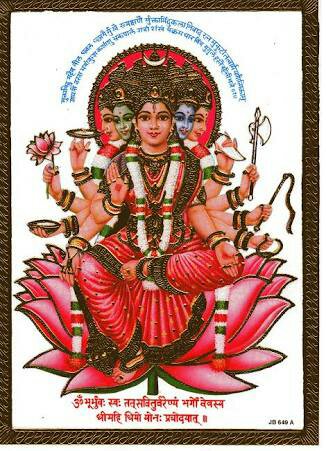
    Meditate on the Goddess Gaaytri with five heads, sitting in a pond on a red lotus flower. She wears a red sari and is beautiful. Her heads are pearl, coral, gold, blue, and white in color. Gaayatrii has three eyes and wears the cresant moon upon Her head. She has ten arms. She makes the mudra dispelling fear (abhaya mudra), and the mudra granting gifts (varada mudra), She holds a mace, a chakra, a conch, an ankusam, pasam, kapalam and two lotuses .

    Devi Gayatri’s five faces are white like pearl; one is red like coral, second is yellow like gold, third is blue like neelam, fourth white like milk, and the fifth is of ‘trinetra’ or three eyed. We meditate Her gem studded headgear with half- moon like jewel on Her Head,

    5) Reference, Book, Personal Collection:

    Sri Santhya Vandanam, Srivatsa Somadeva Sarma, Vaideega Dharma Vardani Publication, Chennai, Year 1952, Pages 9 to 13, Total Pages 116+20.

    6) Edited:

    There are different gayatri metre based mantras for different gods.

    http://www.stephen-knapp.com/gayatri_and… )

    The Gayatri Mantra appears in Rigveda 3.62.10 (Yajurveda Mantra 22.9, 30.2 & 36.3, Samaveda Mantra 1462). To distinguish this from others, this is ALSO called as Savitri Mantra as this contain the word Savitr.”


    Citation:

    https://in.answers.yahoo.com/question/index?qid=20110819223118AAv65jn


    Related articles

    Enhanced by Zemanta
  • How Many Letters In Gayatri Mantra Shankaracharaya

    I have delivered a Lecture in Chennai on Vedic Hinduism,Quantum Theory and Gayatri Mantra and its


    relevance in unlocking the Secrets of the Universe, on the occasion of the release


    of the Book ‘Downloading Nature’s Secret from Akasa to The Quantum Vacuum Field’.


    A detailed post on this follows.


    After the Lecture a young man approached me and asked that the number of letters in Gayatri Mantra add only to 28 and why do people say it has 24 letters?


    People , including me have been saying The Gayatri Mantra has only twenty-four letters.


    I asked him to search for it and he will find the answer by himself within twenty-four hours and if he does not


    find it I shall let him know.


    Gayatri Mantra in written Form Image Credit.http://www.gayatri.info/gayatri-mantra---word-for-word-translation
    The Gayatri Mantra


    My belief is that in Hinduism, the Sadahka has to find the things by himself and must resort to learning from


    others as a shortcut as a last resort.


    And something inside me told me that he would find it by himself.


    He agreed to do so.


    I came Home and checked whether I have posted any material .


    I had the impression that I had and I had not.


    I am posting the information now.


    In the composition of the Richas (couplets) of Veda s, meanings are subordinate to the syntax of words,’


    Gayatri essentially being a Chhandas ,Musical Notations are given importance over Meaning or Grammar.


    The chhandas (components of Veda  (classified according to number of letters) in the Veda s are composed


    to retain symphony as grasped by the Rishis to guide people in Realizing The Self.


    Those who recite in a Chhandas change the pitch while Intoning.


    The  difference between the “written” and pronounced “Nyam‘ in the Mantra lies in its sonic effect.


    The Vedas are Sabda Pramana, Sound as an Instrument of Knowledge


    ‘Nyam’ as a composite of ‘Ni’ and ‘Yam’ according to their musical notation, the first


    second and third segments of the Mantra add up to 8 words each.


    Adi Shankaracharya endorses this .


    The Pingal Shastra and Mantrartha Chandrodaya supporrtthis satnd on Gayatri.


    Mantra on the same principle.


    In this way, the letters in the Mantra are to be counted as follows:
    TAT SA VI TU VAR RE NI YAM BHA RGO DE VASYA DHI 1 1 1 1 1 1 1 1 1 1 1 1 1 1
    MA HI DHI YO YO NAH PRA CHO DA YAT 1 1 1 1 1 1 1 1 1 1 = 24


    The Shruthi is the Revelation  are not governed by Grammatical rules as they are grasped by The Rishis

    intuitively and Vedas are learnt only the word of mouth,by intonations and not through written form.


    Being timeless and Eternal The Vedas precede Grammar and hence this issue.


    Enhanced by Zemanta
  • Sandya Vandanam Text, Procedure Part 2-Hindu Rites.

    Sanyda Vandanam Part 2 Japam:

    This is done sitting cross-legged or in the Padmasana pose , sitting on a mat or wooden
    Palagai placed on the floor either on the shores of the river or inside the house. This is
    done facing east during pratha sandhya, facing north during madyannikam and facing
    west during sayam sandhya.
    1.Japa sankalpam
    Recite the following manthra slowly hitting the forehead with both fists together.:-
    Shuklambaradharam Vishunum Sasi Varnam ChathurBhujam,
    Prasanna Vadanam Dyayeth Sarva Vigna Upa Santhaye.
    *This prayer is not recited by Vaishnavas.They are requested to go to the next section.
    .Do Pranayamam.

    Hold both Nostrils with Thumb and the little and third finger of the hands and recite the
    following Manthra:-
    Om Bhoo
    Om Bhuva
    Ogum Suva
    Om Maha
    Om Jana
    Om Thapa
    Ogum Sathyam
    Om Tatsa vithur varenyam Bargo devasya dhi mahi dhiyo yona prachodayath
    Om Apa
    Jyothj rasa
    Amrutham brahma
    Bhoorbuvasuvarom
    Touch the ears three times saying
    Om, Om , Om
    Keep the right palm inside the left palm and keep the palms on the right thigh and
    recite the following manthra:-
    Mamo partha samastha duritha kshaya dwara, Sri Parameshwara preethyartham*,
    pratha sandhya gayathri maha manthra japam karishye (for madhyannikam instead tell”
    madhyaynika gayathri maha manthra japam karishye “and for evening sandhya
    vandhanam tell “sayam sandhya gayathri maha manthra japam karishye”)
    *Vaishnavas may instead tell “shri bhagavadaaGYayaa shriimannaaraayaNa priityartham.

    Pranava japam
    Pranavasya Rishi Brahma(touch the forehead with fingers), Devi gayathri
    Chanda(touch below the nose), Paramathma devatha(touch the middle of the chest)
    Bhooradhi saptha vyahrudeenam athri- brugu – kuthsa – vasishta – gowthama – kasyapa
    – aangeerasa rishaya ( touch forhead)
    Gayathree- ushnig- anushtup -brahathi –pankthi- trushtup- jagathi –chandamsi (touch
    below the nose)
    Agni- vayu- arka- vageesa- varuna- indra- viswe deva- devatha (touch the middle of the
    chest.)
    Do pranayama as given below ten times:-
    Hold both Nostrils with Thumb and the little and third finger of the hands and recite the
    following Manthra:

    Om Bhoo Om Bhuva
    Ogum Suva
    Om Maha
    Om Jana
    Om Thapa
    Ogum Sathyam
    Om Tatsa vithur varenyam Bargo devasya dhi mahi dhiyo yona prachodayath
    Om Apa
    Jyothj rasa
    Amrutham brahma
    Bhoorbuvasuvarom
    Touch the ears three times saying
    Om, Om , Om

    Gayathri avahanam
    Aayadithya anuvagasya vamadeva rishi(touch head), Anushtup chanda(touch below
    nose), Gayathri devatha (touch the middle of the chest)
    Aayathu varada devi aksharam brahma samhitham.
    Gayathri chandasam mathedam brahma jushaswana.
    Oojosi , sahosi ,balamasi, brajosi ,devaanaam dhama naamaasi . viswamasi,
    viswayu sarvamasi, sarvayu abhipoorom ,Gayathrim avahayami, Savithrim avahayami,
    saraswathim avahayami(while reciting the last three manthras, after avahayami, keep
    both the palms together with little fingers touching and then slowly take the fingers
    towards oneself , and bring it back to original position after one rotation)
    For Rik Vedis
    Om ithyekaksharam brahma. Agnir devatha brahma. Ithyarsham
    Gayathram chandam paramathmam swaroopam Sayjyam viniyogam
    Aayathu varada devi akshatram brahma samhitham.
    Gayathri chandasam mathedam brahma jushaswana.
    Oojosi , sahosi ,balamasi, brajosi ,devaanaam dhama naamaasi . viswamasi,
    viswayu sarvamasi, sarvayu abhipoorom ,Gayathrim avahayami, Savithrim avahayami
    saraswathim avahayami, chanda rishinaam avahayami, Sriyam avahayami, Gayathrya
    gayathrischando viswamithra rishi(touch forehead), savitha devatha(touch below nose),
    Agnir mugam brahma, siro Vishnu, hrudaya Rudra, shikaa pruthvi, yoni prana apana
    vyano dana samano sapranaa, Swetha varna, sankhyayana sagothra, gayathri cha dur
    visathyakshara tripada shadrushi pancha seershopanayane viniyoga.
    4.Gayathri nyasam
    Savithrya rishi brahma(touch the forehead), nichrud gayathri chanda(touch below the
    nose), savitha devatha( touch the middle of the chest)

    Gayathri japam
    Repeat 108 times the Gayathri facing east in the morning, west in the evening :-
    “Om Bhorbuvaswa, tat sa vithur varenyam , bhargo devasya deemahi, dhiyo yona
    prachodayath
    (take care that the manthra is not heard to any one and if possible without the lips
    moving. The counting is done by using japamala are counting 10 with using the thumb
    the ten phalanges except the bottom two of the ring finger. Some people insist that the
    counting should not be known to others and cover the counting hand with towel)
    Some people repeat Gayathri manthra only 54 times during madhayannikam,
    6.Gayathri upasthanam
    Do pranayamam and then stand up and chant
    Facing the same direction:-
    Pratha sandhyam upasthanam karishye(during pratha sandhya)
    Adithyam upasthanam karishye (during madyannikam)
    Sayam sandhyaupasthanam karishye (during sayam sandhya)
    Then repeat
    Uthame shikare devi , bhoomyam parvatha vardhini,
    Brahmanebhyo anugnanam , gacha devi yada sukham.
    7. Surya upasthanam
    During morning (pratha sandhya)
    For Yajur vedis
    Mithrasya charshanee drutha sravo devasya saanaseem,
    Sathyam chithra sravasthamam
    Mithro janan yathayathi prajanan mithro dhadhara prithveem udadhyam.
    Mithra krushti ranimisha bichashte sathyaya havyam krudavath vidhema
    Prasa mithra martho aasthu prayaswan yastha adithya sikshathi vrathena
    Na hanyathe na jeeyathe thwotho naina manho asnoth yanthitho na doorath
    For Rik vedis
    Mithrasya charshani drutho aavo devasya sanaasi
    Dyumnama chitra sravasthamam
    Mithro janan yathayathi bruvaano mithro dathaara prithveem udathyam
    Mithra srushtir nimishaa abhishte mithraaya havyam gruthava jjuhodha
    Prasamithra martho asthu prayaswaan yastha adhithya sikshathi vruthena
    Na hanyathe, na jeeyathe dwotho sannama aho asnodhyanthitho na doorath

    Jatha vedase sunavaama soma marathi yadho nitha hadhi veda
    Sa na parshathathi durgaani viswaa naaveva sindhum durithath yagni
    Pisanga brushti mam brunam pisasi mindra sam mruna
    Sarvam raksho nibarhaya (rotate hand over face)
    Badhram karnobhi srunyama deva
    Badhram pasye makmaa akshabir yajathraa
    Sthirai rangaisdushtuvaangsathaubhi
    Vyasema deva hitham yadayu(touch ears)
    Kesya agnim kesee visham kesi pibarthi rodani
    Kesi viswam swarduche keseetham jyothi ruchyathe(touch hair)
    For sama vedis
    Yaso aham bhavami brahmananaam yaso ragnam yaso visaam
    Yasa sathyasya bhavami
    Bhavami yasasaam yasa
    Adithya naava maroksham poornamparipadinim
    Achithram bharayishnaveem satharithraam swasthye om nama adithyaya
    Udyantham dwa aadithyanu deeyasam
    During noon (madyaneekam)

    For Yajur vedis
    Aasathyena rajasa varthamano nivesayan amrutham marthyancha
    Hiranyena savitha rathena aaadevo yathi bhuvana vipasyam
    Udvayam thamasaparee pasyantho jyothirutharam
    Devam devathra soorya maganma jyothiruthamam
    Uduthyam jatha vedasam devam vahanthi kethava
    Druse viswaya soorya
    Chithram devaana mudagaa daneekam chakshu mithrasya varunasyagne
    Aa praa dyaava pruthvi aanthareeksha soorya aathma jagathasthushacha
    Tachakshur deva hitham purasthath chakra mucharath
    For Rik vedis
    Aakrushno na rajasa varthamano nivesayan amrutham marthyancha
    Hiranyayena savitha ratheno devo yadhi bhuvanani pasyan
    Thachakshur devahitham purasthaschakra mucharath
    Pasyema sarada satham
    Jeevema sarada satham
    Hamsa suchishath vasur anathreeksha sath hotha vedishadathir drona sath
    Nrushatvarasath ruthasath vyomaasa thabja koja ruthaja adrija rutham bruhath

    Uduthyam jatha vedasam devam vahanthi kethava
    Druse viswaya sooryam
    Apathye dayavo yada nakshatrayandyakthubhi
    Sooraaya viswa chakshase
    Chithran devanam udagadaneekam chakshur mithrasya varunasyagne
    Aapradyava pruthvee anthareeksha soorya athma jagatha sthas dushacha
    That sooryasya devathvam than mahithwam
    Madhya karthor vidhatham sancha bhara
    Yadeda yuktha haridas sadasthath
    Aadrathri vasa sthanu they simasmai
    Than mithrasya varunasya abhi chakshe
    Sooryo roopam grunuthe dyo roopasthe.

    For Sama vedis
    Aadhithya navamaroksham poorna maparipaddhineem
    Acchithram bharayishnaveem sadarithraam swasthaye
    Om nama adithyaya , nama adhithyaya, nama adhithyaya
    Uduthyam jatha vedasam devam vahanthi kethava
    Druse viswaya sooryam
    Chithram devaanam udaganeekam chakshur mithrasya varunasyagne
    Aa pra dyava pruthvi anthareeksha soorya athma jagadas tha dushacha
    Thachkshur deva hitham purasthac chukramussarth
    Om bhorbuvaswarom
    Soorya iva druse bhooyasam agneeriva thejasa, vayuriva pranena, soma iva ganthena,
    brahaspathher iva budhya, aswina iva roopena, indragni iva balena, brahma bhaga
    evaham bhooyasam paap mabhaga me dwishantha.

    During evening (Sayam sandhya)
    For Yajur Vedis;

    Imam me varuna sruthi hava Madhya cha mrudaya
    Thvaam mavsyu rachake
    Tathwayami brahmana vandamanas thadhasaasthe yajamano havirbhi
    Ahedamano varuneha bhodyurusa sa maa na aayu pramoshi
    Yacchidithe visho yadha pradheva varuna vratham
    Minimasi dyavi dyavi
    Yat kinchedam varuna daivye jane abhidroham manushyascharamasi
    Achithee yath thava dharma yoyopima maa nasthasma thenaso deva reerisha

    Kitha vaso yad riripur na dheevi yad vagha Sathya muthayanna vidhma
    Sarvaa thaa vishya sithireva devathaa the syama varuna priyasa
    For Rik vedis
    Imam me varuna sruthi hava Madhya cha mrudaya
    Thvaam mavsyu rachake
    Tathwayami brahmana vandamanas thadhasaasthe yajamano havirbhi
    Ahedamano varuneha bhodyurusa sa maa na aayu pramoshi
    Yacchidithe visho yadha pradheva varuna vratham
    Minimasi dyavi dyavi
    Yat kinchedam varuna daivye jane abhidroham manushyascharamasi
    Achithee yath thava dharma yoyopima maa nasthasma thenaso deva reerisha
    Kitha vaso yad riripur na dheevi yad vagha Sathya muthayanna vidhma
    Sarvaa thaa vishya sithireva devathaa the syama varuna priyasa
    Jatha vedis sunavaama soma maarathi yadho nitha hadhi Veda
    Sa na parshathathi durgaani viswaa naaveva sindhum durithath yagni
    Pisanga brushti mam brunam pisasi mindra sam mruna
    Sarvam raksho nibarhaya (rotate hand over face)
    Badhram karnobhi srunyama deva
    Badhram pasye makmaa akshabir yajathraa
    Sthirai rangai sdushtuvaan sasathaubhi
    Vyasema deva hitham yadayu(touch ears)
    Kesya agnim kesee visham kesi pibarthi rodani
    Kesi viswam swarduche keseetham jyothi ruchyathe(touch hair)

    For Sama Vedis
    Yaso aham bhavami brahmananaam yaso ragnam yaso visaam
    Yasa sathyasya bhavami
    Bhavami yasasaam yasa
    Adithya naava maroksham poornamparipadinim
    Achithram bharayishnaveem satharithraam swasthye om nama adithyaya , nama
    adhithyaya , nama adithyaya
    Prathi thishtantham thavar adhithya anu prathi thishtassam.

    Samashti abhivadanam
    Starting from the direction facing which the japa was done after each manthra turn 90
    degrees to the right. Say the next manthra and so on.
    Sandhyayai nama

    Savithryai nama
    Gaythryai nama
    Saraswathyai nama
    Then chant with folded hands facing the same direction
    Sarvebhyo devathabhyo namo nama
    Then chant facing the same direction
    Kamo karshed manyura karshed namo nama.
    Then touch with both hands the ears slightly bow and chant
    Abhivadaye (tell your rishis)
    2
    (tell number) Risheya
    (tell your pravara) pravaranvitha
    (tell your Gothra)gothra
    (tell your Suthra)suthra
    (tell your Veda)adhyay1
    Sri (tell your name) sarmanam aham asmibho

    After this touch your feet with both hands and do namaskaram.

    Some examples of pravara rishis
    Gothra pravara rishaya
    Athreya Athreya Archanaanasa, syavaaswa traya risheya
    Naidruva kasyapa Kasyapa, Avathsara, Naidruva traya risheya
    Gargeya Aangeerasa, Chainya, Gargya traya risheya
    , Aangeerasa, Barhaspathya, Baradwaja, Chainya-Gargya pancharisheya
    Koundinya Vasishta, Maithra varuna, Koundinya traya risheya
    Koushika Vaiswamithra, Aagamarshana, Koushika traya risheya
    Gowthama Aangirasa-aayasya-gowthama traya risheya
    Baradwaja Aangeerasa, Barhaspathya, Bharadwaja traya risheya
    Haritha Aangeerasa, Ambareeksha, Younaswa trayarsheya
    Sounaka Garthsamadha Ekarsheya
    Chandilya Kasyapa, Aavathsara, Naidruva, Reba, Saptha risheya
    Raibha, Choundilya, Chandilya

    Dik devatha vandhanam
    With folded hands offer salutations to the different directions facing that direction:_
    Pracyai dishe nama (east)
    Dakshinayai dishe nama (south)
    Pradeechai dishe nama ( west)
    Udichyai dishe nama (North)
    Then again face the direction in which you were doing japa and continue.

    Oordwaya nama (above)
    Adharaya nama (below)
    Anthareekshaya nama (straight)
    Bhoomyai nama (earth)
    Brahmane nama
    Vishnave nama
    Mrutuyuve nama
    10. Yama vandanam
    Yamaya nama
    Yamaya dharma rajaya , mrutyuve cha anthakaya cha
    Vaivaswathaya kalaya sarva bhootha kshayaya cha
    Oudhumbharaya dhagnaya neelaya parameshtine
    Vrukodharaya chithraya chithra gupthaya vai nama
    Chithra gupthaya vai nama om nama ithi

    Harihara vandhanam
    Ruthagum sathyam para brahma purusham Krishna pingalam,
    Oordhwrethwam viroopaksham Viswa roopaya vai nama
    Viswa roopaya vai nama om nama ithi
    12.Soorya Narayana vandhanam
    Nama savithre jagadeka chakshushe,
    Jagat prasoothi sthithi naasa hethave,
    Trayin mayaya trigunathma dharine
    Virinchi Narayana sankara athmane
    Dyeya sada savithru mandala Madhya varthi
    Narayana sarasijasana sannivishta
    Keyuravan makara kundalavaan
    Kiriti haari hiranya vapur drutha sankha chakra
    Sanka chakra gatha pane dwaraka nilayachythe
    Govinda pundarikaksha raksha maam sarana gatham
    Aakasath pathitham thoyam,
    Yada gachathi sagaram,
    Sarva deva namaskara
    Sri kesavam prathi gachathi,
    Sri kesavam prathi gachathi om na ithi

    Some families face the North after this and chant the following Sarpa Raksha Manthram:-
    Narmadayayi Nama-Prathar narmadayai namo nisi
    Namosthu narmadhe thubhyam trahi maam visha sarpatha
    Apa sarpa sarpa bhadram the Dooram gacha maha yasa
    Janamejayasya yagnanthe aasthika vachanam smaran
    Jarath karer Jarath karvam samuthpanno maha yasa
    Aasthika Sathya santho maam pannagebhyo abhi rakshathu.
    Then do sashtanga pranamam after reciting Abhivadaye as explained above.
    Vaishnavites recite the following manthra before Abhivadaye in addition: –
    Namobrahmanya devaya Go brahmana hithaya cha,
    Jagathidaya krishnaya Govindaya namo nama
    Sree ranga mangala nidhim karuna nivasam Sree Venkadadri Shikaralaya kala megam
    Sree Hasthi saila Shikarojwala Parijatham Sreesam namami sirasa yadu saila deepam.

    Samarpanam
    Take a small quantity of water recite the following manthra and pour it on the ground
    Kaye na vacha manase indriyair va
    Budhyathma nava prakruthai swabhavat.
    Karomi yadyat sakalam parasmai ,
    Narayana yethi samarpayami
    Then do aachamanam
    14. Raksha
    Sprinkle some water on the place where japa was [performed reciting the manthra below,
    then touch the ground with ring finger and place it between the eyelids.
    Adhya no deva savitha praja vath saavee soubhagam
    Para duswapneeya suva
    Viswani deva savitha –durithani paraa suvaa
    Yad bhadram thama asuva

    * Mantras for all the Vedas are menioned her.For Sukla Yajur Vedis please refer your Family priest .ome books are also available.

    Related.

    http://ramanisblog.in/2012/10/03/sandya-vandan-sandya-vandanam-textposturesprocedure-i/

    http://ramanisblog.in/2012/10/03/sandhya-vandanam-explanation-part-i-hindu-religious-rite/

    http://ramanisblog.in/2012/10/03/sandya-vandana-mantra-first-part-recital-audio/

    Enhanced by Zemanta