Tag: Damaru

  • Tamil Sanskrit From Shiva’s Damaru Simultaneously

    Tamil Sanskrit From Shiva’s Damaru Simultaneously

    I have been trying to find out, through my research over nine years, among other things, which language is more ancient, Tamil or Sanskrit.

    I should have been more careful and modest about searching for things which are ancient and honestly speaking beyond one’s capabilities.

    This, I have learnt though my research on the antiquity of Tamil and Sanskrit.

    I found that Tamil, generally assumed to be later than the Vedas, Ithihasas, Ramayana and Mahabharata and Puranas, to be older than these.

    Vedas, Ramayana, Mahabharatha and the Eighteen Puranas speak of Tamil.

    Hence Tamil should have preceded them.

    Yet the earliest known Tamil work, Tholkappiyam speaks about Vedas and its author Tholkappiyam declares himself to be a Brahmin and a disciple of a Brahmin, Aadhankottu Aasan, Teacher from Aadhankodu.

    Then we have Sage Agastya, who is recorded as having received Tamil from Lord Shiva.

    Agastya is considered to be the Co founder of Tamil Language along with Lord Shiva and his first grammar Agathiyam is lost to us. INDIRIndira

    Then there is another Tamil grammar work, Aindiram, reported to be written by Maya, the Architect of the Devas.

    This could be the reason for Tamil presence in Atlantis which is regarded to have been built by Maya.

    This is also lost.

    There is also a view that Aindiram was By Indira , Chief of Devas.

    Agastya us dated around 5000 BC, based on Star Canopus, called Agastya Nakshatra in Tamil by the Siddhas.

    Based on the same star movement and tectonic shift of the earth’s plate, date of Shiva Uma marriage and Shiva’s ordering Agastya to move over to South, this date can be pushed back to forty lakh years ago, 40,00000 years!

    Mind boggling!

    Thiruvannaamalai, Tamil Nadu, India is dated by archeology, to be 3.94 billion years old and it is the abode of Lord Shiva and the the mountain that exists in all the Yugas, aeons.

    Then one finds the age of Lord Nataraja, form of Shiva at Jwalapuram, Cuddappah, Andhra Pradesh (or Telengana ) ‘India to be 74,000 years old as validated by Mount Toba’ s emissions.

    There is a million year old advanced Tamil Civilization site in Chennai.

    The archaeological remains of Poompukaar, Tamil is dated 30,000 years!

    So the antiquity of Tamil and Sanskrit go back to vast stretches of Time.

    So I gave up trying to find out which is older, Tamil or Sanskrit, with the conviction that both go back to very vast stretches of Time, both quote each other.

    Period.

    As to the origin of Sanskrit, it is from Shiva’s Damaru, a musical instrument, adorned by Shiva.

    The sound of Damaru created Sanskrit and it was compiled as Maheswara Suktha.

    This was revealed to Panini and Agastya.

    IT may be noted that Agastya is the father of Tamil, along with Shiva.

    Panini gave Sanskrit.

    As Tamil and Sanskrit seem to go way back, seem to be coexistent, the Tamil Grantha Lipi seems to be common to Sanskrit, Tamil could have been revealed by Shiva simultaneously at the time of revealing Sanskrit in the form of Maheswara Sutra.

    The Tamil and Sanskrit Grammar are said to have been revealed simultaneously to Agasthya and Panini by Lord Shiva! Though the literary proof for this claim can be had only in the post 15th century AD period, it cannot be denied that both Tamil and Sanskrit grammar have commonality in many ways.‘( Jayasree saranathan Blog )

    The sages recorded this Sanskrit transmission using the Grantha alphabet, as instructed by the Lord. The great Tamil Saint Manikkavasagar also sings, in Tamil, of this revelation by Lord Siva to the sages in the “Kirti Tiruvagaval” of his Tiruvasagam.

    The Grantha script is akin to Tamil. One can see the similarity in letters, such as u, o, ka, ta, tha, na, pa, va, yaand ra, etc., in the two scripts. There are also hundreds of common words found in both Tamil and Sanskrit. Many words appear in their pure Tamil form in the Sanskrit Agamas, Silpa Sastras and related scriptures.

    In his Tirumantiram, Rishi Tirumular talks of an ancient time of cold climate in India, which some conclude points to an indigenous Indian civilization extant as far back as the last ice age, 11,000 years ago, in areas that may now be submerged. It was then, he writes, that Lord Siva revealed the essential scriptures in Sanskrit and Tamil simultaneously to the body of learned scholars (verse 109). The term used by Tirumular to denote Sanskrit is ariyam (arya). The ancient indigenous people who were using this arya language to communicate among themselves were called the aryas. They never migrated into India from outside, nor to the South from the northwest.

    https://www.hinduismtoday.com/modules/smartsection/item.php?itemid=5686

  • Shiva His Ornaments Description And Meaning.

    Shiva His Ornaments Description And Meaning.

    The description of Lord Shiva in Hinduism is unique.

    1.Shiva has both Invisible,Without Form,Aroopa and with Form.

    There is a temple in Avudayar Koil,Tamil Nadu,where the Shiva’s Sanctum is Empty,denoting Invisibilty.There is Chidambaram,Tamil Nadu,where the Serect Sanctum is empty.

    2.Shiva ,as a symbol,in between being invisible and visible with human form,is Linga.

    3.Shiva also has human form .

    4.He is also described as a Yogin,Adi Yogi,the first one to present and practice Yoga.

    5.Unlike the Avatars of Vishnu,He is never born of a womb.

    6.His 64 Avatars as described in Tamil Classics represent the 64 principles of th Universe,as enumerated in Saiva Siddantha.

    His physical description and his ornaments are expressions of the Universe.

    His famous names.

    • Mahadeva (The Supreme Lord : Maha = great, Deva = God – more often than not, the Aghora (fierce) version)
    • Rudra (The one who howls or strict and uncompromising)
    • Maheshwar (The Supreme Lord: Maha = great, Eshwar = God)
    • Rameshwar (The one whom Ram worships: Ram, Eshwar = worships, God; Ram’s God)
    • Mahayogi (The Supreme Yogi: Maha = great, Yogi = one who practices Yoga)
    • Mahabaleshwar (Great God of Strength: Maha = great, Bal = strength, Eshwar = God)
    • Trinetra (Three-Eyed One, i.e. All-Knowing: Tri = three, Netra = Eye)
    • Triaksha (Three-Eyed One, i.e. All-Knowing: Tri = three, Aksha = Eye)
    • Trinayana (Three-Eyed One, i.e. All-Knowing: Tri = three, Nayana = Eye)
    • Tryambakam (Three-Eyed One, i.e. All-Knowing: Tri = three, Ambakam = Eye)
    • Mahakala (Great Time, i.e. Conqueror of Time: Maha = three, Kala = Time)
    • Neelakantha (The one with a Blue Throat: Neel = blue, Kantha = throat)
    • Digambara (One who has the skies as his clothes, i.e. The Naked One: Dik = Clothes, Ambara = Sky)
    • Shankara (Giver of Joy)
    • Shambhu (Abode of Joy)
    • Vyomkesha (The One who has the sky as his hair: Vyom = sky, Kesha =hair)
    • Chandrashekhara (The master of the Moon: Chandra = Moon, Shekhara = master)
    • Siddheshwara (The Perfect Lord)
    • Trishuldhari (He who holds the divine Trishul or Trident: Trishul = Trident, Dhari = He who holds)
    • Dakhshinamurthi (The Cosmic Tutor)
    • Kailashpati (He whose abode is Mount Kailash)
    • Pashupatinath (Lord of all Creatures)
    • Umapati (The husband of Uma)
    • Gangadhar (He who holds the river Ganga)
    • Bhairava (The Frightful One)
    • Sabesan – Lord who dances in the dais
    • (  http://veda.wikidot.com/shiva ) These names are from the Shiva Sahasranama.


    Shiva is portrayed as the color of Red Embers,sitting in Deerskin, representing the Active emotional nature,Rajo Guna being controlled by Sathva,the Calm naure expressed by Deer Skin.

    Shiva is also described as White in color, Swetha,representing Sathva,Pure.

    In this description He sits on Tiger skin,which represents Rajas,indicating one can master the impulsive nature by Calmness,Satva Guna.

    Shiva,being in Smasana,the Burning ghat,is Hot.

    Therefore, He is worshipped with Bilva leaf,which cools.

    The Bilva leaf has three leaves in a cluster.

    The three leaves forming a part on one Bilva leaf express the Three Attributes of Jiva, the Individual Self.

    These three are,

    Pasu, The Brahman as Individual Self,

    Pathi, The Universal SelfBrahman and

    The Paasa, attachment to things worldly.

    Vishnu is Cool in the Ocean of Milk,Ksheera Sagar.

    He is worshipped with Tulsi,which is hot.

    Shiva has maatted locks,he is called Jatadhara.

    These locks of intertwined hairs represent the countless thought which overlap each other ,leading to Confusion of the Chitta.

    These thoughts can be controlled by raising the Kundalini,which lies in the Solar Plexus,Mooladhara to the Centre of the forehead Sahasrara.

    That is Shiva’s Third Eye,

     Trinetra represents Sahasrara.

    Shiva wears the horizontal,parallel white lines across His forehead.

    These lines are to remind one that ‘Dust Thou Art,dust Thou shall retuneth.

    And these three lines also indicate the three fundamental units/forces of the Universe.

    Motion,Non motion and their being held in balance.

    Purusha,the Kinetic Energy,Prakriti,the Potential energy and the Sparsa,the initial contact that evolves the Universe.

    The Universe is constantly in Motion and is born of Motion.

    Which precedes Motion or Sound/Vibration?

    Vibration is caused by Sound or is it the other way?

    Out of Vibration is born Sound.

    Sound is expressed as Language.

    Shivas Damaru,Drum represents Vibration and Sound.

    His Damaru produced Sanskrit in. The form of Maheswara Sutras.

    There are two types of Damaru, Skull Damaru and Chod Damaru.

    Shiva's Damaru emits Maheswara Sutras..jpg.
    Maheswara Sutras from Shivas’ Damaru

    https://ramanisblog.in/2015/01/17/sanskrit-from-shivas-damaru-maheswar-sutras/

    Shiva wears the Moon in its Phase on His head.

    Moon is responsible for the activity of the Mind and it has to be controlled by Chitta to realize Self.

    The Chitta is on a higher plane of mind.

    Shiva’s Trident.

    It represents the the three basic tools of performane.

    Icha Sakthi,desire to act,

    Kriya Sakthi,the Action and 

    Gnana Sakthi,the discriminating power to coose action.

    Shiva’s Earrings.

    These are in the shape of Snakes.

    In Yoga,two nadis,the path of Prana are described.

    The Ida and Pungala,the breath that passes through the left nostril and through the right respectively.

    They have to be equal and in Unison to Realize Self.

    Snake around the neck represent the desires that bind us to the world as mill around the neck.

    Ganga,the river and Rudraksha of Shiva express the physical tools to purify the body.

    • Om Namasthesthu Bhagavan
    • Visveswaraya Mahadevaya
    • Trayambakayah Tripuranthakaya Trikalagni-kalaya
    • Kalagni-Rudraya Nilakantaya Mrityumjayaya Sarveshwaraya
    • Sadasivaya Sriman Mahadevaya Namah!!
  • Sanskrit From Shiva’s Damaru Maheswar Sutras

    Tamil Classical literature and Tamil grammar Texts Agathiyam and Tholkaapiyam declare that Tamil Language was revealed by Lord Shiva as the Language of Mortals,Manusha Basha.

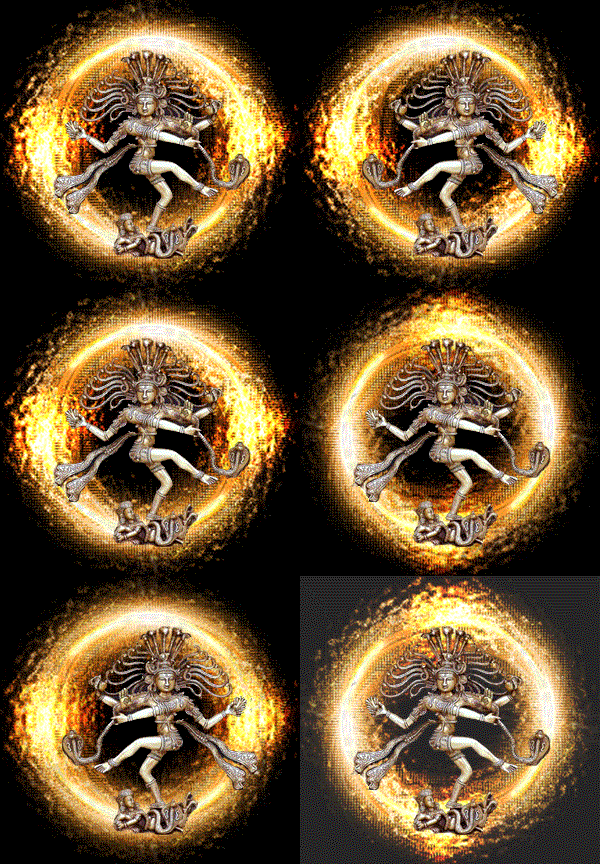
    Nataraja .gif
    Nataraja, A Form of Lord Shiva

    This, Lord Shiva, is reported to have given to Sage Agastya and Lord Shiva presided over the first Conclave of Tamil Poets.

    The second conclave of Tamil Poets was presided over by  Lord Subrahmanya, who is called Muruga in Tamil, the term Murugu in Tamil meaning ‘Exquisite Beauty’, which might denote both Muruga and Tamil.

    The Tamil language is so organised that the Form of Muruga is represented by the Tamil Language.

    I shall be posting on this.

    Now I have come across the information that Sanskrit Language, which the Puranas describe as the Language of Gods, was from the sound of Lord Shiva’s Damru, a percussion instrument which adorns Lord Shiva’s hand.

    After completion of His Cosmic dance,Shiva sounded His Damaru as the Universe was being created.

    These sounds create maintain regulate and destroy the Universe.

    Semen and Sound are mentioned as the Creative Force  of the Universe.

    Lord Subrahmanya is worshiped as the embodiment of both.

    Nada Bindu Kaladi Namo.

    Bindu may be translated as Semen in the physical plane and as stages of spiritual development in Nada Yoga.

    “A damaru (Skt.damaru; Tibetan ཌཱ་མ་རུ; Devanagari: डमरु) or damru is a small two-headed drum, used in Hinduism and Tibetan Buddhism.Damru is known as the instrument of Lord Shiva. Damru was first created by Shiva to produce spiritual sounds by which this whole universe has been created and regulated…

    In the Tibetan Buddhist tradition, the damaru is part of a collection of sacred implements and musical instrument was adopted from the tantric practices of ancient India. These reached the Land of Snows from the 8th to 12th century, persisting in Tibet as the practice of Vajrayana flourished there, even as it vanished in the subcontinent of India…

    There are two types of Damaru, Skull Damaru and Chod Damaru.

    Shiva's Damaru emits Maheswara Sutras..jpg.
    Maheswara Sutras from Shivas’ Damaru
    Shiva Sutras, 14.gif
    The FortennVerses Of Maheswara Sutra.

    The Maheshwara Sutra is the most ancient known Sanskrit alphabet sequence. This alphabet sequence is at the same time a powerful Mantra and the vibrations of its sound has healing powers.

    1. अ इ उ ण् |
    2. ऋ ऌ क् |
    3. ए ओ ङ् |
    4. ऐ औ च् |
    5. ह य व र ट् |
    6. ल ण् |
    7. ञ म ङ ण न म् |
    8. झ भ ञ् |
    9. घ ढ ध ष् |
    10. ज ब ग ड द श् |
    11. ख फ छ ठ थ च ट त व् |
    12. क प य् |
    13.श ष स र् |
    14. ह ल् |

    The fourteen sutras contain all the letters of the Sanskrit varnamala- the svaras (vowels) a, i, u, R^i, lR^i, e, ai, o, au and all the vyanjanas (consonants). As per the Rig Veda Lord Shiva brought this Sanskrit alphabet sequence, and the Sanskrit language to earth. The sounds of the alphabet originated from Lord Shiva’s ‘damru’, probably some kind of a sound device.

    Citation.

    http://vediccafe.blogspot.in/2012/08/the-sanskrit-alphabet-sequence.html