Tag: Vadakalai

  • Thenkalai Origin Details History of Vaishnavism Part 4

    Thenkalai Origin Details History of Vaishnavism Part 4

    I have written on the background of Vaishnavam in my three preceding articles.

    In this article ,I shall present the origin and history of the two forms of Vishnu worship in South India,Dravida Desa.

    As mentioned in my earlier articles on this subject,Vedas speak of Reality, Brahman as a Principle,beyond words and thoughts.

    One has to Realise It by Discerned Wisdom,Gnana and Determination,Vairaagya.

    However, realising that Human mind,human nature being limited and is not equipped to Realise Brahman,Vedas have provided worship of individual Gods,who can be worshipped in line with disposition.

    This method of worship is Saguna Aradhana,while realising Brahman direct is called Nirguna Aradhana.

    Nirguna Aradhana is practiced as Gnana Yoga,more related to Mind.

    Saguna Aradhana is closer to Bhakti Yoga,the Path Of devotion.

    This Emotional Approach.

    Whatever be the method,the Goal is Realisation of Brahman.

    It can be through Saguna Aradhana or Nirguna Aradhana.

    Under Saguna Aradhana people might worship Shiva,Vishnu,Devi,Ganapathy,Subrahmanya….

    Because of this approach of the Vedas,there were numerous Gods right after the Vedic period and performance of Rituals were given priority,as detailed in Mimamsa,and this reached such proportions that there were sixty four systems of worship and the performance of Rituals gained priority over Knowledge and Realisation of Brahman.

    This confusion resulted in the ascendency of Jainism band Buddhism.

    Adi Shankaracharya,realising that the message of Vedas was being diluted,organised these myriad of practices into six six systems of worship.

    This is called Shanmatha,Six Systems.

    They are,

    Ganapathyam, worship of Ganesa,

    Saivam,Of Siva,

    Saaktham,of Devi,

    Vaishnavam, of Vishnu

    Kaumaaram,of Subrahmanya and

    Saura,of Sun,Surya.

    Worship of Vishnu is Vaishnavam.

    Worship of Gods was in Sanskrit as the Vedas are in Sanskrit.

    Though there were about fifty six kingdoms in ancient India, Prakrit was the Link language,though there were local languages in different parts of India.

    Tamil, Telugu,Kannada,Bengali..

    Of these, according to available information,Tamil is older.

    The timeline of Tamil and Sanskrit run parallel.

    When people Worship as ordained by Vedas, simultaneously they also worshipped in the local language,mother tongue.

    The Bhakti Bhava is more compatible with one’s mother tongue.

    Hence many Saints practicing Bhakti Yoga,left behind their experiences of Godhood in Local languages.

    These remain at the regional level and are practiced even today.

    Thus we have Bengal ,Assam,Odisha following the Bhakti Bhava practices from Bengali and Oriya primarily in the East,North East of India.

    In the West Marathi Bhava is in place.

    When one comes to the south of India,from the Vindha mountains to south, Dravida Desa,Tamil Bhakti Bhava has been in practice,and others came later.

    As Tamil was in vogue during Vedic,Puranic and Ithihasa times,the Devotional aspect has been there for quite long.

    The experiences of Saints,thus recorded in Bhakti Bhava in Tamil formed the nucleus of Worship of Vishnu in a different pattern.

    The Azhwars,those who are immersed in Vishnu,are the founding fathers cas it were for the sects that came into being vin Tamil Nadu, Karnataka,Andhra and Kerala.

    The Azhwars are twelve in number.

    Some of them predate Christ.

    Read my article Andal date 3000 BC?

    She is the last in line of the Azhwars.

    Other Azhwars could also be dated back than the dates assigned to them at present.

    So compelling and soul stirring were the compositions of Azhwars,The Bhakti cult in Tamil starts from Azhwars,who are dated to middle ages or slightly before it.

    I do not agree with this date as my study indicates that they belong to much earlier period.

    So there was this concurrent worship of Vishnu both in Sanskrit and Tamil.

    When Ramanujacharya,Propounder of Visishta Advaita, Qualified Non Dualism,he gave priority to Tamil .

    His disciples carried on this practice and the system of Thenkalai was carried on.

    Though Nathamuni who first started this,Ramanujacharya took this system forward and made it popular .

    So ,taking Ramanujacharya, Nathamuni as the benchmark,the Thenkalai system may be dated to Ramanujacharya Nathamuni period.

    That is Tenth century AD.

    But one can not say it began with him as these poems of Azhwars were in place before his time and people were worshipping in Tamil Earlier on the lines of Azhwars.

    What one can say is that Ramanujacharya systematised this .
    Sri Vaishnavism developed in Tamil Nadu in the 10th century.It incorporated two different traditions, namely the tantric Pancaratra tradition and the puranic Vishnu worship of northern India with their abstract Vedantic theology, and the southern bhakti tradition of the Alvars of Tamil Nadu with their personal devotion. The tradition was founded by Nathamuni (10th century), who along with Yamunacharya, combined the two traditions and gave the tradition legitimacy by drawing on the Alvars. Its most influential leader was Ramanuja (1017-1137), who developed the Visistadvaita (“qualified non-dualism”) philosophy.Ramanuja challenged the then dominant Advaita Vedanta interpretation of the Upanishads and Vedas, by formulating the Vishishtadvaita philosophy foundations for Sri Vaishnavism from Vedanta.ri Vaishnavism developed in Tamil Nadu in the 10th century. It incorporated two different traditions, namely the tantric Pancaratra tradition and the puranic Vishnu worship of northern India with their abstract Vedantic theology, and the southern bhakti tradition of the Alvars of Tamil Nadu with their personal devotion. The tradition was founded by Nathamuni (10th century), who along with Yamunacharya, combined the two traditions and gave the tradition legitimacy by drawing on the Alvars. Its most influential leader was Ramanuja (1017-1137), who developed the Visistadvaita (“qualified non-dualism”) philosophy. Ramanuja challenged the then dominant Advaita Vedanta interpretation of the Upanishads and Vedas, by formulating the Vishishtadvaita philosophy foundations for Sri Vaishnavism from Vedanta.

    Source.

    https://en.m.wikipedia.org/wiki/Vaishnavism

    Nathamuni.
    Nathamuni is generally considered to have been born in 823 AD and to have died in 924 AD. His birth name was Aranganathan however he was known as Nathamuni or literally the Saint lord (Nathan-lord, muni-saint) An alternative view is that he was born in 582 AD and died in 922 AD.Yet another view is that Nathamuni was born at Viranarayana Puram sometime shortly after 907 AD and flourished in the 10th century.The traditional view that he lived for than 400 years is untenable. It is likely that Nathamuni lived for slightly over a hundred years in that region controlled by the Chola kings before they rose to the peak of their greatness.His birth star was Anusham

    ..
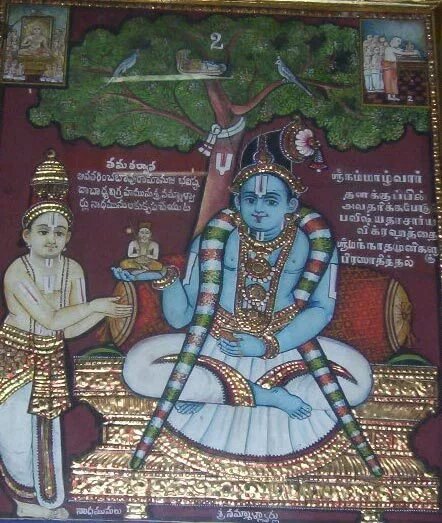
    He spent time travelling in north IndiaHe came to know about Nalayira Divya Prabhandam, but he heard only 10 hymns. He wanted the rest. He recited 12000 times, Kanninun Siruthambu, a poem in praise of Nammazhwar. Nammazhwar appeared and gave the 4000 hymns(Nalayira Divya Prabhandam). He was the one who brought back the 4000 hymns. In addition to teaching the hymns to his two nephews at Srirangam, he introduced them into the Srirangam Temple Service at the Sri Ranganathaswamy Temple, Srirangam where he was the Temple Administrator.

    The story goes that Nathamuni, while at the Vishnu temple at Mannargudi, his native place, heard some Brahmins from the Southern end of the Peninsula recite Tamil verses of Satakopa addressed to the Vishnu God of Kumbhakonam and was charmed with their sense and diction. He also found that these verses concluded with the words “These 10 out of the thousand, composed by Satakopa”.Nathamuni thus placed in the track of research seems to Haven finally recovered the whole of Satakopa’s works and then rearranged them and the extant works of the other Alwars into four collections of about a thousand stanzas each.

    Source.

    https://en.m.wikipedia.org/wiki/Nathamuni

    * I have not touched upon the philosophical imports of each sect.

    I will be writing on this aspect shortly.

  • Ayyangar Vadakalai Thenkalai Vaishnavam History Part 1

    Ayyangar Vadakalai Thenkalai Vaishnavam History Part 1

    I have been postponing writing about the Perceived sub divisions in Hinduism as it is likely to be misinterpreted by vested interests.

    However it is necessary to record facts about Hinduism, without prejudice.

    Before understanding about the divisions in Hinduism,one must first study the Vedas,the highest authority in Hinduism.

    None of Hindu sects question the Authority of the Vedas,Sruthi as a means of Knowledge.

    Knowledge,to Hindus,is of two kinds.

    Para Vidya and

    Apara Vidya.

    Para Vidya is Real Knowledge or Absolute Knowledge.

    This is transcendental.

    It is not relative Knowledge.

    Apara Vidya is the knowledge that relates to our daily activities.

    This is Relative knowledge.

    Here the knowledge is not Absolute.

    It is dependent on various factors.

    This is transient knowledge.

    This does not lead to realisation of Self.

    Sciences and all disciplines are relegated to this category in Hinduism.

    They are considered as lower knowledge.

    Vedas speak of Para Knowledge.

    That is the Absolute knowledge gleaned by the Seers,Rishis and they have recorded it.

    Knowledge derived from Vedas ,declare Vedas are Real and Vedas are considered to be the Breath of Reality.

    Brahman,the Reality is a Principle,beyond description.

    Avaktavya.

    It is beyond mind,senses.

    Beyond space and time.

    It can be experienced,not known,in the Cognitive sense.

    Vedas,though there are various deities invoked in them,speak of one Reality,as expressed in the Four Mahavakyas,Four Great Truths,Sayings.

    Tatvam Asi,That Thou Art,

    Aham Brahmasmi,I am Brahman,

    Soham Asmi,He Is That,

    Pragyaanam Brahma,Brahman is Consciousness.

    This is the Core of the Vedas.

    However many deities are mentioned and mantras to worship them are provided.

    This type of worship is called Saguna Aradhana, Worship of Personal God.

    This is considered as lower knowledge.

    Higher knowledge is that which enables one to realise Brahman.

    Worship of Brahman,with the purpose of Realising It,as One Beyond Attributes,is called Nirguna Aradhana.

    This is higher knowledge.

    However one should not consider Saguna Aradhana as Inferior.

    One can find in Vishnu Sahasranama and Lalitha Sahasranama both Saguna Aradhana and Nirguna Aradhana are found.

    In Lalitha. Sahasranama,these form separate chapters.

    It is one level.

    Contemplating on Abstract Principle is difficult for the Human Mind.

    It needs a point to contemplate,at the initial stages.

    Once one continues Saguna Aradhana,one would automatically proceed to Nirguna Aradhana.

    One has to keep these points in mind before attempting to understand divisions in Hinduism.

    Various systems in Indian philosophy follow these Mahavakyas and the differ in interpreting them.

    It is one Perspective.

    Reality has many Perspectives.

    So we have,

    1. Saivam,
    2. Vaishnavam,
    3. Saaktham,
    4. Kaumaaram,
    5. Souryam and
    6. Ganapathyam.

    As many deities are mentioned, many systems of worship came into being and at one point of time there were over 64 Systems.

    Adi Shankaracharya classified them into the above mentioned six systems.

    The Vedas do not speak of Shaivam or Vaishnavam.

    Later based on who was worshiped, names of sects came into existence.

    So tecnicaly speaking, there is no authority of the Vedas to call one Shaiva or Vaishnava.

    However Smritis have formulated rules for worship.

    But Smriti is not the Final Authority.

    Veda is.

    One who follows Smriti is a Smartha.

    That’s All.

    He may worship Shiva or Narayana.

    This system of worship continued along with Worship of Brahman as Nirguna.

    Vedas are in Sanskrit.

    Tamil,a language of India which is as old as Sanskrit and it is difficult to find out which precedes the other.

    Initially those who worship Narayana,Sri Vaishnavas gave first priority to Sanskrit.

    Later Tamil was given priority.

    It is said that Vedas follow Vishnu,while Vishnu Follows Tamil,alluding to the fact that,while the idol of Vishnu is in procession, those who chant Tamil Hymns from NalayiraDivya.Prabhabandha,precede the Idol,while Those who chant Vedas follow behind the Idol.

    Related.

    https://ramanisblog.in/2018/08/13/vaishnavam-history-part-2-siva-first-devotee-advaita-vaishnavam/

    https://ramanisblog.in/2014/12/11/types-of-vaishnava-sampradayas/

  • What Is Swayam Acharya Of Sri Vainshnavam

    What Is Swayam Acharya Of Sri Vainshnavam

    The Sri vaishavaites of some groupings follow the Swayam Acharya Sampradaya.


    I have a close friend who is a Swayam Acharya.


    Unfortunately, though he is a devout Iyengar,he was unable to say what it was excepting that he was following the Acharya of a Mutt.


    When I checked with some of m other Iyengar friends, they also did not have the details.


    I have referred some texts, the internet and am sharing the information.


    Suggestions for improvement is welcome.


    The earliest name the Puranas ascribe to those who worship Lord Vishnu is ‘Bhagavatha’


    Later it was meant to include those who follow Pancharatra.


    Please read my post on Pancharatra.


    Bhagavatha means one who sings. praises the Glory of Bhagwan, here it refers only to Vishnu,


    Technically this is incorrect as it refers any one who praises Bhagawan,


    Please read my post on Bhagwan, God in Hinduism.


    Equally incorrect to say that Ishwara refers only to Lord Shiva.


    Iswara means personal God , that’s all.


    Now to Swayam Acharya.


    Later when many Devathas were being worshiped, to distinguish those who worship Vishnu, the term Vaishnava was coined.


    As Vishnu is to be worshiped always along with Lakshmi, Sri, has been added.


    Thus was born the term Sri Vaishnava.


    Swayam Acharya means one who is an Acharya to himself.


    In the earlier days, when Brahmins were following all the duties of a Brahmin, including  Agnihotra, the tradition was handed over to the son.


    Thus the father becomes the first Acharya.


    In Upanayana, the Gayathri is first taught by the father.


    In all cases Father is the first Acharya.


    Sruthi says Pitru devo Bhava, Acharya Devo Bhava  in this context.


    Swayam Acharya sampradayam:
    In olden days, all the Vaishvaites were very orthodox, performing daily Agni Hothram in their houses. Therefore the father of the family himself was the Acharyan for the members of that family. He was initiating the members into Sri Vaishnava sampradayam by Samasrayanam process.

    Matams and Munitrayam sampradayam:
    Now a days, most of the family heads do not perform agni hotrams and follow the sampradayam very strictly. So for the purpose of Samasrayanam, we approach Matams. The matadhipathi/Swami/Acharya initiates us into sampradayam.


    Citation.

    http://www.ramanuja.org/sv/bhakti/archives/may99/0063.html


    http://ramanuja.wikifoundry.com/page/Sri+Vaishnavaite+Monastries


    This term is used for Sri Vaishnavas who are descendants
    of the original 74 disciples of Ramanuja, and who continue
    to have association with learned members of their extended
    family who administer the panca-samskAra (samASrayaNam) 
    and minister to their needs.  Many of our most learned
    acharyas came from "svayam-AchArya" families -- Desika,
    Pillai Lokacharya, etc. This is because the concept of
    a maTha and therefore a sampradAya based on the maTha
    dates from the 14th century, much after Sri Ramanuja's
    time.
    
    Some notable svayam-AchArya families are Prativaadi Bhayankaram,
    Tatacharya, Tirumalai Anandaanpillai, Nallaan Chakravarti, etc.
    There are many scholars among these families even today,
    as they have a strong sense of connection to the tradition
    and maintain a certain level of scholarship.
    
    Not all descendants of the 74 original disciples are still
    considered "svayam AchArya".  At some point, some of the  
    descendants drifted away from their traditional acharya or
    did not have a strong scholar in their family, and consequently
    became associated with some maTham or other swami.  So there
    will be Sri Vaishnavas who bear the appellation "Kidambi",
    "Vangipuram", "Tatacharya", etc., who at one point belonged 
    to svayam AchArya purusha families, but who now follow
    some other swami.
    
    It should be pointed out that some people object to the
    term "svayam AchArya purusha" (not the concept behind it)
    with the feeling that only one person is truly a "svayam
    AchArya", an acharya for himself -- the Lord.
    
    
  • Cuddalore Vaishnavaite Clash Painful Anachara

    It gives me great pain to write this post.


    Sri Devanathaswamy Temple at Tiruppadiripuliyur,Cuddalore is the center of the controversy.


    The High Court of Madras has to make certain valid observations which should have been have known to the groups concerned.


    This is a pictorial depiction of Thenkalai and...
    This is a pictorial depiction of Thenkalai and Vadagalai Thiruman side by side with pointers to the differences. Thiruman is the caste or religious mark adorned on the forehead by the followers of vishnu. It reprsents the feet of the lord and his wife consort lakshmi. Apart from the menfolk wearing the centre thiruman this mark is used to brand the temples and places of worship. There are two subsects called Thenkalai (Southerners) Vadagalai (Northerners). (Photo credit: Wikipedia)


    As one who hails from Srivilliputtur, the home of Andal and reasonably exposed to Vaishnavism,I am pained and hurt at this.


    Earlier there have cases galore on which Vaishnavaite mark to use for Kanchi Varadharaja Perumal Temple.


    This went on for years.


    Are the learned scholars of both the sects aware that the other Religious Groups are laughing at us for this act?


    Please do not quote Catholics, Protestants, Shia and Sunni.


    We are Hindus.


    Vedas are our Pramana.


    We know that there was no Advaita , Visistadvaita or Dwaita in the Vedas.


    It is a question of interpretation by the Acharayas who had taken into considerations the social conditions at the point of enunciating their Bhashyas.


    It is a question of Perspectives.


    All our perspectives need not converge.


    Krishna does not advocate this divisions.


    Why differentiate?


    Does it not look silly when we worship a Cowherd and a Kshatriya, yet war amongst us, who belong to the same community?


    The division of Vadakalai and Thenkalai does not have the sanction of the Vedas.


    This act in the premises of Hayagriva, Lord of Wisdom?


    When shall we grow?


    Story:


    Brokering peace between two warring sects of Vaishnavites, and disapproving the controversial practice of one sect closing doors of a famous temple in Cuddalore during a procession by the other sect, the Madras high court has said a true Vaishnavite does not cause pain to others.

    “One who is a Vaishnava knows the pain of others, does good to others, does not let pride enter his mind, tolerates and praises the entire world, and does not say bad things about any one,” said Justice V Ramasubramanian, quoting from Nasinh Mehta’s rendition “Vaishnava Janato’.

    The judge said doors of Devanatha Swamy Temple at Thiruvendipuram in Cuddalore, managed by Vadakalai sect of Vaishnavites, should not be closed when their counterparts in the Thenkalai sect take out Manavala Mamunigal procession on Sunday. He also asked police to ensure that the procession passes off peacefully.

    The dispute is between Vadakalai and Thenkalai sects of Vaishnavites. Thenkalai sect takes out the deity of Manavala Mamunigal in a procession and chants Divya Prabandhams, after lighting camphor in front of Devanatha Swamy Temple. The Vadakalai sect wanted to close the doors of the main entrance to the temple at that time. After Hindu Religious & Chartable Endowments commissioner refused permission to close the temple, a petition was filed seeking permission to close the temple entrance and to restrain Thenkalai members from reciting Divya Prabandhams. Another petition was filed by Swami Govinda Ramanuja Dassar.

    Justice Ramasubramanian said: “Even as per the Sastras, doors to the entrance of a temple constructed as per the Aagamas cannot be closed, except during fixed hours and except during certain inauspicious times. Therefore, the doors of the main entrance shall not be closed when the procession of the deity of Manavala Mamunigal is taken out.”

    The judge asked the processionists not to light camphor when the deity passes through the temple, but said: “It is neither fair, not possible to prohibit the precisionists from chanting Divya Prabhandams and stopping for a few minutes in front of the temple, since it happens to be a public road. However, the processionists shall not obstruct the ingress and egress of devotees to the temple.”

    Citation.


    http://timesofindia.indiatimes.com/city/chennai/Court-steps-in-to-settle-dispute-between-warring-Vaishnavite-sects-in-Cuddalore/articleshow/44872472.cms

  • The Thiruman,Namam Vaishnava Mark

    Srivaishnavaites wear Thiruman, Namam , the Urdhva Pundaram , is worn as a mark indicating the fact that they worship Lord Vishnu.

    Vadakalai Thiruman.
    Vadakalai Thiruman.

    There are two styles of wearing the Thriuman.

    One is called the Vadakalai and the other one is Thenkalai.

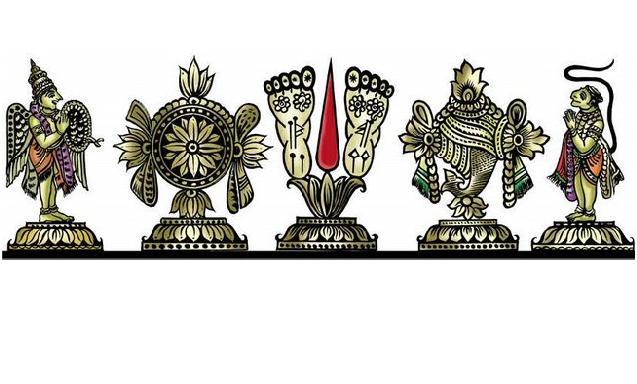
    The Vadakalai Thiruman has a curve at the bottom,  ( the habit of calling this symbol as ‘U’ shape must stop as it is irreverent), while the Thenkalai mark is closed at the bottom and there is the extension at the bottom.

    Generally, the Thiruman is applied on the forehead and it is auspicious to wear the Thiruman in Twelve places in the Body.

    There are twelve Adityas and Vishnu is one of the Adityas.

    ‘Adityaanam Aham Vishnu’ Bhagavad Gita Chapter 10.

    Names of the Adityas.

    The 12 Adityas

    Ruling Month

    Solar Month

    Lunar Month
    1

    Dhata

    March – April

    Madhu

    Chaitra

    2

    Aryama

    April – May

    Madhava

    Vaishakha

    3

    Mitra

    May – June

    Jyeshtha

    4

    Varuna

    June – July

    Suchi

    Ashadha

    5

    Indra

    July – August

    Nabhas

    Shravana

    6

    Vivasvan

    Aug – Sept

    Nabhasya

    Bhadrapada

    7

    Tvashtha

    Sept – Oct

    Isha

    Ashvina

    8

    Vishnu

    Oct – Nov

    Urja

    Karttika

    9

    Amshuman

    Nov – Dec

    Sahas

    Margasirsha

    10

    Bhaga

    Dec – Jan

    Sahasya

    Pushya

    11

    Pusha

    Jan – Feb

    Tapas

    Magha

    12

    Parjanja

    Feb – March

    Tapasya

    Phalguna

    Therefore the Thiruman is applied in Twelve places.

    The Thiruman consists of two parts.

    The outer white line is from Namakkatti, a type of stone, a form of Chalk.

    A vertical line is placed in the center with either turmeric paste(this is used by the Vadakalaiyar), while the Thenkalaiyar use a type of Kumkum made of a mix of Turmeric powder and Lime.

    The two white lines represent the Feet of the Lord Vishnu, while the Sri Churna represents goddess Lakshmi ,his consort.

    Thenkalai Thiruman.
    Thenkalai Thiruman.

    The latter will bring prosperity.

    The extra line is made to represent the feet of Lord Vishnu more graphically or to distinguish the Thenkaliyar in the South.

    I think the latter view is correct as the first type, that of a curve at the bottom is uniform in India except in Tamil Nadu and is prevalent among those who migrated from Tamilnadu,

    Information on this is welcome.