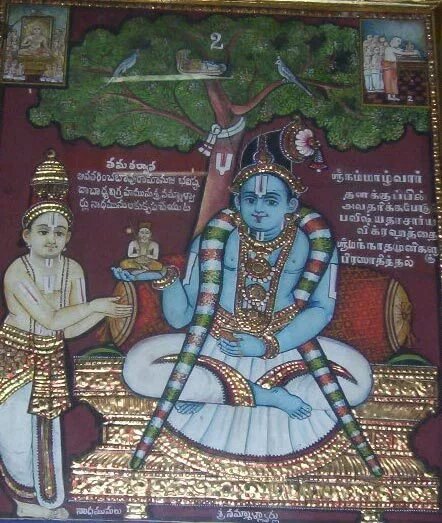
Tag: history of Vaishnavam

  • Thenkalai Origin Details History of Vaishnavism Part 4

    Thenkalai Origin Details History of Vaishnavism Part 4

    I have written on the background of Vaishnavam in my three preceding articles.

    In this article ,I shall present the origin and history of the two forms of Vishnu worship in South India,Dravida Desa.

    As mentioned in my earlier articles on this subject,Vedas speak of Reality, Brahman as a Principle,beyond words and thoughts.

    One has to Realise It by Discerned Wisdom,Gnana and Determination,Vairaagya.

    However, realising that Human mind,human nature being limited and is not equipped to Realise Brahman,Vedas have provided worship of individual Gods,who can be worshipped in line with disposition.

    This method of worship is Saguna Aradhana,while realising Brahman direct is called Nirguna Aradhana.

    Nirguna Aradhana is practiced as Gnana Yoga,more related to Mind.

    Saguna Aradhana is closer to Bhakti Yoga,the Path Of devotion.

    This Emotional Approach.

    Whatever be the method,the Goal is Realisation of Brahman.

    It can be through Saguna Aradhana or Nirguna Aradhana.

    Under Saguna Aradhana people might worship Shiva,Vishnu,Devi,Ganapathy,Subrahmanya….

    Because of this approach of the Vedas,there were numerous Gods right after the Vedic period and performance of Rituals were given priority,as detailed in Mimamsa,and this reached such proportions that there were sixty four systems of worship and the performance of Rituals gained priority over Knowledge and Realisation of Brahman.

    This confusion resulted in the ascendency of Jainism band Buddhism.

    Adi Shankaracharya,realising that the message of Vedas was being diluted,organised these myriad of practices into six six systems of worship.

    This is called Shanmatha,Six Systems.

    They are,

    Ganapathyam, worship of Ganesa,

    Saivam,Of Siva,

    Saaktham,of Devi,

    Vaishnavam, of Vishnu

    Kaumaaram,of Subrahmanya and

    Saura,of Sun,Surya.

    Worship of Vishnu is Vaishnavam.

    Worship of Gods was in Sanskrit as the Vedas are in Sanskrit.

    Though there were about fifty six kingdoms in ancient India, Prakrit was the Link language,though there were local languages in different parts of India.

    Tamil, Telugu,Kannada,Bengali..

    Of these, according to available information,Tamil is older.

    The timeline of Tamil and Sanskrit run parallel.

    When people Worship as ordained by Vedas, simultaneously they also worshipped in the local language,mother tongue.

    The Bhakti Bhava is more compatible with one’s mother tongue.

    Hence many Saints practicing Bhakti Yoga,left behind their experiences of Godhood in Local languages.

    These remain at the regional level and are practiced even today.

    Thus we have Bengal ,Assam,Odisha following the Bhakti Bhava practices from Bengali and Oriya primarily in the East,North East of India.

    In the West Marathi Bhava is in place.
    When one comes to the south of India,from the Vindha mountains to south, Dravida Desa,Tamil Bhakti Bhava has been in practice,and others came later.

    As Tamil was in vogue during Vedic,Puranic and Ithihasa times,the Devotional aspect has been there for quite long.

    The experiences of Saints,thus recorded in Bhakti Bhava in Tamil formed the nucleus of Worship of Vishnu in a different pattern.

    The Azhwars,those who are immersed in Vishnu,are the founding fathers cas it were for the sects that came into being vin Tamil Nadu, Karnataka,Andhra and Kerala.

    The Azhwars are twelve in number.

    Some of them predate Christ.

    Read my article Andal date 3000 BC?

    She is the last in line of the Azhwars.

    Other Azhwars could also be dated back than the dates assigned to them at present.

    So compelling and soul stirring were the compositions of Azhwars,The Bhakti cult in Tamil starts from Azhwars,who are dated to middle ages or slightly before it.

    I do not agree with this date as my study indicates that they belong to much earlier period.

    So there was this concurrent worship of Vishnu both in Sanskrit and Tamil.

    When Ramanujacharya,Propounder of Visishta Advaita, Qualified Non Dualism,he gave priority to Tamil .

    His disciples carried on this practice and the system of Thenkalai was carried on.

    Though Nathamuni who first started this,Ramanujacharya took this system forward and made it popular .

    So ,taking Ramanujacharya, Nathamuni as the benchmark,the Thenkalai system may be dated to Ramanujacharya Nathamuni period.

    That is Tenth century AD.

    But one can not say it began with him as these poems of Azhwars were in place before his time and people were worshipping in Tamil Earlier on the lines of Azhwars.

    What one can say is that Ramanujacharya systematised this .
    Sri Vaishnavism developed in Tamil Nadu in the 10th century.It incorporated two different traditions, namely the tantric Pancaratra tradition and the puranic Vishnu worship of northern India with their abstract Vedantic theology, and the southern bhakti tradition of the Alvars of Tamil Nadu with their personal devotion. The tradition was founded by Nathamuni (10th century), who along with Yamunacharya, combined the two traditions and gave the tradition legitimacy by drawing on the Alvars. Its most influential leader was Ramanuja (1017-1137), who developed the Visistadvaita (“qualified non-dualism”) philosophy.Ramanuja challenged the then dominant Advaita Vedanta interpretation of the Upanishads and Vedas, by formulating the Vishishtadvaita philosophy foundations for Sri Vaishnavism from Vedanta.ri Vaishnavism developed in Tamil Nadu in the 10th century. It incorporated two different traditions, namely the tantric Pancaratra tradition and the puranic Vishnu worship of northern India with their abstract Vedantic theology, and the southern bhakti tradition of the Alvars of Tamil Nadu with their personal devotion. The tradition was founded by Nathamuni (10th century), who along with Yamunacharya, combined the two traditions and gave the tradition legitimacy by drawing on the Alvars. Its most influential leader was Ramanuja (1017-1137), who developed the Visistadvaita (“qualified non-dualism”) philosophy. Ramanuja challenged the then dominant Advaita Vedanta interpretation of the Upanishads and Vedas, by formulating the Vishishtadvaita philosophy foundations for Sri Vaishnavism from Vedanta.

    Source.

    https://en.m.wikipedia.org/wiki/Vaishnavism

    Nathamuni.
    Nathamuni is generally considered to have been born in 823 AD and to have died in 924 AD. His birth name was Aranganathan however he was known as Nathamuni or literally the Saint lord (Nathan-lord, muni-saint) An alternative view is that he was born in 582 AD and died in 922 AD.Yet another view is that Nathamuni was born at Viranarayana Puram sometime shortly after 907 AD and flourished in the 10th century.The traditional view that he lived for than 400 years is untenable. It is likely that Nathamuni lived for slightly over a hundred years in that region controlled by the Chola kings before they rose to the peak of their greatness.His birth star was Anusham

    ..
    He spent time travelling in north IndiaHe came to know about Nalayira Divya Prabhandam, but he heard only 10 hymns. He wanted the rest. He recited 12000 times, Kanninun Siruthambu, a poem in praise of Nammazhwar. Nammazhwar appeared and gave the 4000 hymns(Nalayira Divya Prabhandam). He was the one who brought back the 4000 hymns. In addition to teaching the hymns to his two nephews at Srirangam, he introduced them into the Srirangam Temple Service at the Sri Ranganathaswamy Temple, Srirangam where he was the Temple Administrator.

    The story goes that Nathamuni, while at the Vishnu temple at Mannargudi, his native place, heard some Brahmins from the Southern end of the Peninsula recite Tamil verses of Satakopa addressed to the Vishnu God of Kumbhakonam and was charmed with their sense and diction. He also found that these verses concluded with the words “These 10 out of the thousand, composed by Satakopa”.Nathamuni thus placed in the track of research seems to Haven finally recovered the whole of Satakopa’s works and then rearranged them and the extant works of the other Alwars into four collections of about a thousand stanzas each.

    Source.

    https://en.m.wikipedia.org/wiki/Nathamuni

    * I have not touched upon the philosophical imports of each sect.

    I will be writing on this aspect shortly.

  • Vaishnavam History Part 2 Siva First Devotee Advaita Vaishnavam

    Vaishnavam History Part 2 Siva First Devotee Advaita Vaishnavam

    This is the second part of the History of Vaishnavam article.

    Vedas,though there are various deities invoked in them,speak of one Reality,as expressed in the Four Mahavakyas,Four Great Truths,Sayings.

    Tatvam Asi,That Thou Art,

    Aham Brahmasmi,I am Brahman,

    Soham Asmi,He Is That,

    Pragyaanam Brahma,Brahman is Consciousness.

    This is the Core of the Vedas.

    However many deities are mentioned and mantras to worship them are provided.

    This type of worship is called Saguna Aradhana, Worship of Personal God.

    This is considered as lower knowledge.

    Higher knowledge is that which enables one to realise Brahman.

    Worship of Brahman,with the purpose of Realising It,as One Beyond Attributes,is called Nirguna Aradhana.

    This is higher knowledge.

    However one should not consider Saguna Aradhana as Inferior.

    One can find in Vishnu Sahasranama and Lalitha Sahasranama both Saguna Aradhana and Nirguna Aradhana are found.

    In Lalitha. Sahasranama,these form separate chapters.

    It is one level.

    Contemplating on Abstract Principle is difficult for the Human Mind.

    It needs a point to contemplate,at the initial stages.

    Once one continues Saguna Aradhana,one would automatically proceed to Nirguna Aradhana.

    One has to keep these points in mind before attempting to understand divisions in Hinduism.

    Various systems in Indian philosophy follow these Mahavakyas and the differ in interpreting them.

    It is one Perspective….

    ..

    So technically speaking, there is no authority of the Vedas to call one Shaiva or Vaishnava.

    However Smritis have formulated rules for worship.

    But Smriti is not the Final Authority.

    Veda is.

    One who follows Smriti is a Smartha.

    That’s All.

    He may worship Shiva or Narayana.

    This system of worship continued along with Worship of Brahman as Nirguna.

    In Saguna Aradhana, Worship of Individual Gods,many forms are found.

    Hinduism is highly personalized.

    One can worship any God,in any manner so long the spiritual quest is present.

    So we have many modes of worship or systems in worshiping one God.

    This is true of Vaishnavam as well.

    It has many forms.

    They are four in number traditionally.

    1. Sri Sampradaya,Brahma Sampradaya,
      Kumara Sampradaya,and
      Rudra Sampradaya.

    Brahma Sampradaya,
    Kumara Sampradaya,and
    Rudra Sampradaya.

    In South India.

    1. The Iyengars, who follow the Sri Vaishnava Vishistadvaita philosophy of Asuri Ramanujacharya. The Iyengars are further divided into the Vadakalai-i.e. the northern school, and Thenkalaior southern school. Both these sects adhere to the Pañcaratra agama, in temples.

    These two sects evolved about 200 years after Ramanuja and differ on 18 points of doctrine. The founder of the Vadagalai sect is Swami Vedanta Desika, and the Tengalai sect is Manavala Mamuni. But both schools have a common Guru Parampara prior to the division. The Sri Vaishnavas use both the Sanskrit veda as well as the Tamildivyaprabandham in temple worship.

    https://ramanisblog.in/2014/12/11/types-of-vaishnava-sampradayas/

    There are other Forms as well.

    Rudra Sampradaya is one of four Vaishnava sampradayas, a tradition of disciple succession in the religion. Vaishnavism is distinguished from other schools of Hinduism by its primary worship of deities Vishnu and/or Krishna and their Avatars as the Supreme forms of God. The ascetic Vishnuswami formed the Rudra-Sampradaya,though the sampradaya is believed to have traced its origins to the Hindu deity Shiva, also known as Rudra, who passed on the knowledge imparted to him by Vishnu (or Krishna), on mankind. According to Vaishnavism, Shiva, who has the Shaivismschool dedicated to his worship as the Supreme God, is the first and foremost Vaishnava, or follower of Vishnu. According to the tradition, Vishnuswami was fifteenth in the line of passing of the knowledge from teacher to student. The date of formation of the sampradaya is disputed. While James Hastings dates Vishnuswami to the early 15th century,and Carl Olson dates him to the 13th century, followers of the sampradaya says that Vishnuswami was born 4500 years earlier. Not much about the historical Vishnuswami is known and all his works are thought to have been lost in time. The Sampradaya originated in Sri Kshetra(Odisha) but currently is mainly present in Gujarat/Rajasthan, through the Vallabha sampradaya. The beliefs of the sampradaya was further propagated by Vallabha Acharya(1479–1531).

    Rudra sampradaya has two main divisions: Vishnuswamis, that is, followers of Vishnuswami and the Vallabhas or Pushtimarg sect, founded by Vallabha. According to William Deadwyler, the sampradaya has disappeared, except for the Pushtimarg group.

    The philosophy of the sampradaya is Shuddhadvaita, or pure monism.

    Source.

    https://en.m.wikipedia.org/wiki/Rudra_Sampradaya

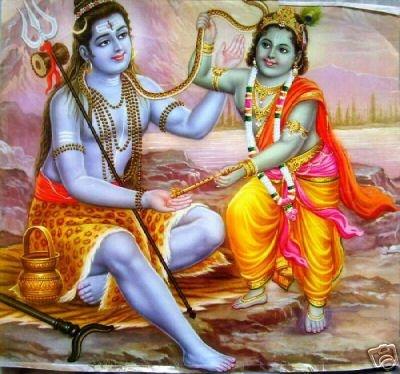
    Featured image credit.

    https://hinduism.stackexchange.com/questions/24863/what-are-the-events-when-lord-shiva-and-lord-krishna-met?noredirect=1&lq=1

    Related.

    https://ramanisblog.in/2018/08/13/vaishnavam-history-part-2-siva-first-devotee-advaita-vaishnavam/