Tag: Poompuhar

  • Poompuhar Founded Eleven Thousand Years Ago?

    Poompuhar Founded Eleven Thousand Years Ago?

    Now comes the tough part in determining the Timeline for Kaveri River.From Chola Copperplates evidence of Thiruvalankadu and the genealogical table by the Purans,it becomes evident that Cauvery River was brought to earth by Chitradhanvan Chola, emulating his ancestor Bhagirath who brought Ganga River to Earth.This would place Cauvery River timeline and consequently date of Poompuhar to Treata Yug,which is atleast a 900,000 years ago( We are in Kaliyug now; Dwapar Yug preceded this lasting for 8,64,000 years).

    However, dating of Ramayana places it around 5114 BC, that is about Seven thousand years ago.

    The conundrum is because of Time being Cyclic and not Linear.

    The origin of Kaveri river is associated with Sage Agastya and it was brought to earth by him.We find references to Agastya ,apart from references to him in Puran, Vedas,is mentioned in Vedas. He imparted Adhitya Hruday stotra to Sri Rama to shrug of his depression when Lakshmana was felled by Ravana’s Mohanastra. Agastya is reported to have come down south . This time frame is validated by Star Canopus, Agastya Nakshatra visibility in the southern hemisphere.And Ramayana lists over Thirty Rivers.

    Our minds do not accept such vast scale of Time. Can we then ,place Cauvery River and Poompuhar date around 7000 years ago.

    But we have archeological evidence from Poompuhar that Poompuhar to support a date of around atleast 11,000 years ago.

    So as a compromise, we may assign the Date of Cauvery River to atleast 11000 ago?

    Now, Indra Vizha celebrated in Poompuhar also supports this timeline because Uparichara Vasu was a Chola King who ruled Chedi Kingdom and was a friend of Indra. Indra is reported to have given him Bamboo Pole.
    Uparichara Vasu was a king of Chedi belonging to the Puru Dynasty. He was known as the friend of Indra. During his reign, Chedi kingdom had a good economic system and contained much mineral wealth, which made a lot of merchants around the world, come to the Kingdom. It was abundant in animals and corn. There were many towns and cities in the kingdom. He possessed a very special chariot. He introduced a festival in his kingdom in the honour of Indra. The festival involved planting of a bamboo pole every year, in honour of Indra. The king will then pray for the expansion of his cities and kingdom. After erecting the pole, people decked it with golden cloth and scents and garlands and various ornaments.

    Chedi Kingdom

    Indra Vizha , Festival was celebrated with great pomp in Poompuhar. Failure to conduct it had resulted in a great Tsunami consuming Poompuhar, Tamil Sangam Classics, including Silappadikaram aver.

    So this shall place Poompuhar being intact before Kaliyug that is Chola Perunarkilli , who is recorded to be the first Chola King in Kaliyug.

    Hence ,it is safer to postulate the date of Poompuhar to about 11000 years ago.

    Cholavarman’s son was Rajakesarivarman and Rajakesarin’s son was Parakesarin (vv. 30 and 31).  These two names were used as titles alternately by the Chola kings in the order of their coronation (v. 32).  Parakesarin’s son was Chitraratha; his son was Chitrasva and his son, Chitradhanvan (v. 33).  It is stated that this last king Chitradhanvan brought into his dominions the river Kaverakanyaka, i.e., Kaveri, just as Bhagiratha brought into the earth Ganga, the river of the gods (v. 35).( Chitradhanvan was an ancestor of Sri.Rama and therefore Kaveri was in flow during Ramayana)

    Thiruvaalangadu Copperplates

    V. 36.) In that family was (born) Suraguru who was the hereditary abode of the maiden, the Lakshmi of victory.  This king having conquered by his glory the god of Death in his own territory acquired the name Mrityujit.

    (V. 37.) In his race was born king Chitrartha called Vyaghraketu from his banner-cloth bearing (the figure of) a tiger, who was a store of great heroism and who wore as an ornament on his head the flowers of the dhataki (Grislea Tomentosa).

    (V. 38.) The Treta-age having come to a close, a son of this king known as Narendrapati became the ruler.  The diadems of (subordinate) kings dropped down their gems ; (because their) fastenings had become loosened by the constant rolling at his footstool.

    (V. 39.) From him was produced the head-jewel of the powerful Solar race, (king) Vasu, who was the cause of the destruction of the demons (and) who (known) by the significant surname of Uparichara moved in any direction he liked in a celestial car which was presented (to him) by the lord of gods (i.e., Indra).

    (V. 40.) At the end of the Dvapara (-age) was born in the family of this head-jewel of kings a conqueror of all hostile kings named Visvajit.[30]https://www.whatisindia.com/inscriptions/south_indian_inscriptions/volume_3/no_205b_aditya_ii_karikala.html

    Kings after Muchukunda Chozha.

    Mandhata
    Muchukunda
    Valabha
    Prithulaksha
    Parthivachudamani
    Dirghabahu
    Chandrajit
    Sankriti
    Panchapa
    Satyavrata
    Rudrajit
    Sibi
    Marutta
    Dushyanta
    Bharata
    Cholavarman
    Rajakesarivarman
    Parakesarin
    Chitraratha
    Chitrasva
    Chitradhanvan. https://www.whatisindia.com/inscriptions/south_indian_inscriptions/volume_3/no_205_aditya_ii_karikala.html

  • River Kaveri Brought To Earth Chola King Close Of Treta Yuga

    River Kaveri Brought To Earth Chola King Close Of Treta Yuga

    It is always a great pleasure to delve into ancient Tamil literature and study it in conjunction with Purana Ithihasa,Ramayana and Mahabharata.And to check them against Landmasses and River bodies is exhilarating.

    I have been writing on the antiquity of Sanatana Dharma,Tamil and their intricate relationship. Each supplements the other.One finds references to Tamil,Tamils,Tamil land in Puran,Vedas and Ithihasas, Ramayana.They also talk about geography of Bharatvarsh and it’s flora and fauna.And waterbodies.The daily ritual of Sandhya vandhana of Hindus,Sun Worship, mention Seven Holy rivers.They are

    • Ganga
    • Yamuna
    • Godavari
    • Saraswati
    • Narmada
    • Sindhu
    • Kaveri

    ‘ Gange cha Yamuneschaiva, Godavari Saraswati; Narmadhe Sindhu Kaveri Jalesmin Sannithim kuru’

    River Kaveri which flows South of Vindhyas from Karnataka through Tamil Nadu is mentioned in early texts .Kaveri is considered as holy as Ganga.It is considered so holy that the Chola kings built over 100 temples on it’s banks. The first temple of Vishnu on the banks of Kaveri begins at Srirangapatna in Karnataka and the last Vishnu temple on the banks of Kaveri before Kaveri joins the sea at Poompuhar, is Srirangam.There is a saying in Tamil that Kaveri worships Renga,Vishnu wherever she goes.Kavei is inseparable from Tamil Culture.Sanskrit texts also as I said earlier,venerate Kaveri as Holy.

    सर्वपापक्षयकरे मम पापं विनाशय ।
    कवेरकन्ये कावेरि समुद्रमहिषिप्रिये ‘ Kaverikanya(Kaveri) is very holy and is considered as beloved of Ocean’s Beloved.( Varuni is the consort of Varuna,Ocean)

    The origin of Kaveri river is associated with Sage Agastya and it was brought to earth by him.We find references to Agastya ,apart from references to him in Puran, Vedas,is mentioned in Vedas. He imparted Adhitya Hruday stotra to Sri Rama to shrug of his depression when Lakshmana was felled by Ravana’s Mohanastra. Agastya is reported to have come down south . This time frame is validated by Star Canopus, Agastya Nakshatra visibility in the southern hemisphere.And Ramayana lists over Thirty Rivers. List provided here below from research paper. I recommend readers to visit the site,( link provided in this article) and read a well researched study.

    Table 1: River of Kritibasi Ramayana Epic

    SL. No.

    Name of the river

    Page no.

    Frequency of river in Ramayana Sloka

    1

    Ganga

    50, 56, 57, 103, 103, 103, 152, 153, 164, 233, 238, 454, 524, 567, 567, 580, 599, 599, 600, 626, 646, 654, 654

    23

    2

    Aghrinja

    53

    1

    3

    Mandakini

    54

    1

    4

    Jahnabi

    54, 152, 502, 654

    4

    5

    Basu

    55

    1

    6

    Bhadra

    55

    1

    7

    Shweta

    55

    1

    8

    Alakananda

    54

    1

    9

    Bhagirathi

    238, 526, 567, 629

    4

    10

    Koushiki

    239

    1

    11

    Bhogbati

    454

    1

    12

    Saryu

    51, 88, 109, 119, 119, 155, 163, 233, 511, 651, 652, 654

    16

    13

    Suradhani

    56

    1

    14

    Padma

    58

    1

    15

    Pravash Tir

    59, 60, 261, 597

    4

    16

    Narmada

    81, 83, 235, 260, 261, 549, 549

    7

    17

    Tamasha

    151, 151, 151, 585

    4

    18

    Gomti

    151, 178, 233, 504, 506

    5

    19

    Yamuna

    87, 153, 154, 155, 164, 502, 594, 595, 602, 602, 602, 605, 624, 638

    13

    20

    Balarenu nadi

    157

    1

    21

    Phalgu

    170

    1

    22

    Godabari

    181, 182, 182, 200, 201, 235

    6

    23

    Pampa

    223

    1

    24

    Saraswati

    223

    1

    25

    Krishna

    235

    1

    26

    #Kaberi

    *235, 236

    2

    27

    Triyojan Nadi

    234

    1

    28

    Sindhu

    236, 263, 511, 625, 620, 620

    6

    29

    Bimala

    239

    1

    30

    Punyada

    240

    1

    31

    Nadipati

    265

    1

    32

    Kharatara Nadi

    438, 447

    2

    33

    Maya Nadi

    463

    1

    34

    Kunti Nadi

    501

    1

    35

    East sea

    49, 512

    2

    36

    North sea

    49, 512

    2

    37

    West sea

    49,512

    2

    38

    South sea

    512
    Aspects of Flows of the Rivers Mentioned in the Indian Epic Ramayana.
    1

    https://rjhssonline.com/HTMLPaper.aspx?Journal=Research%20Journal%20of%20Humanities%20and%20Social%20Sciences;PID=2018-9-4-21https://rjhssonline.com/HTMLPaper.aspx?Journal=Research%20Journal%20of%20Humanities%20and%20Social%20Sciences;PID=2018-9-4-21

    Now was Kaveri brought down to earth like Ganga was by Bhagirath, ancestor of Sri. Rama?Answer is Yes. It was King Chitradhanvan, of Ikshvaku) Chola Dynasty. Chitradhanvan’ s great grandson was the last King in Treta Yuga.’His son was Narendrapati who became king at the end of the Treta age.  His son was king Vasu entitled Uparichara on account of his having received a celestial car from Indra by which he moved about in all directions (v. 39).  https://ramanisblog.in/2020/08/07/chola-kings-list-treta-yuga-ikshvaku-tamil-copper-plates-evidence/

    One must remember that Cholas belong to Ikshvaku Dynasty.

    Genealogy of Ikshvaku. Ikshvaku Dynasty.

    https://ramanisblog.in/2017/07/06/rama-family-tree-from-manu-confirmed-by-genome-studies/

    Cholavarman was the King who founded the Chola Dynasty in South ( Cholas had their Kingdom in North of Vindhyas too.Sivi, Muchukunda,among others ruled from there). Cholavarman was the grandson of Dushyant and son of Bharath‘. Bharat varsh is named after Bharat.

    Cholavarman’s son was Rajakesarivarman and Rajakesarin’s son was Parakesarin (vv. 30 and 31).  These two names were used as titles alternately by the Chola kings in the order of their coronation (v. 32).  Parakesarin’s son was Chitraratha; his son was Chitrasva and his son, Chitradhanvan (v. 33).  It is stated that this last king Chitradhanvan brought into his dominions the river Kaverakanyaka, i.e., Kaveri, just as Bhagiratha brought into the earth Ganga, the river of the gods (v. 35).  In that family was born Suraguru entitled Mrityujit (v. 36).  In his family was born Chitraratha who bore the title Vyaghraketu after his banner on which was the figure of a tiger.

    Thiruvalankadu Copperplates

    Kings after Muchukunda Chozha.

    Mandhata
    Muchukunda
    Valabha
    Prithulaksha
    Parthivachudamani
    Dirghabahu
    Chandrajit
    Sankriti
    Panchapa
    Satyavrata
    Rudrajit
    Sibi
    Marutta
    Dushyanta
    Bharata
    Cholavarman
    Rajakesarivarman
    Parakesarin
    Chitraratha
    Chitrasva
    Chitradhanvan

    Genealogy from Chola Inscriptions
  • Why Special Honour To Indra Among Ancient Tamil Kings

    Why Special Honour To Indra Among Ancient Tamil Kings

    When one cross checks the Dynasties of India as explained in ancient Indian texts,, One is rewarded with a lot Information, that would clear the cobwebs surrounding Indian History.Contraray to what is being touted the relationship between the so called Dravididas and those from the Aryavartha was quite intimate and the Three Great Dynaties of Tamils, Chera, Chozha and Pandya descended from Ikshvaaku/Chandravamsa.I had written in detail about this in a c couple of articles, where I had proved, with evidence that the Chozhas descended from Ikshavaaku /Lunar Dynasty.

    Tamils, who belong to Dravidian group, have one of the most ancient Languages of the world. Along with Sanskrit.The basis of Tamil literature is Tholkaapiyam,Grammar Book of Tamils.Tholkaapiyam is dated 3000 years traditionally.My eleven years of research shows that it is atleast 20,000 years old.Tholkaapiyam divides Tamil landmass into five entities.

    1. Kuriinji, Mountainous Region.
    2. Marutham,Arable Land.
    3. Mullai,Pastoral Land
    4. Neydhal, Seashore and
    5. Paalai, Desert Region

    Each of these region is assigned a God.Kurinji,Murugan,Subrahmanya;Marutham,Indra;Mullai,Vishnu;Neydhal, Varuna and Paalai, Durga, Kotravai.

    It is interesting to note that all the Gods mentioned in the Vedas are found in the above classification.Of special interest is Indra nd Varuna. These two devas are not given as much pride of place in Vedas in the sense that they are accorded the status of Regining deities for a specific Land.Varuna, in the Vedic Tradition is the God of water, while Indra is the chief of all devatas and God of Thunder.

    .In the Tamil tradition ,Indra is elevated to the position of the God of Marutham landmass, Arabale land.It is a fact arable land needs copious water and Indra is the God of Thunder and Varuna God of Water.And Varuna obeys Indra..Tamils celebrated the Festival for Indra called Indra Vizha and this is one of the most Important festival of Tamils.This is to celebrate Indra, The Rain God and alomg with him,Krisahna was also celebrated as Krishna provided shelater to Govardhan people when Indra hit the land with Deluge when the Govardhan people did not perform Pooja for him.Krishna protected the people.This event was also celebrated in Tamil tradition.The details are found in earlies Tamil works of Sangam Age, inclding th Silappadikaaram One of the Five Epics of Tamils.This belongs to Tamil Sangam Era..Failure to Celebrate the Indra Vizha, Indra Festival, Tamil Literature recors,resulted in the Tamil Land being inundated by A Tsunami.Silappadikaaram mentions, so deos Manimekalai, another Epic of Tamils, mentions the Second Tamil Sangam was destroyed due to The Deluge.Tamils had three Sangams, Poets’ Conclave.Firt was at Then Madurai, the second at Kapaatapuram(Kavatam) and the third one at Madurai.Kapaatapuram was destroyed by a Tsunami.

    There is also a view that Poompuhar,Kaverippommpattinam,the harbour of Chozhas was submerged because of failure to celebrate Indira festival.

    Marudam region (area of the plains) Tamil agriculturists used to worship Indra as their Lord. Indra was considered as the god of the rains and since the farmers were dependent on rains for their crops, they used to worship Indra for rain, thunder and lightening.

    There were many festivals celebrated in ancient India and references of them can be found in the ancient works like Vishnudhetrmottara Purana, and the Bhagavata Purana. This practice was prevalent in Tamil Nadu also. One such festival is known as `Indra Vizha`. The Chola kings whose port-city was Kaveripum-pattinam used to take the responsibility of this festival.

    The detailed information on the celebration of `Indra Vizha` festival can be seen in the Tamil epics, the `Silappadikaram` and the `Manimekhalai`. As per the Manimekhalai, the famous sage Agastya helped the people of Kaveripumpattinam during a period of drought. He advised the Chola king Todittol Sembian to celebrate a festival for Indra to please him and then only Indra would bring rain to this city. According to the advice, the king arranged a big festival for the Lord Indra. In return, they got rain in the city and experienced the benefits of this, his successors also continued to celebrate this festival every year. This `Indra Vizha` festival generally continues for a period of twenty-eight days.

    The festival usually commenced with a group beating drums and announcing to the people the start of the celebrations. The citizens of the town then cleaned the streets and roads and redecorate the city, with each house being adorned with many decorations. The officials of the kingdom would pay their respects to the king and wish him and the kingdom well. Musical performances would be held and the fire oblations offered in many temples for Siva, Vishnu and other deities. The festival ended with people bathing in the sea with the members of the family. It was generally believed that this festival was actually a prayer to Indra, and would remove the difficulties and dangers to those who celebrate it.’

    ‘The Sangam literature also records legends about mythical Chola kings.These myths speak of the Chola king Kantaman, a supposed contemporary of the sage Agastya, whose devotion brought the river Kaveri into existence. Two names are prominent among those Chola kings known to have existed who feature in Sangam literature: Karikala Chola and Kocengannan. There are no sure means of settling the order of succession, of fixing their relations with one another and with many other princelings of around the same period.Urayur (now a part of Thiruchirapalli) was their oldest capital. Kaveripattinam also served as an early Chola capital. The Mahavamsa mentions that an ethnic Tamil adventurer, a Chola prince known as Elara, invaded the islandaround 235 BCE.

    Citations and references.

    http://m.indianetzone.com/artical.aspx?iwebpageid=11753

    https://en.wikipedia.org/wiki/Chola_dynasty#Origins

    Krishna Lifts Mountain Indra Vizha By Early Cholas

    https://ta.wikisource.org/wiki/%E0%AE%9A%E0%AE%BF%E0%AE%B2%E0%AE%AE%E0%AF%8D%E0%AE%AA%E0%AE%BF%E0%AE%A9%E0%AF%8D_%E0%AE%95%E0%AE%A4%E0%AF%88/%E0%AE%87%E0%AE%A8%E0%AF%8D%E0%AE%A4%E0%AE%BF%E0%AE%B0%E0%AE%B5%E0%AE%BF%E0%AE%B4%E0%AE%B5%E0%AF%81_%E0%AE%8A%E0%AE%B0%E0%AF%8D_%E0%AE%8E%E0%AE%9F%E0%AF%81%E0%AE%A4%E0%AF%8D%E0%AE%A4_%E0%AE%95%E0%AE%BE%E0%AE%A4%E0%AF%88

    Why this status for Indra?

    I had stated that Chozhas trace their ancestry to Ikshvaaku Dynasty in the Copperplates evidence of Rajendra Chola at Thiruvaalangadu and Epigraphs in Kanyakumari.This refernece is found in almost all epigraphs and copperplates of Chozhas.Chozha Emperor Sibi was the (son of Usinara) Graet Great Grand son of Yayati, who founded the Chandra Vamsda ,Lunar Dynasty.Lunar Dynasty sprang upg up from Ikshavaaku,Solar Dynasty.Please refer my articles on these.

    Mandhata ,aka Mandatri was an Ikshvakku ancestor of Rama.

    Ushinara was given north-western side of India. Shibi was the son of King Ushinara and his descendants were MadrasKekayas and Sauviras. He is the one who gave flesh for a hawk and an eagle.

    1. Shibi, Vara, Krmi, Dakshas were the sons of king Ushinara.
    2. Vrshadarha, Setuka, Madra and Kekaya were the sons of Shibi (Contemporary to Suryavanshi King Trishanku). https://en.wikipedia.org/wiki/Turvasu_Druhyu_and_Anu_Dynasties

    Mandhata’s legend is cited in the Vana Parva, Drona Parva, and Shanti Parva of Mahabharata.

    King Yuvanaswa of Ayodhya was childless. Once, he went on a hunting expedition and in the afternoon, he became wracked with thirst.

    He came across the hermitage of sage but found no one. The king saw a pitcher of water and drank it. When sage came to know of this, he told the king that the water was meant for his wife so that she would conceive. Since the king drank it he became pregnant with his son.

    One century later, the sages and saints arrived to help him give birth and slit open the left side of Yuvanaswa’s abdomen without causing pain and brought the baby boy. Indra, King of the Gods declared “He shall draw sustenance and dependence from me” or “Mandhata”. Indra provided milk from heaven to Manadhata. The milk began to accelerate the boy’s growth. Within twelve days, he resembled a twelve-year-old boy who was thirteen cubits tall. Mandhata spontaneously acquired the entire knowledge of the Vedas and military sciences. Mandhata acquired an impenetrable armor, a quiver with an inexhaustible supply of arrows and the Ajagava bow (originally belonging to Shiva) which fell from the sky. Mandhata ascended the throne.

    https://en.wikipedia.org/wiki/Mandhatri

    ‘Then Indra said to the king Muchukunda, “O king, we, the Devas are indebted to you for the help and protection which you have given us, by sacrificing your own family life. Here in the heaven, one second equals one year of the earth and you had fought with asuras for one year of heaven. Since, it has been a long time, there is no sign of your kingdom and family because it has been destroyed with the passage of time. We are happy and pleased with you, so ask for any boon except Moksha (liberation) because Moksha (liberation) is beyond our capacities”.

    https://en.m.wikipedia.org/wiki/Muchukunda

    It is probable that as Muchukunda , Mandhata were very close to Indra, especially Mandhata being the Foster Son of Indra,Chozhas ,as a token of respect might have celebrated Indra Vizha in honor of Indra.And Mandhata,Sagara, Muchukunda …all are ancestors of Chozhas because Chozhas belong to Ikshvaku Dynasty.

    Dravidian Roots of Sri Rama


  • Date Of Buddha 9000 BC?

    Date Of Buddha 9000 BC?

    Archeological findings unearthed recently in Tamil Nadu  shake up traditional historical dates assigned to many events in India.

    The finding of Poompuhar,Kaverippommpattinam,Tamil Nadu on the shores off Tamil date pushes the date of Poompuhar by at least 14,000 years.

    In fact this can be as far back by 30,000 years.

    The place is called Poompuhar. It lies on southeast India’s Coromandel coast facing the Bay of Bengal between modern Tamil Nadu and Sri Lanka. Its immediate offshore area has been the subject of marine archaeological investigations by India’s National Institute of Oceanography since the 1980’s — and numerous non-controversial finds of man-made structures dated between the third century AD and the third century BC have been made in the “inter-tidal zone” close to shore at depths down to 6 feet (approximately 2 metres).

    These finds of structures in shallow water (some so shallow that they are exposed at low tide) have been quite widely written-up in the archaeological literature. But for some reason other discoveries that the NIO has made in deeper water off Poompuhar have attracted no attention at all. Most notably these other discoveries include a second completely separate group of structures fully three miles from the Poompuhar shore in water that is more than 70 feet (23 metres) deep. The lack of interest is surprising because to anyone with even minimal knowledge of post-glacial sea-level rise their depth of submergence is – or should be – highly anomalous. Indeed according to Glenn Milne’s sea-level data the land on which these structures were built last stood above water at the end of the Ice Age more than 11,000 years ago.

    Is it a coincidence that there are ancient Tamil flood myths that speak of a great kingdom that once existed in this area called Kumari Kandam that was swallowed up by the sea? Amazingly the myths put a date of 11,600 years ago on these events — the same timeframe given by Plato for the end of Atlantis in another ocean.’

    https://ramanisblog.in/2017/07/06/tamil-sangam-dates-4140-to-14000-bc/

    Silappadikaram refers to Buddhism in detail and the author Ilango Adigal,brother of Chera King,Cheran Chenguttuvan,was a Buddhist monk.

    The authorship of Silappatikaram is credited to the pseudonym Ilango Adigal (“Prince-Ascetic”). He is reputed to be the brother of Chera king Senguttuvan, although there is no evidence in the Sangam poetries that the famous king had a brother. There are also claims that Ilango Adigal was a contemporary of Sattanar, the author of Manimekalai..The prologues of each of these books tell us that each were read out to the author of the other [Silappatikaram, pathigam 90]. From comparative studies between Silappatikaram and certain Buddhist and Jain works such as Nyayaprakasa, the date of Silappatikaram has been determined to be around the fifth and the sixth centuries CE’

    https://en.m.wikipedia.org/wiki/Silappatikaram

    Manimekalai ,another epic of Tamil is also Buddhist in approach and is believed to have been composed around the same time as that of Silappadikaram.

    These texts have been assigned between fifth and sixth century BC.

    Poompuhar remains Tamil Nadu,India.image
    Poompuhar remains Tamil Nadu,India.

    However,as most of the events narrated in Silappadikaram take place in Poompuhar,called Kaverippommpatinam then,and Poompuhar’s date can be pushed back by 14,000 years at least,Silappatikaram can be dated around the same time.

    https://ramanisblog.in/2015/03/02/poompuhar-find-sets-tamilhinduism-by-atleast-20000-years/

    More important is the fact that Silappatikaram refers to Buddhism extensively.

    This implies Buddhism,The Buddha should be dated 11,000 years back.

    But the current date assigned to Buddha is,

    Scholars are hesitant to make unqualified claims about the historical facts of the Buddha’s life. Most accept that he lived, taught and founded a monastic order during the Mahajanapada era during the reign of Bimbisara (c. 558 – c. 491 BCE, or c. 400 BCE’

    https://en.m.wikipedia.org/wiki/Gautama_Buddha

    How and Why?

    *The archeological finding related here and more dates arrived at based on Archeology makes one ponder over the present dates assigned to ancient history and our present concept of Time and Multiverses.

    I have written on these issues under Hinduism,Astronomy,Physics.e

    I am aware that the date arrived for Buddha places him before Ramayana.

    It is interesting to note that many Buddhist concepts are found in the Bhagavad Gita.

    Shall be writing on this.

    Featured Image Credit.

    http://soulwritings.ca/tag/miracles/page/2/

  • Tamil Sangam Dates 4140 to 14,000 BC

    Tamil Sangam Dates 4140 to 14,000 BC

    Dates assigned to Events,persona and literature of India are undergoing a thorough overall ,thanks to new findings in Archaeology Anthropological research,new advanced technics and simulated software of ancient events.

    The dates of the following have been pushed back and Indian Ithihasas,Ramayana and Mahabharatha have been found to be recorded History.

    Rig Veda ,by 50,000 years,

    Ramayana placed at 5114 BC,

    Mahabharatha, at 3000 BC.

    * for the anomalies of dates in Ramayana,which the Puranas say had happened about a million years ago and Mahabharatha did happen thousands of years later to Ramayana,Ramayana had taken place in Tretha Yuga and Mahabharatha during Dwapara Yuga,please check my article Rama’s Death precedes Krishna’s by 200 years?

    And many more arbitrarily assigned dates have been revised.

    Now to another ancient Culture and Language ofcIndia,Tamil.

    Tamils have a hoary past and they have been referred to in the Vedas,Puranas ,Ramayana and Mahabharatha.

    They were a powerful maritime power and references are made by Ancient Greek Historians including Periplus and Roman records the presence of Tamils in Roman Empire and the Romans had a colony of their own in Musiri,Tamil Nadu.

    The ancient grammar book available,Tholkappiyam speaks of land extending up to 7000 miles from Kanya Kumari to The South,which is somewhere near New Zealand.

    Sage Agastya,the co founder of Tamil along with Lord Shiva is found in New Zealand and Micronesia.

    Shiva, the Primary Deity of the Tamils is worshipped by the Aborigines of Australia.

    Sage Agastya’s date is confirmed by Astronomy,Star Canopus.

    Tamil records speak of Three Conclaves of Poets in Tami Land.

    These were called Tamizh Sangam..

    Nakkīrar describes three “Sangams” (caṅkam) spanning thousands of years. The first Sangam (mutaṟcaṅkam)mudharchangam is described as having been held at “the Madurai which was submerged by the sea”, lasted a total of 4400 years, and had 549 members, which supposedly included some gods of the Hindu pantheon such as SivaKubera and Murugan. A total of 4449 poets are described as having composed songs for this Sangam. There were 89 Pandiya kings starting from Kaysina valudi to Kadungon were decedents and rulers of that period..The grammar followed in the first sangam was agattiyam. The poems composed were Paripaadal, mudunarai, mudukurugu, kalariyavirai. If credence is given to the commentary of Irayanar Ahapporul, the beginning of sangam should be placed somewhere in 9000 BC.’

    https://en.m.wikipedia.org/wiki/Tamil_Sangams

    Silappadikaram,one of the Five Epics ,which came later to Sangam period is dated at 1 AD.

    Recent excavations of Poompuhar,which was called Kaverippoompattinam date pushes it back by 11,000 years.

    The date of Poompuhar artifact was arrived at and verified by  Glenn Milne Sea Level changes.

    The place is called Poompuhar. It lies on southeast India’s Coromandel coast facing the Bay of Bengal between modern Tamil Nadu and Sri Lanka. Its immediate offshore area has been the subject of marine archaeological investigations by India’s National Institute of Oceanography since the 1980’s — and numerous non-controversial finds of man-made structures dated between the third century AD and the third century BC have been made in the “inter-tidal zone” close to shore at depths down to 6 feet (approximately 2 metres).

    These finds of structures in shallow water (some so shallow that they are exposed at low tide) have been quite widely written-up in the archaeological literature. But for some reason other discoveries that the NIO has made in deeper water off Poompuhar have attracted no attention at all. Most notably these other discoveries include a second completely separate group of structures fully three miles from the Poompuhar shore in water that is more than 70 feet (23 metres) deep. The lack of interest is surprising because to anyone with even minimal knowledge of post-glacial sea-level rise their depth of submergence is – or should be – highly anomalous. Indeed according to Glenn Milne’s sea-level data the land on which these structures were built last stood above water at the end of the Ice Age more than 11,000 years ago.

    Is it a coincidence that there are ancient Tamil flood myths that speak of a great kingdom that once existed in this area called Kumari Kandam that was swallowed up by the sea? Amazingly the myths put a date of 11,600 years ago on these events — the same timeframe given by Plato for the end of Atlantis in another ocean.

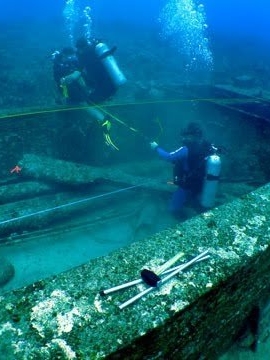
    Like the cities in the Gulf of Cambay the underwater structures three miles offshore of Poompuhar were first identified by an instrument called sidescan sonar that profiles the seabed. One structure in particular was singled out for investigation and was explored by divers from India’s National Institute of Oceanography in 1991 and 1993. Although they were not at that time aware of the implications of its depth of submergence — i.e. that it is at least 11,500 years old — the 1991 study confirms that it is man-made and describes it as:

    a horse-shoe-shaped object, its height being one to two metres. A few stone blocks were found in the one-metre wide arm. The distance between the two arms in 20 metres. Whether the object is a shrine or some other man-made structure now at 23 metres [70 feet] depth remains to be examined in the next field season.

    The 1993 study refines the measurements:

    The structure of U-shape was located at a water depth of 23 metres which is about 5 kilometres off shore. The total peripheral length of the object is 85 metres while the distance between the two arms is 13 metres and the maximum height is 2 metres Divers observed growth of thick marine organism on the structure, but in some sections a few courses of masonry were noted.

    Graham Hancock is an advocate of this theory and I subscribe to this as this has more science to back it up.

    The Glenn Milne Theory of Sea Level Change places a landmass Sundaland.

    Sundaland was a cluster of islands in South consisted of Malay peninsula, Java, Sumatra, Borneo and other surrounding areas.’

    So it is logical to arrive at the conclusion that the Silappadikaram Town was in existence around 11000 CE and for a rich language as Tamil to develop, from a dialect, colloquial form and then to literary ,it requires  minimum  5000 Years.

    And Tamil quotes Ithihasas ,Ramayana and Mahabharata and the Vedas.

    That should place these Ithihasas earlier .

    Hence based on this evidence available now, Tamil should be at least 16000 years old and the Sanskrit Puranas earlier.

    Please read my Post Million Year Old Tamil quotes Vedas and they quote Tamil.

    But we are assigning Tamil Sangam at 5 BC and Rig veda at 5000 BC!’

    https://ramanisblog.in/2015/03/02/poompuhar-find-sets-tamilhinduism-by-atleast-20000-years/

    Silappadikaram and its sister Epic Manimekalai speaks of the Tsunami that devoured the Tamil land.

    And this is the Third Tsunami,the earlier two having swallowed Tamil land .

    Assuming ,at the most conservative level ,that the Tsunami struck immediately before Silappadikaram period,which is unlikely as to reconstruct the Land and take the language to classical level of Silappadikaram would have required at least five thousand years,we can assign the last Tsunami at 14,000 BC.

    And taking the account of Tamil classics for the duration of each Sangam at ( there is novreason to doubt this as their version about Third Tsunami is validated,

    ‘First Sangam.-It was said to be located in Then Madurai (now part of Madurai) under the patronage of 89 Pandya kings, during this period. It is said to have lasted for 4,440 years,

    Second Sangam-The second Sangam was convened in Kapatapuram. This Sangam lasted for 3700 years and had 59 members, with 3700 poets participating. There were 59 Pandiya kings starting from Vendercceliyan to Mudattirumaran were decedents and rulers of that period. This city was also submerged in sea. Ramayana and Arthashastra of Kautalya corroborates the existence of a city named Kavatapuram.

    Third Sangam-The Third Sangam (Tamil: மூன்றாம் சங்கம், Moondram Sangam) was a historical assembly and the last of the three Tamil Sangams. Established under the aegis of 49 Pandyan kings, it ran for 1850 years, ending around the time that Christianity emerged’

    https://en.m.wikipedia.org/wiki/Sangam_period

    Third Sangam 12,250 to 14000 ( 14000-1850)

    Second Sangam 8550 to 12,250 ( 12,250-3700) and

    First Sangam.   4140 to 8550.(8750-4440).