Tag: Samudra Gupta

  • Worlds First Republic Malla Kingdom India 700 BC

    History of India might seem to be disorganised ,but a careful and patient study will show that the history of India is an integrated one and Kingdoms were interrelated.

    Mostly through marriages.

    The difficulty in identifying the early history lies in the fact that the identification of these intricate relationships.

    Once we identify this ,the task becomes easier.

    While I was trying to fix the date of King Vikramaditya,I stumbled upon the History of Samudra Gupta,father of Chandra Gupta II,who is popularly known as Vikramaditya.

    But,as it is the wont,western historians dismiss most of the facts associated with Vikramaditya Chandra Gupta as legends.

    Facts seem to indicate otherwise.

    Vikramaditya’s grandfather,Chandra Gupta I married a princess from Lichavi Kingdom .

    (Samudra Gupta was the son of Chandra Gupta I).

    Malla reference may be found in Lichaavis.

    This Kingdom coexisted with the most ancient Kingdoms of India,that is the Mahajanapadas,the Sixteen Kingdoms of India,which is mentioned in the Vedas.

    The astonishing fact is that it was a Republic.
    The roots of Lichavis may be traced back to Nepal,Varanasi.

    These places are venerated in Buddhist texts.

    The date of Malla Kingdom is between 700 to 300 BC!

    The Gupta emperor Chandragupta I married a Licchavi princess Kumaradevi and the legend Licchavayah is found along with a figure of goddess Lakshmi on the reverse of the Chandragupta I-Kumaradevi type gold coins of Samudragupta. In the Allahabad Pillarinscription of Samudragupta, he is described as the Licchavidauhitra (the grandson of the Licchavis from his mother’s side). These probably suggest Licchavi occupation of Magadha immediately before the rise of the imperial Guptas, although there is no direct evidence to prove it

    Kautilya in his Arthaśāstra (ch. XI), describes the Licchavis as a tribal confederation (gaṇa sangha), whose leader uses the title of rājā(rājaśabdopajīvinah). A Buddhist text, the Mahāparinibbāna Suttanta refers them as Kshatriyas and one of the claimants of the relics of Buddha. They have claimed Kshatriya status themselves. According to the Dīgha Nikāya, the Licchavis were of the Vasiṣṭhagotra.Buhler assumes that, in the Manusmriti (X.22), the Licchavis are placed in the category of the Vratya Kshatriyas.

    Buddhaghośa in his Paramatthajotikā, traced the origin of the Licchavis to Benaras. The date of the establishment of the Licchavi domination over the area consisting of present-day north Bihar and Terai region of Nepal is not known. By the time of Mahavira and Gautama Buddha this clan was already well settled in the area around their capital Vaiśālī. Buddhist tradition has preserved the names of a number of eminent Licchavis, which include prince Abhyaya, Oṭṭhaddha(Mahāli), generals, Sīha and Ajita, Dummukha and Sunakkhata. The Kalpasūtra of Bhadravāhu refers to the nine Licchavi gaṇarājas (chieftains) who along with the nine Malla gaṇarājas and the eighteen KāśīKośalagaṇarājas formed a league against Magadha. The leader of this alliance was Chetaka, whose sister Trishala was the mother of Mahavir)

    Source.

    https://en.m.wikipedia.org/wiki/Licchavi_(clan)

    Malla was an ancient Indian republic (Gaṇa sangha) that constituted one of the sixteen Mahajanapadas (great kingdoms) of ancient India. The republic is notable for being the chosen death place of Mahavira and Gautama Buddha.

    Malla was one of the solasa (16) mahajanapadas of mentioned in the Anguttara Nikaya. It was named after the ruling clan of the same name. The Mahabharata (VI.9.34) mentions the territory as the Mallarashtra (Malla state). The Malla mahajanapada was situated north of Magadha. It was a small mahajanapada. The mahajanapada was divided into two main parts and the river Kakuttha (present day Kuku) was probably the dividing line. The capital of these two parts were Kusavati(modern Kasia near Gorakhpur) and Pava, modern Fazilnagar, 12 miles from Kasia.

    Source.

    https://en.m.wikipedia.org/wiki/Malla_(Ancient_India)

  • Twenty Six Brahmin Gotras Samudra Gupta Period 350 AD Alampbayana,Salankayana

    Twenty Six Brahmin Gotras Samudra Gupta Period 350 AD Alampbayana,Salankayana

    History of India,as I have been finding,is quite ancient and when one checks it,date of Indian history is constantly pushed back by centuries.

    There are many avenues to explore it’s antiquity.

    Historical references in Indian and Foreign Literature,Indian Piranhas,Ithihasas(Ramayana and Mahabharata), Cultural links with tribes of the world, Etymology Astronomical dating,Legends verified by archeological findings and through the groups in India,who are classified based on their dispositions and Character.

    One such factor is the study of Gotra system,the Indian system of tracing one’s roots.

    I have written on the Gotras of Brahmins, Kshatriyas and Vaisyas, providing details about their origin and geological area where they had come from

    When the history is ancient and one is unable to trace it for want of Knowledge of Indian texts,it was easy to dismiss facts as myths and bring in a theory like Aryan Invasion theory which stands discredited now.

    In the process of unearthing the details of Gotras,I have come across instances where I could not get information on some Gotras and their Group details.

    And their geographical locations.

    I have been updating information as and and when I find information relating to the missing Gotras.

    One such is Alampayana Gotra.

    One reader wrote to me that he,with great difficulty, was able to find the Alambayana Gotta,which was misspelt.

    He also wanted a clarification whether it was a Kshatriya Gotra.

    I found some interesting information.

    The Alambayana Gotra is a Brahmin Gotra.

    Sometimes,as the group is determined by profession, disposition and character,the group name changes when one changes any of the attributes mentioned above undergoes Change.

    Such is the case with Alampayana Gotra.

    Though it is a Brahmin Gotra,it might have been modified as a Kshatriya Gotra because of change in Profession.

    Viswamitra Gotra is a Brahmin Gotra .

    But when Viswamitra became a Rajarishi and gave the Gayatri Mantra to the world his Gotra became Brahmin.

    His initial Gotra,Kaushika,was a Kshatriya Gotra as he was a king before he became a Rishi.

    The Alampayana Gotra was mentioned by Varma Dynasty of Bengal,Assam.

    And they date back to 350-600 AD!

    And one may also note from the plates that how each Gotra was assigned based on the part of Vedas one followed.

    Kamrupi Brahmins, also known as Kamarupi Brahmana and Kamrupi Bamon; are those brahmins who claimed their descent from the Kanauji immigrant brahmins whom settled in Kamarupa(present day Assam). They brought with them different Hindu epics and became the torch-bearers of Aryan culture in the region.

    Kamrupi brahmins are those brahmins who claimed their descent from the Kanauji immigrant brahmins of a very early period. They settled in Kamrup and later on spread out

    Kamrupi Brahmins were prosperous during the Varman dynasty‘s reign of Kamarupa. The Kamrupi king Bhaskaravarman regularly gave land grants to the Kamrupi Brahmins. With these land grants they were also given copper plates grants.A portion of the copper-plate grant of Bhaskaravarman states: Rigvedic, Samavedic and Yajurvedic Brahmins lived in Kamarupa before the time of Bhaskaravarman.Of these three classes of Brahmins the followers of the Bahvrichya branch of the Rigveda were divided into the gotras of: – Kasyapa, – Kausika, – Gautama, – Parasarya, – Bharadvaja, – Varaha, – Vatsya, – Varhaspatya and – Saunaka ; Of those following the Chhandoga branch of the Samaveda belonged to the gotras of : – Paskalya The followers of the Taittiriya branch of the Yajurveda belonged to the gotra of: – Kasyapa And those of the Charaka branch to the gotra of: – Katyayana ; The followers of the Vajasaneya branch belonged to the gotras of: – Angirasa, – Alambayana, – Gargya, – Gautama, – Bharadvaja, – Yaska, – Sakatayana, and – Salankayana besides the six gotras mentioned before.In all these three groups of Brahmanas living in Kamarupa had 26 gotras at the time of their greatest power and standing. In later ages any traces of the Samavedic and Rigvedic Brahmanas disappeared .’

    Varman Dynasty.

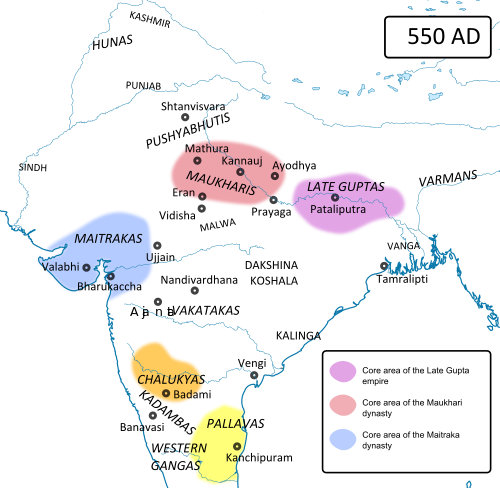
    The Varman dynasty (350-650) is the first historical dynasty of the Kamarupa kingdom. It was established by Pushyavarman, a contemporary of Samudragupta

    Reference and citation.

    https://en.m.wikipedia.org/wiki/Kamrupi_Brahmins

    https://en.m.wikipedia.org/wiki/Varman_dynasty