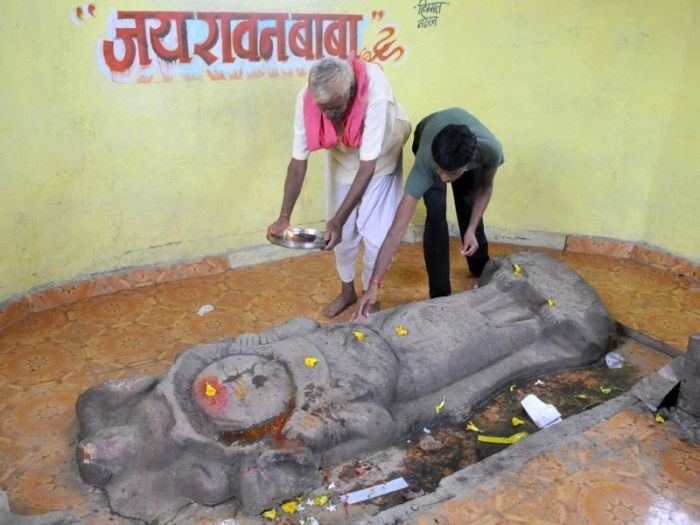
Tag: History of Sri Lanka

  • Ravana History by Brahmin Somachandra Odisha in Gold

    Ravana History by Brahmin Somachandra Odisha in Gold

    I am checking on the history of Ravana from Sri Lanka.

    Though some information is yet to be cross checked, I am providing information that have been checked and will be writing more.

    Ravana who was killed by Lord Rama was a Brahmin.

    He was also considered to be part Yaksha.

    He was also part of the Dravidas of the South and the Naga Loka was considered to be under him.

    He was a Sanskrit scholar and an ardent devotee of Lord Shiva.

    He ruled vast stretches of territory which included the now sunk Atlantis.

    His father in law, Maya built a city in Atlantis.

    Maya is also credited with having built Indraprastha, now called Delhi, capital of India.

    Ravana had his reserve Army in Atlantis, The Americas.

    Ravana is mentioned in Ramayana in detail and all the Eighteen Puranas of India, Mahabharatha, and classics of regional languages of India.

    Not only Hindu texts refer to him but Buddhist texts as well.

    He was called Ravana Buddha, Buddha denoting Enlightened one.

    He wrote Shiva Tandava Stotra, treatises on Astrology and Ayurvedateachers veda.

    He is reported to have conquered territories not covered by the Ikshvaku dynasty of Lord Rama.

    Information of Ravana abounds in Sinhala , Ceylon.

    One such work is Ravana Tales.

    Ravana tales was written in Gold plate by a Brahmin, Somachandra Sri Bharathi from Odisha, India.

    `Ravana Saga’ were based on the ola manuscript `Ravana

    Tales’. The readers will wonder what this `Ravana Tales’

    is? What is its history? This concluding chapter is intended

    to provide the answer to such concerns.

    Dr. Mirandi Obeysekere explains it as follows.

    The original Ravana Tales had been written on gold

    plates by Somachandra Sri Bharathi, an erudite Brahmin of

    Kälinga Dash (presently known as Orissa) to be presented

    to King Khallatanaga (110-104 BC) of Murunda dynasty.

    However, he could not fulfill his wish as the King died

    before the writing was completed.

    Prince Marina, the elder son of King Khallatanaga

    ascended the throne following the demise of his father

    and the book was presented to him. Prince Marina was at

    that time ruling in Girandurukotte with Mirandi Villa as

    his centre of administration.

    This book of gold sheaves was later inherited by his

    elder son Prince Marina Senadhilankara and had since then

    been passed over to the senior member of the succeeding

    generation. Accordingly, it came into the possession of

    the Chieftain Mildew Marina Senadhilankara who was

    the Chieftain of Eva region. Subsequently it was inherited

    by Marina Mahakappina Lanni Bandana Senadhilankana

    who was a chieftain of Eva region, from his father Mildew

    Marina Senadhilankara.

    Erudite successors of this dynasty subsequently

    contributed additional pages written on silver and copper

    sheets to the original book of Sotuachandra Sri Bharathi.

    The book contains factual information about King

    Ravana, ancient Kshatriya (royal) families of Canna,

    Brahmanic lineage, Naga, Yaksha, Diva clans, ancient

    medicine, incantations, illangam and illangam (ancient battle

    craft). The contents of the book were subsequently re-

    written on Ala leaves and the original gold and copper

    sheets had been donated to Mahiyangana temple.

    The donation had been done by Adigar Wickramasinghe

    (1515-1542 AD), son of General Rajaguru Marina

    Mahakappina Lanni Bandana Kenadhilankara. Adigar

    Wickramasinghe served as the Chief Adigar (Mama

    Adikaratn) of King Jayaweera I (1514- 42 AD)’

    Reference and Citation.

    https://ravana1.wordpress.com

    Image credit.

    http://www.india.com/buzz/6-ravana-temples-in-india-you-need-to-visit-atleast-once-in-your-life-609985/

  • Is This The History Of Sri Lanka? Mahavamsa,Jells

    There is no need to know why Rakapashe behaved the way he did, by indulging in Genocide of The Tamils.

    The Mahavamsa explains it.

    Abnormal sexual Behavior, Taboos, Fratricide, Matricides, Patricides galore, to cite a few incidents from their History, explains it all.

    At the beginning of the chronicle (see History of Sri Lanka) the King of Banga (Bengal) is married to the daughter of the King of Kalinga. Their daughter, Suppadevi, was not only ‘very fair and very amorous’, but was also prophesied to consummate a ‘union with the King of beasts[5] – in the Mahavamsa, a lion.

    Mahavamsa
    Mahavamsa

    When this duly happened, she gave birth to two children – Sinhabahu and Sinhasivali. ‘Sinhabahu’ means ‘lion-armed’ and the young prince himself is described as having ‘hands and feet…formed like a lion’s’.[5]

    The family lived together in the lion’s cave, blocked in by a large rock the lion had placed to prevent their exit.

    Eventually, however, Suppadevi and her two children flee the cave.

    Later Sinhabahu kills his father with an arrow.

    Tamil Women raped and Killed Sri Lanka.
    Tamil Women raped and Killed Sri Lanka.

    Then, marrying his sister, he establishes a kingdom based on a city called Singhapur. Sinhasivali bears him a series of twins; their eldest child is named Vijaya, and his younger twin brother Sumitta

    . However, a critical twist and serious study by scholars and researchers with further references suggest that the King of Sinhpur/Sinhapura ( Sihor ), region’s very ancient telltales and references about Prince Vijaya, his exile, his route, are the ones which connect strongly to the History of Sri Lanka and Sinhala/Sinhalese people and culture.

    Vijaya is described as indulging in ‘evil conduct, and his followers were…(like himself), and many intolerable deeds of violence were done by them’.

    So antisocial were his activities that the people of the kingdom eventually demanded that the (now aging) King Sinhabahu have him executed.[5]

    Instead Sinhabhu had half their heads shaved (a sign of disgrace) and exiled Vijaya with his followers, their wives and children, from the kingdom – traditionally said to number a total of 700 souls. After resting in several places they are found to be hostile, and the wayward prince and his associates eventually ‘landed in Lanka, in the region called ‘Tambapanni.[5]

    Later research by Sinhala linguist W.S. Karunatillake supports the hypothesis that the Sinhalese originated in the Eastern India and that many words (over 50%) resemble Bengali language.[6]

    At the same time, the fact can not be denied for it was rise and origin of sub languages from Sanskrit in the times of Middle India where a great volume of syntax and material were common to all the newly emerging Indian Languages.

    And yet they were few at that time. This is to ask for a serious comparison and conclusion for Prince Vijaya’s origin, whether it was from Singhpur, Kalinga or it was from Sihor, Gujarat, despite references weigh more in favor of Vijaya’s origin to lower Indus, and Sihor, which was officially known as Sinhapur in Kathiawar peninsula in ancient times.

    Another critical point of observation is that, the last and, now only home to Asiatic Lions (locally referred as ‘Sinh’ or ‘Sinha’) is Gir Forest falls under Kathiawar peninsula in Gujarat and approach to core Gir territory is just some miles away from Sihor. In fact, till date as in year 2011, Lions are sighted in rural areas adjoining Sihor.

    http://en.wikipedia.org/wiki/Prince_Vijaya

    Trustworthiness of The Mahavamsa.

            The author of I is Mahanama, of II.1, Dhammakitti,
            of II. 3, Sumangala ;the author of II. 2 is unknown.            I need  not say  that, if we try to inquire  into
            the question of the trustworthiness of the chronicle,
            each part must be treated separately. As to the first
            part (chs.  1--37,50) I shall confine myself to a few
            remarks, as the matter  has been fully  dealt with in
            the Introduction to my translation of the poem.(1)            1.  There is a good number of fables, legends and
            tales  of marvels  in the  Mahavamsa, and we must  in
            each  particular  case  attempt  to find  out whether
            there  is in the narrative  an historical  kernel  or
            not....
    http://ccbs.ntu.edu.tw/FULLTEXT/JR-ENG/gei.htm