


Vedic mathematics and science are ancient Indian systems of knowledge that have been passed down through generations. These systems originated in the Vedas, which are a collection of ancient Indian scriptures. Vedic mathematics is a system of mathematical calculations based on 16 sutras, or word-formulas, and 13 sub-sutras, or corollaries. This system is known for its simplicity and efficiency, as it allows for faster calculations and mental math techniques.
Vedic science, on the other hand, is a system of knowledge that encompasses a wide range of subjects, including astronomy, astrology, medicine, and philosophy. It is based on the principles of the Vedas and the Upanishads, which are ancient Indian texts that contain philosophical and spiritual teachings.
One of the key principles of Vedic science is the idea of interconnectedness between all things, known as the principle of unity. This principle suggests that everything in the universe is connected and that there is a fundamental unity underlying all of existence.
Another important principle of Vedic science is the idea of balance, or the principle of equilibrium. This principle suggests that in order for an individual or society to achieve health and well-being, there must be a balance between different aspects of life, such as work and rest, or physical and spiritual pursuits.
Overall, Vedic mathematics and science offer unique insights into ancient Indian knowledge systems and can provide useful tools and perspectives for modern-day learning and living.
Before I write on what Kerala Calculus is, I feel it is necessary to remind us Indians of the fact that our continued ignorance, indifference reluctance to learn our highly scientific texts have resulted in the Myth of Aryan Invasion Theory by the Eurocentric colonialists gained currency and it has taken a lot of efforts to deny the theory which attempted to deny India its glorious past.
There are other insidious attempts too.
That the scientificancient texts are vague, they do not really talk about science and people use it, after the modern science discovers something,Indians say that the facts were mentioned in the Hindu Texts.
And another ingenious attempt to deny India its rich scientific heritage is by stating that the data referred to in the tests were not used by the ancient Indians !
The only way one can counter these arguments is for us to study the original texts and bring into light the scientific thoughts found in our Texts.
I am trying to instill a sense of pride in our heritage by posting articles on various astounding facts in out texts, our stupendous Temples Astronomy.
It is for the specialists to delve deep into the Texts and reveal what they contain.
Unfortunately those who know Sanskrit are not generally aware of advanced modern Scientific Theories and those familiar with modern concepts do not know Sanskrit.
My request is that both the groups must get familiar with what they do not know or get together to highlight the highly advanced scientific nature of Hindu Thought.
I shall continue to post articles giving general directions.
Now to Calculus.
‘
Calculus is the mathematical study of change, in the same way that geometry is the study of shape and algebra is the study of operations and their application to solving equations. It has two major branches, differential calculus (concerning rates of change and slopes of curves),and integral calculus (concerning accumulation of quantities and the areas under and between curves); these two branches are related to each other by the fundamental theorem of calculus. Both branches make use of the fundamental notions of convergence of infinite sequences and infinite series to a well-defined limit. Generally, modern calculus is considered to have been developed in the 17th century by Isaac Newton and Gottfried Leibniz. Today, calculus has widespread uses in science, engineering and economics and can solve many problems that algebra alone cannot.
Calculus is a part of modern mathematics education. A course in calculus is a gateway to other, more advanced courses in mathematics devoted to the study of functions and limits, broadly called mathematical analysis. Calculus has historically been called “the calculus of infinitesimals”, or “infinitesimal calculus”. The word “calculus” comes from Latin (calculus) and refers to a small stone used for counting. More generally, calculus (plural calculi) refers to any method or system of calculation guided by the symbolic manipulation of expressions. Some examples of other well-known calculi are propositional calculus, calculus of variations, lambda calculus, and process calculus.”
The Kerala Calculus.
The Kerala school of astronomy and mathematics was a school of mathematics and astronomy founded by Madhava of Sangamagrama in Kerala, India, which included among its members: Parameshvara, Neelakanta Somayaji, Jyeshtadeva, Achyuta Pisharati, Melpathur Narayana Bhattathiri and Achyuta Panikkar. The school flourished between the 14th and 16th centuries and the original discoveries of the school seems to have ended with Narayana Bhattathiri (1559–1632). In attempting to solve astronomical problems, the Kerala school independently created a number of important mathematics concepts. Their most important results—series expansion for trigonometric functions—were described in Sanskrit verse in a book by Neelakanta called Tantrasangraha, and again in a commentary on this work, called Tantrasangraha-vakhya, of unknown authorship. The theorems were stated without proof, but proofs for the series for sine, cosine, and inverse tangent were provided a century later in the work Yuktibhasa (c. 1500 – c. 1610), written in Malayalam, by Jyesthadeva, and also in a commentary on Tantrasangraha.
Their work, completed two centuries before the invention of calculus in Europe, provided what is now considered the first example of a power series (apart from geometric series). However, they did not formulate a systematic theory of differentiation and integration, nor is there any direct evidence of their results being transmitted outside Kerala ..
The Kerala school has made a number of contributions to the fields of infinite series and calculus. These include the following (infinite) geometric series:
 for <img class="mwe-math-fallback-image-inline tex" src="https://upload.wikimedia.org/math/1/1/2/112f97d0a5732861bb9297b7d2c3e631.png" alt="|x|
This formula, however, was already known in the work of the 10th century Iraqi mathematician Alhazen (the Latinized form of the name Ibn al-Haytham) (965-1039).[8]
The Kerala school made intuitive use of mathematical induction, though the inductive hypothesis was not yet formulated or employed in proofs. They used this to discover a semi-rigorous proof of the result:
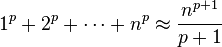 for large n. This result was also known to Alhazen.
They applied ideas from (what was to become) differential and integral calculus to obtain (Taylor-Maclaurin) infinite series for  ,
,  , and
, and  .TheTantrasangraha-vakhya gives the series in verse, which when translated to mathematical notation, can be written as:
 where
where 

 where, for
  , the series reduce to the standard power series for these trigonometric functions, for example:
 and
and (The Kerala school did not use the “factorial” symbolism.)
The Kerala school made use of the rectification (computation of length) of the arc of a circle to give a proof of these results. (The later method of Leibniz, using quadrature (i.e.computation of area under the arc of the circle), was not yet developed.) They also made use of the series expansion of to obtain an infinite series expression (later known as Gregory series) for  :
:

Their rational approximation of the error for the finite sum of their series are of particular interest. For example, the error,  , (for n odd, and i = 1, 2, 3) for the series:

- where

- They manipulated the terms, using the partial fraction expansion of :
 to obtain a more rapidly converging series for :[1]
They used the improved series to derive a rational expression,
 for correct up to nine decimal places, i.e.
  . They made use of an intuitive notion of a limit to compute these results. The Kerala school mathematicians also gave a semi-rigorous method of differentiation of some trigonometric functions, though the notion of a function, or of exponential or logarithmic functions, was not yet formulated.
The works of the Kerala school were first written up for the Western world by Englishman C. M. Whish in 1835, though there exists another work, namely Kala Sankalita by J. Warren from 1825 which briefly mentions the discovery of infinite series by Kerala astronomers. According to Whish, the Kerala mathematicians had “laid the foundation for a complete system of fluxions” and these works abounded “with fluxional forms and series to be found in no work of foreign countries.” However, Whish’s results were almost completely neglected, until over a century later, when the discoveries of the Kerala school were investigated again by C. Rajagopal and his associates. Their work includes commentaries on the proofs of the arctan series in Yuktibhasa given in two papers, a commentary on the Yuktibhasa’s proof of the sine and cosine series and two papers that provide the Sanskrit verses of the Tantrasangrahavakhya for the series for arctan, sin, and cosine (with English translation and commentary)..
The following notes by westerners would justify what I had written at the beginning of the Post.
“
- (Bressoud 2002, p. 12) Quote: “There is no evidence that the Indian work on series was known beyond India, or even outside Kerala, until the nineteenth century. Gold and Pingree assert [4] that by the time these series were rediscovered in Europe, they had, for all practical purposes, been lost to India. The expansions of the sine, cosine, and arc tangent had been passed down through several generations of disciples, but they remained sterile observations for which no one could find much use.”
- Jump up^ Plofker 2001, p. 293 Quote: “It is not unusual to encounter in discussions of Indian mathematics such assertions as that “the concept of differentiation was understood [in India] from the time of Manjula (… in the 10th century)” [Joseph 1991, 300], or that “we may consider Madhava to have been the founder of mathematical analysis” (Joseph 1991, 293), or that Bhaskara II may claim to be “the precursor of Newton and Leibniz in the discovery of the principle of the differential calculus” (Bag 1979, 294). … The points of resemblance, particularly between early European calculus and the Keralese work on power series, have even inspired suggestions of a possible transmission of mathematical ideas from the Malabar coast in or after the 15th century to the Latin scholarly world (e.g., in (Bag 1979, 285)). … It should be borne in mind, however, that such an emphasis on the similarity of Sanskrit (or Malayalam) and Latin mathematics risks diminishing our ability fully to see and comprehend the former. To speak of the Indian “discovery of the principle of the differential calculus” somewhat obscures the fact that Indian techniques for expressing changes in the Sine by means of the Cosine or vice versa, as in the examples we have seen, remained within that specific trigonometric context. The differential “principle” was not generalized to arbitrary functions—in fact, the explicit notion of an arbitrary function, not to mention that of its derivative or an algorithm for taking the derivative, is irrelevant here”
- Jump up^ Pingree 1992, p. 562 Quote: “One example I can give you relates to the Indian Mādhava’s demonstration, in about 1400 A.D., of the infinite power series of trigonometrical functions using geometrical and algebraic arguments. When this was first described in English by Charles Whish, in the 1830s, it was heralded as the Indians’ discovery of the calculus. This claim and Mādhava’s achievements were ignored by Western historians, presumably at first because they could not admit that an Indian discovered the calculus, but later because no one read anymore the Transactions of the Royal Asiatic Society, in which Whish’s article was published. The matter resurfaced in the 1950s, and now we have the Sanskrit texts properly edited, and we understand the clever way that Mādhava derived the series without the calculus; but many historians still find it impossible to conceive of the problem and its solution in terms of anything other than the calculus and proclaim that the calculus is what Mādhava found. In this case the elegance and brilliance of Mādhava’s mathematics are being distorted as they are buried under the current mathematical solution to a problem to which he discovered an alternate and powerful solution.”
Reference and citation.
https://en.wikipedia.org/wiki/Kerala_school_of_astronomy_and_mathematics
- where




Mr Ram your predication is right some people is only give unauthorized data aur some unlike script i with you you argument “kuch kar rahe hai HIND ke liye jinhone nahi kiya wo tou ungali uthayege ” salute
I have been doing research in INDOLOGY/TAMILOGY ever since I was branded as an ARYAN MARAUDER when i joined PRIMARY SCHOOL. Indian history suffers from SELF DECEPTION/EULOGY/MYOPHIA and relies wholly on AIT/IVC/ALBERUNI/SAYANA’S COMPILATION. You please set aside these four historical frauds and then go to understand history. Our thinking process starts from SIR WILLIAM JONES/GOETHE who praised KALIDASA AND PANINI IN UNEQUIVOCAL TERMS and then MAXMULER’S TRANSLATION OF SAYANA AND THEN SIR JOHN MARSHALL/S DISCOVERY OF IVC. While NORTH INDIANS WERE NEVER CONCERNED with sustenanace for posterity South Indians cared for posterity. Why did nobody go into the fact that AFTER ASOKAN EDICTS there were no stone inscriptions in North Indians while South India has the largest stone inscriptions in India–300000 inscription out of which 100000 are in Tamil out of which only 30000 inscriptions have been deciphered.Cholas’ BRONZE are derivatives of PALA who are BUDDHISTS yet promoted all kinds of SAIVISM AND ALSO TANTRISM. The exquistive sixty four forms of LORD SIVA IN CHOLA BRONZES are actually derived from Palas. Yet we did not PALAS ERCET TEMPLES AND DEVISE TEMPLE WORSHIP AS CHOLAS DID. If invasion has been one of the reasons why did not there have been revival since in most places from Jerusalem to Japan. Why did not BENGAL ARTISANS MIGRATE TO OTHER PLACES?Though there are a number of CHOLA INSCRIPTIONS TALK ABOUT SETTLEMENT OF BRAHMINS FROM BENGAL–ST.ARUNAGIRINATHAR BELONGED TO DINDIMA KAVI SETTLED IN TAMILNADU AND ILADA BRAHMINS CONTRIBUTED MUCH TO TAMIL. Hence frequent invasion cannot be main reason for decline of temple worship in North India. But let us look North India differently. Unlike South India where there have been large scale migration-Kannadigas of VOKKALIGAS/DEVANGAS migrating to Western Tamilnadu/Nadars migrating from MALABAR KAMMAS/BALIGAS/IDIGAS/BRAHMINS/SOWRASHTRAS migrating from Andhra North Indian has people fixed to certain areas who never migrated even in worst kind of disasters–GUJJARS/JATS HAVING FIXED IN ROHILKHAND I.E.,UPTO MATHURA–YADAVAS/AHIRS FROM MATHURA TO EAST BIHAR/MAHANISHADS/VALMIKIS FROM PUNJAB TO EASTERN UP etc., The only people who migrated were JAINS AND KAYASTHAS WHO ARE PRESENT THROUGHOUT NORTH INDIA. EVEN KUNBHIS never deserted Maharashtra and did not settle in Tamilnadu at the time of Mahratta Rule. All these communities have no particular interest in Brahminism and don’t adopt Smarthic/Srautic rituals for birth and death. There was a big question with regard to applicability of SRAUTHA RITUALS for all communities in general. Those who want to study Indian History in earnest should read the famous SUCCESSION OF ESTATE OF SIR SUNDARAAM IYER AND OTHERS VS RAJA OF KOLHAPUR. One KAMALADHARA of Maharashtra devised rituals for all communities in general except Brahmins which is being all communities throughout South India probably excep Kerala. It is clear that after eleventh century AD the social conditions in SOUTH INDIA collapsed beyond recognition while the major communities retained their originality intact Thus while one is not able to trace history of SOUTH INDIA BEYOND fourteenth century AD what is the use of claiming superiority of KERALA MATHEMATICIANS OF FOURTEENTH CENTURY AD?.Even among the Tamil Brahmins it is hard to trace the formation of sub sects beyond sixteenth century AD. The most puzzling factor is the recitation of certain slokas in Sandhya Vandhanam in KRISHNA YAJUR VEDA-APASTHAMBA SUTRA which clearly shows that the system cannot go back beyond fifteenth cen tury AD. A large number of inscriptions and NACHINARKINIYANAR COMMENTARY reveals that THE CONCEPT OF FOUR VEDAS as understood those times was not with reference to SAYANA but with reference to GRIHYA SUTRAS having applicatio some rare SUTRAS LIKE BHARATHDWAJA/KAUSHIKA/AGNIVESHYA. For your kind information there is misconception abaout SIRUTHONDAR-MANY BELIEVE HE IS AVELLALA BUT THE FACT IS OTHERWISE. HE IS AGNIVESHYA–BRAHMA VAIDHYA OR BRAHMAKSHATRIYA AND HIS OTHER ILLUSTRIOUS PEOPLE WERE SATTAN GANAPATHI OF VELVIKUDI GRANT AND KUMUDAVALLI WIFE OF THIRUMANGAI MANNAN. THESE SHAKAS HAVE GONE INTO OBVILION AND IT IS SAID THAT VAIKANAS BHATTACHARYAS HAVE NOT BBEN GIVEN DUE RECOGNITION SINCE SAGE VIKANASA CREATED GRIHYA SUTRA ON KRISHNA YAJUR VEDA. What are the application of SAYANA’S MANDALAS WHERE DASARNA WAR AND WAR OF ARYA/DASA/DASYUS FIGHT BETWEEN BHARATHAS/TURVASU? Thus please shed the history on SAYANA’S BHASHYA. It is not true history. In my opinion History of I ndia starts only from VIJAYANAGAR KINGDOM and anything written about prior period is mere conjecture since the social order before VIJAYANAGAR has completely disappeared beyond recognition
Readres may react
I am a freelance researcher in INDOLOGY/TAMILOGY. I am a student of PHYSICS. It is unfortunate that we rely on self deception. If Kerala mathematicians knew CALCULUS did they at any time prove GRAVITATIONAL FORCE OF ATTRACTING LIKE SIR ISAAC NEWTON AND FROM IT KEPLER’S LAW OF MOTION. INDIAN MATHEMATICANS never developed a system of proof but only aphorism what may be called INTELLECTUAL INTUITION but without application. We ourselves could know about CALCULUS IN INDIA only from WESTERNERS. WHAT WAS THE USE OF INDULGING IN SELF MYOPHIA when we limited our application only to calculate planetary positions for JYOTHISHA and noting more. DON’T DECRY the greatness of DESCARTES/NEWTON/LEIBINITZ/GAUSS/STOKES
I am not decrying Descartes etc.Your observations confirm my statements about present Indian view of our science.You say our people knew of Calculus only from these westerners.Can some one explain to me how the Thanjavur Temple was built without the aid of Calculus: the Panchanga where the eclipses are predicted to the minute.I wish our people read more of our vedic Texts and ancient Tamil texts to understand the greatness of India.On Descartes ,Spinoza, Leibniz , let me add that I have specialised in European and Indian Philosophy and I am no armchair philosopher.Over eight years have been spent in learning the Vedas and equal number of years in studying Tamil.So when some one says Indian culture learnt thngs from the west,I am dismayed.
Suggest one reads Varahamihiram, Aryabhatta’s works,Surya Siddhanta .Regds
No Newton, Descartes and all those European thinkers were frauds and cheats and hacks who plagiarized from the Kerala school; the system of proofs and writing that supposed Europeans got was from the Egyptian mystery schools and the Ancient Indian universities and colleges which they were the original inventors and progenitors of. The laws of gravity and gravitational forces were all invented in Ancient India and surmised by thinkers like Ayrbhatta which Newton plagiarized off Ancient Indian Vedic texts. All those supposed laws of motion that Kepler and all those Euro hacks and frauds supposedly came up with, were all come up with and invented in Ancient India and were in Ancient Indian Vedic texts but re-hashed and re-named with Ancient Indian names. Sorry to say but this is the truth.
Also the author is wrong, EUROPEANS WERE AWARE OF THE KERALA SCHOOL AND ANCIENT INDIAN UNIVERSITIES AND COLLEGES! Infact various so called Greek thinkers and philosophers went to and attended Ancient schools and universities like Taxila and then plagiarized and copied their mathmatical ideas from there, like the fraudelent Pythogorean theorem. So much of European thought isn’t European at all but stolen African and Asian knowledge……