When people are trying to prove the birth place of Rama, many are not even aware of some other ancient Hindu Temples razed to the ground and Mosques built over them.
I have written article listing the Temples turned into Mosques.
He was man who murdered his siblings and tortured His Father to Death.
This ‘pious Man’ demolished Hindu Temples and built Mosques there after plundering the wealth of these temples and defiling the Deities.
He chose most sacred temple for his special treatment.
One such is the Kasi Viswanathar Temple, Varanasi.
This city has the unique distinction of the being the Oldest continuously inhabited city in the world!
Please read my article on this.
Gyanvapi Mosque built on original Kashi Vishwanath temple,by Aurangzeb.Image. i
”
The Gyanvapi mosque is located in Varanasi, Uttar Pradesh, India. It was constructed by the Mughal Emperor Aurangzeb, on the site of the demolished Kashi Vishwanath temple. It is located north of Dashaswamedh Ghat, near Lalita Ghat along the river Ganges.
Dashaswamedh Ghat, means the Bank of the river where hundred Aswamedha Sacrifice was performed.
It is a Jama Masjid located in the heart of the Varanasi city.
It is administered by Anjuman Inthazamiya Masajid (AIM)
The mosque was built by the Mughal emperor Aurangzeb in 1664 CE, after destroying a Hindu temple:1 The remnants of the Hindu temple can be seen on the walls of the Gyanvapi mosque.
The demolished temple is believed by Hindus to be an earlier restoration of the original Kashi Vishwanath temple. The original temple had been destroyed and rebuilt a number of times. The temple structure that existed prior to the construction of the mosque was most probably built by Raja Man Singh during Akbar’s reign Aurangzeb’s demolition of the temple was also probably attributed to the escape of the Maratha king Shivaji and the rebellion of local zamindars (landowners). Jai Singh I, the grandson of Raja Man Singh, is alleged to have facilitated Shivaji’s escape from Agra. Some of the zamindars were alleged to helped Shivaji avoid the Mughal authorities. In addition, there were allegations of Brahmins interfering with the Islamic teaching. The temple’s demolition was intended as a warning to the anti-Mughal factions and Hindu religious leaders in the city.[5]
Maulana Abdus Salam contests the claim that a temple was destroyed to build the mosque. He states that the foundation of the mosque was laid by the third Mughal emperor Akbar. He also adds that Akbar’s son and Aurangzeb’s father Shah Jahan started a madrasah called Imam-e-Sharifat at the site of the mosque in 1048 hijri (1638-39 CE).
( what an audacity? what was there before the existence of the Mosque?)
‘
Around 1750, the Maharaja of Jaipur commissioned a survey of the land around the site, with the objective of purchasing land to rebuild the Kashi Vishwanath temple. The survey map provides detailed information about the buildings in this area and information about their ownership. This survey shows that the edges of the rectangular Gyanvapi mosque precinct were lined up with the residences of Brahmin priests.:85
Describing the site in 1824, British traveler Reginald Heber wrote that “Aulam Gheer” (Alamgir I i.e. Aurangzeb) had defiled a sacred Hindu spot and built a mosque on it. He stated that Hindus considered this spot more sacred than the adjoining new Kashi Vishwanath temple. He described the site as a “temple court”, which was crowded with tame bulls and naked devotees chanting the name of Rama.
In 1742, the Maratha ruler Malhar Rao Holkar made a plan to demolish the mosque and reconstruct Vishweshwar temple at the site. However, his plan did not materialize, partially because of intervention by the Nawabs of Lucknow, who controlled the territory. Later, in 1780, his daughter-in-law Ahilyabai Holkar constructed the present Kashi Vishwanath Temple adjacent to the mosque.
In the 1990s, the Vishwa Hindu Parishad (VHP) campaigned to reclaim the sites of the mosques constructed after demolition of Hindu temples. After the demolition of the Babri mosque in December 1992, about a thousand policemen were deployed to prevent a similar incident at the Gyanvapi mosque site. The Bharatiya Janata Party leaders, who supported the demand for reclaiming Babri mosque, opposed VHP’s similar demand for Gyanvapi, on the grounds that it was an actively used mosque.
The mosque now receives protection under the Places of Worship (Special Provisions) Act, 1991. Entry into the mosque precinct is restricted, and photography of the mosque’s exterior is banned.
People are aware that Lord Krishna was born in a prison where his parents Devaki and Vasudeva were imprisoned by Krishna’s ,maternal Uncle(brother of Devaki) Kamsa.
The whole Nation is talking about Rama Janma Bhoomi Ayodhya , the Birth Place of Lord Rama.
Krishna as a child
What people are not aware is about the Mosque adjacent to Kasi Viswanatha Temple, the original Shiv Linga is in the Well abutting the wall of a Mosque;the Shiv Linga thrown by the Muslim Invaders.
What we see to day Kasi Viswanatha Temple is not the original Shiv Linga.
How many of us are aware of the Mosque in Krishna Janma Bhoomi!
The Birth place of Krishna.
Krishnajanma Bhoomi, The prison Cell where Lord Krishna was born, Mathura,India
‘Mathura, the birth city of Krishna is situated on the banks of river Yamuna and is approximately 145 km from the capital city Delhi. The town is renowned for being host to the most revered temple of Shri Krishna-the famous Krishna Janma Bhoomi Mandir. The temple is the place where lord is said to have been born thousands of years ago. Along with neighboring towns Govardhan, Nandgaon and Vrindavan, the area is a major pilgrimage site for Hindus.The temple is located in the middle of the city mathura.(wiki Sri Krishna Janmabhoomi)
‘Garbh Griha ( Sanctum sanctorum or Prison Cell ) : The divine ambience of the sanctum sactorum thrills the hearts of the devotees as soon as they enter the auspicious place, and a sense of conviction surges in their minds that this indeed is the place where Lord Krishna manifested Himself. It is true that Mathura is the holiest, and it is the only place in the universe where Brahma and Shakti have been manifested at the same place. It is in Mathura that Leelapurushottam Shri Krishna and Ashthabhuja Ma Yogmaya manifested. A spacious verandah and an artistic marble pavilion, Shikhar Mandap, were constructed exactly on the upper part of theMedhi. A miracle observed here is that innumerable forms of Shri Radha-Krishna have appeared on the Makrana marble slabs of the wall of the Shikhar Mandap. The devotees are overwhelmed by the palpable feeling of His divine grace at this place.’
The area surrounding the prison cell, hat is the Krishna Janma Bhoomi had a magnificent Temple which was called Katara Keshav Dev Temple.
Krishna Janma Bhoomi Temple.
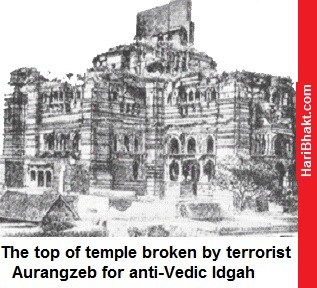
This was demolished by, who else,the Muslims and a Mosque, Shah Mosque, and Idgah, burial ground was built.
The facts.
Archaeological and historical evidences show that birth place of Krishna is given different names by the bhakts of Shri Krishna and devotees. In due course of time, surrounding area of birth place of Krishna is also known as “Katara Keshavdev”. Mr. F.S. Grauja, Archaeologist and the then collector of Mathura opined that Katara Keshavdev and surrounding area is known as Mathura alone. From historical literature, the historian Kaniham, informed that there was a Jungle king named Madhu. The place is named after him as “Madhupur” which is known as “Maholi” today. After the defeat of King Madhu, surrounding area of prison presently called as “Bhuteshwar” was called as Mathura and the same was Katara Keshavdev. The historian Kaniham called this as Keshavpur….
From the analysis of Archaeological research and thousands of archaeological fragments of Katara Keshavdev and the different writings of foreign tourists, it is evident that huge temples were built from time to time at this place. The evidence show that Brajanabh the great grand son of Krishna, has built first temple at the prison of Kans where the Bhagwan Krishna was divinely born….
From the stones script written in Brahmi script “Mahakshatrap Shodash” (B.D. 80-57) it is evident that a person named Vasu has built a Festonn and yagna kund (यज्ञकुन्ड) at the birth place of Krishna. During the regime of Chandragupta, Vikramaditya, the temple was rebuilt.
During this period this temple was not only the place of Vaidik ritual but also the place of faith for Buddhists, Jains. In A.D.1017 this gracious temple was looted by Mohammed of Ghaznavi. In the book, Tarike Yamini written by Mir Munshi Al-Utabi, it is stated that in the very middle of the city there was an elegant temple, it was so beautiful, it appeared to have been built by the angels. It is very difficult to describe the elegance of the surrounding temples too in words and in pictures. Sultan Mohammed has also stated that if anybody tries to built such a gracious temple, the expenses would be 10 crores of Dinar and it will take not less than 200 years. However, Being a follower of koran, Mohammed destroyed this temple in the heat of anger. The history shows that the very sincere devotion towards Krishna and lively Hinduism inspired a person named Jajja to built another Krishna Janma Bhoomi and during the regime of Maharana Vijaypal Dev of Mathura in 1150, the temple was rebuilt.
The evidence from stones script written in Sanskrit at Katara Keshavdev shows that the temple has become the target of destruction in the evil eyes of Muslim rulers. During the regime of Sikander Lodi, Krishna Janma Bhoomi was once again was destroyed. After about 125 years during the rule of Jahangir King, Vir Sinha Judev Bundela constructed a very huge temple of 250 feet tall at the cost of Rs.33 lakhs. In order to protect the temple from evil eye of Muslim rulers, a tall and strong wall was built around the temple….
The tourist Taivaniyar from France, Manuchi from Italy described the temple as beautiful master piece. The apex of temple was covered with Gold and it was so tall that one can see from distance of 36 miles away from the Agra. All these praise worthy writings regarding the temple made Aurangzeb angry and he destroyed the temple in 1669. He was so irritated about the elegance of Hindu temples that bricks and other material recovered from the destruction of temple was used by him to make a big chair. The height of destructive islamic mind of Aurangzeb is nothing but the construction of anti-Vedic evil structure of Idgah at the very birth place of Krishna. Brahmins and Sages had forewarned Aurangzeb of dire consequences for his evil act of destructing Hindu temples and now Shri Krishna Janm Bhoomi temple….
The East India Company later auctioned the place to generate revenue on the emotions of the Hindus. Marathas declared the whole area of Katara Keshavdev including Idgah as unowned property and nobody has taken care of this property. This was grave mistake on the part of erstwhile Marathas, they should have owned the property and constructed a huge Shri Krishna temple over it. Due to fragmentation of strength among Hindu rulers, in 1802 Lord Lake acquired victory over Marathas and Mathura and Agra became territory of East India Company. [The loss of places by Maratha rulers is a lesson for modern Hindus, to remain united and fight aggressively against invaders and mlecchas(anti-Hindus)]. East India Company was managed by cruel, wicked and cunning Britishers, they needed money to take other parts of India in the grip. So they devised several ways to generate income from Hindus which included charging extra money from Hindu pilgrims in their holy places – this evil concept was followed by the precedence set by terrorist mughal rulers. In 1815 East India Company declared auction of Katara Keshavdev area admeasuring 13.37 sq.acres. This area was sold to King Patnimal of Kashi. However, though King wanted to built a gracious temple in the memory of Bhagwan Krishna, to fulfill the demands of millions of Hindus, the Muslims took wrong objection that the auction was only for Katara Keshavdev and not for anti-Vedic structure, Idgah. The dispute was initiated by muslims which instigated further rift among peaceful Hindus and trouble maker muslims. The unfair and illegal demand of muslims took the course of disputes to legal battle.
In the year 1878, for the first time, Muslims registered the case. They stated that Katara Keshavdev is property of Idgah and Idgah was built by Aurangzeb. In this case evidence was demanded from Mathura jurisdiction. The then collector secretary Mr. Tailor stated that this area was unowned in the regime of Maratha. However, the East India Company has also considered the area as unclaimed. Subsequently, in the year 1815 King Patnimal purchased the area in the auction. He further added that according to the verdict, King Patnimal was the owner of the area including other constructions and Idgah, since he paid for the entire area admeasuring 13.37 sq.acres. So any construction happening within the premise is fully owned by King Patnimal. Muslims became peechless, because they cribbed without any substantial evidence of legal ownership. And since the original temple of Shri Krishna Janam Bhoomi belonged to Hindus and later to Hindu King Patnimal, their false claim was overturned….
Second time the case was registered as Ahmed Shah V/s. Gopi under section 447/352 I.P.C. Mathura in the court of second class Magistrate, Anthony. In this case, Ahmed Shah alleged that the watchman of Idgah, Gopi, was constructing a road in the western side of Katara Keshavdev. However, that road is the property of Idgah and hence, Ahmed Shah stopped Gopi from improving the road. In this case, the learned judge gave decision that the road was the property of family Patnimal and allegation made by Ahmed Shah was completely untrue. The cunning ploy to establish somehow ownership of Idgah again fell flat.
The Third case was made by the district judge of Agra in the civil court. Appeal No.236 of 1921 and 276 of 1920. This appeal was made in opposition to the decision given by Judge Hoper of Mathura. In the verdict of this case, it is stated that East India Company had auctioned entire area and sold to King Patnimal at Rs.1140/- and tax was collected by the King. In the court verdict, decision is given as the disputable area is not of Idgah as Idgah is property of King Patnimal. So King and his heirs had every right to collect tax on their own land.
Declaration of the Hindu Rights on Entire Area of Shri Krishna Janm Bhoomi
Muslims by any which means wanted illegal ownership of anti-Vedic strucure, Idgah. In the year 1928, Muslims installed a mill for maintenance and renovation of Idgah. Again the case was registered in the Court of Law and learned Pandit Bishan Narayan Tankha gave the verdict that Katara Keshavdev is the property of descendants of Raja Patnimal and hence neither renovation of Idgah nor installation of mill is allowed. On 7.2.1944 Pandit Madan Mohan Malviya expressed his desire to build Shri Krishna Temple at that place. From the inspiration of M.M.Malviya, Jugal Kishore Birla purchased the entire area at Rs.13,400/- and a trust was formed by Madan Mohan Malviya, Hanuman Prasad Potdar & Bhikamal Atriya.
You must be logged in to post a comment.