Tag: Mathura

  • Mosque In Krishna Janma Bhoomi Katara Keshava Dev Temple Facts

    Mosque In Krishna Janma Bhoomi Katara Keshava Dev Temple Facts

    People are aware that Lord Krishna was born in a prison where his parents Devaki and Vasudeva were imprisoned by Krishna’s ,maternal Uncle(brother of Devaki) Kamsa.

    The whole Nation is talking about Rama Janma Bhoomi Ayodhya , the Birth Place of Lord Rama.

    Lord Krishna as a child.Image.jpg
    Krishna as a child

    What people are not aware is about the Mosque adjacent to Kasi Viswanatha Temple, the original Shiv Linga is in the Well abutting the wall of a Mosque;the Shiv Linga thrown by the Muslim Invaders.

    What we see to day Kasi Viswanatha Temple is not the original Shiv Linga.

    How many of us are aware of the Mosque in Krishna Janma Bhoomi!

    The Birth place of Krishna.


    Krishnajanma Bhoomi
    Krishnajanma Bhoomi, The prison Cell where Lord Krishna was born, Mathura,India

    ‘Mathura, the birth city of Krishna is situated on the banks of river Yamuna and is approximately 145 km from the capital city Delhi. The town is renowned for being host to the most revered temple of Shri Krishna-the famous Krishna Janma Bhoomi Mandir. The temple is the place where lord is said to have been born thousands of years ago. Along with neighboring towns Govardhan, Nandgaon and Vrindavan, the area is a major pilgrimage site for Hindus.The temple is located in the middle of the city mathura.(wiki Sri Krishna Janmabhoomi)

    Garbh Griha ( Sanctum sanctorum or Prison Cell ) : The divine ambience of the sanctum sactorum thrills the hearts of the devotees as soon as they enter the auspicious place, and a sense of conviction surges in their minds that this indeed is the place where Lord Krishna manifested Himself. It is true that Mathura is the holiest, and it is the only place in the universe where Brahma and Shakti have been manifested at the same place. It is in Mathura that Leelapurushottam Shri Krishna and Ashthabhuja Ma Yogmaya manifested. A spacious verandah and an artistic marble pavilion, Shikhar Mandap, were constructed exactly on the upper part of theMedhi. A miracle observed here is that innumerable forms of Shri Radha-Krishna have appeared on the Makrana marble slabs of the wall of the Shikhar Mandap. The devotees are overwhelmed by the palpable feeling of His divine grace at this place.’

    http://mathuravisit.com/mathura/krishna-janambhoomi.html


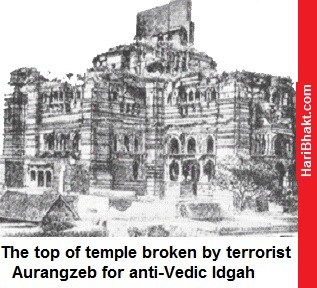
    The area surrounding the prison cell, hat is the Krishna Janma Bhoomi had a magnificent Temple which was called  Katara Keshav Dev Temple.

    Krishna's Birth Place .Temple demolished by Aurangazeb.
    Krishna Janma Bhoomi Temple.


    This was demolished by, who else,the Muslims and a Mosque, Shah Mosque, and Idgah, burial ground was built.

    The facts.

    Archaeological and historical evidences show that birth place of Krishna is given different names by the bhakts of Shri Krishna and devotees. In due course of time, surrounding area of birth place of Krishna is also known as “Katara Keshavdev”. Mr. F.S. Grauja, Archaeologist and the then collector of Mathura opined that Katara Keshavdev and surrounding area is known as Mathura alone. From historical literature, the historian Kaniham, informed that there was a Jungle king named Madhu. The place is named after him as “Madhupur” which is known as “Maholi” today. After the defeat of King Madhu, surrounding area of prison presently called as “Bhuteshwar” was called as Mathura and the same was Katara Keshavdev. The historian Kaniham called this as Keshavpur….

    From the analysis of Archaeological research and thousands of archaeological fragments of Katara Keshavdev and the different writings of foreign tourists, it is evident that huge temples were built from time to time at this place. The evidence show that Brajanabh the great grand son of Krishna, has built first temple at the prison of Kans where the Bhagwan Krishna was divinely born….

    From the stones script written in Brahmi script “Mahakshatrap Shodash” (B.D. 80-57) it is evident that a person named Vasu has built a Festonn and yagna kund (यज्ञकुन्ड) at the birth place of Krishna. During the regime of Chandragupta, Vikramaditya, the temple was rebuilt.

    During this period this temple was not only the place of Vaidik ritual but also the place of faith for Buddhists, Jains. In A.D.1017 this gracious temple was looted by Mohammed of Ghaznavi. In the book, Tarike Yamini written by Mir Munshi Al-Utabi, it is stated that in the very middle of the city there was an elegant temple, it was so beautiful, it appeared to have been built by the angels. It is very difficult to describe the elegance of the surrounding temples too in words and in pictures. Sultan Mohammed has also stated that if anybody tries to built such a gracious temple, the expenses would be 10 crores of Dinar and it will take not less than 200 years. However, Being a follower of koran, Mohammed destroyed this temple in the heat of anger. The history shows that the very sincere devotion towards Krishna and lively Hinduism inspired a person named Jajja to built another Krishna Janma Bhoomi and during the regime of Maharana Vijaypal Dev of Mathura in 1150, the temple was rebuilt.


    The evidence from stones script written in Sanskrit at Katara Keshavdev shows that the temple has become the target of destruction in the evil eyes of Muslim rulers. During the regime of Sikander Lodi, Krishna Janma Bhoomi was once again was destroyed. After about 125 years during the rule of Jahangir King, Vir Sinha Judev Bundela constructed a very huge temple of 250 feet tall at the cost of Rs.33 lakhs. In order to protect the temple from evil eye of Muslim rulers, a tall and strong wall was built around the temple….

    The tourist Taivaniyar from France, Manuchi from Italy described the temple as beautiful master piece. The apex of temple was covered with Gold and it was so tall that one can see from distance of 36 miles away from the Agra. All these praise worthy writings regarding the temple made Aurangzeb angry and he destroyed the temple in 1669. He was so irritated about the elegance of Hindu temples that bricks and other material recovered from the destruction of temple was used by him to make a big chair. The height of destructive islamic mind of Aurangzeb is nothing but the construction of anti-Vedic evil structure of Idgah at the very birth place of Krishna. Brahmins and Sages had forewarned Aurangzeb of dire consequences for his evil act of destructing Hindu temples and now Shri Krishna Janm Bhoomi temple….

    The East India Company later auctioned the place to generate revenue on the emotions of the Hindus. Marathas declared the whole area of Katara Keshavdev including Idgah as unowned property and nobody has taken care of this property. This was grave mistake on the part of erstwhile Marathas, they should have owned the property and constructed a huge Shri Krishna temple over it. Due to fragmentation of strength among Hindu rulers, in 1802 Lord Lake acquired victory over Marathas and Mathura and Agra became territory of East India Company. [The loss of places by Maratha rulers is a lesson for modern Hindus, to remain united and fight aggressively against invaders and mlecchas(anti-Hindus)]. East India Company was managed by cruel, wicked and cunning Britishers, they needed money to take other parts of India in the grip. So they devised several ways to generate income from Hindus which included charging extra money from Hindu pilgrims in their holy places – this evil concept was followed by the precedence set by terrorist mughal rulers. In 1815 East India Company declared auction of Katara Keshavdev area admeasuring 13.37 sq.acres. This area was sold to King Patnimal of Kashi. However, though King wanted to built a gracious temple in the memory of Bhagwan Krishna, to fulfill the demands of millions of Hindus, the Muslims took wrong objection that the auction was only for Katara Keshavdev and not for anti-Vedic structure, Idgah. The dispute was initiated by muslims which instigated further rift among peaceful Hindus and trouble maker muslims. The unfair and illegal demand of muslims took the course of disputes to legal battle.

    In the year 1878, for the first time, Muslims registered the case. They stated that Katara Keshavdev is property of Idgah and Idgah was built by Aurangzeb. In this case evidence was demanded from Mathura jurisdiction. The then collector secretary Mr. Tailor stated that this area was unowned in the regime of Maratha. However, the East India Company has also considered the area as unclaimed. Subsequently, in the year 1815 King Patnimal purchased the area in the auction. He further added that according to the verdict, King Patnimal was the owner of the area including other constructions and Idgah, since he paid for the entire area admeasuring 13.37 sq.acres. So any construction happening within the premise is fully owned by King Patnimal. Muslims became peechless, because they cribbed without any substantial evidence of legal ownership. And since the original temple of Shri Krishna Janam Bhoomi belonged to Hindus and later to Hindu King Patnimal, their false claim was overturned….

    Second time the case was registered as Ahmed Shah V/s. Gopi under section 447/352 I.P.C. Mathura in the court of second class Magistrate, Anthony. In this case, Ahmed Shah alleged that the watchman of Idgah, Gopi, was constructing a road in the western side of Katara Keshavdev. However, that road is the property of Idgah and hence, Ahmed Shah stopped Gopi from improving the road. In this case, the learned judge gave decision that the road was the property of family Patnimal and allegation made by Ahmed Shah was completely untrue. The cunning ploy to establish somehow ownership of Idgah again fell flat.


    The Third case was made by the district judge of Agra in the civil court. Appeal No.236 of 1921 and 276 of 1920. This appeal was made in opposition to the decision given by Judge Hoper of Mathura. In the verdict of this case, it is stated that East India Company had auctioned entire area and sold to King Patnimal at Rs.1140/- and tax was collected by the King. In the court verdict, decision is given as the disputable area is not of Idgah as Idgah is property of King Patnimal. So King and his heirs had every right to collect tax on their own land.

    Declaration of the Hindu Rights on Entire Area of Shri Krishna Janm Bhoomi

    Muslims by any which means wanted illegal ownership of anti-Vedic strucure, Idgah. In the year 1928, Muslims installed a mill for maintenance and renovation of Idgah. Again the case was registered in the Court of Law and learned Pandit Bishan Narayan Tankha gave the verdict that Katara Keshavdev is the property of descendants of Raja Patnimal and hence neither renovation of Idgah nor installation of mill is allowed. On 7.2.1944 Pandit Madan Mohan Malviya expressed his desire to build Shri Krishna Temple at that place. From the inspiration of M.M.Malviya, Jugal Kishore Birla purchased the entire area at Rs.13,400/- and a trust was formed by Madan Mohan Malviya, Hanuman Prasad Potdar & Bhikamal Atriya.

    Image, reference and Citations.

    http://haribhakt.com/truth-and-facts-about-shri-krishna-janam-bhoomi-mandir/#Archaeological_and_Historical_Namesof_Katara_Keshavdev_Mathura_as_Birth_Place_of_Shri_Krishna

  • Temples Old Over Five Thousand Years I

    There are temples in India which are older over Five Thousand years.

    Some of them are damaged.

    When a modern building  built with the latest Technology do not seem to last for fifty years,these temples are a tribute to the Technology and skill of our ancestors.

    Temple for Balarama
    Dauji Temple

    Near Gokul, in Village Baladeva (District Mathura), Shri Dauji Temple is situated 21 km southeast of Mathura, on the other side of Yamuna river.  The name Dauji means ‘Elder Brother’. Here in the temple two metre (6×6″)  Deity of Lord Balrama was installed by King Vajranabha.

    Near Gokul, in Village Baladeva (District Mathura), Shri Dauji Temple is situated 21 km southeast of Mathura, on the other side of Yamuna river.  The name Dauji means ‘Elder Brother’. Here in the temple two metre (6×6″)  Deity of Lord Balrama was installed by King Vajranabha.

    seven kilometers south of Gokula, not far from Mathura, is the Dauji temple. Dauji is the Deity of Lord Balarama that was originally installed 5,000 years ago by King Vajranabha, Krishna’s great-grandson. From Lord Krishna and His queen Rukmini was born the great warrior Pradyumna, one of His prominent sons, who married the daughter of Rukmi, Rukmavati. They gave birth to Anirudha. Anirudha married Rukmi’s son’s daughter, Rachana, and from her was born Vajra, who would remain among the few survivors of the Yadus’ battle. (Bhagavatam 10.90.35-37)

    In fact, King Vajra established a number of Krishna Deities in the area. The present Dauji temple that we see today was built 200 years ago by Shyama Das of Delhi. Many people also attend this temple to get darshan of the single Deity of the 6 feet tall Lord Balarama. From the other side of the temple you can see the Deity of Revati, Lord Balarama’s wife. Nearby is the Balabhadra Kund or Kshira (milk) Sagara (sea) where the Deity of Lord Balarama had been hidden during the Moghul invasion. Near this kund is a temple to Harideva, and in the bazaar is another temple to Krishna as Banke Bihari.”

    Old Krishna Temple
    Krishna temple

    There is also much history on the site of Krishna’s birth, the Krishna Janmasthana in Mathura. Historical records indicate that the first temple here was also built by King Vajranabha. This temple lasted for many years. The next temple was supposedly built by King Vikramaditya in 400 BCE. That was destroyed by the infamous Mahmud Ghazni in 1017-18. Ancient descriptions relate that such a magnificent building would have taken 200 years of great toil by the world’s greatest craftsmen. Thereafter, a third temple was built by a citizen named Jajja during the time of King Vijayapalavadeva, ruler of Mathura, according to an inscription on a stone slab discovered in the area. Sri Chaitanya visited this temple during His visit in 1515. Unfortunately, that was destroyed by the Muslim Sikander Lodi shortly thereafter. The next temple was built by Raja Virsinghadeva Bundela during the reign of Jehangir (around 1650). It is said that this temple stood 250 feet tall and was a stately structure made of intricately carved red sandstone, costing some 33 lakhs of rupees. But again it was destroyed by the fanatic Muslim Aurangzeb in 1669-70. Then it its place a mosque was built, which still stands today. The next temple over the place of Krishna’s birth appeared later in the mid-20th century.

    Varaha Avatar by Sudhamshu. Varaha Image (Not the Mathura Temple) : Source : http://www.flickr.com/photos/sudhamshu/3338614940/
    Varaha Avatar by Sudhamshu.
    Varaha Image (Not the Mathura Temple) : Source : http://www.flickr.com/photos/sudhamshu/3338614940/

    Also in Mathura, not far from the Dwarkadish Mandira, there is the temple of white Sweta-Varaha, and another of Adi-Varaha. According to local history as explained by local pandits, back in Satya-yuga this Deity had been given to Lord Indra who worshiped Him in Swarga, his heavenly abode. The Deity was later taken by Ravana when he defeated Indra who took Him to Sri Lanka. Then, after Ravana was defeated by Lord Ramachandra, the Deity was taken to Ayodhya by Lord Ramachandra. Lord Ramachandra gave it to His brother Satrughna who brought it to Mathura when he was dispatched to conquer Madhu Daitya and Lavanasura. After defeating the demonic father and son, Madhu and Lavanasura, he installed the Deity of Adi-Varaha here. This story is more fully explained in Chapter 163 of the Varaha Purana.

    Source:

    http://www.stephen-knapp.com/antiquity_of_deity_worship_in_vedic_tradition.htm

    Enhanced by Zemanta
  • Vaisya Surnames

    Vaisya Community
    Vaisyas

    Of the four castes in Indian system , Vaisyas play an important part in the development of the Society.

    They are the economic powerhouse of the Indian Community.

    Like Brahmins and Kshtriyas all the Samskaras, including the Upanayana Ceremony is applicable to them.

    Their Deity is Vasavi.

    In Tamil Nadu they are called Chettiars.

    Chettiars have subdivisions, mainly they are Vaniba Chettairs(traders), Ennai Chettiars(Oil traders) and Nattukkottai Chettiars( denotes Geographical Location, they are mainly into Financing).

    Artisans alos come under this category.

    But over a period of time they got separated from the community.

    Information is scant on this subject.

    I will be grateful if Readers can contribute.

    “The Mahuri Vaisya have 14 surnames (family names), each with a different gotra.

    It is believed that Lord Krishna advised the ancient ancestors of the Mahuri to engage themselves in trade and commerce—that is, to take up the ways of the Vaisya—in order to earn their livelihood. They settled in fourteen hamlets nestled in the forests of Vrindavana (now Vrindavan) around the ancient city of Mathura, whence the name “Mahuri”. The fourteen original Mahuri surnames or family names (referred to by modern Mahuri Vaisya as “khatas”) are derived from the names of these forest hamlets.’

    • Athaghara (अठघरा) – “Athaghara” khata is derived from “khelvan” which is believed to be the lila-ashali of Lord Krishan and Radha. A pond named “mansarovar” was believed to be located in the “khelwan”. “Chandra muni” is the gotra of athaghara.
    • Bargaway (बढ़गवे) – Bargaway derives their Khata from “bahulavana”. Krishan-kunda and temples of Baldeojee and Bahula cow are located here. The gotra of Bargaway is “Kanta muni”.
    • Barahapuriya – Barahapuriyas derive their khata from “madhuwan” where their ancestors used to reside. In this place, one king by the name of Brihat Sen is reported to have performed yagya under the priesthood of Shanta rishi. It is believed that the children performed yagya. It is believed that “barahapuriyas” are descendants of “baraha-sainis”. The gotra of “barahpurias” is “vashista muni” gotra.
    • Bhadani (भदानी) surname was acquired by the families who resided in the hamlet of Bhadrawana. Bhadanis belong to Usha Muni gotra. (This name is also used by some other social groups in the Indian Subcontinent, but often with a modified spelling – e.g. Badani.)
    • Charanpahari (चरणपहाढ़ी) – In Vrindavana area there are 5 hillocks, Gowardhan, Varasatu, Nandishawar, Charanpahari and Dushari Charanpahari. These small mountains gave the Khata “Charanpahari”. The gotra of “charanpahari” is “Saravesh muni”.
    • Ekghara – From the “vatsha-vana”, Lord Brahama is reported to have stolen some calves. Here, Gwal Mandol and Haribole thirthas are located. It is believed that “Ekghara” families used to reside in “vatsha-vana”. “Chandra muni” is the gotra of “Ekghara”.
    • Kandhaway Kandhaway is given to those families who resided in the hamlet of Kaamvana. Kandhaways belong to the gotra of Kashyap muni.
    • Kapsimey (कपसीमे) – Kapsimey is derived from the “kumudvan”. Here, there is the shrine of Mahaprabhujee. The gotra of Kapasimey is “Shandilya muni”.
    • Kutariyaar (कुटरियार) – Families residing in the “bhandeervana” acquired “Kutariyaar” khata. A well by the name “Bhandeer” is here. It is believed that this well appeared when the lord Krishan annihilated the demon “vatasha-ashur”. “Sharan muni” is perhaps the gotra of “kutariyaar”.
    • Lohani (लोहानी) is given to families who resided in the hamlet of Lohawana (near the cave of the demon Lohasur). Lohani folks were initiated in the school of “kapila Muni” and accordingly their gotra is “kapil muni”.
    • Pawanchaudaha – The temple of “pawan mohan jee” is located in Mahavan. Families residing in this area derived the Khata “Pawanchaudaha”. The gotra of “Pawanchaudaha” is “Surya muni”.
    • Seth Or Gupta(सेठ) – Those families who were residing in “viharvana” acquired the khata “seth”. This location was believed to be a beautiful spot. Presently, there stands a magnificent temple built by Jaipur King Shree Madawajee. “Kamal muni” is the gotra of “Seth” Khata.
    • Tarway (तरवे) is given to those families who resided in the hamlet of Talwan. Taraways belongs to “Vatasa muni” gotra. In the talwan, Shri Balaramjee is reported to have killed a demon by the name of ‘Dhenuka-asur”.
    • Vaishakhiyar (वैश्यकियार) – Families residing in the “brihatvana” derived the khata “Vaishakhiyar”. This “brihatvana” was reportedly located on the eastern flank of “lohavana” where “Nimbakacharya” is believed to have appeared. “Vaishakhiyar” belongs to “Bhardwaj muni” gotra.(wiki)

    Trading communities in India include:
    • Agrawals of Haryana, Delhi, Uttar Pradesh and Punjab
    • Guptas, related to Agarwals
    • Varshneys of Uttar Pradesh
    • Oswals of Rajastan, Punjab & Gujarat
    • Rauniyars of Nepal ,UP, Bihar & West Bengal
    • Barnwals of UP, Bihar & West Bengal
    • Chetti from Tamil Nadu
    • Gahoi of UP/MP
    • Komti of Andhra
    • Maheshwari of Rajasthan
    • Pancham of Maharashtra, Karnataka
    • Parwars of Madhya Pradesh
    • Vaishnav of Gujarat
    • Rauniars of Nepal ,UP, Bihar & West Bengal .

     Different Type of Vaish Subcast
    Aggrawal Rajwanshi Baranwal Churuwal Shrimal
    Shrawak Maheshwari Khandelwal Vijaywargia Oswal
    Nagar Barahseni (Varsneya) Mahur Mahor Mathur Rastogi
    Gahoi Gujrati Kadimi Gandharia Dhakar
    Meratwal Kolwar Jangre Puruwal Bhagerwal
    Atode Mordh Palliwal Jaini Lohania
    Kumartanay Pokere Tokwal Puruwal Neme
    Padmawati Narsinghpure Jaini Dasoire Khatoire Choiseni
    Didu Kesarwani Shivhare Gulhare Golwara
    Majan Vaisya Jhankare Bhatebare Yagyaseni Kanyakubjya
    Doser Lohia Mehta Vatham Kasondhan
    Omar Gaware Mahore Mahawar Mahuri Roniyar
    Jayaswal Chourasia Tailik Ayodhyawasi Awadhiya
    Awadhpuria Sunmania Chaturshreni Mahor Aghari Madhyadesia
    Shondrik Bhagat Arya Vaisya Kaumti Maharajan
    Mihir Mihiriya Madar Maurya Mahavanik
    Usmar Kunware Khobi Pisarwani Sursen
    Barsani Khat Jameya Kamalpuriya Khath
    Gudia Kapola Puratan Khandayat Harsora
    Gobhuj Oswal Sethi Ligayat Adajal
    Anepwal Ajmera Adora Atachar Adaliya
    Achatwal Arachitwal Unwal Adhaya Urvala
    Indauria Khatherwal Kurmi Bania Kakaria Kajohiwal
    Kambowal Karnera Kandoiya Kathola Kathora
    Kartiwal Kakola Kolapuri Kunthatar Kaparia
    Kurwar Kasmiri Kanu Khakhna Khadu
    Khadeta Khatarwal Khochi Khakha Khemwal
    Khadaychi Kherwal Golpuri Gasora Gujakha
    Gangerwal Gogwar Gabchack Gajera Gauri
    Gaurat Gardhwali Gangrara Gujarwala Gandharia
    Golai Gorkhe Gangapari Gohle Grami
    Chitrawal Cholodia Chacckchap Chokede Chathurath
    Thalnara Nachatra Chitore Churuwal Chouti
    Jarola Jiwanwal Jaitwal Jambu Jema
    Janoura Jamania Jaitiswar Jalhari Jingopari
    Jhaliyar Jalora Jharoul Tatar Tachsal
    Tatouroa Titora Thathwal Thakarwal Thakhar
    Didoria Disawal Dedhoumar Dabsiwes Dwarikawasi
    Dasoura Dasara Doelbaya Deshwal Dasadi
    Dewari Dilliwal Dhawal Dharwal Dhari
    Dhoi Dhawalkosthi Nagendra Nadhora Narodha
    Narasia Naraya Nathchalla Nahame Nagdawhi
    Nawamara Notia Nathila Naganhesa Nani
    Tadra Patolia Padmira Patewal Panchyawal
    Puskarwal Parwal Pawachia Piwadi Padasia
    Tancham Pasra Parwata Padhara Pantiwal
    Poukar Prawara Prahrav Patania Patnapuri
    Panchampokhra Gadhdas Baisbania Badesa Budhal
    Bougar Bahnkaya Bagbas Bawaria Barahmasi
    Bohra Bargas Badnora Jhugarwal Bhakaria
    Bhawangeh Bharija Bhagorwal Bhungada Brityanuri
    Bhatia Bhitewara Bhagau Bhugat Bhragadi
    Moudh Mehwada Mangora Mandalia Medara
    Matia Maya Mathpar Mandara Mandihad
    Maithal Moranwal Medawal Mihirwal Miranwal
    Muihar Morko Rajpuri Rothai Rogora
    Rui Rama Rahti Rajia Ladisak
    Lad Luharinya Lahu Lakam Lawech
    Waruri Vidiyada Vaish Batiwara Vayad
    Visalwar Vogra Varnvara Vagrah Vasami
    Vayeda Vayech Vaish Basta Vadarwal
    Vagriwa Variri Vagrora Vadvaiya Vapchwal
    Vachad Vednara Vahora Valmival Vaheda
    Bandarwal Varmaka Swarnkar Sojatwal Soharwal
    Sourathia Sutal Sarahia Satwal salau
    sarkharal surani soudhath salahkhar san
    satiguru sahel sadiya swariv saredwal
    sigar setwal souneya sadh sawaria
    sirkata sachora sursarwal bhikhand halora
    hihal harad hakharia hum harsora
    hardui shetti-chetti

    Source.

    http://www.vaishfederation.in/about-us/vaish-subcast.htm

    Enhanced by Zemanta