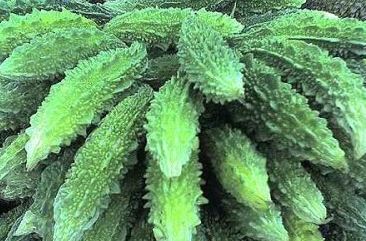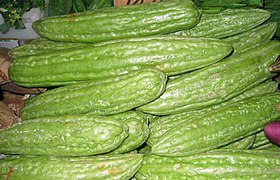
Momordica charantia, called bitter melon, bitter gourd or bitter squash in English, Karavella [1] in Sanskrit and Karela in Hindi and Urdu, Karla in Marathi, Pavakai (பாகற்க்காய்) in Tamil, Hagala kayi in Kannada, Kakarakaya in Telugu, kudhreth narhy(kudret narı) in Turkish, is a tropical and subtropical vine of the family Cucurbitaceae, widely grown in Asia, Africa, and the Caribbean for its edible fruit, which is among the most bitter of allfruits. Its many varieties differ substantially in the shape and bitterness of the fruit. This is a plant of the tropics.
Karela originated in India and it was carried to China in the 14th century.[2]….
Antihelmintic
Bitter melon is used as a folk medicine in Togo to treat gastrointestinal diseases, and extracts have shown activity in vitro against the nematode worm Caenorhabditis elegans.[4]
[edit]Antimalarial
Bitter melon is traditionally regarded in Asia as useful for preventing and treating malaria.[citation needed] Tea from its leaves is used for this purpose also in Panama and Colombia. In Guyana, bitter melons are boiled and stir-fried with garlic and onions. This popular side dish known as corilla is served to prevent malaria. Laboratory studies have confirmed that species related to bitter melon have antimalarial activity, though human studies have not yet been published.[15]
[edit]Antiviral
In Togo, the plant is traditionally used against viral diseases such as chickenpox and measles. Tests with leaf extracts have shown in vitro activity against the herpes simplex type 1 virus, apparently due to unidentified compounds other than the momordicins.[4]
Laboratory tests suggest compounds in bitter melon might be effective for treating HIV infection.[16] As most compounds isolated from bitter melon that impact HIV have either been proteins orlectins, neither of which are well-absorbed, it is unlikely that oral intake of bitter melon will slow HIV in infected people. Oral ingestion of bitter melon possibly could offset negative effects of anti-HIV drugs, if an in vitro study can be shown to be applicable to people.[17]
[edit]Cardioprotective
Studies in mice indicate bitter melon seed may have a cardioprotective effect by down-regulating the NF-κB inflammatory pathway.[18]
[edit]Diabetes
In 1962, Lolitkar and Rao extracted from the plant a substance, which they called charantin, which had hypoglycaemic effect on normal and diabetic rabbits.[19] Another principle, active only on diabetic rabbits, was isolated by Visarata and Ungsurungsie in 1981.[20] Bitter melon has been found to increase insulin sensitivity.[21] In 2007, a study by the Philippine Department of Health determined a daily dose of 100 mg per kilogram of body weight is comparable to 2.5 mg/kg of the antidiabetes drug glibenclamide taken twice per day.[22] Tablets of bitter melon extract are sold in the Philippines as a food supplement and exported to many countries.[22]
Other compounds in bitter melon have been found to activate the AMPK, the protein that regulates glucose uptake (a process which is impaired in diabetics).[23][24][25][26][27]
Bitter melon also contains a lectin that has insulin-like activity due to its nonprotein-specific linking together to insulin receptors. This lectin lowers blood glucose concentrations by acting on peripheral tissues and, similar to insulin’s effects in the brain, suppressing appetite. This lectin is likely a major contributor to the hypoglycemic effect that develops after eating bitter melon.[citation needed]
[edit]Anticancer
Two compounds extracted from bitter melon, α-eleostearic acid (from seeds) and 15,16-dihydroxy-α-eleostearic acid (from the fruit) have been found to induce apoptosis of leukemia cells in vitro.[28] Diets containing 0.01% bitter melon oil (0.006% as α-eleostearic acid) were found to prevent azoxymethane-induced colon carcinogenesis in rats.[29]
Researchers at Saint Louis University claim an extract from bitter melon, commonly eaten and known as karela in India, causes a chain of events which helps to kill breast cancer cells and prevents them from multiplying.[30] [31]
Related articles
- Health Benefits of Bitter Melon (refreshingnews99.blogspot.com)