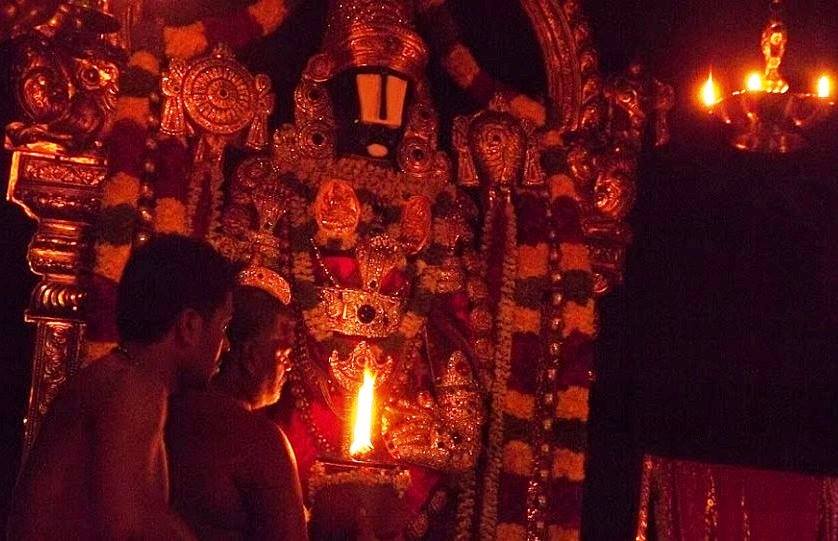
Tag: Tirupati Temple

  • Tirupati – Tirumala 2100 Million Years Old ,Geology

    Tirupati – Tirumala 2100 Million Years Old ,Geology

    Tirupati Balaji, Venkateswara is one of the most venerated Gods of Hinduism and the temple, in Chittoor District is visited by thousands of people everyday.

    The Hindu Puranas speak of this temple as being quite old.

    This Temple in the Tirupati/Tirumala Hills is and surrounded by  Hills which are prehistoric and the Hills have the world’s most ancient natural rock Archway.

    Geologists have dated this and the information tallies with what Hindu Puranas say about the age of the Hills.

    It is about 21oo Million years old.

    Eparchaean Unconformity (Tirupati hills) is a major discontinuity of stratigraphic significance that represents a period of remarkable serenity in the geological history of the earth. It is seen at the steep natural slopes, road scars and ravines in the Tirupati – Tirumala Ghatroad in Chittoor district of Andhra Pradesh, India.[1][2]

    Antiquity of  Tirupati, Tirumala Hills, India.jpg Plaque gives brief details of Eparchaen Unconformity Image Credit.”Plaque at Tirumal hills on Eparchean Unconformity” by Nvvchar – Own work. Licensed under CC BY-SA 3.0 via Wikimedia Commons – https://commons.wikimedia.org/wiki/File:Plaque_at_Tirumal_hills_on_Eparchean_Unconformity.jpg#/media/File:Plaque_at_Tirumal_hills_on_Eparchean_Unconformity.jpg

    In 2001, the Geological Survey of India (GSI) declared the unconformity to be one of the 26 “Geological Monuments of India”. GSI’s commemoration document, published on the occasion of the 150 years anniversary celebration, provides an insight into the formation of the subcontinent, the orogeny, the paleoenvironment and the exotic collection of paleo-flora and fauna. The details provided for the Eparchaean Unconformity monument indicate that this feature forms the boundary surface between Proterozoic Nagari Quartzites andArchaean granite. The time gap between the formation of the two units is at least 500 Ma.[2]

    Naturak Archway Tirupati.jpg Natural Archway Tirupati, The assessed geological age of the rock arch is 2.5 billion years. Formation of the arch is attributed to intensified weathering and erosion of stream action that has withstood the torque of nature Image Credit.”Natural stone arch in tirumala” by Tatiraju.rishabh at English Wikipedia. Licensed under CC BY 3.0 via Wikimedia Commons – https://commons.wikimedia.org/wiki/File:Natural_stone_arch_in_tirumala.JPG#/media/File:Natural_stone_arch_in_tirumala.JPG

    Garuda hiils , Tirupathi.jpg
    Garuda hiils , Tirupathi.Million Years Old.

    At this location, the boundary is between sedimentary rocks of the Cudappah Supergroup, 1600 million years in age, and Archaean rocks comprising granites, gneisses and dolerite dykes that are more than 2100 million years old. This unconformity gives an indication of the enormous time gap in the creation of the earth’s crust.

    Tirupati Tirumala hilld.jpg
    Tirupat Hills, Balaji TempleTirupati Tirumala

    The Tirupati hills are situated at the foot of a range of hills known by several names, including ‘Seshachala’, ‘Venkatachala’ and ‘Balaji’. There are four geological units:

    (1) Archaean rocks of the eastern Dharwar Craton (the granites and gneisses)
    (2) the Eparchean unconformity (Quartzose sandstones overlying the granite with a distinct unconformity)
    (3) Puranas (a general name for Proterozoic sedimentary sequences found in a series of basins deposited on the Indian Shield; including the Cuddapah Basin)[4]
    (4) Quaternary deposits

    The Tirumala hills essentially of precambrian period are composed of sedimentary rocksquartzites and intercalated shales, which are referred to as the Nagari quartzites, which forms part of the Cuddapah Supergroup. It is a subset of the Purana rock succession that rests above the archaean rocks.[2][3][5]

    The hill ranges of the Tirumala rise to a height of 900 metres (3,000 ft) (at Tirumala) from the average height of 150 metres (490 ft) in the plains at Tirupati. The steep scarp of the ranges shows the Eparchian Unconformity’s topographic, structural and denudational features.[2][6] The sedimentary thickness of the Cudappah basin is of the order of 12 kilometres (7.5 mi), and includes volcanic sequences in the form of sills and dykes. A prominent Eparchaean Unconformity of the formation resting on the archaean peninsular gneissic complex is noted. Rocks of the Cuddapah Supergroup, and the overlying Kurnool Group, comprise the stratigraphic sequence of the basin. This feature is contiguous all along the defined Archaean-Cuddapah contact zone even though its age may vary along its traced path.[2][7]

    Access

    The location of the Geological Monument is well connected by road, rail and air routes. The nearest railhead to Tirumala hills is Tirupati. The geological monument is located 10 kilometres (6.2 mi) northwest of Tirupati town, at the 12 kilometres (7.5 mi) point on the Tirupati – Tirumala Ghat road. From Tirupati railway station the approach to the Tirumal temple is only by road, a distance of 10 kilometres (6.2 mi).[2][8] The nearest airport is located at Renigunta, about 15 kilometres (9.3 mi) away from the Tirupati city, which connects to Chennai, Hyderabad and Bangalore airports. Regular bus services (both private and government) are operated by all the states bordering Andhra Pradesh.

    Known History of the temple as per records.

    All the great dynasties of rulers of the southern peninsula have paid homage to Lord Sri Venkateswara in this ancient shrine. The Pallavas of Kancheepuram (9th century AD), the Cholas of Thanjavur (a century later), the Pandyas of Madurai, and the kings and chieftains of Vijayanagar (14th - 15th century AD) were devotees of the Lord and they competed with one another in endowing the temple with rich offerings and contributions. It was during the rule of the Vijayanagar dynasty that the contributions to the temple increased. Sri Krishnadevaraya had statues of himself and his consorts installed at the portals of the temple, and these statues can be seen to this day. There is also a statue of Venkatapati Raya in the main temple. After the decline of the Vijayanagar dynasty, nobles and chieftains from all parts of the country continued to pay their homage and offer gifts to the temple. The Maratha general, Raghoji Bhonsle, visited the temple and set up a permanent endowment for the conduct of worship in the temple. He also presented valuable jewels to the Lord, including a large emerald which is still preserved in a box named after the General. Among the later rulers who have endowed large amounts are the rulers of Mysore and Gadwal. After the fall of the Hindu kingdoms, the Muslim rulers of Karnataka and then the Britishers took over, and many of the temples came under their supervisory and protective control. In 1843 AD, the East India Company divested itself of the direct management of non-Christian places of worship and native religious institutions. The administration of the shrine of Sri Venkateswara and a number of estates were then entrusted to Sri Seva Dossji of the Hatiramji Mutt at Tirumala, and the temple remained under the administration of the Mahants for nearly a century, till 1933 AD. In 1933, the Madras Legislature passed a special act, which empowered the Tirumala Tirupati Devasthanams(TTD) Committee to control and administer a fixed group of temples in the Tirumala-Tirupati area, through a Commissioner appointed by the Government of Madras. In 1951, the Act of 1933 was replaced by an enactment whereby the administration of TTD was entrusted to a Board of Trustees, and an Executive Officer was appointed by the Government . The provisions of the Act of 1951 were retained by Charitable and Religious Endowments Act, 1966.
    
    From The Puranas.
    Sri Venkatachala Mahatmya is referred to in several Puranas, of which the most important are the Varaha Purana and the Bhavishyottara Purana. The printed work contains extracts from the Varaha Purana, Padma Purana, Garuda Purana, Brahmanda Purana, Markandeya Purana, Harivamsa, Vamana Purana, Brahma Purana, Brahmottara Purana, Aditya Purana, Skanda Purana and Bhavishyottara Purana. Most of these extracts describe the sanctity and antiquity of the hills around Tirumala and the numerous teerthams situated on them. The legends taken from the Venkatachala Mahatmya and the Varaha Purana, pertaining to the manifestation of the Lord at Tirumala, are of particular interest. According to the Varaha Purana, Adi Varaha manifested Himself on the western bank of the Swami Pushkarini, while Vishnu in the form of Venkateswara came to reside on the southern bank of the Swami Pushkarini. One day, Rangadasa, a staunch devotee of Vishnu, in the course of his pilgrimage, joined Vaikhanasa Gopinatha, who was going up the Tirumala Hill for the daily worship of Lord Venkateswara. After bathing in the Swami Pushkarini, he beheld the lotus-eyed and blue-bodied Vishnu beneath a tamarind tree. Vishnu was exposed to the sun, wind and rain and was only protected by the extended wings of Garuda. Rangadasa was astounded by the wonderful sight. He raised a rough wall of stones around the deity, and started supplying flowers faithfully to Gopinatha everyday for Vishnu's worship. One day, Rangadasa was distracted by a Gandharva king and his ladies. Consequently, he forgot to supply flowers to Gopinatha for Vishnu's worship. The Lord then revealed Himself and told Rangadasa that He had been testing the latter's continence, but Rangadasa had not been steadfast and had succumbed to temptation. However, the Lord accepted and appreciated Rangadasa's devoted service to Him till then, and blessed Rangadasa that he would be reborn as an affluent ruler of a province and would enjoy the earthly pleasures. He would continue to serve the Lord, construct a beautiful temple with a vimana and high surrounding walls, and thereby earn eternal glory. Rangadasa was reborn as Tondaman, the son of the royal couple, Suvira and Nandini. Tondaman enjoyed a pleasurable life as a young man. One day, he set out on a hunting expedition on the Tirumala Hill, and with the help of a forester, saw Vishnu under the tamarind tree. Tondaman returned home, deeply affected by the vision of Vishnu. Tondaman later inherited his father's kingdom, Tondamandalam. In accordance with the directions given by Adi Varaha to a forester, Tondaman constructed a prakaram and dvara gopura, and arranged for regular worship of the Lord (according to Vaikhanasa Agama). In the Kali Yuga, Akasaraja came to rule over Tondamandalam. His daughter Padmavathi was married to Venkateswara. The marriage, officiated by Brahma, was celebrated with great pomp and splendour.
    

    Tirumala-Tirupati :-

        The town of Tirupati is one of the most ancient and spectacular places of pilgrimage in India. It is situated in the Chittoor district in southern Andhra Pradesh. The town owes its existence to the sacred temple of Lord Sri Venkateswara situated on the Tirumala Hill adjoining it. With a history that dates back to over twelve centuries, the temple is the jewel in the crown of ancient places of worship in southern India.
    

    The Tirumala Hill is 3200 ft above sea level, and is about 10.33 sq miles in area. It comprises seven peaks, representing the seven hoods of Adisesha, thus earning the name, Seshachalam. The seven peaks are called Seshadri, Neeladri, Garudadri, Anjanadri, Vrishabhadri, Narayanadri and Venkatadri.

        The sacred temple of Sri Venkateswara is located on the seventh peak, Venkatadri (Venkata Hill), and lies on the southern banks of Sri Swami Pushkarini. There are several legends associated with the manifestation of the Lord in Tirumala.
    Citations.
    https://en.wikipedia.org/wiki/User:Kamble16
    
    https://en.wikipedia.org/wiki/Eparchaean_Unconformity
  • What Is Brahmotsava,Tirupati Brahmotsva

    One would have across the term Brahmotsava being performed n Lord Vishnu Temples.

    Brahmotsvams are quite popular in Thirupathi Sri Balaji Temple and Sri Rangam Ranganatha Temple , though the Brahmotsavams are conducted in all the Sri Vaishnava Templs in the South.

    What is Brahmotsavam?

    Brahmotsavam means a Festival, an offering  By Lord Brahma to Lord Vishnu.

    There are legends that Lord Brahma performs the Brahmotsava ans a special Pooja for Lord Visnhu daily at Suchidram Sthaumalaya Temple, where Brahma , Vishnu and Shiva are found in on Idol.

    Brahmotsavam,Tirupati.Image.jpg
    Brahmotsavam,Tirupati.

    While Brahma is believed to perform this every day in the early morning around 4.30 am, Indra, Chief of the Devas, performs in the dead of the night at 12 Midnight.

    The performance of the Pooja by Brahma to Lord Vishnu is known as Brahmotsavam.

    There is another interpretation.

    Brahma in Sanskrit means ,Very big, original cause.

    A Big Festival , Pooja in a Temple is called Brahmotsavam.

    The dates of Brahmotsavams vary from temple to temple.

    ‘One of the major Kaalotsavams in Srivaishnava Temples is Brahmotsavam (tiruk-kODi-tirunAL).   Brahmotsavam is conducted at different times in different Temples:
    Period of the year in which the Brahmotsavam is conducted varies from temple to
    temple. Some examples of when it is performed are: 1. Pratishtapana (Kumbhabhishekam) day of the Temple, 2. Pratishtapana day of Sri Shataari, 3. Thirunakshatram- Birthstar/Birthday of the Temple Deity, 4. Conducted as Shraddotsavam or Kaamyotsavam as desired  (sponsored) by devotees.

    Thus, there can be more than one Brahmotsavam in a given year. In the Thirumala
    Temple, it is conducted once in the Tamil month ofPurattasi (Sep. 18- Oct.18). It starts on first day of Navaratri (Oct. 10, for 1999) and concludes on Vijayadashami (Oct.19, for 1999), which also happens to be the Thirunakshatram (Shravanam star) of Sri Venkateshwara, the Deity of the Temple. This is the most prominent Brahmotsavam (also called Manava Brahmotsavam). Brahmotsavams in Tirumala are also conducted at three other times of the year, namely: Kaisika Ekadashi (also known as, Raakshasa Brahmotsavam), Mukkoti Dwadashi (also known as, Daiva Brahmotsavam) and Rathasaptami (also known as, Aarsha Brahmotsavam). Besides, these 4 Brahmotsavams in a year, it is also conducted as a shraddotsavam as desired by devotees. It is stated that in the
    year 1551 AD, as many as 11 Brahmotsavamas took place.

    Origins: Brahmotsavam means “Grand celebration” or a “celebration performed by Brahma”. We will shortly see how both the meanings are appropriate for this event.  Lord Indra once killed a Brahma-raakshasa (a Brahmin with demonic characters). In doing so, he incurred a great sin of killing a Brahmana- “Brahma hatya dosham(BHD)”. To relieve Indra of this burden, Lord Brahma conducted a ceremony. In this ceremony, officiated by Brahma himself, Indra held Sriman Narayana ( Lord Vishnu) on his head during the special ritual bath “Avabritha Snaanam”. This verily was the first Brahmotsavam.

    Because of the immense cleansing power of Brahmotsavam, this utsavam is periodically performed in Temples to wash away all wrong doings that may have been
    incurred. It is said that the Lord Brahma himself rendered the first Brahmotsavam seva
    (service) to Lord Venkateshwara (Vishnu) of the Thirumalai shrine. Indeed, it is a
    common belief that every Brahmotsavam is witnessed by Lord Brahma. In recognition
    of this, a well decorated empty chariot is pulled in front of the chariot carrying the
    deities at the processions held during the Brahmotsavam Brahma is believed to be
    seated in that chariot  overseeing  the celebration. Thus, Brahmotsavam is also
    referred to as “Brahmapratyakshotsavam” (celebration conducted right in front of
    Brahma). References to Brahmotsavam can be found in Varaaha Puraanam (ch.18) and
    Bhavishyotthara Puraanam (ch. 24).

    Events of Brahmotsava.

    Brahmotsavam celebration lasts for 9 days. Brahmotsavam is not just a Temple ritual, but is a grand festival for the whole town. It begins with Ankurarpanam and concludes with AvabhrithaSnanam (Ritual bath or Theerthavaari). On each day, the UtsavaMurthis (Mobile Deities) will be  decorated and taken in procession, once in the morning and once in the evening on different Vahanams (vehicles). In the night, there will also be Unjalseva (Deities seated on the swing). The intricate step by step details vary from Temple to Temple. Here is a brief summary of main events in the Brahmotsavam celebration at the Balaji temple in Thirumalai.

    Day 1
    Ankurarpanam (planting 9 grains in soil placed in earthen dishes). Kankanadharanam (wrist band) to Utsava Muthi and priests.Procession of Vishvaksenar (Commander-in-chief of Vishnu’s army).
    Mritsangrahanam- Collecting the soil for Brahmotsava Yagna(Hawan, Fire ceremony) Peetam. Vishvaksenar returns from procession and enters the Yaga Shaala (Place where Yagnam is conducted), where he is received with Poorna Kumbham honor(special Pot filled with water). He is believed to be the Pradhana Yajaman (Chief conductor) of this Yagnam. This is followed by Procession of Deity on Pedda Sesha (Big serpent) Vahanam.

    Day 2
    Morning Utsavam (procession) of Deity on Smaller Shesha (smaller serpent) Vahanam.
    Dwajaarohanam in the evening. Garuda Dwajam- a flag bearing the emblem of Garuda
    (The Eagle- Vehicle of Vishnu) is hoisted with Veda Mantrams from Taittiriya samhita
    dedicated to Garuda. This signals start of Brahmotsavam to the whole town. Once the
    flag is hoisted, it is expected that no householder leaves town or plans any auspicious
    ceremony in the house until the conclusion of Brahmotsavam. Thus the whole town is
    able to fully take part in the celebration and not be preoccupied with other personal
    activities. Even if someone has to leave town on emergency, they are expected to
    return prior to un-hoisting the flag (Dwaja-awarohanam) on day 9.

    Day 3
    Morning procession on Lion (Simha Vahanam)

    Day 4
    Morning procession on the “every desire fulfilling giving tree” (Kalpavriksha
    vahanam)

    Day 5
    Deity is dressed as Mohini (temptress, a form of Vishnu) and taken procession in
    ivory pallaki (carrier).
    Night procession is taken on Eagle (Garuda vahanotsavam – Garuda Sevai).

    Day 6
    Morning: Procession on Hanuman (Monkey, devotee of Rama/Vishnu) vahanam.
    Night procession on Gaja (Elephant) vahanam.

    Day 7
    Morning procession on Surya Prabha (Sun) vahanam.
    Evening procession on Chandra Prabha(Moon) vahanam.

    Day 8

    Morning: Rathotsavam -Ratha (chariot) Yatra (procession) for the Deities.
    Night: Procession on Ashva (horse) vahanam.

    Day 9
    Morning: Deities carried in pallaki (carrier) to the Pushkarani (sacred pond) in front of
    the Varaha Swami (the Boar incarnation of Vishnu) Temple for the special bath
    -Abhishekam and Avabritha Snanam (Theerthavaari thirumanjanam). All devotees
    also take bath in the pushkarani. The Deities are taken back to the Kalyana Mantapam
    of the Temple. The flag is un-hoisted, marking the conclusion of Brahmotsavam. Even
    watching the video of this majestic celebration in itself deeply touches our heart, mind, eyes and ears.

    References::

    1. S.K. Ramachandra Rao, The Hill-Shrine of Vengadam: Art, Architecture and Agama
    of Tirumala Temple, First Edition, (Ed., Daivajna K.N. Somayaji), Pub., Kalpatharu
    Research Academy, Bangalore, 1993.

    2. S.K. Ramachandra Rao, Thirupathi Thimmappa (in Kannada), IBH publihers,
    Bangalore, 1980.


  • Islamic University At Tirupati In Vishnu Temple Land

    An Islamic University is coming up 11 km from Tirupati.

    Islamic varsity coming up ,Tirupati
    Islamic University near Tirupati. Click to Enlarge

    Would The Saudi Government allow a Hindu Temple to come up near Mecca?

    Global Hindu Heritage Foundation (GHHF) was able to get about ten pictures of the building and the nearby places. Many of our friends have been trying to find out the sinister plans of starting Islamic College near Tirupathi.  Following information is being provide for your purview :

    1. The seven layer/storied building is being constructed in Chandragiri village which is about 13 kilometers from Tirupathi.

    2. There is big sign posted on the main road to indicate that it is the home of “Heera International Islamic College (HIIC).” On the same sign board it is written “Women Arabic College.”

    3. Down below the sign board, on the ground there is a sign “Swarnamukhi River Rejuvenation Project.” The name Chandragiri is also printed on the sign board.

    4. HIIC is being built approximately in a seven-acre lot. It appears that this land is parceled into few pieces of lots.

    5. It is noted that this land was acquired in 2007. Research is ongoing for the authenticity as well as the circumstances under which this land was acquired.

    6. This land belonged to a VISHNU Temple, known as Timmappa Temple, with a very tall Rajagopuram according to the villagers. They were in dilapidated condition for many years.

    7. We have taken TEN new pictures to indicate that they are building the HIIC in the Vishnu Temple complex. The pictures indicate the dilapidated Rajagopuram on the left side (Westside of the building).

    8. It appears that HIIC never got permission to start the college. No permission was granted before they started the construction.

    9. Tirupati Urban Development Authority (TUDA) area includes 70 kilometers radius from Tirupathi. Chandragiri is only 13 kilometers from Tirupati. Any construction in Chandragiri should have the prior approval from TUDA. No such permission was granted to start this construction.

    10. According to TUDA zonal rules no permission to construct any building can be granted, if it has more than five layer/stories plus stilt.

    11. It appears that a letter was sent to the Special officer in Collector’s Office to grant approval for permission for construction, which is totally against the Zonal rules.

    12. Villagers in the area feel that some local politicians are behind this idea of constructing an Islamic College at this location.

    13. Villagers feel that Vishnu Temple land is illegally occupied by HIIC and building is being constructed illegally.

    Why near Tirupathi ?

    Is there a plan to silence the bells and stop the aarathi at Lord Venkateswara Temple ? Is there a plan to keep buying lands as close to Balaji Temple as possible to start Minarets with high volume loud speakers announcing that “Allah is great.” Do you think that it is a far-fetched imagination ?

    Please take a look at few examples of the recent times

    1. The present government has asked some Temples in old Hyderabad to stop aarathi and also stop ringing the temple bells as the Muslims celebrate Eid.

    2. Swami Paripoornananda was asked not to visit the Bhagya Lakshmi Temple because Muslims may be upset. He was arrested and taken in a car to have darshan only from the police car; never allowed him to get down and go to the Temple.

    3. In Hyderabad, the Hanuman Temple was desecrated by throwing Beef into the Temple compound and splashing the green color water on the walls to create animosity in the community.

    4. Akbaruddi Owaisi made a statement to remove the Bhagya Lakshmi Temple from the premises of Charminar in the old city. He even made a blood thirsty pronouncement that “We are 25 crores, you are 100 crores. Remove the police for 15 minutes and we will show you who has more courage and strength.”

    We tried to approach different community leaders and politicians of different parties – Congress, BJP and TDP. We could not reach any Congress leader so far. TDP representative asked us to approach the concerned minister.

    We were able to talk to NVSS Prabhakar, BJP leader who also started investigating the matter. He had a news conference on Friday (12th). He questioned the motive behind the construction of HIIC. He even traced the history of religious activities of Christians and Muslims in and around Tirupathi for the past ten years and their attempt to take over the Temple property and their missionary activities. More details will be forthcoming.

    Who is building the Islamic University ?

    Ms. Aalima Shaikh Nowhera, Heera Group is a Global Fortune Company with business in the commodity as well as educational chain. The first Muslim woman of India to lead a company, Ms Shaikh is a renowned entrepreneur. It is a business conglomerate in various economics fields.

    She even received an award from Indian Economic Development and Research Association for attending a seminar on “Outstanding Achievements and National Development” in July 2013.”

    http://hinduexistence.org/2013/09/18/sinister-design-to-change-the-hindu-heritage-of-tirupati-by-bulding-an-islamic-unversity-for-running-jihad-from-nearby-villagers-alleged-for-a-racket-to-occupy-the-lands-of-hindu-temple/

    http://www.thehindu.com/news/national/andhra-pradesh/furore-over-establishment-of-islamic-university-in-tirupati/article5126602.ece

    http://ramanisblog.in/2013/07/22/temples-converted-into-mosques-a-pointer/

    Enhanced by Zemanta