I had written an article on the Pilgrimage undertaken by Arjuna to South India.
Papavinasana Theertha, Tirupati.
Among other places visited by Arjuna, he visited Tirupati, had Darshan of Lord Varaha ,Balaji and took a holy dip in the Papavinasana Theertha for atoning the sin of seeing Yudhistra and Draupadi together.(Skanda Purana)
Tirupati Papnanasa Theertham.
‘
When the five Pandavas were living together with their wife Draupadi, they had an arrangement,that Draupadi shall live as wife together with one of the Five and the other four Pandvas shall not be with her.
Balaji Tirupati,Srivathsam is visible.
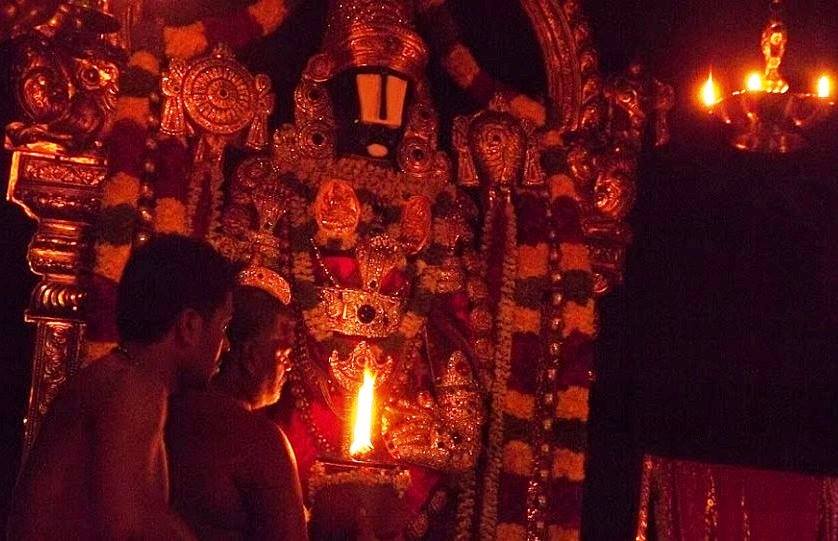
Lord Balaji, Tirupati.
At a point of time, Yudhistra was living with Draupadi.
Agni,God Fire,in the guise of a Brahmin sought the help of Arjuna to help ease his hunger.
Arjuna,being a Kshatriya and a King, could not but to accede to Agni’s request.
Without knowing who Agni was and what his hunger was for, Arjuna agreed and was shocked to know it was Agni and his hunger was for burning down the Kanadava Forest.
He was in a dilemma for as a King he(Prince) he had a duty to protect forests with the animals living in it.
He consulted(who else?) Lord Krishna,who told him as a King and Kshatriya it was his duty to fulfill his promise .
( Krishna had a hidden agenda.
He knew that a great war will ensue , that Arjuna did not have a powerful Bow and he waned Arjuna to possess one.
He engineered the whole event though Indra,father of Arjuna.)
As anticipated by Krishna Agni asked Vauna to give the best bow and he gave the Kandeeva to Arjuna.
Arjuna burnt the forest.
Agini gave him the Agneyastra as well.
When Arjuna came Home to take his old bow and arrows,he unintentionally saw Yudihistra and Draupadi together.
It is considered to be a sin to see man and wife together when they are intimate,Sastras declare and one has to atone for this,Prayaschitta.
One of the Prayascitta was going on a Pilgrimage.
Krishna advised the Prayaschitta of Pilgrimage as He wanted Arjuna to get the help of as many Kings as possible for the Mahabharata war(Arjuna was not aware of the fact).
Arjuna went on a Pilgrimage of India and in the process married many a princesses,including the daughter of a Pandya king-the Pandya fought the war along with the Panadvas.
Vyasa gives a detailed description of the route taken by Arjuna during the Pilgrimage.’
Papavinasam Theertham is around 2 miles from Tirumala and is a beautiful waterfall in the region. The devotees also believe a holy dip at this site can relieve them from their sins and evils. There are separate dressing rooms at this site for men and women, where they can change their dresses. The reservoir near the dam restricts the water flow in this theertham.
Tirupati Balaji, Venkateswara is one of the most venerated Gods of Hinduism and the temple, in Chittoor District is visited by thousands of people everyday.
The Hindu Puranas speak of this temple as being quite old.
This Temple in the Tirupati/Tirumala Hills is and surrounded by Hills which are prehistoric and the Hills have the world’s most ancient natural rock Archway.
Geologists have dated this and the information tallies with what Hindu Puranas say about the age of the Hills.
It is about 21oo Million years old.
‘
Eparchaean Unconformity (Tirupati hills) is a major discontinuity of stratigraphic significance that represents a period of remarkable serenity in the geological history of the earth. It is seen at the steep natural slopes, road scars and ravines in the Tirupati – Tirumala Ghatroad in Chittoor district of Andhra Pradesh, India.[1][2]
In 2001, the Geological Survey of India (GSI) declared the unconformity to be one of the 26 “Geological Monuments of India”. GSI’s commemoration document, published on the occasion of the 150 years anniversary celebration, provides an insight into the formation of the subcontinent, the orogeny, the paleoenvironment and the exotic collection of paleo-flora and fauna. The details provided for the Eparchaean Unconformity monument indicate that this feature forms the boundary surface between Proterozoic Nagari Quartzites andArchaean granite. The time gap between the formation of the two units is at least 500 Ma.[2]
At this location, the boundary is between sedimentary rocks of the Cudappah Supergroup, 1600 million years in age, and Archaean rocks comprising granites, gneisses and dolerite dykes that are more than 2100 million years old. This unconformity gives an indication of the enormous time gap in the creation of the earth’s crust.
Tirupat Hills, Balaji TempleTirupati Tirumala
…
The Tirupati hills are situated at the foot of a range of hills known by several names, including ‘Seshachala’, ‘Venkatachala’ and ‘Balaji’. There are four geological units:
(1) Archaean rocks of the eastern Dharwar Craton (the granites and gneisses)
(2) the Eparchean unconformity (Quartzose sandstones overlying the granite with a distinct unconformity)
(3) Puranas (a general name for Proterozoic sedimentary sequences found in a series of basins deposited on the Indian Shield; including the Cuddapah Basin)[4]
(4) Quaternary deposits
The Tirumala hills essentially of precambrian period are composed of sedimentary rocks – quartzites and intercalated shales, which are referred to as the Nagari quartzites, which forms part of the Cuddapah Supergroup. It is a subset of the Purana rock succession that rests above the archaean rocks.[2][3][5]
The hill ranges of the Tirumala rise to a height of 900 metres (3,000 ft) (at Tirumala) from the average height of 150 metres (490 ft) in the plains at Tirupati. The steep scarp of the ranges shows the Eparchian Unconformity’s topographic, structural and denudational features.[2][6] The sedimentary thickness of the Cudappah basin is of the order of 12 kilometres (7.5 mi), and includes volcanic sequences in the form of sills and dykes. A prominent Eparchaean Unconformity of the formation resting on the archaean peninsular gneissic complex is noted. Rocks of the Cuddapah Supergroup, and the overlying Kurnool Group, comprise the stratigraphic sequence of the basin. This feature is contiguous all along the defined Archaean-Cuddapah contact zone even though its age may vary along its traced path.[2][7]
Access
The location of the Geological Monument is well connected by road, rail and air routes. The nearest railhead to Tirumala hills is Tirupati. The geological monument is located 10 kilometres (6.2 mi) northwest of Tirupati town, at the 12 kilometres (7.5 mi) point on the Tirupati – Tirumala Ghat road. From Tirupati railway station the approach to the Tirumal temple is only by road, a distance of 10 kilometres (6.2 mi).[2][8] The nearest airport is located at Renigunta, about 15 kilometres (9.3 mi) away from the Tirupati city, which connects to Chennai, Hyderabad and Bangalore airports. Regular bus services (both private and government) are operated by all the states bordering Andhra Pradesh.
Known History of the temple as per records.
All the great dynasties of rulers of the southern peninsula have paid homage to Lord Sri Venkateswara in this ancient shrine. The Pallavas of Kancheepuram (9th century AD), the Cholas of Thanjavur (a century later), the Pandyas of Madurai, and the kings and chieftains of Vijayanagar (14th - 15th century AD) were devotees of the Lord and they competed with one another in endowing the temple with rich offerings and contributions. It was during the rule of the Vijayanagar dynasty that the contributions to the temple increased. Sri Krishnadevaraya had statues of himself and his consorts installed at the portals of the temple, and these statues can be seen to this day. There is also a statue of Venkatapati Raya in the main temple. After the decline of the Vijayanagar dynasty, nobles and chieftains from all parts of the country continued to pay their homage and offer gifts to the temple. The Maratha general, Raghoji Bhonsle, visited the temple and set up a permanent endowment for the conduct of worship in the temple. He also presented valuable jewels to the Lord, including a large emerald which is still preserved in a box named after the General. Among the later rulers who have endowed large amounts are the rulers of Mysore and Gadwal. After the fall of the Hindu kingdoms, the Muslim rulers of Karnataka and then the Britishers took over, and many of the temples came under their supervisory and protective control. In 1843 AD, the East India Company divested itself of the direct management of non-Christian places of worship and native religious institutions. The administration of the shrine of Sri Venkateswara and a number of estates were then entrusted to Sri Seva Dossji of the Hatiramji Mutt at Tirumala, and the temple remained under the administration of the Mahants for nearly a century, till 1933 AD. In 1933, the Madras Legislature passed a special act, which empowered the Tirumala Tirupati Devasthanams(TTD) Committee to control and administer a fixed group of temples in the Tirumala-Tirupati area, through a Commissioner appointed by the Government of Madras. In 1951, the Act of 1933 was replaced by an enactment whereby the administration of TTD was entrusted to a Board of Trustees, and an Executive Officer was appointed by the Government . The provisions of the Act of 1951 were retained by Charitable and Religious Endowments Act, 1966.
From The Puranas.
Sri Venkatachala Mahatmya is referred to in several Puranas, of which the most important are the Varaha Purana and the Bhavishyottara Purana. The printed work contains extracts from the Varaha Purana, Padma Purana, Garuda Purana, Brahmanda Purana, Markandeya Purana, Harivamsa, Vamana Purana, Brahma Purana, Brahmottara Purana, Aditya Purana, Skanda Purana and Bhavishyottara Purana. Most of these extracts describe the sanctity and antiquity of the hills around Tirumala and the numerous teerthams situated on them. The legends taken from the Venkatachala Mahatmya and the Varaha Purana, pertaining to the manifestation of the Lord at Tirumala, are of particular interest. According to the Varaha Purana, Adi Varaha manifested Himself on the western bank of the Swami Pushkarini, while Vishnu in the form of Venkateswara came to reside on the southern bank of the Swami Pushkarini. One day, Rangadasa, a staunch devotee of Vishnu, in the course of his pilgrimage, joined Vaikhanasa Gopinatha, who was going up the Tirumala Hill for the daily worship of Lord Venkateswara. After bathing in the Swami Pushkarini, he beheld the lotus-eyed and blue-bodied Vishnu beneath a tamarind tree. Vishnu was exposed to the sun, wind and rain and was only protected by the extended wings of Garuda. Rangadasa was astounded by the wonderful sight. He raised a rough wall of stones around the deity, and started supplying flowers faithfully to Gopinatha everyday for Vishnu's worship. One day, Rangadasa was distracted by a Gandharva king and his ladies. Consequently, he forgot to supply flowers to Gopinatha for Vishnu's worship. The Lord then revealed Himself and told Rangadasa that He had been testing the latter's continence, but Rangadasa had not been steadfast and had succumbed to temptation. However, the Lord accepted and appreciated Rangadasa's devoted service to Him till then, and blessed Rangadasa that he would be reborn as an affluent ruler of a province and would enjoy the earthly pleasures. He would continue to serve the Lord, construct a beautiful temple with a vimana and high surrounding walls, and thereby earn eternal glory. Rangadasa was reborn as Tondaman, the son of the royal couple, Suvira and Nandini. Tondaman enjoyed a pleasurable life as a young man. One day, he set out on a hunting expedition on the Tirumala Hill, and with the help of a forester, saw Vishnu under the tamarind tree. Tondaman returned home, deeply affected by the vision of Vishnu. Tondaman later inherited his father's kingdom, Tondamandalam. In accordance with the directions given by Adi Varaha to a forester, Tondaman constructed a prakaram and dvara gopura, and arranged for regular worship of the Lord (according to Vaikhanasa Agama). In the Kali Yuga, Akasaraja came to rule over Tondamandalam. His daughter Padmavathi was married to Venkateswara. The marriage, officiated by Brahma, was celebrated with great pomp and splendour.
Tirumala-Tirupati :-
The town of Tirupati is one of the most ancient and spectacular places of pilgrimage in India. It is situated in the Chittoor district in southern Andhra Pradesh. The town owes its existence to the sacred temple of Lord Sri Venkateswara situated on the Tirumala Hill adjoining it. With a history that dates back to over twelve centuries, the temple is the jewel in the crown of ancient places of worship in southern India.
The Tirumala Hill is 3200 ft above sea level, and is about 10.33 sq miles in area. It comprises seven peaks, representing the seven hoods of Adisesha, thus earning the name, Seshachalam. The seven peaks are called Seshadri, Neeladri, Garudadri, Anjanadri, Vrishabhadri, Narayanadri and Venkatadri.
The legends of India and Hinduism are at once mind boggling to the extent of testing one’s imagination and at the same time most of them are verifiable with facts from antiquity, Astronomical dating, Linguistics, Carbon Dating..
.We have Human settlements in India,in Chennai itself dating back to 1.07 Million years!
We have Bhimbedka rock inscriptions dating back to some 50,000 years.
Lord Balaji Face in Tirupathi Hills.
We have references to Tsunamis in Tamil Classics,which are now being accepted by science as Facts.
Mount Toba’s ashes settled in Jwalapuram, Kurnool, Andhra and this is dated again to antiquity.
We have the Nazca lines of Peru which resembles Shiva’s Trident.
Lord Krishan’s son Pradhyumna built a city in Russia.
Lahore Pakistan was built by Lava, son of Lord Rama.
The Mayas and Incas followed the Agama procedure in building their Pyramids.
In the Middle east we have the Shiva Temple now called Mecca.
Also we have a Shiva temple in Petra Jordan.
The US is not far behind nor are the Americas.
The Central American countries followed Ramayana and even Andal’s Thiruppaavai.
Makara Sankaranthi was celebrated there.
And we have a Natural Vishnu temple in the Grand Canyon.
I have written on all these with authentic proof and Links.
About a couple of years back I posted an article that the Thirumala Hills in the Eastern ghats of India resemble the face of Lord Venkateswara of Tirupati.
I also posted some articles on some strange happenings in Tirupati which defy reason.
Mind you these have been documented.
Now as the Deccan Plateau is one of the oldest landmass of the earth and it has a natural arch, I checked whether I could find any information geologically in support of the Legend of Lord Balaji.
In the process I came across information that Lord Venkaestwara’s Feet are to be found in the Thirumala Hills.
And people worship this.
Though I had been to Tirupati many times I never knew of this.
”
Srivari Padalu:
According to Vedas/Puranas ‘Srivari Padalu’ is the place where Lord Venkateswara Swamy first set his feet on one of the seven hills namely ‘Narayanagiri’. The footprint of the Lord is available in this place to the pilgrims with restricted access by T.T.D so that they cannot touch the foot prints. Pilgrims have to climb 300 odd steps to reach this divine spot from where a beautiful top view of the temple town ‘Tirumala’ is very delightful to watch.
Location: Srivari Padalu , Tirumala
Distance: 6 Km from Tirumala Bus stand
Timings: 6:00 AM to 6:00 PM
Address:
Srivari Padalu,
Narayanagiri Road,Tirumala,
Tirupathi, Andhra Pradesh
India
What about the History of the Easten Ghat of which the Thirumala forms a part along with six other Hills?
The Eastern Ghats are older than the Western Ghats, and have a complex geologic history related to the assembly and breakup of the ancient supercontinent of Rodinia and the assembly of the Gondwana supercontinent.
The Eastern Ghats are made up of charnockites, granite gneiss, khondalites, metamorphic gneisses and quartzite rock formations. The structure of the Eastern Ghats includes thrusts and strike-slip faults[2] all along its range. Limestone, bauxiteand iron ore are also found in the Eastern Ghats hill ranges.
The Eparchaean Unconformity of the Tirumala Hills is a major discontinuity of stratigraphic significance that represents an extensive period of erosion and non-deposition. It is seen at the steep natural slopes, road scars and ravines in the Tirupati– Tirumala Ghat road in the Chittoor district of Andhra Pradesh.
Which individual has gone up to the top of the Thirumala hills to sculpt Two Feet only to propagate Hinduism and Lord Venkateswara?
One would have across the term Brahmotsava being performed n Lord Vishnu Temples.
Brahmotsvams are quite popular in Thirupathi Sri Balaji Temple and Sri Rangam Ranganatha Temple , though the Brahmotsavams are conducted in all the Sri Vaishnava Templs in the South.
What is Brahmotsavam?
Brahmotsavam means a Festival, an offering By Lord Brahma to Lord Vishnu.
There are legends that Lord Brahma performs the Brahmotsava ans a special Pooja for Lord Visnhu daily at Suchidram Sthaumalaya Temple, where Brahma , Vishnu and Shiva are found in on Idol.
Brahmotsavam,Tirupati.
While Brahma is believed to perform this every day in the early morning around 4.30 am, Indra, Chief of the Devas, performs in the dead of the night at 12 Midnight.
The performance of the Pooja by Brahma to Lord Vishnu is known as Brahmotsavam.
There is another interpretation.
Brahma in Sanskrit means ,Very big, original cause.
A Big Festival , Pooja in a Temple is called Brahmotsavam.
The dates of Brahmotsavams vary from temple to temple.
‘One of the major Kaalotsavams in Srivaishnava Temples is Brahmotsavam (tiruk-kODi-tirunAL). Brahmotsavam is conducted at different times in different Temples:
Period of the year in which the Brahmotsavam is conducted varies from temple to
temple. Some examples of when it is performed are: 1. Pratishtapana (Kumbhabhishekam) day of the Temple, 2. Pratishtapana day of Sri Shataari, 3. Thirunakshatram- Birthstar/Birthday of the Temple Deity, 4. Conducted as Shraddotsavam or Kaamyotsavam as desired (sponsored) by devotees.
Thus, there can be more than one Brahmotsavam in a given year. In the Thirumala
Temple, it is conducted once in the Tamil month ofPurattasi (Sep. 18- Oct.18). It starts on first day of Navaratri (Oct. 10, for 1999) and concludes on Vijayadashami (Oct.19, for 1999), which also happens to be the Thirunakshatram (Shravanam star) of Sri Venkateshwara, the Deity of the Temple. This is the most prominent Brahmotsavam (also called Manava Brahmotsavam). Brahmotsavams in Tirumala are also conducted at three other times of the year, namely: Kaisika Ekadashi (also known as, Raakshasa Brahmotsavam), Mukkoti Dwadashi (also known as, Daiva Brahmotsavam) and Rathasaptami (also known as, Aarsha Brahmotsavam). Besides, these 4 Brahmotsavams in a year, it is also conducted as a shraddotsavam as desired by devotees. It is stated that in the
year 1551 AD, as many as 11 Brahmotsavamas took place.
Origins: Brahmotsavam means “Grand celebration” or a “celebration performed by Brahma”. We will shortly see how both the meanings are appropriate for this event. Lord Indra once killed a Brahma-raakshasa (a Brahmin with demonic characters). In doing so, he incurred a great sin of killing a Brahmana- “Brahma hatya dosham(BHD)”. To relieve Indra of this burden, Lord Brahma conducted a ceremony. In this ceremony, officiated by Brahma himself, Indra held Sriman Narayana ( Lord Vishnu) on his head during the special ritual bath “Avabritha Snaanam”. This verily was the first Brahmotsavam.
Because of the immense cleansing power of Brahmotsavam, this utsavam is periodically performed in Temples to wash away all wrong doings that may have been
incurred. It is said that the Lord Brahma himself rendered the first Brahmotsavam seva
(service) to Lord Venkateshwara (Vishnu) of the Thirumalai shrine. Indeed, it is a
common belief that every Brahmotsavam is witnessed by Lord Brahma. In recognition
of this, a well decorated empty chariot is pulled in front of the chariot carrying the
deities at the processions held during the Brahmotsavam Brahma is believed to be
seated in that chariot overseeing the celebration. Thus, Brahmotsavam is also
referred to as “Brahmapratyakshotsavam” (celebration conducted right in front of
Brahma). References to Brahmotsavam can be found in Varaaha Puraanam (ch.18) and
Bhavishyotthara Puraanam (ch. 24).
Events of Brahmotsava.
Brahmotsavam celebration lasts for 9 days. Brahmotsavam is not just a Temple ritual, but is a grand festival for the whole town. It begins with Ankurarpanam and concludes with AvabhrithaSnanam (Ritual bath or Theerthavaari). On each day, the UtsavaMurthis (Mobile Deities) will be decorated and taken in procession, once in the morning and once in the evening on different Vahanams (vehicles). In the night, there will also be Unjalseva (Deities seated on the swing). The intricate step by step details vary from Temple to Temple. Here is a brief summary of main events in the Brahmotsavam celebration at the Balaji temple in Thirumalai.
Day 1
Ankurarpanam (planting 9 grains in soil placed in earthen dishes). Kankanadharanam (wrist band) to Utsava Muthi and priests.Procession of Vishvaksenar (Commander-in-chief of Vishnu’s army).
Mritsangrahanam- Collecting the soil for Brahmotsava Yagna(Hawan, Fire ceremony) Peetam. Vishvaksenar returns from procession and enters the Yaga Shaala (Place where Yagnam is conducted), where he is received with Poorna Kumbham honor(special Pot filled with water). He is believed to be the Pradhana Yajaman (Chief conductor) of this Yagnam. This is followed by Procession of Deity on Pedda Sesha (Big serpent) Vahanam.
Day 2
Morning Utsavam (procession) of Deity on Smaller Shesha (smaller serpent) Vahanam.
Dwajaarohanam in the evening. Garuda Dwajam- a flag bearing the emblem of Garuda
(The Eagle- Vehicle of Vishnu) is hoisted with Veda Mantrams from Taittiriya samhita
dedicated to Garuda. This signals start of Brahmotsavam to the whole town. Once the
flag is hoisted, it is expected that no householder leaves town or plans any auspicious
ceremony in the house until the conclusion of Brahmotsavam. Thus the whole town is
able to fully take part in the celebration and not be preoccupied with other personal
activities. Even if someone has to leave town on emergency, they are expected to
return prior to un-hoisting the flag (Dwaja-awarohanam) on day 9.
Day 3
Morning procession on Lion (Simha Vahanam)
Day 4
Morning procession on the “every desire fulfilling giving tree” (Kalpavriksha
vahanam)
Day 5
Deity is dressed as Mohini (temptress, a form of Vishnu) and taken procession in
ivory pallaki (carrier).
Night procession is taken on Eagle (Garuda vahanotsavam – Garuda Sevai).
Day 6
Morning: Procession on Hanuman (Monkey, devotee of Rama/Vishnu) vahanam.
Night procession on Gaja (Elephant) vahanam.
Day 7
Morning procession on Surya Prabha (Sun) vahanam.
Evening procession on Chandra Prabha(Moon) vahanam.
Day 8
Morning: Rathotsavam -Ratha (chariot) Yatra (procession) for the Deities.
Night: Procession on Ashva (horse) vahanam.
Day 9
Morning: Deities carried in pallaki (carrier) to the Pushkarani (sacred pond) in front of
the Varaha Swami (the Boar incarnation of Vishnu) Temple for the special bath
-Abhishekam and Avabritha Snanam (Theerthavaari thirumanjanam). All devotees
also take bath in the pushkarani. The Deities are taken back to the Kalyana Mantapam
of the Temple. The flag is un-hoisted, marking the conclusion of Brahmotsavam. Even
watching the video of this majestic celebration in itself deeply touches our heart, mind, eyes and ears.
References::
1. S.K. Ramachandra Rao, The Hill-Shrine of Vengadam: Art, Architecture and Agama
of Tirumala Temple, First Edition, (Ed., Daivajna K.N. Somayaji), Pub., Kalpatharu
Research Academy, Bangalore, 1993.
There has a been a systematic attempt at converting students to Christianity by the principal of Sri Venkateswara Arts. College Tirupati.
Evangelical literature is being distributed in the hostel .
Famous Hindu Paintings Personalities disfigured in TTD Tirupathi College.
Protesting students were lathi charged while no action seems to have been taken against the offenders.
It is strange that a Non Hindu is appointed as a Principal in a Hindu run Educational Institution.
Would any Church or a Muslim Institution even dream of appointing a Non Christian, Non Muslim in their institutions?
There have been attempts to run an Islamic University in Tirupati, grabbing Lord Vishnu’s Temple land.
The news on the latest attempt by Christians to convert in TTD College, as in the case of Islam University, did not make it to Main stream newspapers.
Ghar Wapsi is being splashed around everywhere.
Long Live Secularism.
The Story.
The Principal of the Sri Venkateshwara Arts College who goes by the name of Dr M. D. Christopher has been accused by the students of college and various student organizations that he is aiding Christian proselytization. If one looks at the happenings at the SV Arts College in the recent months, there is a strong possibility that this allegation is indeed true.
Evangelist literature is being distributed to students in the college campus. The manner in which the evangelist books are distributed is quite alarming and would not have been possible without the helping hand of the college administration. The students of the hostel are specially targeted for this soul harvest. Evangelical books and other literature arrived in a postal package and were addressed to each student by his name and they were in fact delivered to his room in the hostel. The students say that such distribution of books has happened many times over.
Students allege that complaints about this missionary activity to the Principal andTTD officials have fallen on deaf ears. The students of the college directly point fingers at the Principal. The Principal has appointed to his staff a person named Rajkumar. Rajkumar is alleged to have given out the names and addresses of the students to the missionary organization distributing the literature. In spite of repeated complaints, no action was taken by the Principal. The Principal is also accused of appointing non-Hindu staff.’
Related.
Islamic University near Thirupathi?
Would The Saudi Government allow a Hindu Temple to come up near Mecca?
Global Hindu Heritage Foundation (GHHF) was able to get about ten pictures of the building and the nearby places. Many of our friends have been trying to find out the sinister plans of starting Islamic College near Tirupathi. Following information is being provide for your purview :
1. The seven layer/storied building is being constructed in Chandragiri village which is about 13 kilometers from Tirupathi.
2. There is big sign posted on the main road to indicate that it is the home of “Heera International Islamic College (HIIC).” On the same sign board it is written “Women Arabic College.”
3. Down below the sign board, on the ground there is a sign “Swarnamukhi River Rejuvenation Project.” The name Chandragiri is also printed on the sign board.
You must be logged in to post a comment.