There is an excellent group in Facebook called Shiva Shambho,where excellent information is shared. The information is Subtle and one has to understand the essence of Yoga and authentic texts. I shall be sharing information from the group.
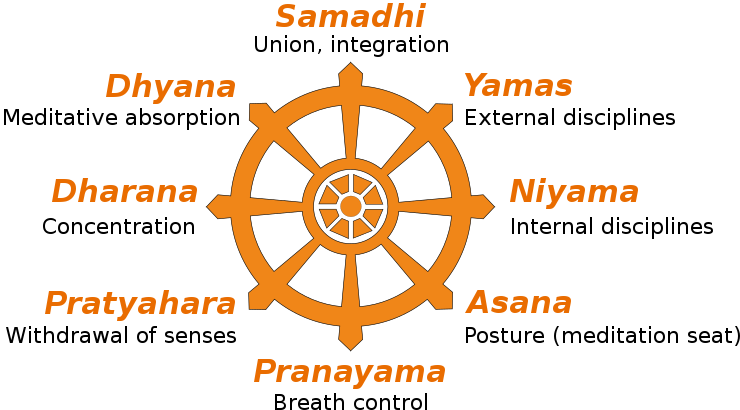
Today ,we have so many people and institutions are conducting Yoga classes and Meditation courses. Most of them do not seem to follow the Patanjali Yoga Sutra to the letter. What they teach is what they think will sell. Practices that do not have rigorous procedures are taught. Fir instance, in Patanjali ‘s Ashtanga Yoga, Niyama and Yama, that is Dos and Don’ts are the first two steps before proceeding to, in the order,Asana,Pranayama, Pratyahara,Dhyana and Dharana.Then comes Samadhi, Savikalpa and Nirvikalpa
Yoga is not a physical exercise per se. The physical benefits that accrue are the spinoffs of the Spiritual Endeavour Yoga,which, many have taken tens of years to perfect.Sastras say some Carry forward Sadhana from their previous birth to this birth and take off where they left off in their earlier births.
The Yama are according to Patanjali,
Ahimsa (अहिंसा): Nonviolence, non-harming other living beings.
Satya (सत्य): truthfulness, non-falsehood
Asteya (अस्तेय): non-stealing
Brahmacharya (ब्रह्मचर्य): chastity,marital fidelity or sexual restraint
And there is Niyama, things that are to be done or followed are,
The second component of Patanjali’s Yoga path is niyama, which includes virtuous habits and observances (the “dos”).Sadhana Pada Verse 32 lists the niyamas as:
. (शौच): purity, clearness of mind, speech and body
Santosha (संतोष): contentment, acceptance of others, acceptance of one’s circumstances as they are in order to get past or change them, optimism for self
Svadhyaya (स्वाध्याय): study of Vedas, study of self, self-reflection, introspection of self’s thoughts, speech and actions.
Ishvarapranidhana (ईश्वरप्रणिधान): contemplation of the Ishvara (God/Supreme Being, Brahman, True Self, Unchanging Reality).
Then comes Pranayama.Prana is the Life, verily it is the energy,that is vital that is present in every part of one’s body till it leaves the Body,when it the body becomes Inert or Sava.
For the body to be Siva, Yoga is one of the best methods.
However caution is to be exercised in following Yogic practices.
I have listed a total ten do’s and don’ts here before one attempts to go ahead in Yoga. Yama and Niyama are the first steps, preparing ground , equivalent to ,say,pre KG classes.
In the forth coming articles, I shall share information on other aspects like Prana, where to concentrate, difference between Pratyahara, Dhyana and Dharana. # I had published Explanation of Patanjali ‘s Yoga Sutras upto 32. Shall write more . Published articles are under Yoga Category.
I posted an article,Photo Essay on the nine sleeping poses of Vishnu. Lord Vishnu does not sleep. His sleep is called Yoga Nidra (Sleeping posture i Yoga) or Ari Thuyil(Tamil–sleeping while aware of everything) The Snake Adisehsa is the coiled Cosmic energy in the Solar Plexus(Mooladhaara). The Ksheera Saagara is a representation of the Milky way Galaxy. Please read my Post Vishnu’s’ Conch and Discus in galaxies, filed under Hinduism/Astrophysics. This Yoga Nidra of Lord Vishnu is of Nine types. 1.Vadabadra Sayanam, Srivilliputtur.Moolavar Image…
Such a Manuscript was found in Lhasa, Tibet by the Chinese. ‘the Chinese discovered some sanskrit documents in Lhasa, Tibet and sent them to the University of Chandrigarh to be translated. Dr. Ruth Reyna of the University said recently that the documents contain directions for building interstellar spaceships!
The first reference to Yoga is found in the Rig Veda.
The Yoga is at Realising Self.
There are steps to follow in Yoga.
Patanjali in his Yoga Sutras explains these steps.
They are Eight.
Yama,
Niyama,
Asana,
Pranayama,
Prathyaahaara,
Dhyana,
Dharana and Samadhi.
Of these eight, Samadhi is the culmination of the earlier seven steps.
Yoga is a spiritual exercise and not a physical one.
Practicing Yoga as a physical exercise does not find reference in Patanjali Yoga Sutras.
However, practice of Yoga as a Spiritual regimen,gives out beneficial physical side effects apart from enhancing Spiritual development.
The Physical benefits apart,Yoga also results in skillsets,which are,to a normal individual, impossible.
These include
Assuming minute Form,
Graining Large Forms,
Transmigration,.
These skill sets are Eight .
They are called Ashtama Siddhis,Eight Great Skills.
General physical side effects of Yoga ,are,
Clear Mind, devoid of indecisiveness and confusion,
General well being,
Relief from Breathing ,Lung and heart related issues,
Relief from Insomnia,
Improved Digestion.
Recent studies have shown that Yoga reduces the side effects of Cancer,and Cancer treatment.
It,
Improves quality of Sleep,
Reduces Depression and Negative thoughts,
Removes Anxiety,Fear.
‘Yoga has been used in the management of a variety of symptoms such as fatigue, sleep disturbances, loss of appetite, chemotherapy-induced nausea and vomiting (CINV), and pain in cancer patients.[56,58] The effects of yoga intervention have been moderate to large in these studies. Cooling Pranayama such as Sheetali, Sheetakari, and Sadanta have been useful in managing CINV along with Pavanamuktasana (supine knee-chest) and Uttana padasana (straight leg raise).
Source.
Research Study in Indian Journal of Palliative Care.
The negative thoughts and mental confusion can be eradicated by Pranayama.
Pranayama is the regulation of Life Energy.
It is present in all Life.
It is more than just breath,it is the Life Force.
It can be controlled at the level of Breath.
The whole Tantra and Yoga is an attempt to Reach out the Consciousness in Man and tune it in consonance with the Reality,which is Being,Consciousness and Bliss.
There are four ways of reaching out this Consciousness.
Patnajali Yoga 1.34
This Consciousness can be reached through the two components that make up humans,Emotion and Reason.
While the emotion is used to raise the level of Consciousness through Bhakti Yoga,the process of surrendering oneself to God,the Reason is used to reach out Consciousness by practicing Karma Yoga,the Path of Action and by Gnana Yoga,Path of Discrimination.
The purpose is to reach Consciousness through the available tools,Emotion and Reason.
But again as Human Beings have different dispositions/Nature,one must choose what is best for him/ her.
There are three basic categories of Natural Dispositions.
Satva,the calm,raional,
Rajas,the Dynamic,driven by ambition and Emotions and
Tamas,Docile,ignorant
No single disposition is present in an individual in its full measure.
The Dispositions present in Individuals is an admixture of all the three dispositions.
And these Dispositions in an individual changes at different times.
So to choose the correct method to practice Yoga,one needs an Objective assessment of the Dispositions present in an individual.
As it is difficult for one to analyse oneself objectively,one requires A Guru,Mentor ,who can identify the Disposition and suggest the best method to raise Consciousness,Bhakti,Karma or Gnana Yoga.
Once the path is chosen, one has to practice it.
The Yoga aspect of raising Consciousness is,in general,recommended for people of Rajasic Disposition,the Dynamic,who are more involved in day to day activities with passion.
Most of us belong to this category.
Now to Swami Vivekananda on this.
34. प्रच्छदन
य णवधायिाभ्यांवा प्रािस्य ॥ ३४॥
prachchhardanavidharanabhyan va prannasya
By throwing out and restraining the Breath.
The word used in Prana. Prana is not exactly breath. It is the
name for the energy that is in the universe. Whatever you
see in the universe, whatever moves or works, or has life, is a
manifestation of this Prana. the sum-total of the energy
displayed in the universe is called Prana. This Prana, before
a cycle begins, remains in an almost motionless state, and
when the cycle begins this Prana begins to manifest itself. It
is this Prana that is manifested as motion, as the nervous
motion in human beings or animals, and the same Prana is
manifesting as thought, and so on. The whole universe is a
combination of Prana and Akasa; so is the human body. Out
of Akasa you get the different materials that you feel, and
see, and out of Prana all the various forces. Now this
throwing out and restraining the Prana is what is called
Pranayama. Patanjali, the father of the Yoga Philosophy,
does not give many particular directions about Pranayama,
but later on other Yogis found out various things about this
Pranayama, and made of it a great science. With Patanjali ist
is one of the many ways, but he does not lay much stress on it.
He means that you simply throw the air out, and draw it in,
and hold it for some time, that is all, and by that, the mind will
become a little calmner. But, later on, you will find that out of
this is evolved a particular science called Pranayama. We
will hear a little of what thoese later Yogis have to say. Some
of this I have told you before, but a little repetition will serve
to fix it in your minds. First, you must remember that this
Prana is not the breath. But that which causes the motion of
the breath, that which is the vitality of the breath is the Prana.
Again, the word Prana is used of all the senses; they are all
called Prana, the mind is called Prana; and so we see that
Prana is the name of a certain force. And yet we cannot call
it force, because force is only the manifestation of it. It is that
which manifests itself as force and everything else in the way
of motion. The Chitta, the mind-stuff, is the engine which
draws in the Prana from the surroundings, and manufactures
out of this Prana the various vital forces. First of all the
forces that keep the body in preservation, and lastly thought,
will, and all other powers. By this process of breathing we can
control all the various motions in the body, and the various
nerve currents that are running through the body. First we
begin to recognise them, and then we slowly get control over
them. Now these later Yogis consider that there are three main
currents of this Prana in the human body. One they call Ida,
another Pingala, and the third Susumna. Pingala, according
to them, is on the right side of the spinal column, and the Ida
is on the left side, and in the middle of this spinal column is
the Susumna, a vacant channel. Ida and Pingala, according
to them, are the currents working in every man, and through
these currents, we are performing all the functions of life.
Susumna is present in all, as a possibility; but it works only in
the Yogi. You must remember that the Yogi changes his body;
as you go on practising your body changes; it is not the same
body that you had before the practice. That is very rational,
and can be explained, because every new thought that we
have must make, as it were, a new channel through the brain,
and that explains the tremendous conservatism of human
nature. Human nature likes to run through the ruts that are
already there, because it is easy. If we think, just for
example’s sake, that the mind is like a needle, and the brain
substance a soft lump before it, then each thought that we
have makes a street, as it were, in the brain, and this street
would close up, but that the grey matter comes and makes a
lining to keep it separate. If there were no grey matter there
would be no memory, because memory means going over
these old streets, retracing a thought as it were. Now perhaps
you have remarked that when I talk on subjects that in which I
take a few ideas that are familiar to everyone, and combine,
and recombine them, it is easy to follow, because these
channels are present in everyone’s brain, and it is only
necessary to recur to them. But whenever a new subject
comes new channels have to be made, so it is not understood
so readily. And that is why the brain (it is the brain, and not
the people themselves) refuses unconsciously to be acted
upon by new ideas. It resists. The Prana is trying to make
new channels, and the brain will not allow it. This is the secret
of conservatism. The less channels there have been in the
brain, and the less the needle of the Prana has made these
passages, the more conservative will be the brain, the more it
will struggle against new thoughts. The more thoughtful the
mane, the more complicated will be the streets in his brain,
and the more easily he will take to new ideas, and understand
them. So with every fresh idea; we make a new impression in
the brain, cut new channels though the brain-stuff, and that is
why we find that in the practice of Yoga (it being an entirely
new set of thoughts and motives) there is so much physical
resistance at first. That is why we find that the part of
religion which deals with the world side of nature can be so
widely accpeted, while the other part, the Philosophy, or the
Psychology, which deals with the inner nature of man, is so
frequently neglected. We must remember the definition of
this world of ours; it is only the Infinite Existence projected
into the plane of consciousness. A little of the Infinite is
projected into consciousness, and that we call our world. So
there is an Infinite beyond, and religion has to deal with both,
with th elittle lump we call our world, and with the Infinite
beyond. Any religion which deals alone with either one of
these two will be defective. It must deal with both. That part
of religion which deals with this part of the Infinite which has
come into this plane of consciousness, got itself caught, as it
were, in the plane of consciousness, in the case of time, space,
and causation, is quite familiar to us, because we are in that
already, and ideas about this world have been with us almost
from time immemorial. The part of religion which deals with
the Infinite beyond comes entirely new to us, and getting
ideas about it produces new channels in the brain, disturbing
the whole system, and that is why you find in the practice of
Yoga ordinary people are at first turned out of their groove. Inorder to lesson these disturbances as much as possible all these methods are devised by Patanjali, that we may practice any one of them best suited to us.
The obstacles,as listed by Patanjali in earlier Yoga Sutras from 1.21 to 1.31,totalling 9 and another 3,can be overcome says Patanjali in Yoga Sutra 1.32.
Human Mind,by nature receives many Stimulii,at the same time.
It is the disposition of the individual on the one hand and the environment in which he grows up,which clouds one’s Mind,the other.
Multitude of Thoughts ,most of them occurring at the same time creates a conflict of Ideas.
It might be the clash of ideas,or the value system one has /been exposed to or merely the presence of totally contradicting ideas or overlapping ideas.
This,essentially,is because of the Perception one has of Objects and the ideas he forms of them.
The Object,we observe first ,as Fact.
Then our association of Ideas make us link the Object to various Objects we have perceived earlier and our impressions of it and the pain or pleasure it has caused us.
This Conditioned Perception,though we are not aware of it,determines our present Perception.
This is the cause of Prejudice.
And also our failure to distinguish Fact from Impression.
This is the cause for clash of ideas,confusion,indecision,incorrect judgement and finally inaction.
This has been addressed by Lord Krishna in the Second Chapter of The Bhagavad Gita,in the form of Karma Yoga.
Patanjali,in Yoga Sutra 1.31, addresses this issue thus,
Yoga Sutra .1.32 of Patanjali
32. तत्प्रणतषधेाथभय
ए्कतत्त्वाभ्यास् ॥ ३२॥
tatpratishedhartham ekatattvabhyasah
To remedy this practice of one subject (should be
made).
(Translation by Swamy Vivekananda)
The inability to Perceive the Reality as One,says Yoga,is the cause for these conditions and he sets forth remedial measures to overcome this.
This will be explained in the forthcoming Yoga Sutras.
Yoga means ‘Union’, that is connecting with the Reality, Brahman,the One with no attributes.In Saguna Upasna,worship of Reality with Attributes is practiced.
In fact it was Patanjali who introduced the concept of Ishwara into otherwise worship of Reality as without Attributes or Nirguna Brahman.
When one analyses the systems of Yoga, one would find some common characteristics as well as differences.
While the effort to realize Self is common to all, the methodology differs.
Essentially , there are five aspects or components in Yoga.
1.Postures.
2 .Breath control.
3.Meditation, Dhyana,
4.Nada ,Sound,
5.Tantra.
Patanjali’s Yoga Sutra deals more with Meditation or Dhyana,while the Siddhas emphasize Breath control,Vaasi Yoga.
I shall write more on this later.
And there seems to be some Deities or system of worshiping a specific God or Goddess.
We have, thus, Shaiva,Shakta,Vaishnava Yoga Upanishads.
And we have Samanya, common Yoga Upanishads for Gruhastha or householders and Sannyasa Yoga Upanishads for the Renounced.
I have written on some of these Yoga Upanishads.
Shall write further.
Here is the list of twenty Yoga Upanishads.
List of Yoga Upanishads.
Hamsa Upanishad Sukla Yajurveda
Amritabindu Upanishad Atharvaveda
Nadabindu Upanishad or Amrita Nada Bindu Upanishad Rigveda or Atharvaveda
Kshurika Upanishad Atharvaveda Krishna Yajurveda
Tejobindu Upanishad Atharvaveda
Nadabindu Upanishad. Atharvaveda and Rig Veda.
Dhyanabindu Upanishad. Atharvaveda and Samaveda
Brahmavidya Upanishad. Atharvaveda and Krishna YajurVeda.
You must be logged in to post a comment.