I have been researching Sanatana Dharma, Hinduism and its presence throughout the world.
Over the last nine years, I have been able to find the presence of Sanatana Dharma in all world cultures and Religions.
The basis for the findings are,
Archeological remains,
Etymology of the local ancient language/dialect of the region,
References in Regional literature of the Area,Legends,
Sociological practices,
Tribal links to Vedic tribes,
References in foreign literature,
References in Indian Literature ,Puranas, Ramayana, Mahabharata in Sanskrit and references in Tamil,an ancient language of India,
Epigraphs,
The methodology used are,
Astrodating,
Carbon dating,
Infrared studies,
Plate tectonics,
Geological characters,
Thermal imaging,
Ocean floor mapping,
Sea level changes.
Information is available in the web on all these and they are cross checked for veracity.
Then I publish.
But as the subject is vast and the time frame runs into thousands of years, I could scratch only the surface of Indian history.
So, as and when I come across information of interest I verify facts and write.
As this is an evolving process,many times information relating to a specific subject or temple or area,may be written at different times, about different aspects.
So ,in this sense,the findings in this blog are not complete but are subject to updation,when new information comes through.
Thus I have written on Arabia.
About its,
Hoary past,
It’s ancient tribes,
How it was related to Sanatana Dharma,
How Tamil culture influenced them and how they influenced Tamils,
How Indian God’s and Goddesses formed a part of Pre Islamic Arabia,
How Sapthapathi was practiced there(Sapthapathi is a Hindu Marriage ritual),
How Prophet’s Grandfather dug a well for Ganges,
How Prophet’s uncle wrote a Poem on Shiva,Shiva Sruthi,
How Mecca is a Hindu shrine,
Shiva is worshipped in Kaaba,
786 is Flipped OM,the most sacred Mantra of Hinduism….
Now more evidence has come to light about the construction of Kaaba in Mecca.
Prophet ordered the demolition of 360 Idols in Mecca.
Most of them were Idols of Hindu Gods and Goddesses.
Fearing one Idol might have been spirited away to Somnath,Ghazni Muhammad Destroyed the Somnath Temple in India.
I will be writing details of Idols destroyed in Kaaba.
Though the present evidence suggests that the Black Stone worshipped in Kaaba is a Shiva Kings,new evidence suggests that there could have been a huge Temple Complex,where now stands a truncated Kaaba.
This temple housed 360 Deities.
Lord Vishnu seems to have been another Primary Deity along with Shiva.
The ground floorplan of Mecca is after the Vedic Principle of Temple Construction.
It has eight points, representing the Devathas, Ashtadikpalakas.
More on this .
‘
Above is the ground-plan of the hoary Kaba (Vishnu) temple constructed on the esoteric, Tantric, octagonal Vedic pattern in Mecca, Saudi Arabia.
The eight corners occupied the images of the sentinel Vedic deities Indra, Varun, Yama, Agni, Vayu, Juber, Ishan and Nirut.
The central square represents the present truncated Kaba, the central sanctum housing the image of the Reclining Vishnu “in labour”. Therefore this shrine is remembered even in convert, Islamic tradition as the Navel of the World.
Its other name “Haram” is the Sanskrit term “Hariyam”, i.e. the shrine of Lord Vishnu alias Hari.
Note the rectangular dent near the upper left corner of the central square. That marks the spot where the cylindrical Shivling stone is vertically partially embedded on the exterior of the southeast corner of the Kaba wall. Therefore perambulation of the Shivling involves circling the entire Kaba building. Even after conversion, Muslims feel compelled to observe the seven-fold ancient Vedic perambulation. The Kaba sanctum itself is always kept secretively shut to hide its Vedic interior.
The seven-stories-high Kaba building is covered perpetually by a ghilaf, i.e. a black burqa, hiding its Vedic saffron-colour stone surface, lotus designs and what are believed to be Sanskrit inscriptions on the inner side of the sanctum walls. International pressure on the Saudi government should continue to be exerted by all countries until the Kaba is thrown open to all people as in pre-Muslim times.
I have often wondered why Ghazni Muhammad should single out the Somnath Temple,an Abode and Temple of Shiva in Gujrat.
‘
An idol of her was also likely among the 360 idols in the Kaaba. According to Ibn al-Kalbi, when worshipers would circumambulate the Kaaba, they would chant her name along with that of her sisters, al-Lat and al-Uzza, seeking their blessings and interception.[12]
The attack on Somnath temple in India in 1024 by Mahmud of Ghazni may have been inspired by the belief that an idol of Manat had been secretly transferred to the temple.[20] According to the Ghaznavid court poet Farrukhi Sistani, who claimed to have accompanied Mahmud on his raid, Somnat (as rendered in Persian) was a garbled version of su-manat referring to the goddess Manat. According to him as well as a later Ghaznavid historian Abu Sa’id Gardezi, the images of the other goddesses were destroyed in Arabia but the one of Manat was secretly sent away to Kathiawar (in modern Gujarat) for safe keeping. Since the idol of Manat was an aniconic image of black stone, it could have been easily confused with a lingam at Somnath. Mahmud is said to have broken the idol and taken away parts of it as loot and placed so that people would walk on it. In his letters to the Caliphate, Mahmud exaggerated the size, wealth and religious significance of the Somnath temple, receiving grandiose titles from the Caliph in return’
Manat was also thought to watch over graves, as indicated by a tomb inscription reading “And may Dushara and Manat and Qaysha curse anyone who sells this tomb or buys it or gives it in pledge or makes a gift of it or leases it or draws up for himself any document concerning it or buries in it anyone apart from the inscribed above”.[2]
1025: Somnath: Mahmud sacks the temple and is reported to have personally hammered the temple’s gilded Lingam to pieces, and the stone fragments are carted back to Ghazni, where they are incorporated into the steps of the city’s new Jama Masjid (Friday Mosque) in 1026. He places a new king on the throne in Gujarat as a tributary. His return detours across the Thar Desert to avoid the armies of Ajmerand other allies on his return.( https://en.m.wikipedia.org/wiki/Mahmud_of_Ghazni )
Islamic sources indicate that Ghazni Muhammad believed that an Idol of Manat was spirited away to Somnath ,India from Mecca when the idols at Mecca’s were destroyed at the behest of The Prophet.
The information.
‘
Contrary to what we have been taught,Arabia indeed had Religion and street culture before the advent of The Prophet.
The Pre Islamic Arabia had a Religion and they had a Pantheon of Gods ,whose legends have been borrowed from Hinduism.
Arabia was influenced by Sumrerian Culture and Religious practices.
The Prophet Muhammad destroyed around 300 Idols in Mecca.
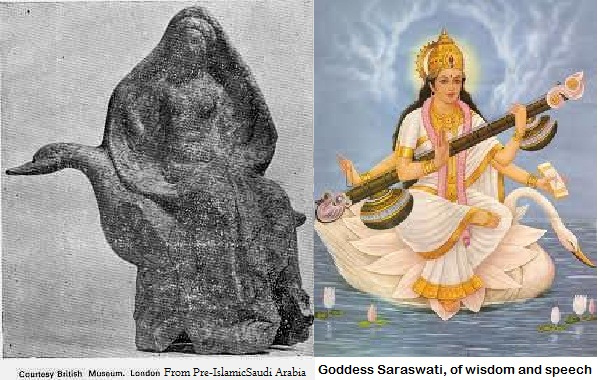
These included the Navagrahas and Saraswathi.
The three Goddesses mentioned above are from the Hindu Trinity of Goddesses Saraswathi,Lakshmi and Durga.
Please read my articles on Mithraism around the world.
Will be writing on these Arabian Gods and Goddesses in detail.
‘The Goddesses Al-Uzza, Al-Lat and Menat formed a triad in pre-Islamic Arabia. They were widely worshipped: from Nabatean Petra in the North to the legendary Kingdoms of Arabia Felix in the South, including Saba, the Biblical Sheba; as far east as Iran and Palmyra; and the three of them were very popular Goddesses in Mecca at the time of Mohammed. From left they are: Al-Uzza, whose name means “The Mighty One”, the Goddess of the Morning Star; Al-Lat, the Mother, whose name means simply “The Goddess”, as Al-Lah simply means “The God”; and Manat, Crone-goddess of Fate or Time. Sometimes the three of them are referred to as the daughters of Al-Lah; sometimes Manat and Al-Lat are considered daughters of Al-Uzza.(. Image and quote from. http://www.thaliatook.com/AMGG/arabtriple.php )
‘
The pre-Islamic Arabs believed Manāt to be the goddess of fate. The followers prayed to her for rains and victory over enemies. She was considered the wife of Hubal.There are also connections with Chronos of Mithraism and Zurvan mythology. The Book of Idols describes her:
The most ancient of all these idols was Manāt. The Arabs used to name [their children] ‘Abd-Manāt and Zayd-Manāt. Manāt was erected on the seashore in the vicinity of al-Mushallal in Qudayd, between Medina and Mecca. All the Arabs used to venerate her and sacrifice before her. The Aws and the Khazraj, as well as the inhabitants of Medina and Mecca and their vicinities, used to venerate Manāt, sacrifice before her, and bring unto her their offerings… The Aws and the Khazraj, as well as those Arabs among the people of Yathrib and other places who took to their way of life, were wont to go o
n pilgrimage and observe the vigil at all the appointed places, but not shave their heads. At the end of the pilgrimage, however, when they were about to return home, they would set out to the place where Manāt stood, shave their heads, and stay there a while. They did not consider their pilgrimage completed until they visited Manāt.
— Book of Idols, pp 12–14
The attack on Somnath Temple in India in AD 1024 by Mahmud of Ghazni may have been inspired by the belief that an idol of Manat had been secretly transferred to the temple.According to the Ghaznavid court poet Farrukhi Sistani, who claimed to have accompanied Mahmud on his raid, Somnat (as rendered in Persian) was a garbled version of su-manat referring to the goddess Manat. According to him as well as a later Ghaznavid historian Gardizi, the images of the other goddesses were destroyed in Arabia but the one of Manat was secretly sent away to Kathiawar (in modern Gujarat) for safe keeping. Since the idol of Manat was an aniconic image of black stone, it could have been easily confused with a Shiva lingam at Somnath. Mahmud is said to have broken the idol and taken away parts of it as loot and placed so that people would walk on it. In his letters to the Caliphate, Mahmud exaggerated the size, wealth and religious significance of the Somnath temple, receiving grandiose titles from the Caliph in return.
Ibn al-Kalbī; (author) and Nabih Amin Faris (translator & commentary) (1952): The Book of Idols, Being a Translation from the Arabic of theKitāb al-Asnām. Princeton University Press. LCCN52-6741.
Grunebaum, G. E. von (1970). Classical Islam: A History 600 A.D. – 1258 A.D.. Aldine Publishing Company. ISBN978-0-202-15016-1.
I have written on the Vedic past of Arabia , though doctored History would have us believe that there was no civilization or culture before the Prophet and Islam.
I had written on the fact that Arabia is from the word Arabia was derived from the Sanskrit word Aravasthan, meaning the place of Horses.
I had also written that,
Arabia was a part of Lemuria,
Lord Rama’s Kingdom included Arabia,
Chandragupta Vikramaditya established his Kingdom there,
He subdued the local tribes,
Established Shiva Temple, which is now Kaaba,
His inscriptions are found there,
Kaaba is a Shiva Temple,
786 is flipped OM,
Muhammad’s maternal Uncle composed a Hymn in Praise of Lord Shiva,
The Arabian Kings followed Tamil practices,
The Arabians followed Vedic System of marriages with Sapthapathi Mantra.
Now more evidence that Prophet’s Grandfather dug the Zamzam spring which is a word from Ganges, Ganga . associated with Lord Shiva,
Prophet’s Father and his ancestors were the custodians of the Shiva Temple,
the affinity of Arabic with Sanskrit, and the worship of Moon and the
Rama and Soma Tribes were in Arabia!
Shiva Stuthi by Prophet’s Uncle.
‘
The Black Stone is badly mutilated; its carved base has disappeared, and the stone itself is broken at seven places. Its parts are now held together by a silver band studded with silver nails. It lies half buried in the South East portion of the Kaaba Wall. The term Kaaba itself appears to be a corruption of the Sanskrit word Gabha ( Garbha + Griha ), which means “sanctum sanctorum.”
In addition, in inscriptions from Hajja and its neighborhood was found a votive vessel dedicated by members of two tribes called Rama and Somia. Rama and Soma are Vedic deities… Rama is of the Solar dynasty and Soma of the Lunar one.
The moon god was called by various names in pre-Islamic times; one of them was Allah. Allah had 3 children : Al-Lat, Al-Uzza and Manat. Al-Lat and Al-Uzza were both feminine deities. Alla is also another name for the Hindu goddess Durga. It is likely that the goddess Al-Lat was Alla ( Durga ) and Al-Uzza was Oorja ( energy or life force, also known as Shakti ).
Manat may have been none other than Somnath, which is another name for Lord Shiva. One significant point to note is that Soma, in Sanskrit, means Moon and Nath means Lord. Thus the Kaaba itself seems to have been dedicated to the Moon God Somnath, alias Shiva, and the word Somnath was corrupted to Manat.
As observed, the famous Black Stone could have been none other than the Shiva linga of Makkeshwar, alias Mecca. Lord Shiva is always shown with a crescent Moon on his head and every Shiva temple is supposed to have a sacred water spring, representing the Ganges. The Crescent Moon pinnacle of the Kaaba and the Zamzam spring ( actually Zamza, from Ganga ) seem testimonies to the Vedic connections of Kaaba.
Sahih Bukhari Vol 2, Book 26, No 689
Narrated by Abu Huraira :
In the year prior to the last Hajj of the Prophet,
when Allah’s Apostle made Abu Bakr the leader of the pilgrims,
the latter ( Abu Bakr ) sent me in the company of a group of people
to make a public announcement –
‘ No pagan is allowed to perform Hajj after this year;
and no naked person is allowed to perform Tawaf of the Kaaba.’
Can you imagine naked pagans and Muslims performing Tawaf ?
Among Hindus though, Naga ascetics do not cover their bodies
with anything except ash !
Tradition proclaims that Mohammed’s grandfather dug the well of Zamzam and dedicated it to Asaf and Neila. He almost sacrificed his son, Mohammad’s father, to the two stone idols … a very distinct pagan practice !
The Well of Zamzam (or the Zamzam Well, or just Zamzam; Arabic: زمزم) is a well located within the Masjid al-Haram in Mecca, Saudi Arabia, 20 m (66 ft) east of the Kaaba, the holiest place in Islam. According to Islamic belief, it is a miraculously generated source of water from God, which began thousands of years ago when Abraham’s (Ibrāhīm) infant son Ishmael (ʼIsmāʻīl) was thirsty and kept crying for water. Millions of pilgrims visit the well each year while performing the Hajj or Umrah pilgrimages, in order to drink its wate
…..
In all probability, Tsabaism is a corruption of the word Shaivism which is part of the Vedic religion. On page 439 of this book, Sir Drummond mentions some of gods of pre-Islamic Arabs, all of which were among the 360 idols that were consecrated in the Kaaba shrine before it was raided and destroyed by Muhammad and his followers.
Here are some of the Arab deities mentioned and their Sanskrit names :
‘A popular saying refers to the Hussaini Brahmins or Dutts thus:
Wah re Dutt Sultan,
Hindu ka Dharm
Musalman ka Iman,
Adha Hindu Adha Musalman
Oh! Dutt, the king
[Who follows] the religion of the Hindu
and the faith of the Muslim
Half Hindu, half Muslim.’
HERE IS WHAT THE COLUMBIA ENCYLOPEDIA SAYS:
[Sixth Edition – 2001]“Kaaba or Caaba’ (both: kä´b or kä´b) (KEY) [Arab.,=cube], the central, cubic, stone structure, covered by a black cloth, within the Great Mosque in Mecca, Saudi Arabia. The sacred nature of the site predates Islam: tradition says that the Kaaba was built by Adam and rebuilt byAbraham and the descendants of Noah. Also known as the House of God, it is the center of the circumambulations performed during the hajj, and it is toward the Kaaba that Muslims face in their prayers (see liturgy, Islamic). Pre-Islamic Meccans used it as a central shrine housing their many idols, most notable of which were al-Lat, al-Uzza, and Manat, collectively known as al-Gharaniq or the Daughters of God, and Hubal, a martial deity. The Black Stone, possibly of meteoric origin, is located at one of its outside corners. Also dating from pre-Islamic times as a heavenly relic, this stone is venerated and ritually kissed. Worn hollow by the centuries of veneration, the stone is held together by a wide silver band. The actual structure of the Kaaba has been demolished and rebuilt several times in the course of its history. Around the Kaaba is a restricted area, haram, extending in some directions as far as 12 mi, into which only Muslims may enter.”
The above provides impeccable evidence about that pragmatic role played by the Datt Mohyals in the catastrophe of Karbala. There are more than a dozen ballads composed centuries ago which vividly and with great passion describe the scenario of the historic event.
Ancient Shiva Linga in Kaaba
Photo by Suzanna Olsson
In the Preface of a famous historical novel by Munshi Prem Chand, titled “Karbala”, published in 1924 from Lucknow, has stated that the Hindus who fought and sacrificed their lives in the holy war of Karbala, are believed to be the descendants of Ashvathama (hero of “maha bharata”).This clearly establishes their link with the Datts who consider Ashvathama as an ancestor of their clan.
I have written articles on the Vedic roots of Arabia.
If one were to look at the history of Arabia and Africa, one would find that, in the case of Arabia, the entire history of Arabia is dispensed with something like’Idol worshipers were defeated ‘ and Muhammad established his religion,Islam; in the case of Africa it is dismissed with ‘Tribes with superstitious beliefs were engaged in internecine war!( I am surprised that those who make this statement are also the people who say with a straight face that Human migration began from, Africa and it was in Africa Humans evolved from forgetting that such an early civilization could have nothing to offer except wars!).
But real history is different.
Saudi Arabia,, in the earlier days, was a part of Mesopotamia /Sumeria and these were ruled by Sumerians.
One can find , among the Kings of Sumeria, in the Kings List of Sumeria, the names of Lord Rama, his father Dasaratha and Bharatha.
And there is the Tamil connection of Arabia with the unique practice patronizing Poets in Tamil style by offering Gifts to them in return for their praising the Kings.
Sapthapathi was practiced in Arabia and Navagraha Idols were found in Mecca.
Not to forget that Mecca was /is a Shiva temple.
Chandra Gupta Maurya ruled over Arabia and his inscription is found in Mecca.
Prophet’s Uncle composed a Poem on Lord Shiva and the hereditary rights of maintaining the Shiva temple was entrusted to Brahmin Families who settled there.
There are reports that Seramaan Perumaal Nayanaar, a Shiva Bhaktha and King of present Kerala having met prophet and became a follower of Islam.
The evidence about Seramaan Perumaal becoming a follower of Islam is not strong.
Now to the Brahmins and Brahmin Kings of Arabia.
‘
According to “vide Bandobast Report of Gujarat” by Mirza Azam Beg page 422 and widely famous folk songs, “Later on, when umvies and abbasies let loose an orgy of vendetta on Ahl e Bayet (A.S), Shias and Datts, then Datts returned to their motherland around 700 AD and settled at Dina Nagar, District Sialkot and some drifted to as far as the holy Pushkar in Rajasthan. Starting from Harya Bandar (modern Basra on the bank of river Tigris) with swords in hand and beating durms, they forced their way through Syria and Asia Minor and marching onwards captured Ghazni, Balkh and Bukhara. After annexing Kandhar, they converged on Sindh and crossing the Sindh at Attock they entered the Punjab”.
An ancestor of Rahab named Sidh Viyog Datt assumed the title of Sultan and made Arabia (old Iraq) his home. He was a tough and tenacious fighter.
He was also known as Mir Sidhani. He was a worshipper of Brahma. He was the son of the stalwart Sidh Jhoja (Vaj) who was a savant and saint and lived in Arabia (Iraq) around 600 AD.
The supporters of imam Hassan (A.S) and imam Hussain (A.S) honored the Datts with the title of “Hussaini Brahmin” and treated them with great reverence in grateful recognition of the supreme sacrifices made by them in the war of Karbala. According to Jang Nama, written by Ahmed Punjabi, pages 175-176, “At the time to the Karbala, fourteen hundred Hussaini Brahmins lived in Baghdad alone”
According to the “encyclopedia of Indian casts” page 579 “Hussaini Brahmins are a group bringing harmony and brotherhood between Muslim and Hindu religions. They are greatly influenced by martydom of Imam Hussain (A.S), grandson of ProphetMuhammad(peace be upon him and on his children), at Karbala in 680 AD. It is also claimed that their ancestors were fought with imam hussain and martyred during the war of karbala. When the holy month of Muharram starts these Brahmins starts lamenting the death of Imam Hussain (A.S) in Lucknow with the muslims. Brahmins are the highest caste in Hindu hierarchy”
The Hussaini Brahmin sect, located mostly in Indian Punjab, also known as Dutts or Mohyals. Unlike other Brahmin clans, the Hussaini Brahmins have had a long martial tradition, which they trace back to the event of Karbala.
Some Mohyal Brahmins migrated eastward and became as some sub-divisions of Bhumihar Brahmins, some of whom are also descendants of Hussaini Brahmins and mourn the death of Imam Hussain (A.S). An eminent example was Sir Ganesh Dutt Singh. Sir Ganesh Dutt Singh, who was a freedom fighter, administrator and educationist in which capacity he did a lot for improving education and health services in the state of Bihar in the pre-independence era. Sir Ganesh Dutta made generous donations from his earnings and personal property for the development of educational institutions, like radium institute in Patna Medical College, Darbhaga Medical College, Ayurvedic College and schools for the blind, deaf and dumb, among others. A short film based on the life and works of Sir Dutt has been made by Prakash Jha. His essays, articles and books etc, clearly show his love towards imam hussain (A.S).
According to a Hindu news paper “Par tap(English)” 21 April 1949
“The Hussaini Brahmins are concentrating in “satghara katas” (the Rawalpindi-Jhelum regions of Pakistan) for the mourning of the muslim imam “hussain” (A.S). According to the traditions, the Hussaini Brahmins believe that their ancestor Rahab Dutt and his sons fought on the side of Imam Hussain (A.S) at Karbala and they were martyred along with the Imam. They remained Hindus but the tragedy of Kerbala was commemorated from generation to generation in their families and even now their clans observe it all over India, although the younger generation is less keen on such traditions”.
What is particularly striking about the observances of the month of Muharram in large parts of India is the prominent participation of Hindus in the ritual mourning. In several towns and villages, Hindus join Muslims in lamenting the death of Hussain (A.S), by sponsoring or taking part in lamentation rituals and taazia processions. In Lucknow, seat of the Shia nawabs of Awadh, prominent Hindu noblemen like Raja Tikait Rai and Raja Bilas Rai built Imambargahs to house Alams, standards representing the Karbala event.
The non-Muslim tribal Lambadi communities in Andhra Pradesh have their own genre of Muharram lamentation songs in Telugu. Among certain Hindu castes in Rajasthan, the Karbala battle is recounted by staging plays in which the death of Imam Hussain(A.S) is enacted, after which the women of the village come out in a procession, crying and cursing Yazid for his cruelty. This custom is known as “Pitna Daalna”.
In large parts of rural India, Hindus believe that if barren women slip under a Moharrum Alam they would be blessed with a child.
Another story, which seems reliable (but no strong historic avidence is found yet to prove it completely), is related as to how the Dutts of Punjab came to be known as Hussaini Brahmins. According to this version, one of the wives of Imam Hussain(A.S), the Persian princess bibi Shahr Banu(A.S), was the sister of “Chandra Lekha” or “Mehr Bano”, the wife of an Indian king called Chandragupta famous as “raja jaisalmer”.
When it became clear that Yazid was adamant on killing the Imam Hussain (A.S), and “Raja jaisalmer” received the information regarding this, he came to Iraq with a large army to assist the Imam Hussain (A.S). By the time they arrived, however, the Imam (A.S) had been slain. In the town of Kufa, in Iraq, he attacked Damascus the capital of yazid and got martyred by yazeed army however Imam Ali ibn al Hussain (A.S), known as zain ul Abideen, made them alive by the grace of Allah. They went back gathered their army, met with Mukhtar Saqaffi, (a disciple of the Imam(A.S)), who arranged for them to stay in a special part of the town, which even today is known by the name of Dair-i-Hindiya or ‘the Indian quarter’.
Some Dutt Brahmins, under the leadership of one Bhurya Dutt, got together with Mukhtar Saqafi to avenge the death of the Imam. They stayed behind in Kufa, while the rest returned to India. Here they built up a community of their own, calling themselves Hussaini Brahmins, keeping alive the memory of their links with the Imam (A.S).
The Hussaini Brahmins believe that in the “Bhagwadgita” Krishna had foretold the event of the Imam’s death at Karbala. According to them, the Kalanki Purana, (the last of eighteen Puranas), as well as the Atharva Veda, the fourth Veda, refer to Imam Hussain(A.S) as the divine incarnation or avatar of the ”Kali Yug”, the present age. They hold Rasool Allah, in particular reverence, referring to him as “MAHA DEV MAHA MADD” (greatest God) and Imam Ali (A.S), (Imam Hussain’s father, and son-in-law and cousin of the Prophet Muhammad(peace be upon him and on his children)), with the honorific title of ‘Om Murti’. (God’s face).
They also believe that in “ramaayana” “SIRI RAAM JI” told about the birth of Prophet MUHAMMAD (peace be upon him and his children).
Uttar ramaayana says “Siri RAAM said! Behold! that after 4000 years there would be a revelation of a “dev atee dev” (GOD of the gods) near the world’s greatest temple of black stone (kaba) in the land of dates, his name would be “MAHA DEV MAHA MADD” his greatest disciple “OM MURTI (God’s face) shall miraculously revealed beyond the black stone temple. His daughter “DURGA” will get married with “OM MURTI” known as Lion of God and they will have two lions one of them will be martyred on a river bank however he would be thirsty for three days”
Though other Hindus do not believe that it is said for Prophet Muhammad(peace be upon him and his children) but The Hussaini Brahmins observe it like Muslim beliefs.
The Hussaini Brahmins, along with other Hindu devotees of the Imam Hussain (A.S), are today a rapidly decreasing. Younger generation of Hussaini Brahmins are said to be abandoning their ancestral heritage, some seeing it as embarrassingly deviant.
No longer, it seems, can an ambiguous, yet comfortable, liminality be sustained, fuzzy communal identities giving way under the relentless pressure to conform to the logic of neatly demarcated ‘Hindu’ and ‘Muslim’ communities. And so, these and scores of other religious communities that once straddled the frontier between Hinduism and Islam seem destined for perdition, or else to folkloric curiosities that tell of a bygone age, when it was truly possible to be both Hindu as well as Muslim at the same time.’
I have written a few articles on Shiva Linga in Mecca OM is 786,
Muslims Worship Shiv Lingam At Mecca Masjid Al Haraam Says Islamic Site,
Prophets Uncle wrote Siva Sthuthi, A Prayer On Lord Shiva,
Sapthapathi of the Marriage ceremony of the Hindus and Navagrahas in Arabia,
Aravasthan is Arabia and some more articles.
Inside Kaaba(left) and Shiva Abhishekam(Right)
The Prophet, after signing a treaty with tribes the Medina Treaty, stormed Mecca and destroyed 360 Idols housed there.
There is Kaaba Stone which is believed to have been of Abrahamic times.
People are not permitted to take videos or photographs of the inside of the room.
The room seems to contain an Idol, the worship of which is prohibited in Islam.
Now let us see what a a surreptitiously taken video and an article in a web site run by Pakistani Defense Think Tank say.
Video is below.
One can see an Idol resembling Shiv Linga there.
And watch the Video, and look at the clock for the time of opening the Room.
5.20 to 5.45!
Shivas Pradosha Time!
The article from Pakistan Defense Thin Tank Site.
‘Arabia is an abbreviation. The original word even today
is Arbasthan. It originates in Arvasthan. As observed earlier
Sanskrit V changes into B. Arva in Sanskrit means a horse.
Arvasthan signifies a land of horses, and as we all know Arabia
is famous for its horses.
In the 6th and 7th centuries A.D. a wave of effecting a
complete break with the past spread over West Asia. All links
with the past were broken, images smashed, scriptures des-
troyed, education discontinued and the entire West Asian
region took a plunge in abyssmal ignorance which lasted for
centuries thereafter and perhaps persists to a certain extent
even today because if in the whole world modern scientific and
educational developments find stubborn and entrenched resis-
tance anywhere it is in the West Asian countries. It is said
that the late Saudi Arabia ruler could not permit a radio
broadcasting station opened in his own capital because of
oposition from his Maulavis. He then resorted to a stratagem.
Once while he had his council of Maulavis in attendance he had
a radio set switched on to a program of Koranic recitation
broadcast from a small transmitting station set up earlier
without much ado. The Maulavis were delighted, so goes the
report, to hear the word of Allah coming to them as if from
nowhere. The king told them that what objections could they
have to a mechanism which broadcast the word of Allah. The
Maulavis agreed and the small radio broadcasting project was
at last ratified.
According to Encyclopaedia Britannica and Encyclø-
paedia Islamia the Arabs are ignorant of their own history of
the pre-Muslim era. By a strange euphemism they call it a
period of ignorance and darkness. Probably no other country
in the world has deliberately written off a 2,500 year period of
their own history by systematically stamping out and snapping
all links with the past. They have wiped the memories of pre-
Muslim era off their minds. So while they chose to remain
ignorant of their past ironically enough it is they who dub the
pre-Muslim era as a period of ignorance.
Fortunately we can still trace the history of that pre-
Islamic Arabia. It is a well known adage that there is no such
thing as foolproof destruction of all evidence. The pre-Islamic
history of Arabia is the story of Indian Kshatriyas over that
land, with the people following the Vedic way of life.
In our attempt to reconstruct the story of pre-Islamic
Arabia we begin with the name of the country itself. As
explained earlier the name is fully Sanskrit. Its central
pilgrim centre, Mecca is also a Sanskrit name. Makha in
Sanskrit signifies a sacrificial fire. Since Vedic fire worship
was prevalent all over West Asia in pre-Islamic days Makha
signifies the place which had an important shrine of fire
worship.
Coinciding with the annual pilgrimage of huge bazaar
used to spring up in Makha i.e. Mecca since times immemorial.
The annual pilgrimage of Muslims to Mecca is not at all an
innovation but a continuation of the ancient pilgrimage. This
fact is mentioned in encyclopedias.
VIKRAMADITYA
Evidence is now available that the whole of Arabia was
part of the great Indian King Vikramadityas vast empire. The
extent of Vikramadityas empire is one of the main reasons for
his world wide fame. Incidentally this also explains many
intriguing features about Arabia. It could be that
Vikramaditya himself had this peninsula named Arvasthan if
he was the first Indian monarch to capture it and bring it
under his sway
You must be logged in to post a comment.