Tag: Homa

  • Homa Cleans Environment Rids Microbes 3870°C Athirathra Study

    Homa Cleans Environment Rids Microbes 3870°C Athirathra Study

    There are Homas and Yagnyas sanctioned by Vedas, the scriptural authority in Hinduism.

    Though performance of both are mandatory,they are different.

    Yagnyas need not involve Fire,for example Brahma Yagnyas,whereas Homas involve Fire ,Agni.

    Homas are performed with specific purpose in mind,like personal or welfare of the society or for Rains..

    But Yagnyas are mandatory.

    They are to be performed because they ought to be.

    It is A Duty.

    Example,Tharpana,Sraddha,Brahma Yagnyas.

    The Homa involves Agni,Fire,the Primary God of Sanatana Dharma.

    Agni,as Vaisvanara transmits the Oblations to the God addressed in The Homa.(though personal God’s are mentioned in Hinduism,the core of the Vedas describe Reality as Beyond Name and Form.For details click here.

    Scientific studies have been done on the efficacy of the Materials used in Homas,like Darbha and the Homas.

    Darbha,A scientific study

    Many Homas are prescribed in Vedas.

    Homas List.

    One such is Athirathra Homa.

    https://vimeo.com/139488147

    Athirathra Homa
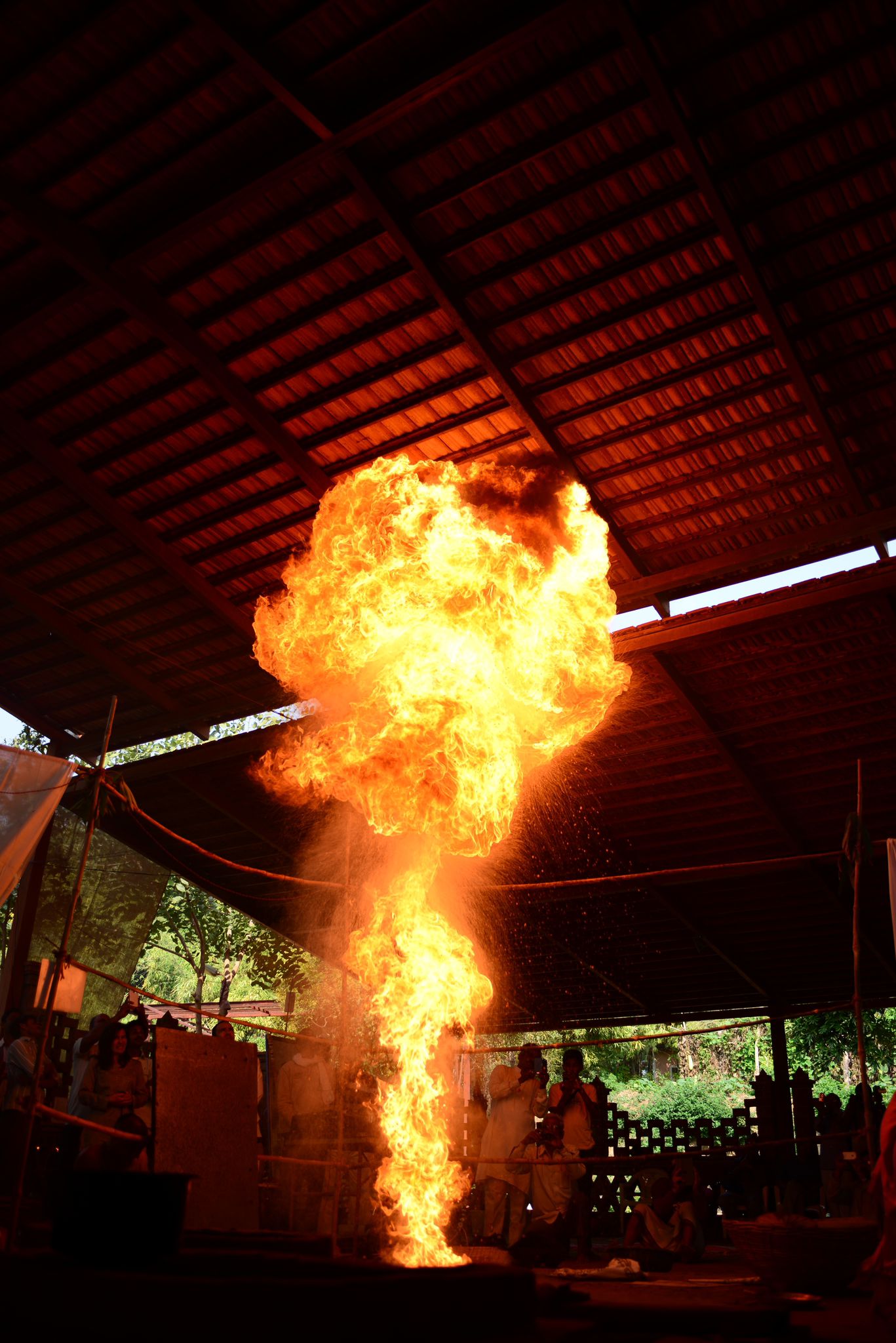
    In the Sanatana Hindu Dharma, Pravargyawas a ceremony introductory to the Agnishtoma (Soma sacrifice), at which fresh milk is poured into a heated vessel called mahavira or gharma and offered to the Ashvins. The ceremony is described in details in the technical texts on proper ritual, the Brahmanas, Aranyakas and Shrautasutras.The temperature in the sun’s chromosphere is 4,320℃. As part of Pravargya (a special ball of fire), a sudden flash of temperature to the tune of 3870℃ is created in order to cleanse the environment.[citation needed] Pravargya almost matches the Sun’s temperature to cleanse the atmosphere.

    Source.

    https://en.m.wikipedia.org/wiki/Pravargyahttps://en.m.wikipedia.org/wiki/Pravargya

    A Scientific study has the following information.

    A 4,000 year old fire ritual conducted in the remote village in Kerala in April this year has a positive impact on the atmosphere, soil and other environment effects, according to scientists who are now ready with their findings.

    The “Athirathram” ritual held on April 4— 15 at Panjal village in Thrissur district was the focus of a detailed study by a team of scientists led by Prof V P N Nampoori, former director of the International School of Photonics, Cochin University of Science and Technology.

    The scientists had focused on the fire ritual’s scientific dimensions and impact on the atmosphere, soil and its micro—organisms and other potential environmental effects.

    The yagna seems to have accelerated the process of seed germination and also the microbial presence in air, water and soil in and around the region of the fire ritual is vastly diminished, according to a statement released by the Varthathe Trust, who organised the ritual.

    The team had planted three types of seeds — cowpea, green gram and Bengal gram — on all four sides of the ritual venue at varying distances. They found that the growth was better in case of pots kept closer to the fire altar.

    This effect, the study says, was more pronounced in the case of Bengal gram with growth about 2,000 times faster than in other places.

    According to Nampoori, sound is a vibration and continuous positive vibrations through chanting, accelerates the process of germination.

    “The findings would not only help dispel superstitious notions associated with Vedic rituals but also help in continuation of such tradition for the betterment of nature and the environment,” says Nampoori.

    He added that further research on the phenomenon were on which could prove that some bio—amplifier generated in the atmosphere because of the ritual, had a selective effect on Bengal gram.

    The study focused on counting bacterial colonies at three locations — within the yagnashala, 500 metres and 1.5 kilometres from the yagnasala. Microbial analysis made before, during and four days after the yagna revealed that the air in the vicinity of the yagnashala was pure and had very low count of microbe colonies.

    The research team also found that microbial activities in the soil and water around the yagnashala were remarkably less compared to normal ground.

    The “Athirathram” ritual which literally means “building up of the fireplace and performed overnight” and usually held to propagate universal peace and harmony, was first documented 35 years ago by US—based Indologist Frits Staal.

    Staal, currently Emeritus Professor of Philosophy and South and Southeast Asian Studies at the University of California, Berkeley had in 1975 organised and recorded the ritual in detail with the help of grants and donations from the Universities of Havard, Berkely and Finland”s Helsinki University.

    The research team conducted tests near the fire altars of the 1918 and 1956 Athirathram, still preserved in the backyards of Namboothiri homes, reveal that the bricks continue to be free of microbial presence.

    “It’s an indication that the effect of the ritual is long—lasting. Studies are on to find out if other positive changes on the atmosphere are transitional or permanent,” say researchers.

    An analysis conducted on the dimensions of temperature from the flames of the pravargya by Prof A K Saxena, head of photonics division, Indian Institute of Astrophysics, Bangalore, found that the fire ball that formed during the ritual had a particular wavelength with an unusually high intensity similar to what is observed in typical laser beams at about 3,870 degree centigrade.

    It may be possible to have stimulated emission at this wavelength (700 nm) and gain from plasma recombination. It needs to be studied further, he says.

    The members of the team of scientists’ team at the Panjal Athirathram 2011 included experts from various disciplines and included Dr Rajalakshmy Subrahmanian (Cusat), Dr Parvathi Menon (M G College, Thiruvanathapuram), Dr Maya R Nair (Pattambi Government College), Prof Saxena ( Indian Institute of Astrophysics, Bangalore) and Prof. Rao (Andhra University).

    The scientific team members were supported by Zarina (Research Scholar, CUSAT), Ramkumar (Biotechnologist), Asulabha (Biotechnologist) and a number of postgraduate, graduate and school students.

    Source

    https://www.thehindu.com/sci-tech/ancient-fire-ritual-has-positive-impact-on-environment-scientists/article2103881.ece

  • How To Prepare Homa Yagnya Fire Agni Manthan Process

    Fire is the primary God in Vedas and the Agni is to be prepared manually using Banyan twigs/logs ,chanting Agni Suktham.


    AGni Manthan Vedic ay of preparing fire for yagnya
    Implements to Prepare Vedic Fire, Agni Manthan
    Costs Rupees  -1100/)
    The lighting of the Havan Agni with the churning (Manthan) of the special instrument made from a banyan tree, is considered extremely auspicious.
    A participant said it required a lot of effort and that is why it is generally not used. It took them about 15 minutes to get it going.
    Creation of Fire for Homa
    Creation of Fire for Homa, the Vedic way of Creating fire.


    Preparing Homa, Yagnya fire with Camphor as is being practiced now is incorrect.

  • Why Ayush Mruthyunjaya Homas


    The Blessing , Aaseervatha Mantra states,

    Sree varchasvam ayushyam aarogyam maavithaath

    Sobamanam maheeyanthe

    Dhaanyam Dhanam pasum bahuputra laabham

    Satha samvathsarm dheeragamaayuhu.

    The blessings start with auspicious life.

    The rest come later.

    Once born it is the desire of one is to live as long as possible.

    Dheergayus means a life span of 120 years in Kali Yuga, though it is mentioned as Satha Samvathsaram( 100 years)

    Life depends on , contrary to what many think, wholly external forces not in our control,be it the air we beathe, water ,earth,fire and the ether.

    We take these for granted.

    We would appreciate them only in their absence.

    The human body is made up of the five elements that make up the Cosmos.

    We are nothing but a reflection, photocopy of the Cosmis in miniature.

    One is likely to lead a longer life if these five elements in the Cosmos and in our bodies sync.

    If there is a variation, one falls sick and in serious maladjustments one leaves the body.

    While we strive to be tuned into Nature’s Rhythm, Nature should also cooperate.

    That is not in our hands.

    As we are nothing but the Cosmos in a small scale, our chitta ( higher plane over mind and intellect) should will for longevity.

    By self tuning the Chitta one controls the Cosmos and its Principles.

    This is Yoga.

    This fine tuning can be done by chanting, listening to mystically locked sounds called Mantras.

    And the propitiator of life , Agni, Fire carries the power of the Mantras to the other elements ,which being the same for us and the Cosmos ignites our Chitta.

    And longevity is assured if the Homa Rites are performed correctly, as prescribed in the texts.

    There are two types of Homas for Longevity.

    The Ayush Homa and

    The Mrutyanjaya Homa.

    mahamritunjay-mantra
    Maha Mrutunjaya Mantra.

    Though they seem to address the same issue, Longevity there is a minor differnce.

    While Ayush Homa increases the Life span in general, the Mrutunjaya Homa addresses the issue of ill health and diseases.

    It is one thing to attain Longevity but Disease free Life is another..

    It is advisable to perform both at the same time.

    It is ordained in the Smriti that these Homas are to be performed every year for a child upto to the age of Five.

    And one can have this  performed any time in during one’s life till one reaches Sixty.

    For them these are performed in Sashtiapthapoorthy and Sathabhishekam.

    Mruthyunjaya Homa.

    Maha Mruthyunjaya Homam is dedicated to Lord Shiva to avoid untimely death. The Mruthyunjaya Homam is performed to achieve Jaya or Victory over Mritya or death. The object of worship of this homa is Lord Shiva. One of the synonyms of Lord Shiva is Mrityu. Mrityu which means death of the death or the destroyer of death. During this homa one chants 21 mantras. The prominent offerings in this homa are durva grass and an herb called amrita.

    The former is famous for purifying blood and the latter is used as a medicine for in a, it is believed that this homam bestows longevity on the performer. The hymns are devoted curable diseases like arbuda or cancer. Since these are used as offerings in this hom to Mrityu, the God of death, praying for long life. These hymns are used in the purnahuti or the final offering in the famous Soma sacrifice. This homa also alleviates Mrityu dosha or untimely death.Dedicated to Lord Shiva to avoid untimely death The Mrityunjaya Homa is performed to achieve Jaya or Victory over Mritya or death.

    Citation.

    http://homam.in/mrityunjaya.php


  • Dharbha Kusa Grass Blocks X Ray Increases Phonetic Vibrations Research

    Darbha, kusha grass is used by the Hindus while performing religious duties.

    This is normally worn, after making a ring of it, in the Right Ring Finger.

    Dharbha is  to be kept above the left ear lobe, if one is to make use of the toilet, while performing the religious duties.

    Dharbha is not to be dropped on the ground in its form as a ring; it has to be restored to its earlier state as grass before dropping to the ground.

    Darbha is also called Pavithra, Holy.

    In Ayurveda, Darbha grass is also used as a medicine to treat dysentery and menorrhagia, and as used as a diuretic (to promote free flow of urine).

    Darbha worn in the Right ring finger .jpg Darbha worn in the Right Ring Finger by Hindus for religious ceremonies.

    Dharpa,Kusha Grass is worn on the Right Ring Finger by Hindus for Religious Functions,
    Since Vedic age, Darbha grass is treated as sacred plant and according to early Buddhist accounts, it was the material used by Buddha for his meditation seat when he attained enlightenment under Bodhi tree.
    This grass was mentioned in the Rig Veda for use in sacred ceremonies and also to prepare a seat for priests and the gods.

    Scientific findings On Dharpa. Kusha Grass.jpg Scientific findings On Dharpa. Kusha Grass.

    Darbha grass ringIn recent medical research, Darbha or Kusha grass has been observed to block X-Ray radiation.
    Darbha is used by hindus as mat, ring on right hand ring finger while chanting vedic mantras, performing homam and all religious rituals.
    For ceremonies related to death only Single leafed Darbha is used; for Auspicious and daily routine a ring made of two leaves is used; for inauspicious but not death related functions, (like Amavasya Tharpanam, Pithru Pooja etc) a three leaf Dharbham ring (Pavitram) is used and for the prayers in a temple, a Four-leaf Darbha ring is used.
    Darbha has the highest value in conducting the phonetic vibrations through its tip.
    Priests in India dip this tip in water and sprinkle allover the house or temple to purify the place.
    During Fire-ritual (Homa), darbha is placed on all four sides of fire to help block all negative radiations.
    During eclipses, darbha are placed on vessels containing water and food, so that negative effect of rays from eclipse does not spoil them.

    Darbha is not cultivated everywhere but it grows naturally in selective places and is available in northeast and west tropical, and northern Africa ; and countries in the Middle East, and temperate and tropical Asia

    For religious purposes, it is not cut or plucked on everyday, but only on Krishna Paksha Padyami (Next day after FullMoon day).

    Traditional tropical grass, Darbha, has been identified as an eco-friendly food preservative.

    This finding was evolved in a research study undertaken jointly by the Centre for Nanotechnology and Advanced Biomaterials (CeNTAB) and the Centre for Advanced Research in Indian System of Medicine (CARISM) of the SASTRA University, Thanjavur, under the supervision of Dr. P. Meera and Dr. P. Brindha respectively.

    Darbha (Desmotachya bipinnata) is a tropical grass considered a sacred material in Vedic scriptures and is said to purify the offerings during such rituals. At the time of eclipse, people place that grass in food items that could ferment and once the eclipse ends the grass is removed.

    A systematic research was conducted by the SASTRA University researchers, in which cow’s curd was chosen as a food item that could ferment easily. Five other tropical grass species, including lemon grass, Bermuda grass, and bamboo were chosen for comparison based on different levels of antibiotic properties and hydro phobicity.

    Electron microscopy of different grasses revealed stunning nano-patterns and hierarchical nano or micro structures in darbha grass while they were absent in other grasses.

    On studying the effect of various grasses on the microbial community of the curd, darbha grass alone was found to attract enormous number of bacteria into the hierarchical surface features.

    These are the bacteria responsible for fermentation of cow’s curd.

    During eclipse, the wavelength and intensity of light radiations available on the earth’s surface is altered. Especially, the blue and ultraviolet radiations, which are known for their natural disinfecting property, are not available in sufficient quantities during eclipse.

    This leads to uncontrolled growth of micro-organisms in food products during eclipse and the food products are not suitable for consumption. Darbha was thus used as a natural disinfectant on specific occasions, say researchers at SASTRA University.

    Further, the scientists say that darbha could be used as a natural food preservative in place of harmful chemical preservatives and the artificial surfaces mimicking the hierarchical nano patterns on the surface of darbha grass could find applications in health care where sterile conditions were required.The ring made of kusha grass is worn on the ring finger of the person performing the ritualistic ceremonies. These rings are known as pavitra (sacred) rings for the puja orPavitri. The head priest or the the Yajmaan (person for whom puja is done) wears this darbha ring, representing the sacred knot or hair-curl (Skt. shrivatsa) of Vishnu.

    The sanctity of dharba or kusha,is as old as the Indian gods.Puranas tell how Vishnu assumed the form of the Cosmic Tortoise (Skt.kurma) whose shell served to support Mandara,the mountain that served as a dasher in the churning of the sea of milk. As the mountain rotated,several hairs were rubbed from the tortoise’s back.With time,they washed ashore and became Kusha.

    Later, when the amrita (nectar) was obtained and distributed among the gods,some drops fell on the grass which further sanctified it imbuing it with healing properties.Therefore,in the tradition hair-cutting of Vaishnava toddlers, the hair is touched with kusha before it is cut. It was used as a ritual seat as far back as the Vedas,and the Bhagavad Gita (ch.6) stipulates that,covered with a skin and a cloth,it is the appropriate seat for meditation.Therefore,it was one of the first offerings made to the Buddha.

    For religious purposes, it is not cut or plucked on everyday, but only on Krishna Paksha Padyami (next day after FullMoon day).

    In Srimad Bhagavad Gita, Lord Krishna says in Chapter 6 entitled Dhayan Yoga:

    Bg 6.11 To practice Dhyan yoga, one should go to a secluded place and should lay Kusha grass on the gorund and then cover it with a deerskin and a soft cloth……

    Science says about Darbha:
    In recent medical research, Darbha or Kusha grass has been observed to block X-Ray radiation. It is scientifically known as Panic grass and of genus borage species. It can grow up to 2 feet and it appears pointed at the top.

    Significance of Darbha:
    Kusha grass is meant to have Lord Vishnu’s potency. It is believed that this grass has immense purifying properties. It is worshipped by Vaishnavas on the special day in Bhadrapada month (August – September) called Darbhashtami.

    The significance of Darbha grass is also found in Buddhist culture. It is believed that Sakyamuni Buddha sat on a Darbha mat to meditate and got enlightened under the Bodhi tree. The capital city of Malla kingdom of Buddhist is named Kushinagara, just to honor Kusha grass. It was in this city Lord Buddha was cremated.

    Citation.

    .https://vimeo.com/103492186

    http://bharatuntoldstory.tumblr.com/post/73862062109/darbha-grass-or-kusha-grass-is-scientifically

    http://www.thehindu.com/news/national/tamil-nadu/darbha-grass-identified-as-a-natural-preservative/article7002014.ece

  • Effects Of Yagnya ,Agnihotra, Scientific Study Results

    There are two types of offerings in the Fire in Hinduism,Yaga and Yagnya.

    Yaaga is one conducted with a Purpose, to fulfill a desire.

    Yagnya.Image.jpg
    Yagnya Being performed

    Yagnya is conducted because it is to be conducted, a Duty, A Categorical Imperative as Immanuel Kant puts it.

    Yagnya is to be performed with a sense of detachment, anticipating nothing in return.

    Fire is chosen to perform Yaaga and Yagnya because Fire has Five Unique Qualities , called

    ‘ Panchagnividya’

    1. The flame of fire always goes upwards.It implies that despite immense pressures of fear and temptations our flame of wisdom, and foresight should ever be kept-alight and up-turned.
    2. Anything coming in contact with fire becomes fire itself, indicating that we , having been a part of Reality,God, become One with It.
    3. Fire accumulates nothing, reminding us that ,in Life we accumulate Nothing
    4. The residue of fire are ashes making us remember that we turn to Ashes thereby reaffirming the Impermanence of Life.
    Types of Yagnyas.


    The Seva Yagna — altruist service of the society is a noble example of Yagya.

    The Gyan Yagya, The Comprehension of True Knowledge.

    Vak Yagnya, Speaking Good of others, never ill of others.

    Mano Yagnya, thinking of only Noble Thoughts,

    Hearing only that which is Good for All (Bhadram karnobi Srunuyaama Devaa-Rig Veda)

    Seeing only those that are Noble.

    Vak Yagnyena Kalpatham,

    Mano Yagnena kalpatham’

    Sakshur Yagnena Kalpatham,

    Srothram Yagnena Kalpatham (Sri Rudram-Chamaka Prasna)

    In Purusha Suktha Brahma is offered as Havis, offering to Fire by the Devas.

    ‘Yath Purushena Havisaa Devaa yagnya mathan vatha”( Purusha Suktham)

    Purusha Suktha speaks about the evolution of the Universe.


    The Prana Yagya implies — the service of saving the lives of people from suffering and agonies and inspiring liveliness and respect for life in them. A variety of such Yagyas are described in the Shastras.


    Benefits of Yagnya.

    Yagya is also glorified as “Yajóoaya Sarvakaamdhuk” meaning, “Yagya is the source of fulfilling all desires”.

    “Agni Mºde Purohitam” The first revelation of Rig Veda of is said to have given knowledge of kindling fire toYagya is also glorified as“Yajóoaya Sarvakaamdhuk” meaning, “Yagya is the source of fulfilling all desires”. .

    Yagnya is the primordial source of the Forces of Nature and this is explained in the Purusha Suktha.

    The efficacy of Yagnya, Scientific study Results.
    3. Purification of Environment by Yagna
    The industrial wastes, rapid urbanization, deforestation, air and water pollution,
    disturbances in the ozone layer -formation, radioactive waves etc., have
    destabilized the human, animal and plant life cycles. The ecological imbalance
    caused by these acts of ‘civilized men’ has resulted into disastrous threat not only
    to human survival but to the life as a whole on our planet.
    Till recently it was accepted that research into science can furnish answer to all of
    man’s problems. Today we find increasing number of diseases including
    malfunctioning of body organs due to increasing severity of pollution in the
    atmosphere. Ozone layer depletion has been causing ailments like sunburn, skin
    cancer, cataracts and weakening of the immune system. Viruses are becoming
    drug-resistant and showing consistent growth trends.
    Experimental studies show that the incidence of physical ailments, sickness and
    disease are reduced in the houses, where the
    Yagna (Agnihotra) is regularly performed because it creates a pure, nutritional and medicinal atmosphere. Itrenews the brain cells, revitalizes the skin, purifies blood and prevents growth of pathogenic organisms.
    Agnihotra is basically a healing process. ‘Heal the atmosphere and the healed
    atmosphere will heal you’— is the Modus Operandi
    Purification of environment through the constituent electrons of the substances
    fumigated in the Yagna is an obvious effect of this process [2-4]. The observation
    of some distinguished scientists is note worthy in this regard.
    Dr. Hafkine has mentioned that — “mixing ghee and sugar and burning them
    creates smoke which kills the germs of certain diseases and secretion takes place
    from some glands relate to the wind-pipe, which fill our heart and mind with
    pleasure.
    Sugars present in Havishya have great power to purify the atmosphere. It kills
    the germs of T.B., measles, smallpox and cow-pox — remarks Prof. Tilward.
    According to Dr. Shirowich, a Russian scientist has remarked that (i) Cow’s milk
    contains great power of protection from atomic radiation; (ii) Houses having
    cow-dung covered floors enjoy complete protection from atomic radiation; (iii) If
    cow’s ghee is put into Yagna fire, its fumes lessen the effect of atomic radiation to
    a great extent.
    The medicinal fumes emanating from Agnihotra have been observed by
    researchers in the field of microbiology to be clearly bacteriolethal in nature.
    These eradicate bacteria and other micro-organisms, which are the root cause of
    illness and diseases. This must be the reason why the incidence of physical
    ailments, sickness and diseases becomes less in the households, where
    Agnihotra is regularly performed.
    Even without going into detailed chemical bacteriology, it can be stated that
    performance of Yagna leads to purification of air. This takes place in the
    following four ways .
    3.1. Removal of Foul Odors:
    As already stated, under steam volatilization, the various volatile oils get diffused
    in the surrounding atmosphere along with steam and smoke. Since these oils have
    distinct good smell, the foul odors are automatically replaced. This aroma can be
    experienced easily in the surroundings when
    Yagna is performed due to diffusion of substances like thymol, eugenol, pine, terpinol and oils of sandal-wood, camphor and clove.
    3.2. Removal of Bacteria:
    As stated under products of combustion, the partial oxidation of hydrocarbons
    and decomposition of complex organic substances produce formal aldehyde
    which is a powerful antiseptic. It is also interesting to note that germicidal action
    of formaldehyde is only effective in the presence of water vapor which is also
    produced in large quantities in Yagna.
     The use of formaldehyde spray for disinfecting of walls, ceiling etc., is common and such a spray is automatically produced when
    Yagna
    is performed.
    The oxidation of hydrocarbons also produces formic acid and acetic acid both of
    which are good disinfectants. Use of formic acid for preservation of fruits and that
    of acetic acid in preserving vinegar is a common practice.
    The antiseptic and antibiotic effects of fumes of
    Yagna
    have also been examined
    by conducting suitable experiments on rabbits and mice and it has been
    established that fumes emitted in Yagna are powerful antibiotic.
    Agnihotra ash purifies and cleanses the water making it fit for drinking
    3.3. Removal of insects:
    There are non-bacterial parasites like flies, ringworm, dice, fleas etc., which are
    immune to bactericides, which are also harmful to other living beings.
    Such insects which are generally immune to ordinary reagents. However they
    either get killed or are driven away, when they come in contact with the fumes of
    volatile oils like camphor diffused in the environment.


    3.4. Effects on Plants and Vegetation:
    The disinfection of air is not only useful to animal life but also helps plant’s life
    though the bacteria responsible for diseases in both may be different. The
    aromatic substances during Yagna get diffused in the air and offer protection to
    plant life against harmful organisms. This ensures healthy plant growth.
    Agnihotra’s atmosphere and ash can be used as adjutants in the ‘Natural
    farming’ methods — also known as the Agnihotra farming methods. It is a
    holistic concept of growing plants in healthy atmosphere and maintaining
    ecological balance by performingAgnihotra(Yagna) in the middle of the farm
    and using theYagna – ash as a fertilizer. It is not only safe and productive but also
    holistic in its approach towards environment.
    3.5. Role of CO2 generated in Yagna:
    Consignment of the wood and other organic maters to flames has been always
    controversial because of generation of CO and CO 2 and increase
    in consequent ‘green house’ effect. It had been argued that performance of
    Yagna also produces CO and CO2. It should be noted here that the way in which theSamidhas and Havishyaare burnt in. Yagna is a process of slow combustion at higher
    temperature. While the burning of coal in factories or in the household fire
    involves rapid combustion. where oxygen is sucked in large quantities and
    enormous CO2 is emitted. In the slow combustion taking place in the process of
    Yagna, small quantity of O2is utilized meager CO2 is emitted that poses no threat
    to the environment. In fact whatever CO2 is generated it is readily absorbed by the
    surrounding vegetation and CO 2 cycle is strengthened [4].
    The other important aspect is the fact that CO 2produced in
    Yagna is not alwaysfree CO 2 but it remains mixed with other aromatic oils and antiseptic products. It therefore, acts as a vehicle in transporting such products to distant surroundings.
    The use of CO 2 as a cerebral stimulant to assist the patients suffering from lack of
    ventilation is common in medical world. Its use to control and cure many mental
    disorders is also known to medical science. Small amounts of CO 2 inhaled by the
    persons performing Yagna acts as a stimulant and more and more aromatic
    fumes are inhaled which help in curing mental disorders.
    Particularly effective results with respect to the elimination or reduction in
    radiation were achieved through Yagna fire and ash. These observations are
    made by Dr. L. Maela Anatoninhowska of Poland after using P.S.I. techniques.
    Results of Some Recent Experiments:
    A group of scientists led by Dr. Manoj Garg, Director, Environmental and
    Technical Consultants and the Uttar Pradesh pollution control board conducted
    experiments during the Ashwamedha Yagna at Gorakhpur, U.P. These
    experiments were set up at about 20 meters east from the
    Yagnashala. The samples of 100 ml each of water and air collected from the surroundings were analyzed using high volume envirotech APM-45 and other sensitive instruments.
    A summary of their results ( [1] – Akhand Jyoti, Sept. ‘97 p.22) is presented below:
    In Air Samples (unit mg per average sample)
    Instant Level of Sulphur dioxide Level of Nitrous Oxide Before Yagna 3.36 1.16
    During Yagna2.82 1.14 After Yagna 0.80 1.02
    Bacteria Count in Average Water Samples
    Before Yagna 4500
    During Yagna 2470
    After Yagna 1250
    Minerals in the Ash (Bhasm) of Yagna
    Phosphorous 4076 mg per kg. Potassium 3407 mg per kg. Calcium 7822 mg per kg.
    Magnesium 6424 mg per kg. Nitrogen 32 mg per kg. Quispar 2% W/W
    These results clearly support the claims made about the role of
    Yagna in control
    of air pollution. The Deputy Director, Agriculture had submitted a technical
    report based on such results, recommending the use ofYagna’s ash as an
    effective fertilizer.
    Comparable results were also obtained by the scientific experiments conducted in
    about 27 large scale Yagnasorganized by Shantikunj, Hardwar in India and
    abroad during 1993-1995
    Citation and for Details.

    http://cincinnatitemple.com/articles/IntegratedScienceOfYagna.pdf