Tag: Christianity in India

  • Jesus In Kashmir His Tomb Attempt At Conversion

    Jesus In Kashmir His Tomb Attempt At Conversion

    There is this story going around fro some years now that Jesus visited India,learnt the Buddhist/Hindu Doctrines during his ‘missing years’!

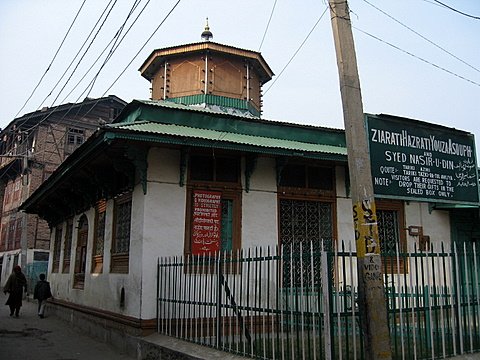
    Jesus's Tomb , Kashmir image
    Jesus’s Tomb, Kashmir

    There are also suggestions that there is a Tomb of Christ In Kashmir.

    Tomb o Jesus in Kashmir
    Jesus Tomb in Kashmir? Image Credit.BBC

    Well, according to an eclectic combination of New Age Christians, unorthodox Muslims and fans of the Da Vinci Code, the grave contains the mortal remains of a candidate for the most important visitor of all time to India.

    ‘Crazy professor’

    Officially, the tomb is the burial site of Youza Asaph, a medieval Muslim preacher – but a growing number of people believe that it is in fact the tomb of Jesus of Nazareth.

    They believe that Jesus survived the crucifixion almost 2,000 Easters ago, and went to live out his days in Kashmir.

    “What else could they do? They had to close it,” Riaz told me.

    His family home almost overlooks the shrine, and he is witheringly dismissive of the notion that Jesus was buried there.

    “It’s a story spread by local shopkeepers, just because some crazy professor said it was Jesus’s tomb. They thought it would be good for business. Tourists would come, after all these years of violence.

    “And then it got into the Lonely Planet, and too many people started coming.

    “And one foreigner…” he gave me an apologetic look, “broke off a bit from the tomb to take home with him. So that’s why it’s closed now.”

    There are gaps in Jesus Story,

    There are unaccounted years in Jesus’s Life.

    This is being used to propagate all sorts of theories.

    Consider these facts.

    1.Name of Jesus is not known even today.

    2.The Bible was compiled by Constantine 300 years after the death of Christ in a Conclave of Cardinals.

    3.The reference to this story of Jesus visiting India is not found in the Old Testament.

    4.The idea for this story started of by a writer of fiction.

    5.Even here it is mentioned that Jesus visited India.

    6.See the Video touting New Evidence of Jesus Tomb in Jerusalem.

    Just how many Tombs one would have?

    7.There are other sources(!?) on this story which could make one laugh aloud,

    Hence the canard that Jesus visited India, learnt from Hinduism and was buried in Kashmir is false

    and mischievous.

    This is yet another attempt at Religious conversion of Hindus by trying to legitimize Jesus as presenting Hinduism in another format much like other stories being spread that the Monotheism of Islam is nothing but Vedic Monotheism

    These pseudo scientific studies must be nipped in the bud.

    …generally refers to the period between Jesus‘s childhood and the beginning of his ministry, a period not described in the New Testament.[1][2]

    The phrases “lost years of Jesus” is usually encountered in esoteric literature (where it at times also refers to his possible post-crucifixion activities), but is not commonly used in scholarly literature since it is assumed that Jesus was probably working as a carpenter in Galilee from the age of twelve till thirty, so the years were not “lost years”, and that he died in Calvary.[2][3][4]

    In the late medieval period, Arthurian legendsappeared that the young Jesus had been inBritain.[5]

    In the 19th and 20th centuries theories began to emerge that between the ages of 12 and 30 Jesus had visited India, or had studied with the Essenes in the Judea desert.[4][6]

    Modern mainstream Christian scholarship has generally rejected these theories and holds that nothing is known about this time period in the life of Jesus.

    Following the accounts of Jesus’ young life, there is a gap of about 18 years in his story in the New Testament.[4][7][13]Other than the generic statement that after he was 12 years old (Luke 2:42) Jesus “advanced in wisdom and stature, and in favor with God and men” (Luke 2:52), the New Testament has no other details regarding the gap.[4] While Christian tradition suggests that Jesus simply lived in Galilee during that period,[14] modern scholarship holds that there is little historical information to determine what happened during those years.[4]

    The story of Jesus visiting Britain as a boy is a late medieval development based on legends connected with Joseph of Arimathea.[5] During the late 12th century, Joseph of Arimatheabecame connected with the Arthurian cycle, appearing in them as the first keeper of the Holy Grail.[5] This idea first appears in Robert de Boron‘s Joseph d’Arimathie, in which Joseph receives the Grail from an apparition of Jesus and sends it with his followers to Britain. This theme is elaborated upon in Boron’s sequels and in subsequent Arthurian works penned by others.[5]

    The idea of Indian influences on Jesus (and Christianity) has been suggested in Louis Jacolliot‘s book La Bible dans l’Inde, Vie de Iezeus Christna (1869)[28] (The Bible in India, or the Life of Jezeus Christna), although Jacolliot does not claim travels by Jesus to India.[29]

    Jacolliot compared the accounts of the life of Bhagavan Krishna with that of Jesus Christ in the gospels and concluded that it could not have been a coincidence that the two stories have so many similarities in many of the finer details. He concluded that the account in the gospels is a myth based on the mythology of ancient India. However, Jacolliot was comparing two different periods of history (or mythology) and did not claim that Jesus was in India. Jacolliot used the spelling “Christna” instead of “Krishna” and claimed that Krishna’s disciples gave him the name “Jezeus,” a name supposed to mean “pure essence” in Sanskrit.[29] However, according to Max Müller that is not a Sanskrit term at all and “it was simply invented” by Jacoillot”

    Citations:

    http://en.wikipedia.org/wiki/Unknown_years_of_Jesus

    http://news.bbc.co.uk/2/hi/programmes/from_our_own_correspondent/8587838.stm

    Related articles
    Enhanced by Zemanta
  • A Frenchman’s view of ‘Hindu terrorism’-My reply.


    • Hinduism is different in that it is a way of life at the individual level and not institutionalized .
    • What is needed is faith-of any hue including Atheism.
    • Hinduism has survived because of its flexibility and tolerance.
    • Hinduism has been targeted as also Hindus, but it has renewed itself with vigor.
    • At the same time one should also remember that if you should not identify a religion as terrorist because of the activities of some (as has been stated here),is it not logical that you should extend the courtesy to Islam as well?
    • The difference is that people of Islam, at least most of them, keep quiet with out condemning terrorism.
    • Should Hindus also follow the same path?
    • Hinduism needed none nor does it need any one to defend it;it can, by itself.
    • Best way to defend Hinduism is to study the scriptures and live accordingly.
    • This is the best service we can do to Hinduism.
    • I received the following forward and above are my comments.

    By Francois Gautier

    Is there such a thing as ‘Hindu terrorism’, as the arrest of Sadhvi Pragya Singh Thakur for the Malegaonblasts may tend to prove? Well, I guess I was asked to write this column because I am one of that rare breed of foreign correspondents — a lover of Hindus! A born Frenchman, Catholic-educated and non-Hindu, I do hope I’ll be given some credit for my opinions, which are not the product of my parents’ ideas, my education or my atavism, but garnered from 25 years of reporting in South Asia (for Le Journal de Geneve and Le Figaro).

    In the early 1980s, when I started freelancing in south India, doing photo features on Kalaripayattu, the Ayyappa festival, or the Ayyanars, I slowly realised that the genius of this country lies in its Hindu ethos, in the true spirituality behind Hinduism. The average Hindu you meet in a million villages possesses this simple, innate spirituality and accepts your  diversity, whether you are Christian or Muslim, Jain or Arab, French or Chinese. It is this Hinduness that makes the Indian Christian different from, say, a French Christian, or the Indian Muslim unlike a Saudi Muslim. I also learnt that Hindus not only believed that the divine could manifest itself at different times, under different names, using different scriptures (not to mention the wonderful avatar concept, the perfect answer to 21st century religious strife) but that they had also given refuge to persecuted minorities from across the world—Syrian Christians, Parsis, Jews, Armenians, and today, Tibetans.

    In 3,500 years of existence, Hindus have never militarily invaded another country, never tried to impose their religion on others by force or induced conversions. You cannot find anybody less fundamentalist than a Hindu in the world and it saddens me when I see the Indian and western press equating terrorist groups like SIMI, which blow up innocent civilians, with ordinary, angry Hindus who burn churches without killing anybody. We know also that most of these communal incidents often involve persons from the same groups—often Dalits and tribals—some of who have converted to Christianity and others not. However reprehensible the destruction of Babri Masjid, no Muslim was killed in the process; compare this to the ‘vengeance’ bombings of 1993 in Bombay, which wiped out hundreds of innocents, mostly Hindus. Yet the Babri Masjiddestruction is often described by journalists as the more horrible act of the two. We also remember howSharad Pawar, when he was chief minister of Maharashtra in 1993, lied about a bomb that was supposed to have gone off in a Muslim locality of Bombay.

    I have never been politically correct, but have always written what I have discovered while reporting. Let me then be straightforward about this so-called Hindu terror. Hindus, since the first Arab invasions, have been at the receiving end of terrorism, whether it was by Timur, who killed 1,00,000 Hindus in a single day in 1399, or by the Portuguese Inquisitionwhich crucified Brahmins in Goa. Today, Hindus are still being targeted: there were one million Hindus in the Kashmir valley in 1900; only a few hundred remain, the rest having fled in terror. Blasts after blasts have killed hundreds of innocent Hindus all over India in the last four years. Hindus, the overwhelming majority community of this country, are being made fun of, are despised, are deprived of the most basic facilities for one of their most sacred pilgrimages in Amarnath while their government heavily sponsors the Haj. They see their brothers and sisters converted to Christianity through inducements and financial traps, see a harmless 84-year-old swami and a sadhvi brutally murdered. Their gods are blasphemed. So sometimes, enough is enough.

    At some point, after years or even centuries of submitting like sheep to slaughter, Hindus—whom the Mahatma once gently called cowards—erupt in uncontrolled fury. And it hurts badly. It happened in Gujarat. It happened in Jammu, then in Kandhamal, Mangalore, and Malegaon. It may happen again elsewhere. What should be understood is that this is a spontaneous revolution on the ground, by ordinary Hindus, without any planning from the political leadership. Therefore, the BJP, instead of acting embarrassed, should not disown those who choose other means to let their anguished voices be heard.

    There are about a billion Hindus, one in every six persons on this planet. They form one of the most successful, law-abiding and integrated communities in the world today. Can you call them terrorists?

    Francois Gautier

    • Related:

    For far too long, the enduring response of the Indian establishment to Hindu nationalists has rarely surpassed mild scorn. Their organised violent eruptions across the country – slaughtering Muslims and Christians, destroying their places of worship, cutting open pregnant wombs – never seemed sufficient enough to the state to cast them as a meaningful threat to India’s national security.

    But the recently leaked confession of a repentant Hindu priest, Swami Aseemanand, confirms what India’s security establishment should have uncovered: a series of blasts between 2006 and 2008 were carried out by Hindu outfits. The attacks targeted a predominantly Muslim town and places of Muslim worship elsewhere. Their victims were primarily Muslim. Yet the reflexive reaction of the police was to round up young Muslim men, torture them, extract confessions and……………..

    http://www.guardian.co.uk/commentisfree/belief/2011/jan/19/india-hindu-terrorism-threat