

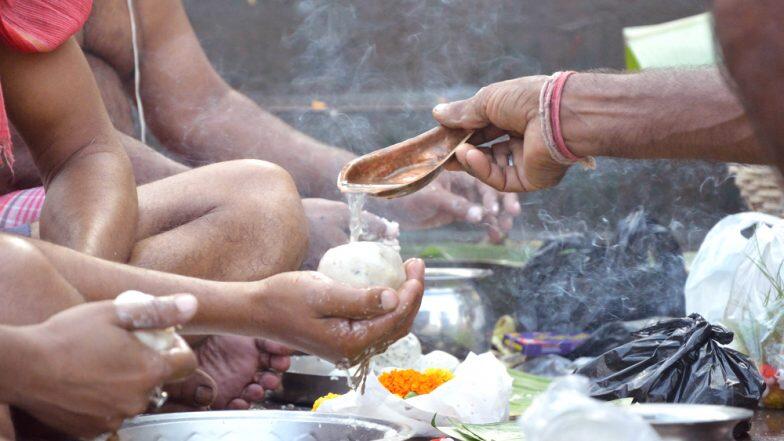
In Hinduism Gods are bathed in a special Ritual called Abhishekam.
In general,Water, Milk are the materials used.
In the case of Shiva, Subramanya and Ganesha Vibhuthi are also used.

For female Goddesses Kumkum is also used.
In Vaishanava Sampradaya, Turmeric powder Abhisheka is performed.
Tender Coconut water, Panchamruth, Flowers are used in many temples for the Deities.
The Deities are bathed in the morning around 5 am and are also bathed five or six times a day depending on the number of Kaala Poojas, that is the time when the Deity is decked up for the Day.
Origins.
The seems to be no mention of Abhisheka in the Vedas, though the Veda Mantras are used now for this Ritual.
Nor is there any reference to this practice in the Ramayana or Mahabharata.
There is no information as to when this practice was started.
Vedas, in essence, advocate the worship of the nameless, Formless Brahman, Reality.
The worship of personal God is also encouraged to prepare the Mind o concentrate on the Abstract.
Even here there is no mention of the Abhisheka in the Vedas.
However Hinduism treats God as one close to the individual and does not keep God in a remote portal to be feared.
Gods are taken to be a part of our family.
One loves to do things for the loved ones.
For a child, we bathe it, dress it up and enjoy.
Hinduism attributes the qualities of man to God, though these attributes are perfect in Him.
So when we bathe God we do so as we would for ourselves.
In personal worship of Gods, the Smritis , The Bhagavad Gita, Vedas and the Puranas insist on cleanliness.
For the Hindus, cleanliness begins with taking bath.
There are three purifiers of Nature.
Water, Air and Fire.
Water purifies while air does purify the odor.
What these two elements could not do, Fire does and it does it perfectly.
So in purification ceremony water is used and air is used in the form of Dhoopa and Deepa.
Fire if used shall destroy.
It is used in the Homa.
In temples water is used for Abhisheka.
There is also this concept.
The idols used in the making of them have special properties.
The stones used for the making of an Idol is selected carefully.
The Agama Sastras are specific on this.
The stones to be selected must have resonance.
In a temple Veda mantras are recited.
The Idol absorbs the sound waves from the mantras and are charged .
Depending on the Nature of the stone used the Abhisheka Theertha, Milk gains medicinal properties as well.
Abhisheka is a Ritual to bring God closer to us mentally by treating Him as one of us.
And to purify the Idol , charge it,


[…] Abhishekam Hinduism Bathing Of Gods Origin […]