
Of all the Paarayanas the Vishnu Sahasranama is the one that granst peace of Mind, apart from bestowing Knowledge to Brahmins, Victory to Kshatriya
, Wealth to Vaisyas and Prosperity to Sudras.
The Vishnu Sahasranam is believed to have been divulged to Arjuna and Yudhistra by Bhishma, the Grand sire of the Mahabharata,a s he lay dying awaiting the arrival of Uttarayana for his death.
His Bhishma was granted a boon to choose his own time of Death as recognition for his having done what one can not do( Bhisma means , one who does what others can not do), that of relinquishing the desire for women in order to ensure that his father could marry a woman he wanted.
As Bhisma was lying in a bed of arrows prepared for him by Arjuna, Yusdhistra was asked by Lord Krishna to seek the advice of Bhishma on how to run a Government and about Dharma.
On being asked thus, Bhisma looks at Krishna and says,
“Krishna, you are the Lord and the Universe and the Personification of Dharma.
When you are here it would not be proper for me to speak on these highly esoteric Truths.
I am eager to listen to you”
Lord Krishna replies,
‘Son of Ganga, it is most powerful and auspicious if the Dharma is taught by the One who has practiced than by the One who set
Yudhistir asks,however, first, about what would be shortest route to get the auspicious results and by reciting whose name one would get the benefit of reciting the names of all Gods.
Kimekam Daivatham Loke Ki vaapyekam Parayanam’
‘By chanting whose Name shall I get the benefit of chanting all the Gods Names?
What Bhishma taught Yudhistir is the Vishnu Sahasranama.
The Vishnusahasranama as found in the Anushasana Parva of the Mahabharata is the most popular version of the 1,000 names of Vishnu.
Another version exists in the Padma Purana and Matsya Purana
It is set in the Anushtup Chandas (Meter)
- “1. Vishnu sahasranama is the essence of the Mahabharata;
- 2. Great sages such as Narada, the Alvars, and composers including Saint Tyagaraja have made repeated references to the “Thousand Names of Vishnu” in their devotional works;
- 3. The person who strung together the thousand names as part of the Mahabharata and preserved it for the world was none other than Sage Veda Vyasa, the foremost knower of the Vedas, who is considered an avatar of Vishnu;
- 4. Bhishma considered chanting of the Vishnu sahasranama the best and easiest of all dharmas, or the means to attain relief from all bondage;
- 5. It is widely accepted that the chanting of this Stotram gives relief from all sorrows and leads to happiness and peace of mind;
- 6. Vishnu sahasranama is in conformity with the teachings of the Gita.”
- Adi Sankaracharya, the Advaita enlightened master, in verse 27 of his hymn, Bhaja Govindam, said that the Gita and Vishnu sahasranama should be chanted and the form of the Lord of Lakshmi, Vishnu should always be meditated on.
- The line ‘Om Namo Bhagavathe Vaasudeeya’, in the ‘Dhyaaana Sloka was composed by Adi Shankaracharya and it is the identification by which Shankara’s version is easily identified.
- He also said that the Sahasranama bestowed all noble virtues on those who chanted it.
- Parasara Bhattar, a follower of Ramanujacharya had said that Vishnu sahasranama absolves people of all sins and has no equal[23]
- Madhvacharya, the Dvaita philosopher, said that the Sahasranama was the essence of the Mahabharata which in turn was the essence of the Shastras and that each word of the Sahasranama had 100 meanings.
Two of the names in Vishnusahasranama that refer to Shiva are “Shiva” (names # 27 and # 600 in Adi Sankara’s commentary) itself, “Shambhu” (name # 38), “Ishanah” (name #6 4), and “Rudra” (name # 114). Most notably, Adi Shankara, according to one interpretation, has not interpreted these to mean that the deity Shiva and the deity Vishnu are the same.[6] Specifically, he asserts that the deity Vishnu is Brahman itself (not just an aspect[disambiguation needed] of Brahmam).[7] Again, he notes that “only Hari (Vishnu) is eulogized by names such as Shiva“,[8] a position consistent with interpretations of the Srivaishnavite commentator Parasara Bhattar. Parasara Bhattar had interpreted Shiva to mean a quality of Vishnu, such as “One who bestows auspiciousness.”.[9] In fact, the Shri Rudram, a sacred prayer for Hindus and devotees of Shiva in particular, describes Vishnu as an aspect of Shiva in the fifth anuvaka.
However, this interpretation of the name Shiva has been challenged by Swami Tapasyananda‘s translation of Sankara‘s commentary on the Vishnusahasranama.
He translates the 27th name, Shiva to mean:”One who is not affected by the three Gunas of Prakrti, Sattva, Rajas,and Tamas;
The Kaivalaya Upanishad says, “He is both Brahma and Shiva.” In the light of this statement of non-difference between Shiva and Vishnu, it is Vishnu Himself Who Is exalted by the praise and worship of Shiva.”
Based on this commonly heldAdvaitan point of view which has been adopted by Smartas, Vishnu and Shiva are viewed as one and the same God, being different aspects of preservation and destruction respectively.
As many Sanskrit words have multiple meanings, it is possible that both Vishnu and Shiva share names in this instance, e.g., the name Shiva itself means “auspicious” which could also apply to Vishnu.
The Deities Ananthapadmanabha and Shankaranarayana are worshipped by Hindus, as is Lord Panduranga Vitthala, a form of Lord Krishna with a Shiva Linga on his crown, signifying the oneness of both deities.
Parasara Bhattar, a follower of Ramanujacharya has interpreted the names “Shiva” and “Rudra” in Vishnu sahasranama to mean qualities or attributes of Vishnu, and not to indicate that Vishnu and Shiva are one and the same God.
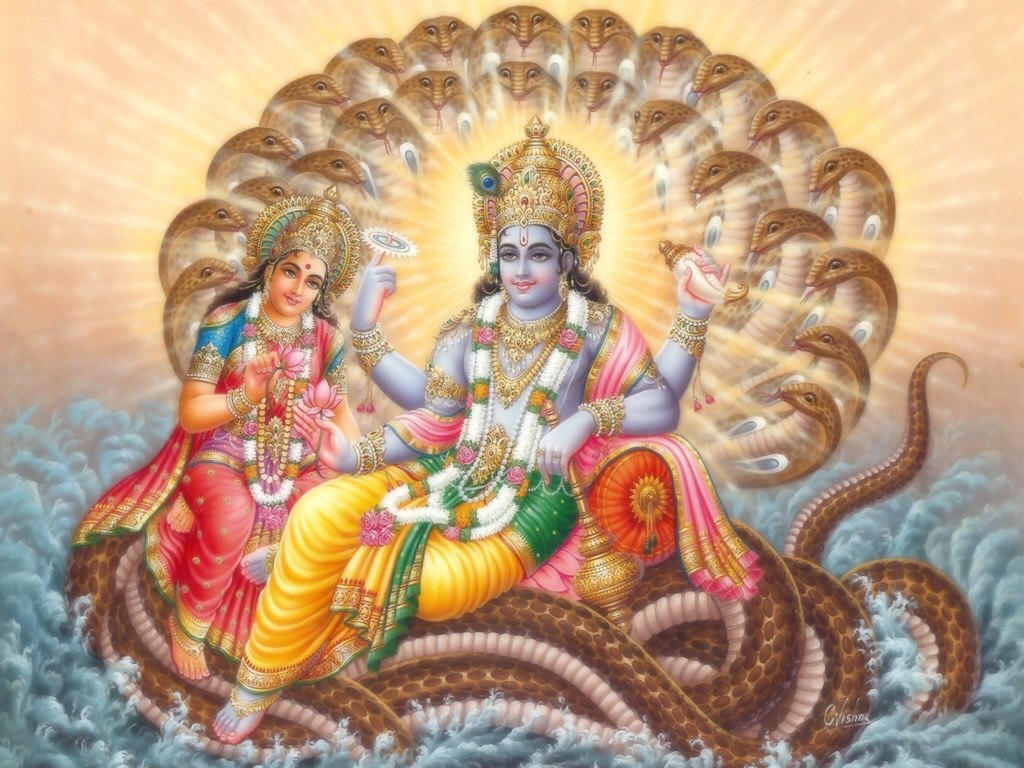
Vaishnavas worship Vishnu in his four-armed form, carrying conch, disc, flower and mace in his hands, believing that to be the Supreme form.
However, Smarthas do not subscribe to this aspect or personification of God, as Smarthas say that God is pure and thus devoid of form.
Additionally, they believe that God is not limited by time nor limited by shape and color. Vaishnava traditions are of the opinion that Vishnu is both unlimited and yet still capable of having specific forms, as to give arguments to the contrary (to say that God is incapable of having a form) is to limit the unlimitable and all-powerful Supreme.
In the Sri Vaishnava tradition, the Bhagavad-gita and the Vishnu Sahasranama are considered the two eyes of spiritual revelation.
In other Vaishnava traditions too, the Vishnu Sahasranama is considered an important text. Within Gaudiya Vaishnavism, Vallabha sampradaya, Nimbarka sampradaya and amongRamanandis, the chanting of the names of Krishna and Rama to be superior to that of Vishnu.
Based on another verse in the Padma Purana which says that the benefit of chanting the one thousand names of Vishnu can be derived from chanting one name of Rama, and a verse in the Brahma Vaivarta Purana equating the benefit of chanting three names of Rama with one name of Krishna.
However, it is important to realize that those verses in those puranas are not to be interpreted literally, as many believe that there is no difference between Vishnu and Krishna.
These verses can be interpreted as it is more important to have pure bhakti or devotion than merely repeating the many names of God without emotion. Indeed, Shri Krishna Himself said, “Arjuna, One may be desirous of praising by reciting the thousand names. But, on my part, I feel praised by one shloka. There is no doubt about it.”
Within Vaisnavism some groups, such as Sri sampradaya, adhere to and follow the Rig Veda: V.I.15b.3, which states “O ye who wish to gain realization of the supreme truth, utter the name of Vishnu at least once in the steadfast faith that it will lead you to such realization.
Citation.
Related articles


