Tag: Thirumoolar

  • Thirumoolar Pranayama Improves Immune System Suppresses Malignant Tumour Growth

    Thirumoolar Pranayama Improves Immune System Suppresses Malignant Tumour Growth

    Yoga,meaning union, is a spiritual practice that originated in India. Though Vedas are one of the sources of Sanatan Dharma, one finds scant reference to Yoga.However, Yoga in the sense used by Patanjali I refer to here.

    Realising Brahman, the underlying Supreme Reality, is the Goal of Life, declare Vedas.The Reality Brahman is beyond Attributes and Mind. It is in the Nature of Being, Consciousness and Bliss. Brahman is beyond Space and Time. It is to be experienced.

    When it is said that Brahman is beyond Attributes, it means that we can not comprehend these as our Mind is limited in Perception.It can not Perceive what All can be Perceived. Perception of a specific thing requires specific tools.

    Now, having given a very brief note on Brahman,let me add that Brahman is a Principle to be meditated upon through the imperfect tool we are endowed with.That is Mind.Mind can be trained.As the Brahman is a Principle, Mind finds it difficult focus on The Brahman which is beyond Attributes.Concentrating on this Brahman beyond Attributes is Nirguna Aradhana.As it is difficult for the Mind to perform Nirguna Aradhana, Sanatana Dharma suggests the worship of Personal God, Iswara,as a beginning. This is Saguna Aradhana.Here the Iswara is concentrated upon to attain Realisation.

    There are four methods used by Rishis of Sanatan Dharma. They are Gnana Yoga,Path of Knowledge, Karma Yoga, Path of Action,Bhakti Yoga, Path of Devotion and Raja Yoga, Path of Physical conditioning as aaa means to regulate consciousness to Realize Brahman.

    To understand this at the individual level, one has to look at the Concept of Nadi , Consciousness and Life
    And of course what we try to understand as Soul. Consciousness is an Attribute of the Soul and it is inseparable from It.Nadi, a Concept by Siddhas, Yogins ,is the flow of Life through the human body. It is the Life Force. It is Consciousness itself yet appears different and It is also the expression of Soul in human body.The Nadis are 72,000 in human body.By regulating the flow of Nadi, through Pranayama, one can manage Consciousness and it paves the way for Realisation.

    The flow of breath is controlled by a process called Nadi Suddhi, Cleaning of the pathways of Nadi. This is a part of Pranayama. After Nadi Suddhi , Pranayama is performed. I shall detail about the process of Nadi Suddhi and Pranayama in a separate article.

    There are different types of Yoga as I mentioned earlier. The Ashtanga yoga of Patanjali and Vaasi Yoga of Siva,Thirumoolar and Bhogar come under Raja Yoga..Vaasi Yoga regulates Consciousness directly and Ashtanga Yoga controls the consciousness indirectly through Mind.

    However the process of Pranayama is essential for both. It is to be performed after three earlier steps, Yama,Niyama and Asana.

    Pranayama , a spiritual practice delivers physical benefits as a side effect of the spiritual endeavour.The benefits can be measured quantitatively by Analysing brain waves. Now a study has been carried out and Saliva has been analysed to understand the impact of Pranayama.

    Changes in gene expression following 2 hours of comprehensive Yoga practice involving postures, breathing, and meditation indicated significant change in gene expression in immune response genes in peripheral blood mononuclear cells . Bower et al. have demonstrated a significant reduction in interferon-related transcription factors and NF-╬║B targets following 12-week Yoga intervention in breast cancer survivors…..5┬а|Article ID┬а376029┬а|┬аhttps://doi.org/10.1155/2015/376029

    Show citation

    Alterations in Salivary Proteome following Single Twenty-Minute Session of Yogic Breathing

    Sundaravadivel Balasubramanian,1┬аMichael G. Janech,2┬аand┬аGraham W. Warren1,3

    Show more

    Academic Editor:┬аSenthamil R. Selvan

    Published19 Mar 2015

    Abstract

    Yogic breathing (YB) has been suggested to reduce stress and blood pressure and increase cognitive processes. However, alterations after YB at the molecular level are not well established. Twenty healthy volunteers were randomized into two groups (

    ┬аper group): YB or attention controls (AC). The YB group performed two YB exercises, each for ten minutes, for a total of twenty minutes in a single session. AC group read a text of their choice for 20 minutes. Saliva was collected at baseline and at 5, 10, 15, and 20 minutes. Using Mass Spectrometry (MS), we initially found that 22 proteins were differentially expressed and then validated deleted in malignant brain tumor-1 (DMBT1) and Ig lambda-2 chain C region (IGLC2) using Western Blotting. DMBT1 was elevated in 7 of YB group by 10-fold and 11-fold at 10 and 15 minutes, respectively, whereas it was undetectable in the time-matched AC group (

    ). There was a significant interaction between groups and time assessed by two-way ANOVA (

    ). IGLC2 also showed a significant increase in YB group as measured by Western Blotting. These data are the first to demonstrate the feasibility of stimulating and detecting salivary protein biomarkers in response to an acute Yoga exercise. This trial is registered with ClincalTrials.gov┬аNCT02108769.

    1. Introduction

    Cultural practices have long played an important role in human health. Incorporated into daily routines, food habits, ethics, sports, social activities, religious ceremonies, and festivities, these practices are considered to promote the overall well-being of individuals belonging to that cultural group [1]. Yoga is the collection of numerous mind-body techniques from the ancient Eastern cultural practices with the main theme of unification (the Tamil word тАЬokkaтАЭ or the Sanskrit word тАЬyokтАЭ means to unite or equalize). Although practiced for its claimed benefits of healthy living and stress relief, the molecular mechanisms underlying how Yoga could improve health are only beginning to emerge. Yogic breathing (YB, also called┬аPranayamam┬аor┬аPranayama) is one of the Yoga practices and is an active way of regulating breathing. Thirumoolar, a saint from ancient times, wrote Thirumanthiram, a Tamil literary work containing several Yogic and Tantric methods [2,┬а3]. There are 14 songs in Thirumanthiram specifically on Yogic breathing (verses 564тАУ577). Although Yoga practitioners widely practice Pranayama techniques, the techniques of Thirumoolar have not yet been studied for their biological effects or molecular changes in biomarkers. Earlier physiological studies with other breathing regulation methods suggest that reducing the breathing frequency (around 15/min in normal adults [4]) could reduce blood pressure among heart failure patients [5]. As Pranayama leads to predominance in abdominal/diaphragmatic breathing [5тАУ7], it increases vagal tone and parasympathetic dominance and decreases sympathetic discharges [8,┬а9].

    Chanting Om is another type of YB, also called┬аPranava Pranayama. Chanting Om is an ancient cultural practice believed to improve physical and mental health. Early stage investigations on┬аPranava Pranayama┬аsuggest that it could (a) reduce heart rate and blood pressure in hypertensive patients [10], (b) promote physical and emotional well-being [11,┬а12], (c) increase cutaneous peripheral vascular resistance [12], (e) induce vagal nerve stimulation (VNS) [13,┬а14], and (f) deactivate the limbic brain regions, amygdala, hippocampus, parahippocampal gyrus, insula, and orbitofrontal and anterior cingulate cortices and thalamus [12]. However, most if not all these studies are pilot in nature and therefore the results have to be validated for elucidating biological mechanism.

    In this line recent studies have begun to unravel the molecular mechanisms of Yoga and other similar practices. For instance, in response to meditation, Black et al. reported the possible involvement of transcriptional regulation in peripheral blood lymphocytes indicative of overall reduction of stress response [15]. Similarly, Bhasin et al. have shown that Relaxation Response including Yoga, meditation, and repetitive prayer seems to improve mitochondrial resiliency by increasing the gene expression of ATPase and insulin function, while decreasing the gene expression of NF-╬║B associated stress response genes among practitioners [16]. Changes in gene expression following 2 hours of comprehensive Yoga practice involving postures, breathing, and meditation indicated significant change in gene expression in immune response genes in peripheral blood mononuclear cells [17]. Bower et al. have demonstrated a significant reduction in interferon-related transcription factors and NF-╬║B targets following 12-week Yoga intervention in breast cancer survivors [18]. These studies suggest that Yoga practices could potentially alter the expression of genes associated with inflammation and stress response. However, these studies have relied upon blood as the major source of biomarkers to study gene expression, and proteome level changes were not measured following Yoga practice. Moreover, the molecular mechanisms of Pranayama in isolation have not yet been studied in detail. Currently there are no established protein biomarkers to help measure the effects of YB on clinical outcomes or well-being. Identification of useful biomarkers would significantly increase the ability of differentiating objective from subjective responses reported by patients or participants in a study. Saliva is an easily accessed biological sample that contains numerous biomarkers including proteins, peptides, metabolites, mRNA, DNA, and miRNA of both human and oral microbial origin. Due to the noninvasive nature and relative ease of sample collection, saliva has been increasingly recognized as a rich source of biomarkers useful in many diseases. For instance, salivary proteomic and mRNA profiling have identified significant differences between control and oral cancer subjects [23].

    As salivation is one of the parasympathetic activation responses [24], we hypothesized that Pranayama might activate salivation and that the proteomic profile of saliva thus produced will be different from the basal saliva. Thirumoolar Pranayama.

    Evidence-Based Complementary and Alternative Medicine+Journal Menu

    PDF

    Article Sections

    Special IssueComplementary and Alternative Medicine in Cancer Prevention and Therapy

    View this Special Issue

    Research Article |┬аOpen Access

    Volume┬а2015┬а|Article ID┬а376029┬а|┬аhttps://doi.org/10.1155/2015/376029

    Show citation

    Alterations in Salivary Proteome following Single Twenty-Minute Session of Yogic Breathing

    Sundaravadivel Balasubramanian,1┬аMichael G. Janech,2┬аand┬аGraham W. Warren1,3

    Show more

    Academic Editor:┬аSenthamil R. Selvan

    Published19 Mar 2015

    Abstract

    Yogic breathing (YB) has been suggested to reduce stress and blood pressure and increase cognitive processes. However, alterations after YB at the molecular level are not well established. Twenty healthy volunteers were randomized into two groups (

    ┬аper group): YB or attention controls (AC). The YB group performed two YB exercises, each for ten minutes, for a total of twenty minutes in a single session. AC group read a text of their choice for 20 minutes. Saliva was collected at baseline and at 5, 10, 15, and 20 minutes. Using Mass Spectrometry (MS), we initially found that 22 proteins were differentially expressed and then validated deleted in malignant brain tumor-1 (DMBT1) and Ig lambda-2 chain C region (IGLC2) using Western Blotting. DMBT1 was elevated in 7 of YB group by 10-fold and 11-fold at 10 and 15 minutes, respectively, whereas it was undetectable in the time-matched AC group (

    ). There was a significant interaction between groups and time assessed by two-way ANOVA (

    ). IGLC2 also showed a significant increase in YB group as measured by Western Blotting. These data are the first to demonstrate the feasibility of stimulating and detecting salivary protein biomarkers in response to an acute Yoga exercise. This trial is registered with ClincalTrials.gov┬аNCT02108769.

    1. Introduction

    Cultural practices have long played an important role in human health. Incorporated into daily routines, food habits, ethics, sports, social activities, religious ceremonies, and festivities, these practices are considered to promote the overall well-being of individuals belonging to that cultural group [1]. Yoga is the collection of numerous mind-body techniques from the ancient Eastern cultural practices with the main theme of unification (the Tamil word тАЬokkaтАЭ or the Sanskrit word тАЬyokтАЭ means to unite or equalize). Although practiced for its claimed benefits of healthy living and stress relief, the molecular mechanisms underlying how Yoga could improve health are only beginning to emerge. Yogic breathing (YB, also called┬аPranayamam┬аor┬аPranayama) is one of the Yoga practices and is an active way of regulating breathing. Thirumoolar, a saint from ancient times, wrote Thirumanthiram, a Tamil literary work containing several Yogic and Tantric methods [2,┬а3]. There are 14 songs in Thirumanthiram specifically on Yogic breathing (verses 564тАУ577). Although Yoga practitioners widely practice Pranayama techniques, the techniques of Thirumoolar have not yet been studied for their biological effects or molecular changes in biomarkers. Earlier physiological studies with other breathing regulation methods suggest that reducing the breathing frequency (around 15/min in normal adults [4]) could reduce blood pressure among heart failure patients [5]. As Pranayama leads to predominance in abdominal/diaphragmatic breathing [5тАУ7], it increases vagal tone and parasympathetic dominance and decreases sympathetic discharges [8,┬а9].

    Chanting Om is another type of YB, also called┬аPranava Pranayama. Chanting Om is an ancient cultural practice believed to improve physical and mental health. Early stage investigations on┬аPranava Pranayama┬аsuggest that it could (a) reduce heart rate and blood pressure in hypertensive patients [10], (b) promote physical and emotional well-being [11,┬а12], (c) increase cutaneous peripheral vascular resistance [12], (e) induce vagal nerve stimulation (VNS) [13,┬а14], and (f) deactivate the limbic brain regions, amygdala, hippocampus, parahippocampal gyrus, insula, and orbitofrontal and anterior cingulate cortices and thalamus [12]. However, most if not all these studies are pilot in nature and therefore the results have to be validated for elucidating biological mechanism.

    In this line recent studies have begun to unravel the molecular mechanisms of Yoga and other similar practices. For instance, in response to meditation, Black et al. reported the possible involvement of transcriptional regulation in peripheral blood lymphocytes indicative of overall reduction of stress response [15]. Similarly, Bhasin et al. have shown that Relaxation Response including Yoga, meditation, and repetitive prayer seems to improve mitochondrial resiliency by increasing the gene expression of ATPase and insulin function, while decreasing the gene expression of NF-╬║B associated stress response genes among practitioners [16]. Changes in gene expression following 2 hours of comprehensive Yoga practice involving postures, breathing, and meditation indicated significant change in gene expression in immune response genes in peripheral blood mononuclear cells [17]. Bower et al. have demonstrated a significant reduction in interferon-related transcription factors and NF-╬║B targets following 12-week Yoga intervention in breast cancer survivors [18]. These studies suggest that Yoga practices could potentially alter the expression of genes associated with inflammation and stress response. However, these studies have relied upon blood as the major source of biomarkers to study gene expression, and proteome level changes were not measured following Yoga practice. Moreover, the molecular mechanisms of Pranayama in isolation have not yet been studied in detail. Currently there are no established protein biomarkers to help measure the effects of YB on clinical outcomes or well-being. Identification of useful biomarkers would significantly increase the ability of differentiating objective from subjective responses reported by patients or participants in a study. Saliva is an easily accessed biological sample that contains numerous biomarkers including proteins, peptides, metabolites, mRNA, DNA, and miRNA of both human and oral microbial origin [19тАУ22]. Due to the noninvasive nature and relative ease of sample collection, saliva has been increasingly recognized as a rich source of biomarkers useful in many diseases. For instance, salivary proteomic and mRNA profiling have identified significant differences between control and oral cancer subjects [23].

    As salivation is one of the parasympathetic activation responses [24], we hypothesized that Pranayama might activate salivation and that the proteomic profile of saliva thus produced will be different from the basal saliva. Our initial mass spectrometry (MS) analysis revealed changes in the levels of 22 proteins following YB. To validate our MS data by Western Blotting, we chose the protein candidates deleted in malignant brain tumor 1 (DMBT1) and Ig lambda-2 chain C region (IGLC2) based on their abundance in saliva, spectral counts and level of statistical significance in MS data, and the roles of these proteins in immune regulation, epithelial differentiation, tumor suppression, and stress response [25,┬а26].

    2. Methods

    2.1. Human Subjects

    A total of twenty healthy volunteers (male or female), aged 18 and above, were included in the study. The exclusion criteria were as follows: breathing problems (inability to breathe through nostrils, chronic bronchitis, emphysema, and asthma), speech problems that would prevent chanting, inability to listen and follow study exercise, sinus congestion, SjogrenтАЩs syndrome, chronic dry mouth due to medication or other conditions, and use of anticholinergic medications. Informed consent was obtained from each subject after initial interview. The study protocol was approved by the Institutional Review Board for Human Research, Medical University of South Carolina. Participants were enrolled after informed written consent. Recruitment of participants was carried out in Charleston Metro area from August 15, 2013, to October 31, 2013. The protocol requires the participant to attend only one 20-minute session with no follow-up. This study is registered at the┬аClinicalTrials.gov. This study was not registered prior to enrollment of participants owing to the small number of participants required for the protocol. The authors confirm that all ongoing and related trials for this drug/intervention are registered.

    Enrolled participants were randomized to one of 2 conditions: Yogic breathing (YB) arm versus the Attention Control (AC) arm (see Figure┬а1┬аfor CONSORT flowchart). Randomization was conducted in collaboration with a biostatistician to ensure equal gender distribution in the 2 experimental groups (YB versus AC). All the participants were tested one-on-one with a trained Yoga instructor. Prior to exercise and sample collection, the Yoga instructor taught each subject how to perform YB.

    Figure 1┬а

    CONSORT flowchart. Details of the overall trial design.

    3. Treatment Conditions

    3.1. Yogic Breathing

    The YB exercise design is depicted in Figure┬а2. The study Yoga instructor taught the subjects how to perform the YB exercises, which consist of Om Chanting and Thirumoolar Pranayamam as detailed below.

    Figure 2┬а

    Yogic breathing intervention. Yogic breathing exercise contains two phases, namely, Chanting Om and Thirumoolar Pranayamam, each for 10 minutes. Saliva sample is collected starting from 0тАЙmin and every five minutes as shown.

    3.1.1. Chanting Om

    The subjects were seated in a chair with eyes closed while chanting. The subjects performed Chanting Om as follows: (a) long deep inhalation through both nostrils at the same time and (b) slow exhalation while chanting тАЬOm.тАЭ These two steps were repeated continuously for 10тАЙmin with a brief interruption at 5 minutes to collect saliva. Saliva was immediately placed on ice after collection.

    3.1.2. Thirumoolar Pranayamam (TP)

    Following the chanting, the subjects performed TP as follows, as instructed by the Yoga instructor based on Thirumanthiram (verse 568) [2,┬а3]: During TP, the inhalation/holding/exhalation cycles each lasting in seconds were counted as follows using the combination of chanting and counting with fingers. Repeatedly chant a phrase within mind (e.g., тАЬIтАЩm beautiful,тАЭ тАЬIтАЩm relaxed,тАЭ тАЬOm Namasivaya,тАЭ etc.) for two times (inhalation), eight times (holding), and four times (exhalation). (a) Close right nostril and inhale through left nostril for two chants and then close both nostrils so that no inhaled air escapes. (b) Hold breath in this position for eight chants mentally. (c) Open right nostril and exhale for four chants. Complete exhalation is required. (d) Go to step (a) and repeat. The subjects performed TP for 10тАЙmin. Salivary samples were collected at 5 and 10 minutes of TP (see below). Thus each individual provided the following five saliva samples: basal (0тАЙmin), Chanting Om (5, 10тАЙmin), and TP (15, 20тАЙmin). Stimulating salivary DMBT1 by a nonpharmacologic, noninvasive, behavioral intervention such as YB could hold several health benefits including maintenance of an effective innate immune system and production of tumor suppressors de novo. Although we have shown an increase of DMBT1 in saliva following YB, the possible mechanisms through which this happens are unknown

    http://downloads.hindawi.com/journals/ecam/2015/376029.pdf

    https://www.hindawi.com/journals/ecam/2015/376029/#results
  • Meru Mountain Hinduism Pico Cao Grande Gabon Africa Where Lemuria Atlantis Met

    Meru Mountain Hinduism Pico Cao Grande Gabon Africa Where Lemuria Atlantis Met

    I have written earlier that the ancient Texts of Hinduism lend themselves to minimum four interpretations.

    1.The literary,word by word meaning.

    2.The Philosophical meaning.

    3.The Scientific meaning and

    4.Tantric meaning which espouses the Geometric and Sound combined Concept for Spiritual upliftment.

    All texts lend themselves to this approach.

    I shall write on this shortly.

    Hence each Concept in Hinduism has at least four interpretations.

    So is the case with Meru.

    Meru ,for example ,is described ,in Lalitha Sahasranama thus.

    ‘Sumeru Mandala Madhyastha Sriman Nagara Nayikaa’

    Of Lalitha Devi it describes,

    ‘The one who dwells in the city of SriChakra(Sri Nagara),which is located in the Meru Mountain.

    Let us look at the Geographical approach.

    Mount Meru has been suggested to be in Arctic,Tanzania,Kashmir,apart from being a Tantric Concept.

    Ayodhya, Mathura,Pandyaa Kingdoms, not to speak of the┬аHoly places, Rivers, Mountains and even the Species that thrive in these locations.

    At the same time one gets the impression that the areas mentioned are not in The┬аEarthand are located in some other location ,Planet, under the Ocean.

    And we have the Lokas, the abode of Beings confusing.

    We have , for example, the Surya Loka, Chandra Loka.’

    Meru in Arctic

    Mount Meru┬аis an active stratovolcano located 70 kilometres (43┬аmi) west of Mount Kilimanjaro in the nation of Tanzania.

    And there is a Town Meru in the neighboring Kenya!

    3.Meru is also┬аidentified Mount Meru or Sumeru with the Pamirs, north-west of Kashmir.

    Meru in Tanzania

    Mount Meru is also theorised somewhere near Sumeria,the term Sumeria from Meru ,Sumeru.

    There are extensive descriptions of Meru in the Puranas.

    There is a parallel system of Hinduism in the south of Vindhya ranges,called Dravida Desa,where the Tamils lived around 230 million years ago.

    Please refer my article Lemuria Home of Tamils.

    There are three concepts regarding this landmass.

    Lemuria,

    Its outer portion MU and

    Kumarikandam.

    Lemuria and Kumarikandam seem to have slightly different landmass,while there is agreement that ┬аMU formed the periphery of the land of Tamils.

    Detailed research was carried out by James Churchward.

    You may read my articles on Kumarikandam,Lemuria and MU.

    Though there are references in ancient Tamil Texts,they are few.

    A text of Yoga and Advaitha,which predates Patanjali,Thirumandhiram by Thirumoolar,A Siddha , is presumed to be over 3000 years old.

    Thirumandhiram has 3000 poems,which deal with Spirituality,Yoga ,Shiva and Advaitha.

    Thirumandhiram is subjected to scientific research in the US.

    A poem refers to Meru.

    It refers Meru as a Mountain a Mountain whics was located at the point where the Equator,and the Zero degrees of Longitude and Latitude converge and it was devoured by the Ocean.

    I checked the information with the present Geographical areas.

    The result is that Mount Meru seems to have been near the Gulf of Guyana.

    To be exact, the intersection of┬а┬аzero degrees┬аlatitude and zero degrees longitude┬аfalls about 380 miles (611 kilometers)┬аsouth of Ghana┬аand 670 miles (1078 km) west of Gabon. This location is in the tropical waters of the eastern Atlantic Ocean, specifically, the Gulf of Guinea.

    The Gulf of Guinea is part of the western edge of the African tectonic plate. Most notably,┬аaccording to the theory of continental drift, this may have been the location where South America and Africa were once joined.

    The equator has a mark of zero degrees latitude and the prime meridian one of zero degrees longitude, but where do these two lines meet? The simple answer is that they intersect in the Gulf of Guinea, just off the western coast of Africa.’

    Source.┬аhttps://www.thoughtco.com/prime-meridian-and-the-equator-intersect-4070819

    ┬аIt is the place where South America and Africa Continents join.

    The equator is at zero degrees latitude.┬а
    It is the starting point for measuring latitude.


    The equator runs through the top of South America, through the middle of Africa and then Indonesia and north of New Guinea.

    The Meru Mountain must be, based on this,should have been among middle of Africa,Indonesia and North of New Guinea.

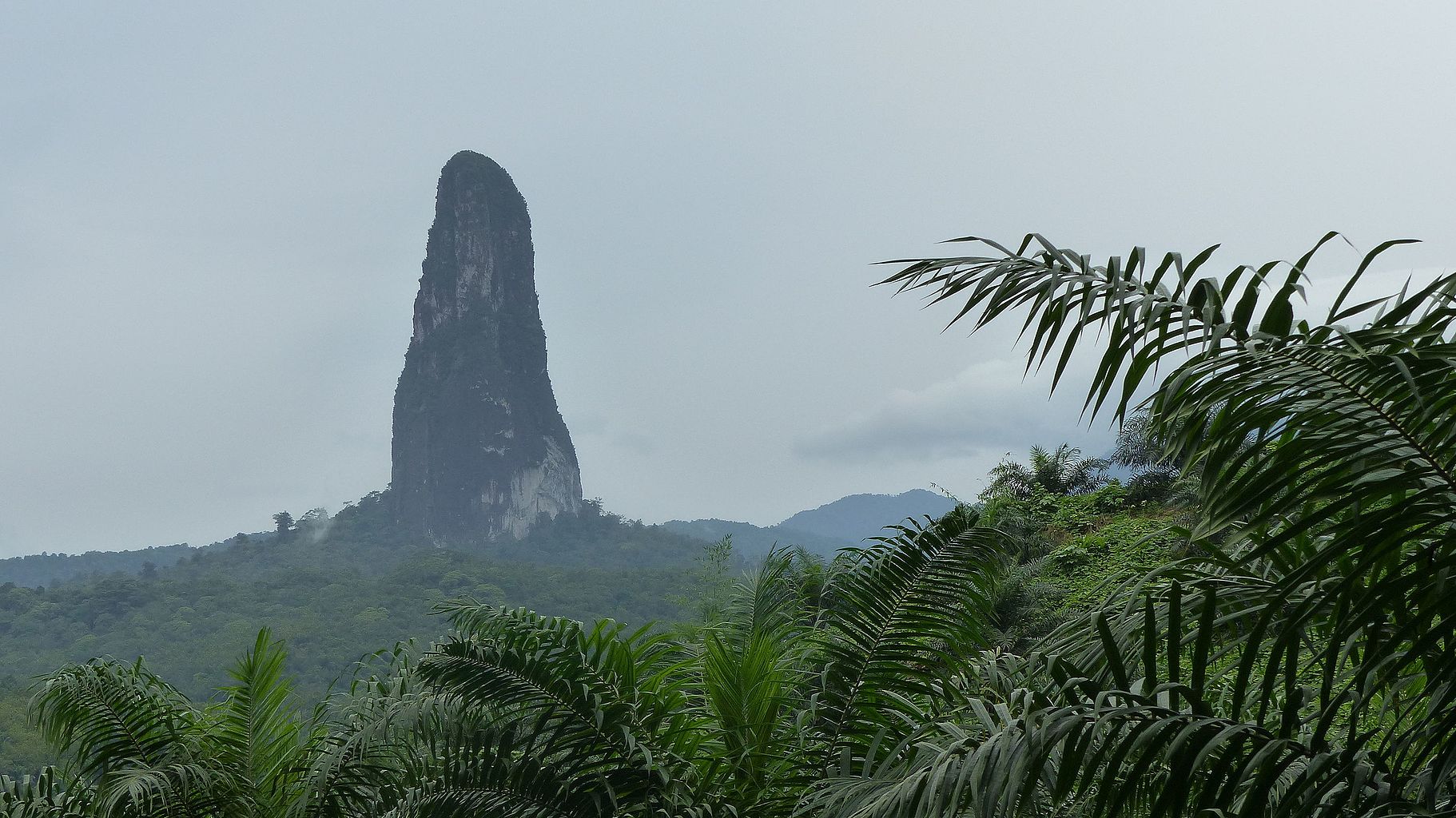
    Pico Cao grande mountain seems to fit the bill ,though it is slighly off the mark in longitude and Latitude

    More exploration under the sea in the nearby areas needed.

    Pico C├гo Grande

    The┬аPico C├гo Grande┬а(Portuguese┬аfor “Great Dog Peak”) is a landmark needle-shaped┬аvolcanic plug┬аpeak in┬аS├гo Tom├й and Pr├нncipe, in the south of┬аS├гo Tom├й Island┬аin┬аObo National Park. It rises dramatically over 370 m (1,000┬аft) above the surrounding terrain and the summit is 668 m (2,175┬аft) above sea level.

    S├гo Tom├й Island, at 854┬аkm2┬а(330┬аsq┬аmi), is the largest island of┬аS├гo Tom├й and Pr├нncipe┬аand is home to about 157,000 or 96% of the nation’s population. This island and smaller nearby islets make up┬аS├гo Tom├й Province, which is divided into six┬аdistricts. The main island is located 2┬аkm (1┬╝ miles) north of the┬аequator. It is about 48 kilometres (30 miles) long (North-South) by 32 kilometres (20 miles) wide (east-west). It rises to 2,024 metres (6,640 feet) at┬аPico de S├гo Tom├й┬аand includes the┬аcapital city,┬аS├гo Tom├й, on the northeast coast. The nearest city on mainland┬аAfrica┬аis the port city of┬аPort Gentil┬аin┬аGabon┬аlocated 240 kilometres (150 miles) to the east.

    https://en.m.wikipedia.org/wiki/S├гo_Tom├й_Island

    0.1180┬░ N, 6.5660┬░ E

    Is this the place where Atlantis and Memuria met?

    The poem runs thus,

    1394. роКро░рпБроорпН роЙро▓роХроорпБроорпН роТроХрпНроХрокрпН рокроЯрпИроХрпНроХро┐ройрпНро▒

    рокрпЗро░ро▒ро┐ ро╡ро╛ро│ройрпН рокрпЖро░рпБроорпИ роХрпБро▒ро┐родрпНродро┐роЯро┐ройрпН
    роорпЗро░рпБро╡рпБроорпН роорпВро╡рпБро▓ роХро╛ро│ро┐ ропро┐ро▓роЩрпНроХрпЖро┤рпБроирпН
    родро╛ро░рогро┐ роиро╛ро▓рпНро╡роХрпИроЪрпН роЪрпИро╡роорпБ рооро╛роорпЗ.

    (рок. роЗ.)┬ароКро░рпН роЙро▓роХроорпН роЙроЯро▓рпН роЙро▒рпБрокрпНрокрпБ роЙрогрпНрокрпКро░рпБро│рпН роОро▓рпНро▓ро╛роорпН роХро░рпБро╡ро┐ропро┐ройрпНро▒ро┐роХрпН роХро▓роирпНродро┐ропроХрпНроХрпБроорпН роХро░рпБродрпНродро│ро╡ро╛ройрпЗ рокроЯрпИродрпНродро░рпБро│рпНроХро┐ройрпНро▒ро╡ройрпН роЪро┐ро╡ройрпН. роЕро╡ройрпН роЗропро▓рпНрокро╛роХ ро╡ро┐ро│роЩрпНроХрпБроорпН роорпБро▒рпНро▒рпБрогро░рпНро╡рпБроЯрпИроп рокрпЗро░ро▒ро┐ро╡ро╛ро│ройро╛ро╡ройрпН. роЕро╡ройрпНро▒ройрпН роЕро│ро╡ро┐ро▓ро╛рокрпН рокрпЖро░рпБроорпИропрпИ роиро╛рооро▒ро┐роирпНрод роЕро│ро╡ро┐ро▓рпН роХрпБро▒ро┐рокрпНрокрпЛрооро╛ройро╛ро▓рпН роорпЗро░рпБро╡ро╛роХро┐роп рокрпКройрпНрооро▓рпИропрпБроорпН, роорпВро╡рпБро▓роХрпИропрпБроорпН роТро░рпБроЩрпНроХрпБ роЖро│рпБроорпН роЕро╡ройрпН (роЪро┐ро╡рокрпЖро░рпБрооро╛ройрпН) рокроЯрпИродрпНродро░рпБро│рпБроорпН роЙро▓роХроорпБроорпН, роЪрпБродрпНродроорпН, рооро┐роХрпБроЪрпБродрпНродроорпН, рооро╛ро░рпНроХрпНроХроорпН, роХроЯрпБроЮрпНроЪрпБродрпНродроорпН роОройрпНройрпБроорпН роиро╛ро▓рпНро╡роХрпИроЪрпН роЪрпИро╡роорпБроорпН роУро░рпН рокрпБроЯрпИ роТрокрпНрокро╛роХроЪрпН роЪрпКро▓рпНро▓ро▓ро╛роорпН. роЕроЪрпБродрпНродроорпН – рооро┐роХрпБроЪрпБродрпНродроорпН. роиро╛ро▓рпНро╡роХрпИроЪрпН роЪрпИро╡роорпБроорпН роЪро┐ро╡рокрпЖро░рпБрооро╛ройро┐ройрпН роиро┐ройрпНро▒рпЗ родрпЛройрпНро▒рпБро╡рой. родрпБро│роХрпНроХрооро┐ро▓рпНро▓ро╛род роЪро┐ро╡рокрпЖро░рпБрооро╛ройро┐ройрпН роЕро│родрпНродро▒рпНроХро░ро┐роп рокрпЖро░рпБроорпИропро┐ройрпБроХрпНроХрпБрокрпН рокрпКройрпНрооро▓рпИропрпКрокрпНрокро╛роХрпБроорпН. роОроЩрпНроХрпБроорпН роирпАроХрпНроХрооро▒ роиро┐ро▒рпИроирпНродрпБ роиро┐ро▒рпНроХрпБроорпН роЗропро▓рпНрокро┐ройрпБроХрпНроХрпБ роиро┐ро▓ро╡рпБро▓роХроорпН роТрокрпНрокро╛роХрпБроорпН. родро╡ро▒ро╛родрпБ родро┐ро░рпБро╡роЯро┐рокрпНрокрпЗро▒ро╛роорпН роорпЖропрпНрокрпНрокропройрпН родро░рпБродро▒рпНроХрпБ роиро╛ро▓рпНро╡роХрпИроЪрпН роЪрпИро╡роорпН роТрокрпНрокро╛роХрпБроорпН. роЪрпБродрпНродроорпН – роЙрогрпНроорпИ, роЗропро▒рпНроХрпИ, роиро╛ро▓рпНро╡роХрпИроЪрпН роЪрпИро╡роорпН ро╡ро░рпБрооро╛ро▒рпБ: роЗропро▒рпНроХрпИроЪрпН роЪрпЖроирпНроирпЖро▒ро┐, роорпА роЗропро▒рпНроХрпИроЪрпН роЪрпЖроирпНроирпЖро▒ро┐, роорпЖропрпНропрпБрогро░рпНро╡рпБроЪрпН роЪрпЖроирпНроирпЖро▒ро┐, роорпЖропрпНроХрогрпНроЯро╛ро░рпН роЪрпЖроирпНроирпЖро▒ро┐ роОройрпНрокрой. роЗро╡ро▒рпНро▒рпИ роорпБро▒рпИропрпЗ, роЪрпБродрпНрод роЪрпИро╡роорпН, роЕроЪрпБродрпНрод роЪрпИро╡роорпН, рооро╛ро░рпНроХрпНроХ роЪрпИро╡роорпН, роХроЯрпБроЮрпНроЪрпБродрпНрод роЪрпИро╡роорпН роОройро╡рпБроорпН роХрпВро▒рпБрок. роЕроЪрпБродрпНродроорпН роОройрпНрокродро┐ро▓рпН ‘роЕ’ роЕрокрпНрокро╛ро▓рпН роОройрпНрокродройрпН роорпБродро▓рпЖро┤рпБродрпНродро╛роХрпБроорпН. роОройро▓рпБ роорпКройрпНро▒рпБ. роЪрпЖроирпНроирпЖро▒ро┐ роОройро┐ройрпБроорпН роЪро┐ро╡ройрпЖро▒ро┐ роОройро┐ройрпБроорпН роТройрпНро▒рпЗ.

    (роЕ. роЪро┐.)┬ароиро╛ро▓рпНро╡роХрпИроЪрпН роЪрпИро╡роорпН – роЪрпБродрпНрод роЪрпИро╡роорпН, роЕроЪрпБродрпНрод роЪрпИро╡роорпН, рооро╛ро░рпНроХрпНроХ роЪрпИро╡роорпН, роХроЯрпБроЮрпНроЪрпБродрпНрод роЪрпИро╡роорпН. роорпЗро░рпБ – рокрпВрооро┐ропро┐ройрпН роородрпНродро┐роп роЗро░рпЗроХрпИропрпБроорпН роиро┐ро░роЯрпНроЪро░ ро░рпЗроХрпИропрпБроорпН роЪрпЗро░рпБроорпН роЗроЯродрпНродро┐ро▓рпН роЗро░рпБроирпНродрпБ роХроЯро▓рпН роХрпКрогрпНроЯроЯрпКро┤ро┐роирпНрод роорпЗро░рпБ рооро▓рпИ. роЪрпБроорпЗро░рпБ – ро╡роЯ родрпБро░рпБро╡роорпН (North pole.) роХрпБроорпЗро░рпБ – родрпЖройрпН родрпБро░рпБро╡роорпН (South pole.) роЗроЩрпНроХрпЗ роиро┐ро▓рпИродро╡ро▒ро╛роорпИроХрпНроХрпБ роЙро╡роорпИропро╛роХ ро╡роирпНродродрпБ. роорпВро╡рпБро▓роХрпБ – рокро░роирпНродрпБ ро╡ро┐ро░ро┐роирпНрод родройрпНроорпИроХрпНроХрпБ роЙро╡роорпИ. роЪрпИро╡роорпН – роорпЖропрпНрокрпНрокропройрпН родро░рпБро╡родро▒рпНроХрпБ роЙро╡роорпИ.’

    Source.┬аhttp://www.tamilvu.org/slet/l4100/l4100pd2.jsp?bookid=118&pno=541

  • Shiva Means Vaasi Yoga Of Thirumoolar

    The treasures of ┬аSanatan Dharma is so rich and huge one may not even touch its periphery in one’s Lifetime

    If one were to give up linguistic and regional bias, one may unearth these treasures.

    I have in many of my posts written on the myth of Tamil and Sanatana Dharma being inimical to each other

    They complement each other

    Siva.jpg
    Lord Shiva.

    If one were to read the Vedic texts and ancient Tamil Texts one may notice the following points

    1.Shiva is not directly mentioned in the Vedas nor do we find any sukthas ascribed/devoted to Him.His name appears in Sri Rudram, Rudra being an amsa of Shiva and not Shiva in His full Glory

    2.Other Gods,Narayna, Vishnu,Varuna, Indra,Agni,Vaayu,Durga, Lakshmi and a Host of others are mentioned in the Vedas

    3.Ancient Tamil Spiritual texts mention the following ┬аDeities and the earliest Grammar work Tholkaapiyam assigns the territories in which they are the Chief Gods.

    A).Kurinji,mountainous terrain, Chief Deity is, Cheyon(means The son) ┬аcalled Murugan , that is Subrahmanya ┬а. Interestingly Vedas do not mention Subrahmanya directly.

    B)Mullai, Pastoral lands, the Chief Deity is Maayaon, Vishnu.Maayon means Illusionist, one who creates the Yoga maaya .This is in keeping with the. description of Vishnu in Vedas and the Puranas.

    C).Marutham, Paddy fields/arable lands, Chief Deity is Indra..

    D)Neydhal, Sea and adjoining areas , Chief Deity is Varuna and

    E)Paalai, Desert Region, Chief Deity is Durga, called Kotravai in Tamil.

    Even in Tamil, which is believed to have been founded by Lord Shiva,He is not assigned a Region in the manner described above

    4.The Yoga system of the Vedic system is by Patanjali.

    5.Patanjali is a disciple of Shiva along with Sage Agastya and Bhogar according to Tamil Classics

    6.The Yoga ┬аdeveloped Thirumoolar, meaning The auspicious first in his Thirumandiram is different from Patanjali’s Yoga Sutra.

    7.Yoga developed by Agastya follows Thirumoolar and is different from Patanjali’s.

    The meaning Shiva in Sanskrit is Auspiciousness. Mangalam.

    No other meaning is assigned to this word.

    In Tamil the etymology is slightly different..

    Shiva is from Vaa Si.

    Vaasi when repeated in quick succession becomes Siva!

    ро╡ро╛роЪро┐ ро╡ро╛роЪро┐ роОройрпНро▒рпБ ро╡ро╛роЪро┐родрпНрод родрооро┐ро┤рпН роЗройрпНро▒рпБ
    роЪро┐ро╡ро╛ роЪро┐ро╡ро╛ роОрой роЪро┐роирпНродрпИ родройро┐ро▓рпН роиро┐ройрпНро▒рпБ
    роЕро╡ро╛ро╡ро┐ройро╛ро▓рпН роЗроирпНрод роТро│ро╡рпИродрпН родрооро┐ро┤рпН роХрпКрогрпНроЯрпБ
    роХро╡ро┐рокро╛роЯро┐ройро╛ройрпН роЙройрпНройрпИроХрпН роХрогрпН роХрпБро│ро┐ро░роХрпН роХрогрпНроЯрпБ!


    Listen to this’ for Vaasi becoming Shiva,

    Now Vaasi is a special type of Yoga.

    It is different from the Yoga of Patanjali.

    It is by Thirumoolar and foll0wed by Sage Agastya.


    Vaasi yoga (vasi yoga) is a form of yoga that concentrates on the breath naadi (nadi), the cycle of the distribution of oxygen throughout the body, that occurs as part of the breathing process. Indian philosophy describes prana (life force) as flowing in channels called naadis. Vaasi yoga attempts to heal the body and sprirt by cleansing the breath naadi, and thus prepare for balance, true consciousness of self and then enlightenment. As such it is one of the kaya kalpa, the class of ancient yogic rejuvenation therapies.┬аAs a yogic practice it is an art of living taught by siddhars for over 3000 years ago, as initiated by Lord Shiva. Like other advanced types of yoga which should be practiced only under the guidance of Guru. Vaasi yoga is practiced by very few.

    Vaasi yogam is the attainment of consciousness about the silent sound in our breath. To attain this consciousness, the body should be devoid of any waste. To remove all the waste from oneтАЩs body, one should be taught with asanas by a guru who should be in a position to analyze the naadi functionality of oneтАЩs body. A guru who has the capacity to analyze the naadi functionality is called Siva Sithan.’

    Vaasi is not Nadi.

    It is the mental flow of Breath .

    In Patanjali’s Yoga one regulates ┬аthe Physical Breath.

    In Vaasi One controls the Mental Breath…

    There has been lot of reference of this yoga to kriya yoga or kundalini prayanama (Yogic Breathing to increase the pranic energy). But all of the above practices are being followed or taught, without empowering the body to practice it. In other words, when the physique is not devoid of waste and when one with such a physique, practices any kind of yoga or breathing techniques, it will only aggravate the body conditions due to the heat or agni produced. All other kinds of yoga do not tend to remove the waste from the body, instead only rise the body temperature and increase the appetite. But in Vaasi yoga, food intake gets controlled automatically and one can control the appetite for food casually.


    Our body cells need oxygen derived from air. There are some definite paths for oxygen to reach the cells and to go out of cells. These paths have some energy centres. These centres control the organs and their functions. This pattern, this throb, which is called тАШNaadiтАЩ in Tamil, differs from person to person. The pulse beat should be not taken for тАШNaadiтАЩ. For a healthy living the Naadi has to function properly and be fully active. The imbalance in the Naadi functionality is the root cause of all ailments and diseases. By practicing Vaasi Yoga Naadi functionality gets strengthened and healthy living is achieved. Vaasi Yoga is a technique to breath. The yogis who are expert in vaasi yoga avoids breathing through normal nostrils. But they exhale the air upward towards kapala (Brain). This strengthens the brain and give brightness to face and whole body too. Siddhar Shiva vaakiyar (Tamilnadu) has narrated the secret of Vaasi yoga and its benefit.


    Vaasi Yoga has unique nature of attaining the consciousness of the Self, by the following stages.

    1. Analysis of Nadi functionality тАУ Guru must have the capacity to identify the imbalance between the 3 NadisтАЩ Idakalai, Pingalai and Sulumunai. The reason being, each individual is unique in nature and the functioning of the body will vary due to the imbalance in these 3 Nadis. The body temperature might be different for every individual based on Vatham, Pitham and Kabam. Hence, that has to be brought under control to a stable level before practicing any kind of yoga .
    2. Asanas to empower body тАУ Based on the above analysis, Guru must have the capacity to teach breathing techniques and asanas to bring the body and breath to a stable condition devoid of any waste. During this period 5 kinds of waste disposal happens. Motion, urine, sweat, mucous and gas. This will happen for minimum of 3 months. Only at the end of 3 months with devoid of all the waste from the body, the breath will be in control. Only when breath is under control, Vaasi can act upon us.
    3. Realizing self – Only through Vaasi Yoga, one can attain the consciousness of the true Self. Another benefit of Vaasi yoga is being younger in appearance. Because Vaasi yoga will burn out all the waste in our body and will only look leaner and younger without any excess muscles in our body . This is the reason why Siddhars lived for years together.

    Vaasi Yoga practice simulates two special hormones 1. Seratonin 2. Melatonin.

    These two hormones ultimately stabilize all the working systems in our body.’

    The term Shiva from a process of a Yogic system,Vaasi Yoga, that Shiva is termed as Adi Guru, the First Siddha, and Dakshinamoorthy as a Preceptor , embodying Silence and Vaasi Yoga being the regulation of the silent Nadi lends to the view that Shiva was a ┬аhuman being and became a Realized Soul .

    The term Sat Chit and Ananda is the description of the Reality,Brahman as descried in the Vedas.

    The term Sachidanda is used for Only Shiva.

    And Consciousness is elevated to Realization by Vaasi Yoga.

    I am providing some basic details of Vassi Yoga.

    Do Not Attempt to Practice without Initiation from a Guru.

    Practicing without initiation by a Guru may prove to be serious and at times Fatal.


    tтАЩs incredibly difficult to do vasi yoga in day to day life for common people. ItтАЩs not so easy to get initiated from the available real guru who is doing vasi yoga for several years with concealed achievements. To find out these types of yogic people is very difficult. Most of the people stay with families and kids. They never disclose to the public view. They will identify the eligible people and give it to their hands with chain reactions and initiation.┬а They know itтАЩs very complicated to achieve the first stage of perception with lot of obstacles when a person starts the vasi yoga. Once after initiation of vasi yoga, yogi should be very careful on the day to day life, it makes you down until unless yogi follows the traditional rules and regulations.

    I have seen number of persons who had initiated and immediately met accidents with severe injuries and wind up the vasi yoga once stuck up with numerous family problems and other life hands down. ItтАЩs a force of accumulation and higher energy level was created manually by vasi yogis in the beginning stages. If the physical body is healthy, it did not make much difference on the physical health. They may face the heart pumping problems or running of lungs operations may vary. This is due to the hunting of heart pumps when the meditation slows down the alpha emit when the kundlini raises from the lower level.

    Emission starts slowly when yogic practices are gradually trending to the upper level of consciousness which comes out from the yogis when they start the real meditations. ItтАЩs spread out from the room and extends physically to the external level, how yogi meditates or the level of attaining the universal spot in the human body. Fission and fusion takes place in the internal way of flow once starts the vasi yoga. Here donтАЩt take it as atomic theories. A yogi comes to know gradually they might have connected with an atom which spreads over the object in and around them. Here the subject is disappeared, so the image starts the process and flow along the vasi every time, mostly all the time, round the clock.

    It never makes difference between the deep sleep and a person on awake with consciousness. They feel to do yoga almost every time, alone, loneliness, facing difficulties when itтАЩs raised up from the mooladhara. Then it starts works itelf constantly along the flow line of vasi from the bottom to top. It never changes the position and flow line. Where ever yogi wants to hold the vasi line, he makes it hampered and activate the chakra to open the vision and subject became spectator. Subject may deviate here. I bring to an end here.


    ‘Vasi yoga is the knack of breathing that allows one to simply transcend mind and in the process burn karma and vasanas (tendencies). Once karma and vasanas are burnt the soul is not different from the eternal truth, Brahmam.

    Question: Are Vasi yoga and Siddha yoga one and the same?

    Answer: Siddha yoga, Gathagatham, Kriya yoga are some of the other names given to Vasi yogam by different teachers. By whatever name it is known, the system is one and the same with some frills here and there at times. The method and practice is the same ultimately. It is about the secret of inner breath.

    Question: Who found this system first and taught this?

    Answer: It is said, LORD KRISHNA taught VASI YOGA. All Siddhas follow this system only.

    • I do not find evidence of Krishna Teaching Vaasi Yoga.Question: Is it тАШpranayamaтАЩ?

      Answer: No! It is not the regular pranayama. In Hatayoga , Pranayama is associated with external breathing and methods of controlling it. Vasi is the тАШinner breathтАЩ DISTINCT from the normal inhalation and exhalation of air through the nostrils. The knowledge and control of the inner breath is vasi yoga.

      Question: Can you explain how I should begin practicing it?

      Answer: No! It cannot be imparted online nor can it be learnt by reading a book. The aspirant should learn it in the physical presence of the teacher.

      Question: Can you please explain a little more about beginning the process?

      Answer: The тАШGathiтАЩ or the inner breath which is in a dormant state in all unenlightened human beings will be activated by the Sathguru through the teacher. The disciple is made aware of the inner breath and its path. There begins the journey of the disciple towards God. The Master will be with the aspirant until he/she reaches his/her final goal.

    • The verses of Bogar are given below for easy understanding on the practices of vasi yoga. Bogar has written evidently the practice of vasi yoga for the eligible person who does the karma in this birth. Verses elaborate yogi should not go beyond the mooladhara. Here mooladhara is quoted for ground reference for detailed explanation by mahayogi bogar. A verse says the kundlini lift up from the mooladhara and goes to the hole where it has closed for number of births. If unable to do, then nandhi will come in front of you and initiate you. Nandhi as described indirectly for yoga practices. Nandhi is located in front of lord shiva temples. Nandi mostly close the state of shiva and makes itтАЩs unable to see the god from outside the temple. Here itтАЩs indirectly described that nandhi comes and help you. When nandhi crosses and deviate the direction, Yogi can get the eight types of siddhis, supreme magical powers before attaining the god shiva. DonтАЩt stay there for long time at this place, shift over in front of nandhi, and blow it continuously so that you can see the god in front of your eyes. The eyebrow opens the screens and shows in front of your real eyes, the appearance of Manonmaniyal, goddess. ItтАЩs a trap; yogis should not stay with this appearance of goddess.роЙро┤ро▓ро╛родрпЗ роКрогро┐ропроЯро┐ роорпВро▓родрпНродрпБро│рпНро│рпЗ

      роЙро▒рпБродрпНродро┐ропрпЗ роироирпНродро┐родройро┐ро▓рпН роКродро┐роПро▒рпБ

      роиро┤ро▓ро╛родрпЗ роироирпНродро┐ро╡роирпНродрпБ роЙрокродрпЗроЪро┐рокрпНрокро╛ро░рпН

      роиро▓рооро╛роХрпБроорпН роОроЯрпНроЯрпЖроЯрпНроЯрпБроЪрпН роЪро┐родрпНродро┐роОро▓рпНро▓ро╛роорпН

      рокрпБро┤ро▓ро╛родрпЗ ро╡ро╛роЪро┐роХрпКрогрпНроЯрпБ роКродро┐ роКродро┐

      рокрпБро░рпБроорпИропродрпН родрпЗроиро┐ройрпНро▒рпБ рокрпБроХро┤рпНроирпНродрпБрокро╛ро░рпБ

      ро╡ро┤ро▓ро╛родрпЗ ро╡ро░ро╛роЯрпНроЯро┐ропройрпИродрпН родро╛рогрпНроЯро┐роиро┐ройрпНро▒рпБ

      ро╡ро┤ро┐ропрпЛроЯрпЗ роЪрпЖройрпНро▒рпЗро▒ро┐ рооройрпЛройрпНроорогро┐ропрпЗроХро╛рогрпЗ

      Bogar

      The verses of Bogar given below indicate particularly on the running of vasi in yogis. Yogis can Suck all the vasi when he raises the kunlini and maintain it on the particular way of built, then its starts to show the dances of nataraja. If the built of vasi from the stream line starts parallel travel through vertical position from top to bottom, there will be development of sounds which is used to hear in the musical stages. Suddenly it inserts into the point of traverse from the vasi and intrudes into the thousand petals of hole and broke out from the humans and spread out in the universe.

      роиро╛роЯрпБрооро┐ро▒роирпН родрпЛроЯро┐ропрпЗ роирооройрпБроХрпНроХрпЖропрпНрокрпНрокро╛ро░рпН

      роиро▓рооро╛рой ро╡ро╛роЪро┐роиро┐ро▒рпИроирпН родрпБро│рпНро│рпЗро╡ро╛роЩрпНроХро┐ро▓рпН

      роЖроЯрпБродро┐ро░рпБ роироЯройроорпБроорпН рокро▓роорпБроорпНроХро╛рогрпБроорпН

      роЖроЯрпНроЯро┐ройродрпБ роХрпБро▒ро┐рокрпНрокрпБродрпНродро╛ройрпН роорпЗро▓рпЛроХрпАро┤рпЛ

      роиро╛роЯрпБроорпВро▓ро╛ родро╛ро░ро╛роЪрокрпИ родрпКроирпНродрпЛроорпНроОройрпНро▒рпБ

      роиро╛роЯрпНроЯро┐ропрпЗ родро▓рооро╛ро▒рпБроорпН роЙро░рпБроХро┐роЪрпНроЪрпБро┤ро┐роКроЯрпЗ

      рокрпВроЯрпБроХрокро╛ро▓роорпН рокрпБроХрпБроирпНродрпБ роХрпБро░рпБрокродродрпНродро┐ройрпНроорпЗро╡ро┐рокрпН

      рокрпБроХрпБроирпНродроорогрпНроЯро▓родрпНродрпБ роЗродро┤рпНродро╛ройрпН роЖропро┐ро░родрпНродрпБроОроЯрпНроЯрпЗ

      ┬аBogar

      The verses below describes how the yogis to perform the vasi yoga. He should not have lust of fire on women, should not follow the ethics and rituals, not to fall on controversies and arguments, stay like a dumb and watch the programs around, avoid the lies, use the vaasi to uplift the practices, its drowse you and it makes you to prepare the solution as symptoms, donтАЩt go beyond the tricky visions.

      роЕропро┐роХрпНроХро┐ропрооро╛ропрпН ро╡ро┐ро┤ро╛родрпЗроирпА роХро╛роородрпНродрпАропро┐ро▓рпН

      роЕройрпБродро┐ройроорпБроорпН ро╡рпЗродро╛роирпНрод роорпБроЯро┐ро╡рпИрокрпНрокро╛ро░ро╛ропрпН

      роТропро┐роХрпНроХро┐ропрооро╛ропрпН роТро░рпБро╡ро░рпБроЯройрпН ро╡ро╛ропро╛роЯро╛родрпЗ

      роКроорпИрокрпЛро▓рпН роЗро░рпБроирпНродрпБроЙройрпНройро┐ роЙройрпНройро┐рокрпНрокро╛ро░рпБ

      родро┐ропроХрпНроХрооро╛ропрпНрокрпН рокрпКропрпНроХрпКро▓рпИроХро│рпН роЪрпЖропрпНродро┐роЯро╛родрпЗ

      роЪрпЗро░рпНроирпНродрпЗро▒рпБ ро╡ро╛роЪро┐роОройрпНро▒ родрпЗроЪро┐родройрпНройро┐ро▓рпН

      рооропроХрпНроХрооро╛ропрпН ро╡родрпНродрпБро╡рпИроирпА рокро╛ройроорпНрокрогрпНрогро┐

      роородродрпНродро╛ро▓рпЗ роЕро┤ро┐ропро╛родрпЗ рооро╛ропрпИроирпАроХрпНроХрпЗ

      Bogar

      Taken from the fire ashes to drink the fluid as considered as alcohol, make it in the format of stream line of yogic practices, have the herbs, avoid the dust particles, clean the solid, it tends to glow the eyes, go to the next stage and clean the semi liquid hanging on the door, closes the five senses and use the knife to cut it, donтАЩt forget to do vasi yoga night and day

      роорпВроЯрпНроЯро┐ропрпЗ роородрпБроЙрогрпНрогрпБ роХро▒рпНрокроорпНроЙрогрпНрогрпБ

      роорпВродрогрпНроЯ роХро╛ропродрпНродрпИроЪрпН роЪро┐родрпНродро┐рокрогрпНрогрпБ

      роХро╛роЯрпНроЯро┐ропрпЗ роХройродрпНрод роорпВро▓ро┐роХрпИропрпИроЙрогрпНрогрпБ

      роХроЪроЯрпБроЕро▒рпНро▒рпБ роХрпБроЮрпНроЪройродрпНродро┐ро▓рпН роХрогрпНроТро│ро┐родро╛ройрпНроорпАро░рпБроорпН

      роЕроЯрпБроХрпНроХро╛ро▒рпБ родро│родрпНродро┐ро▓рпБро│рпНро│ роЖроороорпНроирпАроХрпНроХрпБ

      ро╡ро╛роЯрпНроЯро┐ропрпЗ роЕропрпНроорпНрокрпБро▓ройрпИ ро╡ро╛ро│ро╛ро▓рпНро╡рпАроЪрпБ

      рооро▒ро╡ро╛родрпЗ роЗро░ро╡рпБрокроХро▓рпН ро╡ро╛роЪро┐рооро╛роЯрпНроЯрпЗ

      Bogar

      Agasthiyar discloses the practice of vasi yoga transparently; always bring the vasi in to resagam, pooragam. These two words indirectly indicate the flow direction of breath into left and right. Also indicates the yogi should stand with vasi in this flow direction. When the vasi begins, then there will be possibility of pseudo actions starts itself into the tricky vision and it lead to dreams. Yogi should not fall into that way of dreams, itтАЩs a tricky path, nature doesnтАЩt allow yogis to come into original path, it diverts. So yogi should stand with vasi along with shravana. It should not taken here as lord muruga, the subramaniyar. ItтАЩs a code word here for vasi. Yogi should bring the vasi into centre line of travel so that he can lock the door with the vasi knot after it opens.

      роиро┐ро▒рпНроХрпИропро┐ро▓рпЗ ро░рпЗроЪроХ рокрпВро░роХроорпБроЩрпНроХрпКрогрпНроЯрпБ

      роиро┐роХроЯрпНроЪро┐ропрпБроЯройрпН ро╡ро╛роЪро┐ропрпЛроХроирпН родройрпНройро┐ро▓рпНроиро┐ройрпНро▒рпБ

      роЪрпКро▒рпНрокройрооро╛роорпН роЪро╛родрпНродро┐ропроЩрпНроХро│рпН роЪрпБро┤рпБродрпНродро┐ропро┐ро▓рпЗроХрпКрогрпНроЯрпБ

      родрпЛро▒ро╛рооро▓рпН роХро▓рпИродройрпИропрпЗ роЗро▒рпБроХрпНроХро┐рооро╛роЯрпНроЯро┐

      роЕро▒рпНрокроорпБроЯройрпН роородро┐ропроорпБро░рпНродроХрпН роХро▓рпИропро┐ро▓рпНроиро┐ройрпНро▒рпБ

      роЕрокрпНрокройрпЗ роЪро┐ро░ро╛ро╡рог рокродродрпНродро┐ро▓рпН роиро┐ройрпНро▒рпБ

      родрпБро▒рпНрокро░ро╡ро╛ропрпН роорпИропроиро┐ро▓рпИ роородро┐ропроЩрпНроХрпКрогрпНроЯрпБ

      родрпБро░родрпНродро┐ропрпЗ ро╡ро╛роЪро┐ропрпЖройрпНро▒ роХропро┐ро▒рпИрокрпНрокрпВроЯрпНроЯрпЗ

      ┬а┬а┬а┬а┬а┬а┬а┬а┬а┬а┬а┬а┬а┬а┬а┬а┬а┬а┬а┬а┬а┬а┬а┬а┬а┬а┬а┬а┬а┬а┬а┬а┬а┬а┬а┬а┬а┬а┬а┬а Agasthiyar

      Mahayogi Nandheeswar explains about vasi and compared with the control of breath. Verses say a yogi should keep it on the travel and hold the breath along with vasi. It traverses to left hand side of the yogi. Hence, yogi locates the line of direction and changes into right hand side of the vasi, and then observes from the left hand side of the breath. After some years, he can hold the sun and activated the vasi. Sun here represents as control of right hand breath. Then practice in to flow of direction from left to right hand side of the running breaths.

      ро╡рпИропроЯро╛ рокрпВро░рогродрпНродрпИроХрпН роХрпБроорпНрокроХродрпНродро┐ро▓рпН ро╡рпИродрпНродрпБ

      ро╡ро│рооро╛рой ро╡ро╛роЪро┐ропрпИродрпН родро╛ройрпКро░рпБ рооройродро╛ропрпНроХрпН роХроЯрпНроЯро┐

      роХрпИропроЯро╛ рокро┐роЩрпНроХро▓рпИропро╛ро▓рпН роХрпБроорпНрокроХродрпНродро┐ро▓рпН ро╡рпИродрпНродрпБроХрпН

      роХрогрпНроорогро┐ропрпЗ ропро┐роЯрпИроХро▓рпИ ро╡ро╛роЩрпНроХрпБ ро╡ро╛роЩрпНроХрпБ

      роорпИропроЯро╛ ро╡ро┐ро╡рпНро╡ро┐родрооро╛ропрпН ро╡ро░рпБро╖роЩрпНроХрпБроорпНрокро┐

      роороХродрпНродро╛рой роЪрпВро░ро┐ропройрпНродро╛ройрпН ро╡роЪро┐ропрооро╛ро╡ро╛ройрпН

      роЕропрпНропроЯро╛ ро╡ро┐роЯрпИроХро▓рпИропро┐ро▒рпН рокрпВро░роХродрпНродро┐ро▓рпН роиро╛роЯрпНроЯро┐

      роЕрокрпНрокройрпЗ рокро┐роЩрпНроХро▓рпИропро╛ро▓рпН роорпЖродрпБро╡ро╛ропрпН ро╡ро╛роЩрпНроХрпЗ

      Nandheesar

      Matchamuni Naayanar describes the goddess Vaalai in the beginning point. Verses say that yogi should worship vaalai, the goddess throughout day and night with concentration and surrender; he can achieve everything without any disruption. Verses says after completion of vaalai worship then make self to make Om kept in the centre and worship the lord shiva, the nine mantras around the ohm represents here as lord shiva. Take the light and glow along the vasi and work out daily without any obstruction, it leads to appearance of lord shiva and yogi himself appear as lord shiva.

      ро╡ро╛ро▓рпИропрпИроХрпН роХрогрпНроЯрпБ ро╡рогроЩрпНроХро┐ роирпА роорпИроирпНродро╛

      роХро╛ро▓рпИропрпБ рооро╛ро▓рпИропрпБроЩрпН роХро░рпБродрпНродро╛ропрпН ро╡рогроЩрпНроХро┐ройро╛ро▓рпН

      роЖро▓рпИроп рооро╛роХрпБ рооро╡ройрпБро░рпБродрпН родро╛ройрпБроирпН

      родро╛ро┤рпНро╡родрпБ рооро┐ро▓рпНро▓рпИродрпН родро╡роородрпБро╡ро╛роорпЗ

      родро╡роородрпБ ро╡ро╛роХ роЪро╛родрпНродрпБро╡рпЛроЩрпН роХрпЗро│рпБ

      роЙро╡рооро╛рой рооро┐ро▓рпНро▓рпИ ропрпЛроЩрпНроХро╛ро░ ро╡роЯрпНроЯродрпНродрпБро│рпНi

      роЪро┐ро╡рооро╛рой ро╡ро┐роирпНродрпБро╡рпИроЪрпН роорпНроорпЖройрпНро▒рпБ рокрпВроЪрпИроЪрпЖропрпН

      роиро╡рооро╛роирпН родро┐ро░рпЗроХроорпН роиро▓роЪрпНроЪро┐ро╡ ропрпЛроХроорпЗ

      роорпБродрпНродро┐роХрпН роХрпКро┤рпБроирпНродрпБ роорпБройрпИроХрпКрогрпНроЯ родрпАрокроорпН

      роиро┐родрпНродро┐рокрпН рокро┐роЯро┐роХрпНроХрпБроорпН рокродро┐ро╡ро╛рой ро╡ро╛роЪро┐ропрпИ

      роиро┐родрпНродроорпБроорпН роирпЛроХрпНроХро┐ роирпЗро░рпНроиро┐ро▓рпИроХрпН роХрогрпНроЯро╛ро▓рпН

      роЪро┐родрпНродроорпН рокрпЖро░рпБроХро┐ роЪро┐ро╡ройро╡ ройро╛роорпЗ.

      References and Citations.

    • ┬аhttps://en.wikipedia.org/wiki/Vaasi_Yoga#Misconceptions_about_Vaasi_yoga

    .http://kthillairaj.blogspot.in/2013/08/vaasi-yogamvasi-yoga-3_30.html

    http://ourguru.net/Vasiyoga.aspx