Tag: Pali Manuscripts

  • 650 Vedic Manuscripts 60000 Books Sanskrit Pali with British Museum.

    650 Vedic Manuscripts 60000 Books Sanskrit Pali with British Museum.

    I have come across people who ask me, where the manuscripts of of Sannata Sharma are, about which I have been writing for the past twelve years. The question, I could infer from their tone, is one of mocking Hinduism by implying I write about things which have no proof. They then add that though Vedas were transmitted orally, they were transcribed as Manuscripts. And where are these manuscripts? Or the information that the manuscripts exist is a lie? And the talk about Hinduism had advanced system of thought encompassing wide range of subjects, Astrology, Astronomy, Aeronautics, Physics, Chemistry, Biology, Microbiology, Botany, Medicine, General Surgery, Dentistry, Cosmetic Surgery, Virology, Space technology, …

    Then there are innumerable philosophical treatises, Ethics texts, Literature, Fine Arts.. You name any Branch of Human knowledge, India had dealt with it exhaustively.

    Where are these manuscripts?

    They were taken out of India by invaders, Greeks, Dutch, Portuguese, Spanish, French, British, Mughals. Some manuscripts were destroyed. Most of the manuscripts survived. Apart from what was forcefully taken out, Indians themselves sold them or gave them away as gifts to gain the invaders’ Trust.

    Some of these precious manuscripts are with Bhandarkar Institute, Pune, some in Calcutta, Madras to cita a few. I shall be sharing where in India our ancient texts are available in future posts.

    But majority of the works are abroad, mainly in museums. I had written in earlier lost as to what are available with USA Library of Congress and Canada.

    An outstanding source of different materials in Sanskrit, Prakrit, and Pali language from South Asia and beyond covering a vast range of subject areas.

    About the collection

    Our collections include about 10,800 Sanskrit and Pali manuscripts from pre-modern and modern periods and 1,700 Pali manuscripts. We also hold over 3,500 Sanskrit and Gandhari manuscript fragments from North-Western India and Central Asia in Brahmi and Kharosthi scripts dating from the 1st to 11th centuries AD.

    Manuscripts

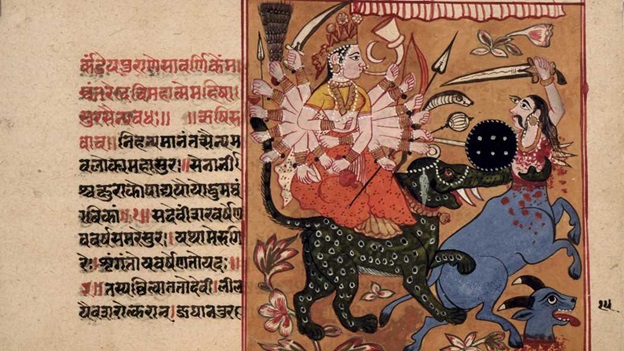
    The manuscript collections stem from the British Museum and India Office Libraries and owe their early growth to the activities of the first patrons of Indology studies who served in South Asia as employees of the East India Company. They include some of the earliest known Buddhist manuscripts (the Gandhari birch bark scrolls, Or. 14915) and the earliest datable Sanskrit manuscript (Or. 6403-04).

    The Stein and Hoernle manuscripts comprise Buddhist canonical literature from the 4th to the 10th centuries, from Dunhuang, Khadalik and other Silk Road oases. 

    Hindu manuscripts covering philosophy, theology, literature, law, science, astronomy, astrology, mathematics, and medicine date from the 10th century or earlier (Or. 3568). Beside we hold a collection of about 600 Vedic manuscripts including accented versions and ritual texts.

    A very wide range of different regional scripts in use over the centuries across the Indian Subcontinent is represented in these collections.

    Books and periodicals

    Our collections include about 60,000 printed books, mostly in Sanskrit and Prakrit, 450 of which were printed before 1850. 

    We have 2,900 Pali books in Sinhalese and South-East Asian scripts, as well as in Devanagari and Roman, including a large proportion of nissaya (exegetical literature) in Burmese script. They form an important source for the study of Theravāda Buddhism. 1,500 of the Pali books belong to the Hugh Nevill collection, many with Sinhalese commentaries. The collection is particularly strong on monograph series and ‘Vernacular tracts’ published between 1867 and 1947 (under the Indian Press and Registration of Books Act) by various South Asian presses such as Nirnaya Sagara and Chowkhamba. They include limited-edition publications in Grantha and other South and North Indian scripts.

    What is available online?

    What is available in our Reading Rooms?

    Reference sources listed below are available in the Asian and African Studies Reading Room.

    Printed books acquired before 1984 are listed in card and microfiche catalogues also available in the Asian and African Studies Reading Room.

    Further information

    Catalogues and reference works on manuscripts

  • Where To Look For Ancient Indian Texts US Canada

    Where To Look For Ancient Indian Texts US Canada

    Through Hindu religious scriptures were/ are passed through oral traditions to succeeding generations,some of them especially relating to Tantra and rare stothras, Grammar, Sanskrit literature were later transcribed in the form of manuscripts.They are, in general ,written on Palm leaves.Not only in Sanskrit but literature, philosophical , religious texts in Indian regional languages like Tamil were also written in Palm Leaves.Vedas, the most authentic scriptures of Hinduism was transmitted orally. However, these were also written during later periods and the Manuscripts of the Vedas ,at least some of them are in Pune. I have written on this.

    The complete corpus of Vedic mantras as collected in Bloomfield‘s Vedic Concordance (1907) consists of some 89,000 padas (metrical feet), of which 72,000 occur in the four Samhitas”

    This is only for the Samhitas.

    Brahmanas,Aranyakas,Upanishads remain.

    There seems to be no information on when the Vedas were written in the form of manuscripts.

    The Digitized copies  of The Rigveda Brahmanas: the Aitareya and Kausītaki Brāhmanas of the Rigveda are in American Libraries.

    (Link provided below).https://ramanisblog.in/2014/07/23/where-are-manuscripts-of-vedas/

    Manuscripts form an invaluable part of India’s documentary heritage. They capture our thoughts, achievements, experience and lessons learnt from history; in other words, they constitute our ‘memory.’ The National Mission for Manuscripts has taken the initiative to nominate Indian manuscripts for inclusion in UNESCO’s Memory of the World register. Under this programme, UNESCO provides recognition to the most valuable documentary heritage of the world and facilitates its preservation and universal access to it. Moreover, efforts are made to increase awareness of the significance of these records.

    The Shaiva manuscripts in Pondicherry were awarded the status of UNESCO’s Memory of the World in 2005 in an application jointly submitted by the French Institute of Pondicherry, Centre for Ecole francaise d’Extreme-Oriente (EFEO) and the National Mission for Manuscripts.The Mission had submitted 2 nominations to UNESCO:

    • Collection of Rigveda manuscripts at Bhandarkar Oriental Research Institute, Pune
    • Gilgit manuscripts at the National Archives of India, New Delhi and the Department of Archaeology, Archives and Museums, Jammu and Kashmir https://www.namami.gov.in/memory-world

    We can also find ancient Indian manuscripts at Library of Congress US and Canada.

    The following is post by Jonathan Loar, South Asian Reference Librarian, Asian Division)

    In 1938, the Library of Congress received a three-year grant from the Carnegie Corporation to establish a project for the development of Indic studies, which was the Library’s first initiative to collect South Asian materials systematically. This grant enabled the project’s director, Horace Poleman, to spend about a year in India between 1939 and 1940. Urgency moved him to collect both rare books and contemporary works on modern affairs, as the outbreak of World War II cast uncertainty on the future of obtaining publications from India and the rest of the region. Poleman’s trip resulted notably in the Library’s acquisition of a large number of Sanskrit manuscripts, such as the Vyavasthasarasangraha (a compendium of Hindu authorities on religious law), Sarasvatistotra (a hymn of praise to the Hindu goddess of learning and music Saraswati), and a copy of Raghunandana Bhattacarya’s Tithitattva (a treatise on Hindu rituals to be performed on specific lunar days) dated to 1628.

    Sanskrit is one of the principal classical languages of ancient India. The word itself means something like “perfected,” “refined,” or “well put together” (sam – together, krta – done, made). Works in Sanskrit are found throughout Buddhist, Jain, and Hindu religious traditions. For many Hindus, it is a sacred medium of expression – the language of ancient scriptures such as the Vedas, Upanishads, and Bhagavad Gita. Many people are familiar with Sanskrit in the Devanagari script – the same script used for Hindi, Nepali and other modern vernaculars – but Sanskrit texts have also been written in other writing systems, (e.g., the Grantha in southern India, the Sharada in Kashmir). To get a sense of what the language sounds like, check out some samples of poetry and prose from contemporary Sanskrit authors in the Library’s South Asian Literary Recordings Project.

    Sanskrit vowels and consonants with a guide to pronunciation, from H.H. Wilson’s “An Introduction to the Grammar of the Sanskrit Language,” 1841, Library of Congress general collections. Also freely available on HathiTrust.

    Poleman was prepared for his acquisition trip to India. In addition to holding a doctorate in Sanskrit from the University of Pennsylvania, he had already authored a comprehensive census of Indic manuscripts in North American libraries. The range of manuscripts in the Library’s collection reflects his deep understanding of Sanskrit literature. The majority deal with religious subjects, like the Anantapuja (worship), Shraddhasankalpa (funerary rites), and Gayatrisahasranamastotra from the Rudrayamala (esoteric religion, or tantra). There are also smaller works from sections of the Padma Purana, Brahmanda Purana, and other puranas, or religious texts that tell the stories of Hindu gods and goddesses. Notable works on other topics are the Vaiyyakaranasiddhantaratnakara (grammar) and Sanketakaumudi (astrology).https://blogs.loc.gov/international-collections/2018/01/sanskrit-manuscripts-in-the-south-asian-rare-books-collection/

    One can find rare manuscripts relating to Philosophy,Science, Astronomy, Astrology, Tantra Sastra, Grammar,..whole spectrum of Knowledge as acquired by Ancient India. These texts cover Hinduism,Jainism, Buddhism,Carvakas and Six systems of Indian Philosophy These texts are in Sanskrit,Pali.

    A census of Indic manuscripts in the United States and Canada,Cite Record.
    https://lccn.loc.gov/39001439
    Poleman, H. I. (Horace Irvin), 1905-1965. A census of Indic manuscripts in the United States and Canada, compiled by H. I. Poleman. New Haven, Conn., American oriental society, 1938.
    xxix, 542 p. 26 cm.
    Z6605.I5 P7. Visit the following Link.https://catalog.loc.gov/vwebv/citeRecord?searchId=612&recPointer=0&recCount=25&searchType=1&bibId=1691194

    Check this link also for rare collection.https://www.hathitrust.org/about