Tag: Ekadasi

  • Ekadasi Upavasa Prevents Aging Increased Neural Functions, Research.

    Ekadasi Upavasa Prevents Aging Increased Neural Functions, Research.

    Hindus fast once a month,that is on the eleventh day of the New Moon/Full Moon.It is called Ekadasi, Eleventh day.

    This day is dedicated to Lord Vishnu,one of the Trinity of Hinduism.

    Lord Vishnu is the ‘Sustainer’

    Hinduism believes in a healing body for Body is the dwelling place of Atman.

    Body is not to be abused.

    Tough spiritual practices,though in vogue,are called as Tamasic(Bhagavad-Gita).

    They are called Asura Tapas,tough on body and as such is relegated behind Gnana, Bhakti and Karma Yogas.

    In Asura Tapas one goes on Fasting for even years, sometimes people live on Water or only on Air!

    But more beneficial results may be obtained by following The Satvic practice of Upavasa.

    Upvasa is Fasting

    Hinduism, Jainism and Buddhism advocate Upavasa.

    While Jainism prescribed Upavasa for long periods,Hinduism recommends once a month.

    On Ekadasi.

    On this day one fasts completely.

    No intake of food at all.

    The next morning,Dwadasi,light meal consisting of cooked Rice, Gooseberry salad in Curds along with special Greens,Agathikeerai in Tamil,is taken.

    This process ,along with taking three spoonful of Tulasi immersed water,after offering food to Lord Vishnu ,is called Bhaarana.

    This light food taken after complete fasting on the earlier day increased longevity and cleans the stomach.

    I am providing a research study done in September,2018,which states that fasting,

    induce anti-aging effects and alleviate aging-related neurodegeneration.

    Study Highlights.
    Published:September 06, 2018

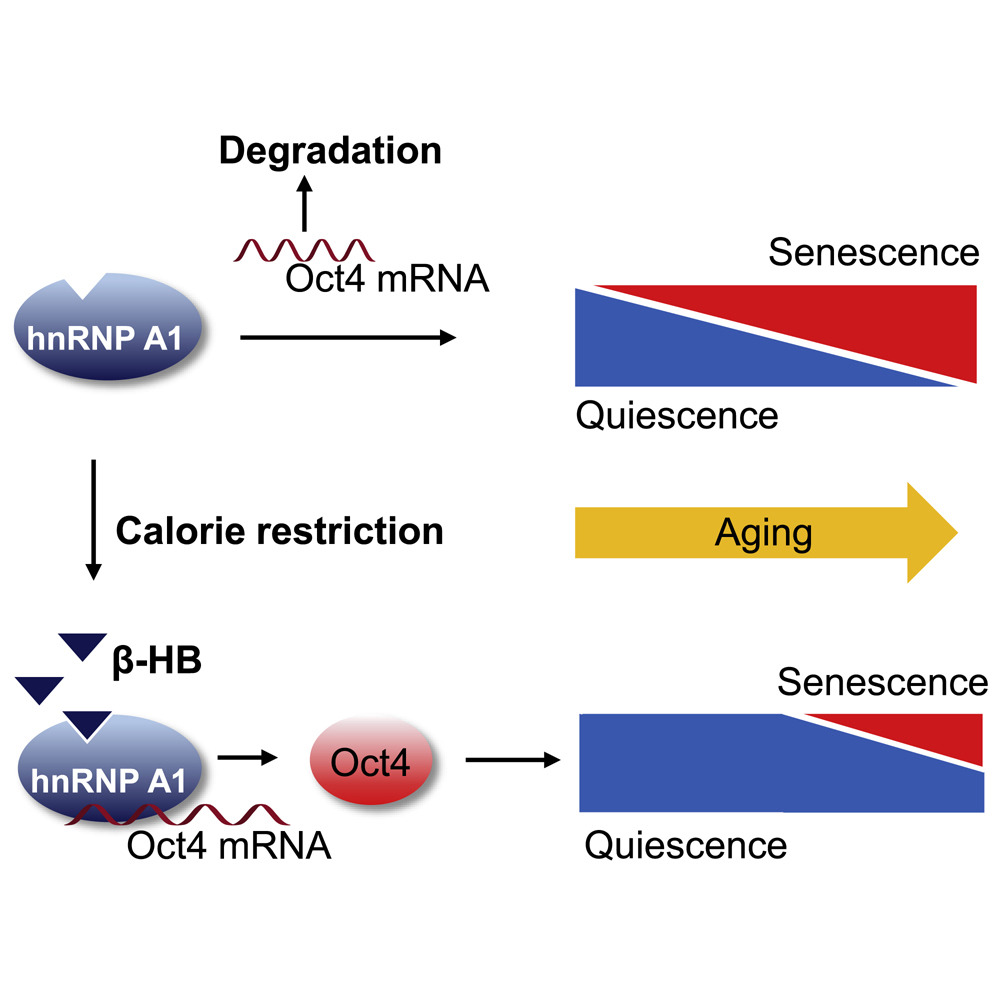
    • β-hydroxybutyrate prevents the vascular cell senescence
    • β-hydroxybutyrate upregulates Oct4 expression via interacting with hnRNP A1
    • Oct4-mediated quiescence is able to attenuate hallmarks of senescence
    • Circulating β-hydroxybutyrate alleviates the senescence of mouse aorta
    Summary

    β-hydroxybutyrate (β-HB) elevation during fasting or caloric restriction is believed to induce anti-aging effects and alleviate aging-related neurodegeneration. However, whether β-HB alters the senescence pathway in vascular cells remains unknown. Here we report that β-HB promotes vascular cell quiescence, which significantly inhibits both stress-induced premature senescence and replicative senescence through p53-independent mechanisms. Further, we identify heterogeneous nuclear ribonucleoprotein A1 (hnRNP A1) as a direct binding target of β-HB. β-HB binding to hnRNP A1 markedly enhances hnRNP A1 binding with Octamer-binding transcriptional factor (Oct) 4 mRNA, which stabilizes Oct4 mRNA and Oct4 expression. Oct4 increases Lamin B1, a key factor against DNA damage-induced senescence. Finally, fasting and intraperitoneal injection of β-HB upregulate Oct4 and Lamin B1 in both vascular smooth muscle and endothelial cells in mice in vivo. We conclude that β-HB exerts anti-aging effects in vascular cells by upregulating an hnRNP A1-induced Oct4-mediated Lamin B1 pathway..

    Source.

    https://www.cell.com/molecular-cell/fulltext/S1097-2765(18)30605-1

  • What Is Vaikunta Ekadasi Origin Procedure

    Vaikunta Ekadashi 2017.

    For January Vaikuntha Ekadashi…
    On 10th, Parana Time = 07:17 to 09:29
    On Parana Day Dwadashi would be over before Sunrise
    Vishnu ViswaroopamVisnu's Cosmic Form.
    Viswaroopa Of Vishnu.
    Smartha Vaikuntha Ekadashi = 08/01/2017
    On 9th, Parana Time for Smartha Ekadashi = 13:50 to 16:01
    On Parana Day Hari Vasara End Moment = 10:17
    Ekadashi Tithi Begins = 07:52 on 8/Jan/2017
    Ekadashi Tithi Ends = 05:03 on 9/Jan/2017

    The term Ekadasi means eleven. Hindus follow two calendars.

    One is Surya Manasa, following the movement of the Sun.

    The other one is Chandra Manasa where one follows the waxing and waning of the Moon.

    In Surya Manasa, the Stars, Nakshatras are given importance for calculations of festivals and auspicious occasions.

    Chandra Manasa takes into account  the wacing and waning of the Moon, called the Thithis. Nakshatras 28  and Thithis are fifteen.

    Thithis are taken into account for calculation of inauspicious occasions like death and performance of Death related rituals like Srardha.

    The period from the New Moon Day to Full Moon Day is called Sukla Paksha, which is considered auspicious and for auspicious occasions days/dates are fixed during this period.

    However major Vows or Vratas are observed during the waning Moon period, Krishna Paksha.

    Vaikunta Ekadasi,Shivratri,Shashti(for Lord Subramanya), Ganesh Chaturthi are observed in this period.

    Of the major Vrats, Vaikunta Ekadasi is observed in Onesiance to Lord Vishnu and this is believed to grant many a boon, including the ttainment of Lord Vishnu’s feet at His Abode, The Vaikunta.

    This is observed on the eleventh day of the Moon Cycle and the one that falls during Sukla Paksha is important.

    However, most important Ekadasi which occurs in the month of Mrigasira, Margazhi in Tamil,December-January in Gregorian calendar, is of special importance and is celebrated on agrand scale in sri Vaishnava Temples, Sriranagam and Srivilliputtur are famous for this occasion.

    Early in the morning of the Vaikunta Ekadasy Day, the doors leading to the Inner Sanctum of Lord Vishnu is opened and people enter through this. Special poojas are performed.

    The doors remain closed during the other days.

    During the Ekadasi day one is expected to fast and take nothing. The next day, Dwadasi, Tulasi water is to be drunk followed by austere food.

    This consists of a Raita prepared out of a Dhal Urad dhal,Black Gram), and special Green leaf vegetable(Agathi Keerai) along with a salad of Amla, Nellikkai,Gooseberry in Curds .

    Food can be taken once during the day.

    At night,light snack made of rice are taken.

    The taking of Tulasi water in the morning of Dwadasi is called Dwadasi Baranai’

    Now people take light snacks on the Ekadasi day.

    This is not correct.

    On the Ekadasi day one engages himself in chanting the names Lord Vishnu and visiting His Temple.

    One also enters His Inner Sanctum through the Doors early in the morning.

    The origin of Ekadashi Vrata.

    According the to Vishnu Purana, fasting on Vaikuntha Ekadashi is equivalent to fasting on the remaining 23 Ekadashis of the (Hindu) year.[2] However according to Vaishnava tradition fasting is mandatory on all Ekadashi of both Shukla paksha and Krishna paksha. Fasting on Ekadashi is considered holier than any other religious observation.

    Vishnu opened the gate of Vaikuntham (his abode) for two demons in spite of their being against him. They also asked for the boon that whoever listens to their story and sees the image of Vishnu coming out of the door (called Dwar), called Vaikunth Dwar, will reach Vaikunth as well. Temples all over India make a door kind of structure on this day for devotees to walk through.

    According to Padma Purana, the female energy of Vishnu slayed the demon Muran and protects the ‘Devas’. This happened on the eleventh day of lunar month during the sun’s journey in the Dhanurrashi or Dhanu Rashi. Impressed by the act, Vishnu names her as ‘Ekadashi’ and gives her the boon that those who worship ‘Ekadashi’ on the day of her victory over Muran would reach ‘Vaikunth’ (His abode).[3]

    Vaikuntha Ekadashi is one of the important and auspicious days for Hindus. It is dedicated to Vishnu. It occurs in the Hindu calendar, in the month of Margashirsha (between December and January). When observed, it bestows liberation from the cycle of birth and death.

    Mohini Alankaram

    Sri Namperumal – Vaikunda Ekadasi Festival – Pagalpatthu 10 day

    2017 January 8

    Sri Namperumal – Vaikunda Ekadasi Festival – Irappatthu (night) 1 day

    Vaikunda Ekadasi – Sorga Vasal Opening (4.30 AM)
    Moolavar Muthangi seva, Namperumal Rathnangi seva

    2017 January 9

    Sri Namperumal – Vaikunda Ekadasi Festival – Irappatthu (night) 2 day

    Moolavar Muthangi seva

    2017 January 10

    Sri Namperumal – Vaikunda Ekadasi Festival – Irappatthu (night) 3 day

    Moolavar Muthangi seva

    2017 January 11

    Sri Namperumal – Vaikunda Ekadasi Festival – Irappatthu (night) 4 day

    Moolavar Muthangi seva

    2017 January 12

    Sri Namperumal – Vaikunda Ekadasi Festival – Irappatthu (night) 5 day

    Moolavar Muthangi seva

    2017 January 13

    Sri Namperumal – Vaikunda Ekadasi Festival – Irappatthu (night) 6 day

    Moolavar Muthangi seva

    2017 January 14

    Sri Namperumal – Vaikunda Ekadasi Festival – Irappatthu (night) 7 day
    Moolavar Muthangi seva, Namperumal Kaithala seva,

    Nammalwar Mohini Alankaran

    2017 January 15

    Sri Namperumal – Vaikunda Ekadasi Festival – Irappatthu (night) 8 day

    Thirumangaimannan Vedupari – Namperumal Horse vahanam

    2017 January 16

    Sri Namperumal – Vaikunda Ekadasi Festival – Irappatthu (night) 9 day

    2017 January 17

    Sri Namperumal – Vaikunda Ekadasi Festival – Irappatthu (night) 10 day

    Theerthavari

    Vaikunta Ekadasi Significance.

    According the to Vishnu Purana, fasting on Vaikuntha Ekadashi is equivalent to fasting on the remaining 23 Ekadashis of the (Hindu) year.[2] However according to Vaishnava tradition fasting is mandatory on all Ekadashi of both Shukla paksha and Krishna paksha. Fasting on Ekadashi is considered holier than any other religious observation.

    Vishnu opened the gate of Vaikuntham (his abode) for two demons in spite of their being against him. They also asked for the boon that whoever listens to their story and sees the image of Vishnu coming out of the door (called Dwar), called Vaikunth Dwar, will reach Vaikunth as well. Temples all over India make a door kind of structure on this day for devotees to walk through.

    According to Padma Purana, the female energy of Vishnu slayed the demon Muran and protects the ‘Devas’. This happened on the eleventh day of lunar month during the sun’s journey in the Dhanurrashi or Dhanu Rashi. Impressed by the act, Vishnu names her as ‘Ekadashi’ and gives her the boon that those who worship ‘Ekadashi’ on the day of her victory over Muran would reach ‘Vaikunth’ (His abode).[3]

    Vaikuntha Ekadashi is one of the important and auspicious days for Hindus. It is dedicated to Vishnu. It occurs in the Hindu calendar, in the month of Margashirsha (between December and January). When observed, it bestows liberation from the cycle of birth and death.”

    Reference for Legend :wiki.

    Live coverage.

    http://www.southupdates.in/srirangam-vaikunta-ekadasi-2017-live-sorgavasal-jaya-tv/


    References and citations.

    http://www.drikpanchang.com/ekadashis/vaikuntha/vaikuntha-ekadashi-datetime.html


    Enhanced by Zemanta