Hindus fast once a month,that is on the eleventh day of the New Moon/Full Moon.It is called Ekadasi, Eleventh day.
This day is dedicated to Lord Vishnu,one of the Trinity of Hinduism.
Lord Vishnu is the ‘Sustainer’
Hinduism believes in a healing body for Body is the dwelling place of Atman.
Body is not to be abused.
Tough spiritual practices,though in vogue,are called as Tamasic(Bhagavad-Gita).
They are called Asura Tapas,tough on body and as such is relegated behind Gnana, Bhakti and Karma Yogas.
In Asura Tapas one goes on Fasting for even years, sometimes people live on Water or only on Air!
But more beneficial results may be obtained by following The Satvic practice of Upavasa.
Upvasa is Fasting
Hinduism, Jainism and Buddhism advocate Upavasa.
While Jainism prescribed Upavasa for long periods,Hinduism recommends once a month.
On Ekadasi.
On this day one fasts completely.
No intake of food at all.
The next morning,Dwadasi,light meal consisting of cooked Rice, Gooseberry salad in Curds along with special Greens,Agathikeerai in Tamil,is taken.
This process ,along with taking three spoonful of Tulasi immersed water,after offering food to Lord Vishnu ,is called Bhaarana.
This light food taken after complete fasting on the earlier day increased longevity and cleans the stomach.
I am providing a research study done in September,2018,which states that fasting,
‘
induce anti-aging effects and alleviate aging-related neurodegeneration.
Study Highlights. Published:September 06, 2018
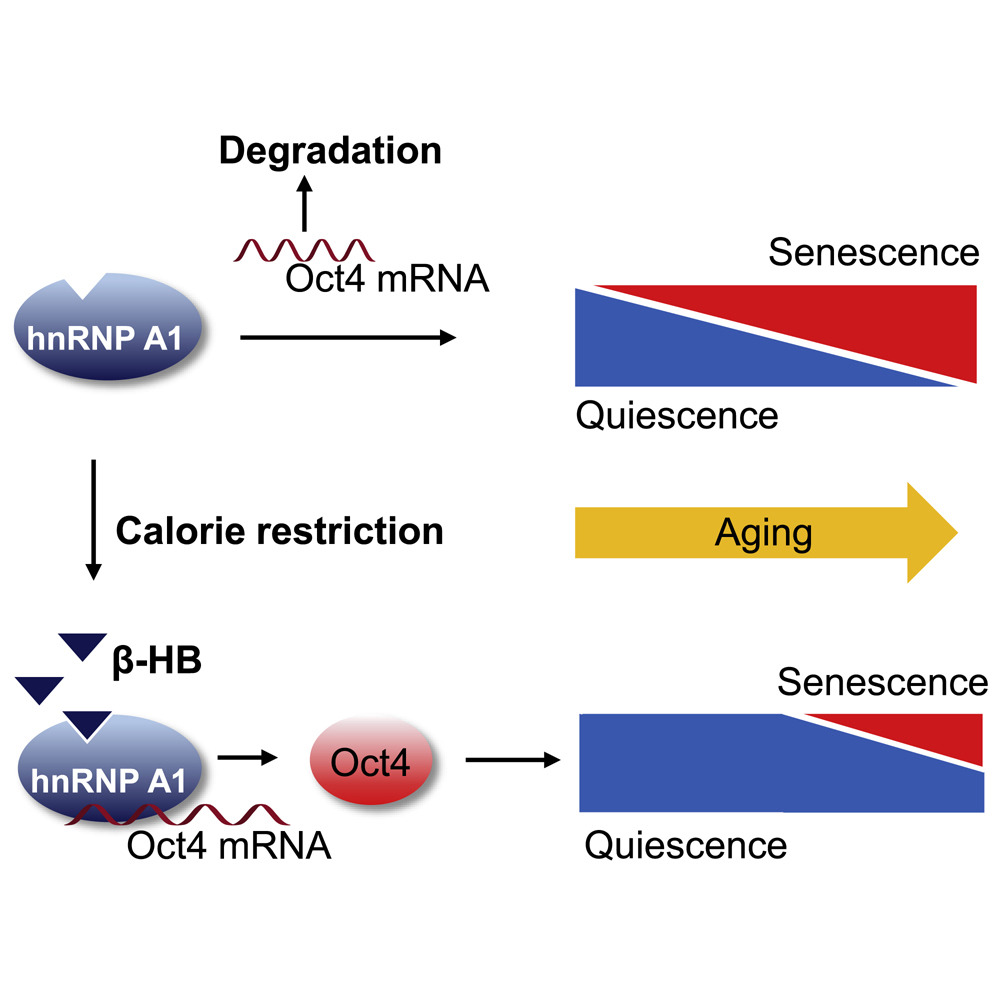
β-hydroxybutyrate prevents the vascular cell senescence
β-hydroxybutyrate upregulates Oct4 expression via interacting with hnRNP A1
Oct4-mediated quiescence is able to attenuate hallmarks of senescence
Circulating β-hydroxybutyrate alleviates the senescence of mouse aorta
Summary
β-hydroxybutyrate (β-HB) elevation during fasting or caloric restriction is believed to induce anti-aging effects and alleviate aging-related neurodegeneration. However, whether β-HB alters the senescence pathway in vascular cells remains unknown. Here we report that β-HB promotes vascular cell quiescence, which significantly inhibits both stress-induced premature senescence and replicative senescence through p53-independent mechanisms. Further, we identify heterogeneous nuclear ribonucleoprotein A1 (hnRNP A1) as a direct binding target of β-HB. β-HB binding to hnRNP A1 markedly enhances hnRNP A1 binding with Octamer-binding transcriptional factor (Oct) 4 mRNA, which stabilizes Oct4 mRNA and Oct4 expression. Oct4 increases Lamin B1, a key factor against DNA damage-induced senescence. Finally, fasting and intraperitoneal injection of β-HB upregulate Oct4 and Lamin B1 in both vascular smooth muscle and endothelial cells in mice in vivo. We conclude that β-HB exerts anti-aging effects in vascular cells by upregulating an hnRNP A1-induced Oct4-mediated Lamin B1 pathway..
The eleventh day of the movement of the Moon is called Ekadasi.
The Eleventh day from New Moon is Shukla Paksha Ekadasi and the during the waning of the Moon Krishna Paksha.
Shukla means white, Krishna, Black.
Hinduism recommends fasting and the chanting of Vishnu’s name during this period.
Aashada Ekadasi Pandharpur Festival
Though there are many Ekadasis some are special, Vaikunta Ekadasi for instance.
Equally sacred is the Shayani Ekadasi or Aashada Ekadasi.
On this day, it is believed that Lord Vishnu goes to sleep.
This description is not technically correct.
Sayana means lying down .
śayana — sleeping; SB 1.10.11-12
śayana — lying down; SB 1.11.16-17
śava-śayana — dead bodies; SB 4.7.33
śayana — lying down; SB 5.8.11
śayana — lying down; SB 7.5.38
śayana — beds; SB 10.48.2
śayana — putting to bed; SB 10.59.45
śayana — arranging His bed; SB 10.61.6
śayana — in taking rest; SB 11.5.47
śayana — in the activities of lying down; SB 11.5.48
śayana — rest; SB 12.3.39-40
karena śayana — lies down; CC Adi 5.55
śayana — on the bed; CC Adi 5.99
Hindu Gods do not sleep
Only when these Gods manifest, to follow Human Norms they perform activities of Man.
What this means is that Vishnu enters His Yoga Nidra.
Looks asleep yet completely with Pure Consciousness.
Lord Vishnu the Para Brahma Swarpa, how can He sleep?
Many translate this Yoga Nidra as ari thuyil, using the soft ‘R’ Itayinam.
It should be the vallinam , R aRi thuyil.
The former means Vishnu’s Sleep, while the later, which is correct, means , Sleeping with Awareness.
”
Vaishnava Devshayani Ekadashi = 09/07/2014
Next Day Parana Time for Vaishnava Ekadashi = 06:03 to 08:35
On Parana Day Dwadashi would be over before Sunrise
Ekadashi Tithi Begins = 05:56 on 8/Jul/2014
Ekadashi Tithi Ends = 04:39 on 9/Jul/2014
Shayani Ekadashi (lit. “sleeping eleventh”) or Maha-ekadashi (lit. “The great eleventh”) or Prathama-ekadashi (lit. “The first eleventh”)
or Padma Ekadashi or Devshayani Ekadashi or Devpodhi Ekadashi is the eleventh lunar day (Ekadashi) of the bright fortnight (Shukla paksha)
Thus it is also known as Ashadhi Ekadashi or Ashadhi.
This holy day is of special significance to Vaishnavas, followers of Hindu preserver god Vishnu.
On this day images of Vishnu and Lakshmiare worshipped, the entire night is spent singing prayers, and devotees keep fast and take vows on this day, to be observed during the entire chaturmas, the holy four month period of rainy season.
These may include, giving up a food item or fasting on every Ekadashi day.
It is believed that Vishnu falls asleep in Ksheersagar – cosmic ocean of milk – on Sheshanāga, the cosmic serpent.
Thus the day is also called Dev-Shayani Ekadashi (lit. “god-sleeping eleventh”) or Hari-shayani Ekadashi (lit. “Vishnu-sleeping eleventh“) or Shayana Ekadashi. Vishnu finally awakens from his slumber four months later on Prabodhini Ekadashi – eleventh day of bright fortnight in the Hindu month Kartik (October–November).
This period is known as Chaturmas (lit. “four months”) and coincides with the rainy season.
Thus, Shayani Ekadashi is the beginning of Chaturmas. Devotees start observing the Chaturmas vrata (vow) to please Vishnu on this day.
A fast is observed on Shayani Ekadashi. The fast demands abstainance from all grains, beans, cereals, certain vegetables like onions .
The recommended diet.
Shaka[vegetables], dadhi[curd], kshira[milk] and dvidala [di-cotyledons and multiseeded
products] are the four vratas observed in these four months. Each vrata is commenced
with a sankalpa, and at the end of chaturmasya it is concluded with homa and Brahmana
puja. During this time, Sanyasi-s stay in one place and follow special procedures as a
worship to Lord. Snana, japa, and dana done during these four months get immense
phala.
The first month is shAka vrata, where all vegetables are given up to please Lord Sri
Shridhara, the niyamaka for this month.
Dadhi vrata is the second one and all items of curd are given up to get special blessings
from Sri Hrishikesha, the niyamaka.
During Kshira vrata, all milk items are given up to get the prasada of Sri Padmanabha.
The last vrata is Dvidala and bahubhija where all di-cots and multi seeded items are given
up to get the grace of Sri Damodhara.
Celebrations.
This is celebrated on a grand scale in Maharashtra and Goa.
This day, a huge yatra or religious procession of pilgrims known as Pandharpur Ashadi Ekadasi Waari Yatra culminates at Pandharpur, in Solapur district in south Maharashtra, situated on the banks of the ChandraBhaga River.
Pandharpur is main center of worship of the deityVithoba, a local form of Vishnu. lacs of pilgrims come to Pandharpur on this day from different parts of Maharashtra.
These pilgrims are referred to as Warkaris. They sing Abhangas (chanting hymns) of Saint Tukaram and Saint Dnyaneshwar, dedicated to Vithoba.
Yogini Ekadasi.
Yudhisthira Maharaj said, “Oh Supreme Lord, I have heard the glories of the Nirjala Ekadasi, which occurs during the light fortnight of the month of Jyeshtha (May – June).
Now I wish to hear from You about the suddha Ekadasi that occurs during the dark fortnight of the month of Ashadha (June – July).
Kindly describe to me all about it in detail, Oh killer of the Madhu demon (Madhusudana).”
The Supreme Lord, Sri Krishna, then replied, “Oh king, I shall indeed tell you about the best of all fasting days, the Ekadasi that comes during the dark part of the month of Ashadha. Famous as Yogini Ekadasi, it removes all kinds of sinful reactions and awards supreme liberation.
“Oh best of kings, this Ekadasi delivers people who are drowning in the vast ocean of material existence and transports them to the shore of the spiritual world.
In all the three worlds, it is the chief of all sacred fasting days.
I shall now reveal this truth to you by narrating a history recounted in the Puranas.
“The king of Alakapuri – Kuvera, the treasurer of the devas (demigods) – was a steadfast devotee of lord Shiva.
He employed a servant named Hemamali as his personal gardener.
Hemamali, a Yaksha like Kuvera, was very lustfully attracted to his gorgeous wife, Swarupavatii, who had large, enchanting eyes.
“Hemamali’s daily duty was to visit Manasarovara Lake and bring back flowers for his master, Kuvera, with which he would use them in the puja offerings to lord Shiva.
One day, after picking the flowers, Hemamali went to his wife instead of returning directly to his master and fulfilling his duty by bringing the flowers for the puja.
Absorbed in loving affairs of a bodily nature with his wife, he forgot to return to the abode of Kuvera.
“Oh king, while Hemamali was enjoying with his wife, Kuvera had begun the worship of lord Shiva as normal in his palace and soon discovered that there were no flowers ready to be offered in the midday puja.
The lack of such an important item (upachara) angered the great Koshad-yaksha (treasurer of the devas) even more, and he asked a Yaksha messenger, ‘Why has dirty-hearted Hemamali not come with the daily offering of flowers?
Go find out the exact reason and report back to me in person with your findings.’
The Yaksha returned and told Kuvera, ‘Oh dear lord, Hemamali has become lost in freely enjoying coitus with his wife.’
“Kuvera became extremely angry when he heard this and at once summoned lowly Hemamali before him.
Knowing that he had been remiss and dawdling in his duty and exposed as meditating on his wife’s body, Hemamali approached his master in great fear.
The gardener first paid his obeisances and then stood before his lord, whose eyes had become red with anger and whose lips trembled in rage.
So enraged, Kuvera cried out to Hemamali, ‘Oh you sinful rascal! Oh destroyer of religious principles! You are a walking offense to the devas!
I therefore curse you to suffer from white leprosy and to become separated from your beloved wife! Only great suffering is deservedly yours!
Oh lowborn fool, leave this place immediately and betake yourself to the lower planets to suffer!’
“And so Hemamali fell at once from grace in Alakapuri and became ill with the terrible affliction of white leprosy.
He awoke in a dense and fearful forest, where there was nothing to eat or drink.
Thus he passed his days in misery, unable to sleep at night due to pain.
He suffered in both winter and summer season, but because he continued to worship lord Shiva himself with faith, his consciousness remained purely fixed and steady.
Although implicated by great sin and its attendant reactions, he remembered his past life because of his piety.
“After wandering for some time here and there, over mountains and across plains, Hemamali eventually came upon the vast expanse of the Himalayan mountain ranges.
There he had the wonderful good fortune to come in contact with the great saintly soul Markandeya Rishi, the best of ascetics, whose duration of life it is said, extends to seven of the days of Brahma.
“Markandeya Rishi was seated peacefully at his Ashrama, looking as effulgent as a second Brahma.
Hemamali, feeling very sinful, stood at a distance from the magnificent sage and offered his humble obeisances and choice prayers.
Always interested in the welfare of others, Markandeya Rishi saw the leper and called him near, “Oh you, what sort of sinful deeds have you done to earn this dreadful affliction?’
“Hearing this, Hemamali painfully and ashamed replied, ‘Dear sir, I am a Yaksha servant of lord Kuvera, and my name is Hemamali.
It was my daily service to pick the flowers from the Manasarovara lake for my master’s worship of lord Shiva, but one day I was negligent and was late in returning with the offering because I had become overwhelmed with lusty passion for enjoying bodily pleasures with my wife.
When my master discovered why I was late, he cursed me in great anger to be as I am before you.
Thus I am now bereft of my home, my wife, and my service.
But fortunately I have come upon you, and now I hope to receive from you an auspicious benediction, for I know that devotees such as you are as merciful as the Supreme Lord (Bhakta Vatsala) and always carry the interest of others uppermost in their hearts.
That is their – your nature. Oh best of sages, please help me!’
“Softhearted Markandeya Rishi replied, ‘Because you have told me the truth, I shall tell you about a fast day that will benefit you greatly.
If you fast on the Ekadasi that comes during the dark fortnight of the month of Ashadha, you will surely be freed of this terrible curse.’
Hemamali fell to the ground in complete gratitude and offered him his humble obeisances again and again.
But Markandeya Rishi stood there and lifted poor Hemamali to his feet, filling him with inexpressible happiness.
“Thus, as the sage had instructed him, Hemamali dutifully observed the Ekadasi fast, and by its influence he again became a handsome Yaksha.
Then he returned home, where he lived very happily with his wife.”
Lord Sri Krishna concluded, “So, you can readily see, Oh Yudhishthira that fasting on Yogini Ekadasi is very powerful and auspicious.
Whatever merit one obtains by feeding eighty-eight thousand brahmins is also obtained simply by observing a strict fast on Yogini Ekadasi.
For one who fasts on this sacred Ekadasi, she (Ekadasi Devi), destroys heaps of past sinful reactions and makes him most pious.
Oh King, thus I have explained to you the purity of Yogini Ekadasi.”
Thus ends the narration of the glories of Ashadha-krishna Ekadasii, or Yogini Ekadasi, from the Brahma-vaivarta Purana.
You must be logged in to post a comment.