

I have posted quite a few articles on the antiquity and the influence of Sanatana Dharma over world Religions and Culture of great civilizations of Mankind.
Whether it is Maya,Incas,Polynesian,Minoan, Sumerian, Egyptian or Greek, one can find the influence of Hinduism.
Let us see how Hinduism is present in the Greek Religion, Culture,Literature and Philosophy.

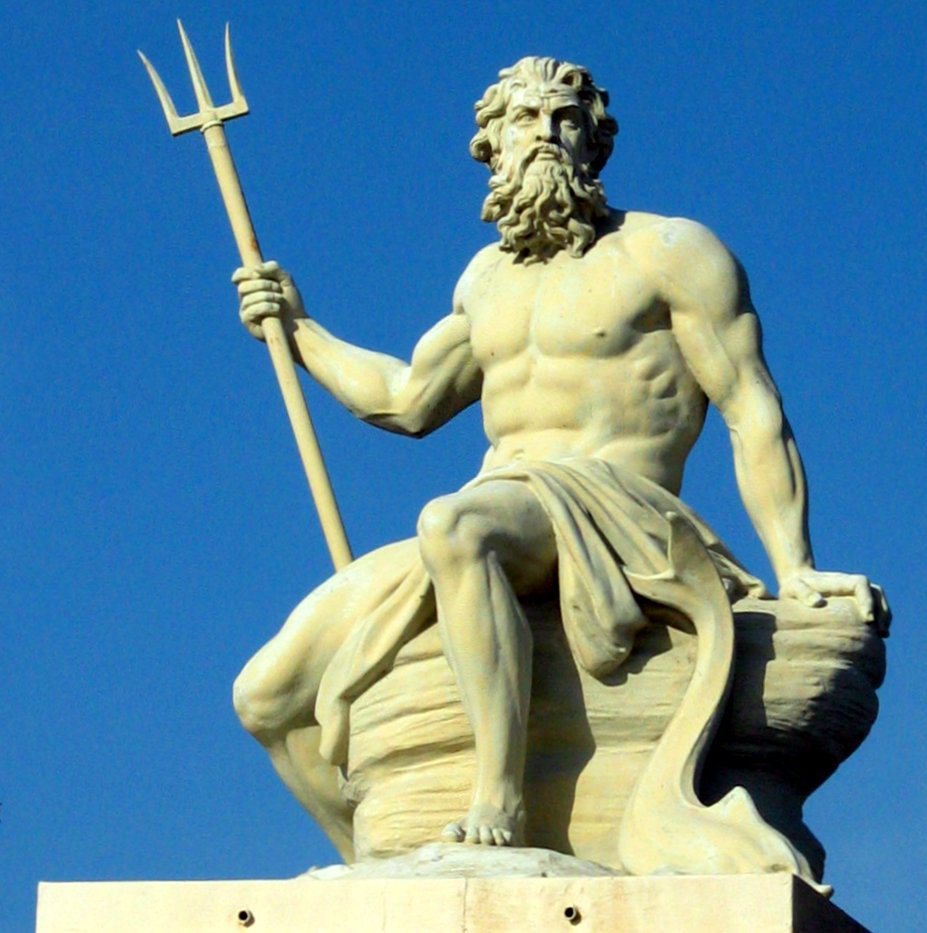
I have posted earlier the connection between Poseidon and Varuna and Shiva.
The Aitreya Brahmana speaks of the movement of the Sun to its stating point.
In Greeks,
Stesichorus(5) and Mimnermus speak
        of the  Sun's  traveling  over  the  ocean  in a cup.
        Mimnermus says: "For a delightful  hollow couch bears
        him over  the  wave, a couch  forged  by the hand  of
        Hephaistus,  made  of  precious  gold,  winged, which
        bears him sleeping over the water's surface, hurrying
        him back from the land of the Hesperides  to the land
        of the Ethiopians."
(Fr.10       Diehl, Anthologia  Lyrica  Graeca (3d
            ed;  Leipzig: 1949).  See also Stesichorus Fr.  6
            Diehl)


In the early Vedic thought, the primary or the first principle has been Water.

This thought is reflected in the Iliad XIV 201 and 246.

Similarity of Gods.


Vedic Dyaus is Zeus,

Varuna,Ouranos, Poseidon,

Agni becomes Ignis in Latin drawn from Greeks with modification, and

Ushas is Eos


Asvini Devatas,Dioscur.

The Concept of Ra, Law of Nature, Cours of Things is the Dike of the Greeks.
”
The Hindu conception of .Rta, the law of
        Nature, or "course  of things," has the same scope as
        the Greek  dike,(13) and a saying  of Heraclitus,'The
        sun shall not transgress  its bounds,"(14) might have
        been  written  with  .Rg Veda I.24.8  and I.160.1  in
        mind.
In the more imaginative view of the Upani.sads,we
        find  that  a  personal  god,  Prajaapati  ("lord  of
        creatures"), draws  forth  from himself  all existing
        things, or, in mother  passage, (20) divides  himself
        into male and female  and producer  all creatures  by
        this self-division. One might adduce here the similar
        Chinese doctrine  of yang and yin, the principles  of
        expansion  and  contraction  by which  the  world  is
        formed  from chaos. Empedocles stems to be expressing
        similar  idea  or,  rather,  combining  it  with  the
        equally ancient doctrine  of primordial  strife, also
        found in the Upanishads:


In a passage of the  Rig Veda, Vac is praised as a divine being. Vac is omnipotent, moves amongst divine beings, and carries the great gods,

Mitra, Varuna, Indra and Agni, within itself. The doctrine of Vac teaches that "all gods live from Vac, also all demi-gods, animals and people.

 Vac is the eternal being, it is the first-born of the eternal law, mother of the Vedas and navel of immortality."

Vedic Aryans attached such great importance to the spoken word that one who could not correctly pronounce Sanskrit was

called barbar (meaning stammering).

Philosophy.
 Anyone   who  studies   the  Hindu  theories   of
        perception  and cognition as set forth in the Nyaaya,
        Vai'se.sika, and Saa^mkhya  systems and then turns to
        the fragments  of Empedocles  cannot but be struck by
        the similarity of their theories.
            Empedocles is keenly conscious of a sort of "fall
        of man" and affects to remember  past births as plant
        and animal, boy  and girl.(28) The way  by which  the
        original bliss may be gained, from which he is now an
        exile,(29) is  by asceticism, the  Hindu  method.  He
        advises meditation, for by this means all truth shall
        be revealed and even supernormal powers attained.(30)
        In the end, the soul of the righteous ascetic regains
        its divinity--a  counterpart  of the Hindu belief  in
        reincarnation   and   mok.sa.  See,  in   particular,
        Empedocles, B.146  (Diels): "At the  end they  became
        seers  and  bards  and  chiefs  and physicians  among
        mortal  men, and finally  they blossom  forth as gods
        highest in honor."
            There  may even be an echo  of the monism  of the
        Upani.sads  in  Empedocles,  which, like  many  other
        features  of  his  philosophy,  seems  to  have  been
        mediated   through   Orphism.   In  the  Maa.n.duukya
        Upani.sad  I.7 we find a list of the qualities of the
        One, which  has resemblances  to Fr.   B17 (Diels) of
        Empedocles as quoted above.
            A distinct  tradition  of mysticism  runs through
        Orphism, Pythagoras, and  Plato  which  is  as unlike
        anything  in Greek  thought  as it is like  the Hindu
        mysticism of the Upani.sads. There is a distinct break
        with  rationalist   humanism  and  with  the  healthy
        unreflecting  extraversion  of the seventh  and sixth
        centuries.  Instead of Homer's "Themselves  he made a
        prey  to dogs,"(31) we have  a complete  shifting  of
        emphasis from the physical to the spiritual, from the
        temporal  to the eternal.  Reality is not now what is
        perceived  by the senses  but what lies beyond  them.
        The soul lives  an in
Citation.

http://buddhism.lib.ntu.edu.tw/FULLTEXT/JR-PHIL/marlow.htm



Reblogged this on panindiahindu.
Reblogged this on free Hindi ebooks and commented:
Greek Gods Philosophy From Hinduism?