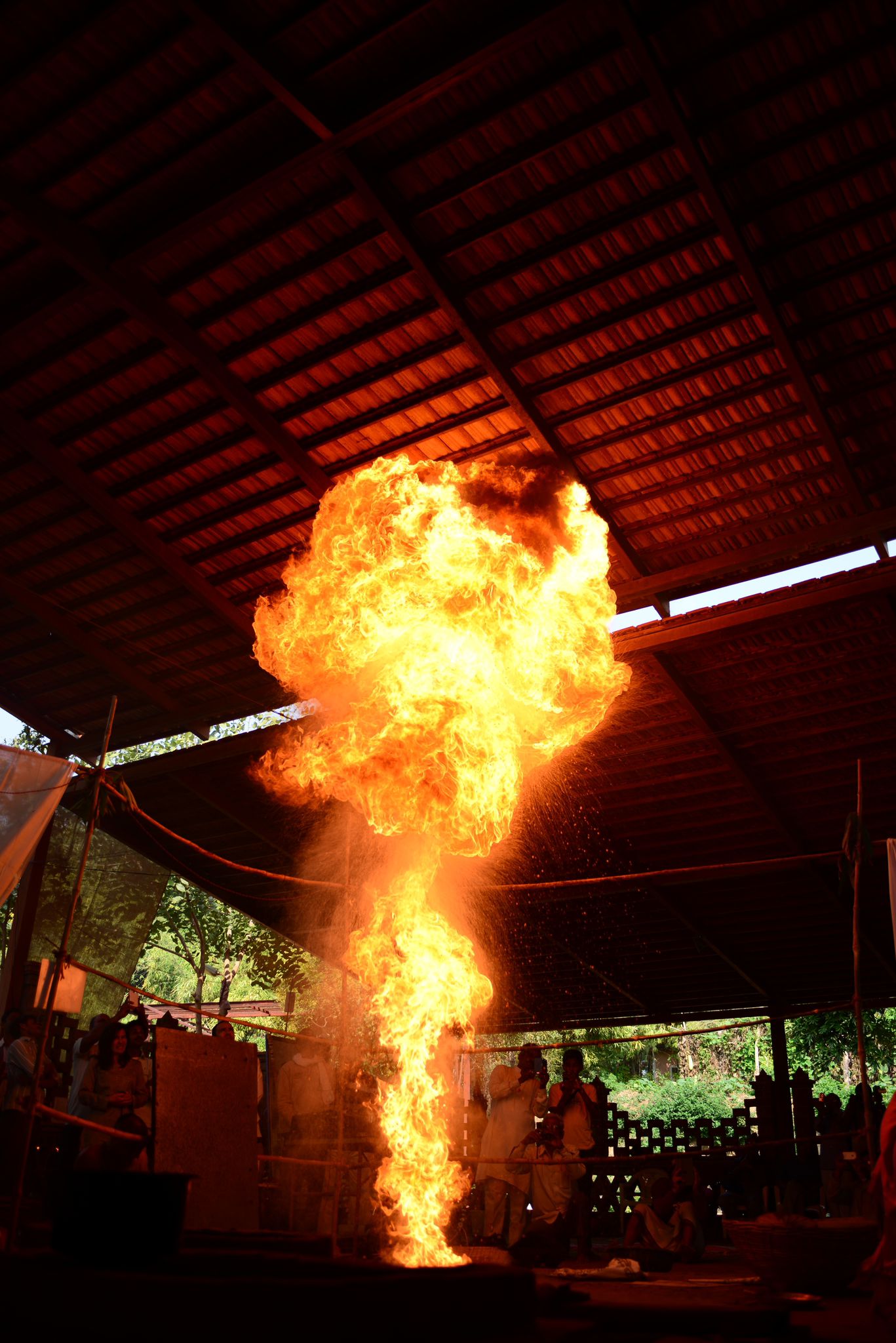
Tag: Agni

  • Homa Cleans Environment Rids Microbes 3870°C Athirathra Study

    Homa Cleans Environment Rids Microbes 3870°C Athirathra Study

    There are Homas and Yagnyas sanctioned by Vedas, the scriptural authority in Hinduism.

    Though performance of both are mandatory,they are different.

    Yagnyas need not involve Fire,for example Brahma Yagnyas,whereas Homas involve Fire ,Agni.

    Homas are performed with specific purpose in mind,like personal or welfare of the society or for Rains..

    But Yagnyas are mandatory.

    They are to be performed because they ought to be.

    It is A Duty.

    Example,Tharpana,Sraddha,Brahma Yagnyas.

    The Homa involves Agni,Fire,the Primary God of Sanatana Dharma.

    Agni,as Vaisvanara transmits the Oblations to the God addressed in The Homa.(though personal God’s are mentioned in Hinduism,the core of the Vedas describe Reality as Beyond Name and Form.For details click here.

    Scientific studies have been done on the efficacy of the Materials used in Homas,like Darbha and the Homas.

    Darbha,A scientific study

    Many Homas are prescribed in Vedas.

    Homas List.

    One such is Athirathra Homa.

    https://vimeo.com/139488147

    Athirathra Homa
    In the Sanatana Hindu Dharma, Pravargyawas a ceremony introductory to the Agnishtoma (Soma sacrifice), at which fresh milk is poured into a heated vessel called mahavira or gharma and offered to the Ashvins. The ceremony is described in details in the technical texts on proper ritual, the Brahmanas, Aranyakas and Shrautasutras.The temperature in the sun’s chromosphere is 4,320℃. As part of Pravargya (a special ball of fire), a sudden flash of temperature to the tune of 3870℃ is created in order to cleanse the environment.[citation needed] Pravargya almost matches the Sun’s temperature to cleanse the atmosphere.

    Source.

    https://en.m.wikipedia.org/wiki/Pravargyahttps://en.m.wikipedia.org/wiki/Pravargya

    A Scientific study has the following information.

    A 4,000 year old fire ritual conducted in the remote village in Kerala in April this year has a positive impact on the atmosphere, soil and other environment effects, according to scientists who are now ready with their findings.

    The “Athirathram” ritual held on April 4— 15 at Panjal village in Thrissur district was the focus of a detailed study by a team of scientists led by Prof V P N Nampoori, former director of the International School of Photonics, Cochin University of Science and Technology.

    The scientists had focused on the fire ritual’s scientific dimensions and impact on the atmosphere, soil and its micro—organisms and other potential environmental effects.

    The yagna seems to have accelerated the process of seed germination and also the microbial presence in air, water and soil in and around the region of the fire ritual is vastly diminished, according to a statement released by the Varthathe Trust, who organised the ritual.

    The team had planted three types of seeds — cowpea, green gram and Bengal gram — on all four sides of the ritual venue at varying distances. They found that the growth was better in case of pots kept closer to the fire altar.

    This effect, the study says, was more pronounced in the case of Bengal gram with growth about 2,000 times faster than in other places.

    According to Nampoori, sound is a vibration and continuous positive vibrations through chanting, accelerates the process of germination.

    “The findings would not only help dispel superstitious notions associated with Vedic rituals but also help in continuation of such tradition for the betterment of nature and the environment,” says Nampoori.

    He added that further research on the phenomenon were on which could prove that some bio—amplifier generated in the atmosphere because of the ritual, had a selective effect on Bengal gram.

    The study focused on counting bacterial colonies at three locations — within the yagnashala, 500 metres and 1.5 kilometres from the yagnasala. Microbial analysis made before, during and four days after the yagna revealed that the air in the vicinity of the yagnashala was pure and had very low count of microbe colonies.

    The research team also found that microbial activities in the soil and water around the yagnashala were remarkably less compared to normal ground.

    The “Athirathram” ritual which literally means “building up of the fireplace and performed overnight” and usually held to propagate universal peace and harmony, was first documented 35 years ago by US—based Indologist Frits Staal.

    Staal, currently Emeritus Professor of Philosophy and South and Southeast Asian Studies at the University of California, Berkeley had in 1975 organised and recorded the ritual in detail with the help of grants and donations from the Universities of Havard, Berkely and Finland”s Helsinki University.

    The research team conducted tests near the fire altars of the 1918 and 1956 Athirathram, still preserved in the backyards of Namboothiri homes, reveal that the bricks continue to be free of microbial presence.

    “It’s an indication that the effect of the ritual is long—lasting. Studies are on to find out if other positive changes on the atmosphere are transitional or permanent,” say researchers.

    An analysis conducted on the dimensions of temperature from the flames of the pravargya by Prof A K Saxena, head of photonics division, Indian Institute of Astrophysics, Bangalore, found that the fire ball that formed during the ritual had a particular wavelength with an unusually high intensity similar to what is observed in typical laser beams at about 3,870 degree centigrade.

    It may be possible to have stimulated emission at this wavelength (700 nm) and gain from plasma recombination. It needs to be studied further, he says.

    The members of the team of scientists’ team at the Panjal Athirathram 2011 included experts from various disciplines and included Dr Rajalakshmy Subrahmanian (Cusat), Dr Parvathi Menon (M G College, Thiruvanathapuram), Dr Maya R Nair (Pattambi Government College), Prof Saxena ( Indian Institute of Astrophysics, Bangalore) and Prof. Rao (Andhra University).

    The scientific team members were supported by Zarina (Research Scholar, CUSAT), Ramkumar (Biotechnologist), Asulabha (Biotechnologist) and a number of postgraduate, graduate and school students.

    Source

    https://www.thehindu.com/sci-tech/ancient-fire-ritual-has-positive-impact-on-environment-scientists/article2103881.ece

  • How To Prepare Homa Yagnya Fire Agni Manthan Process

    Fire is the primary God in Vedas and the Agni is to be prepared manually using Banyan twigs/logs ,chanting Agni Suktham.


    AGni Manthan Vedic ay of preparing fire for yagnya
    Implements to Prepare Vedic Fire, Agni Manthan
    Costs Rupees  -1100/)
    The lighting of the Havan Agni with the churning (Manthan) of the special instrument made from a banyan tree, is considered extremely auspicious.
    A participant said it required a lot of effort and that is why it is generally not used. It took them about 15 minutes to get it going.
    Creation of Fire for Homa
    Creation of Fire for Homa, the Vedic way of Creating fire.


    Preparing Homa, Yagnya fire with Camphor as is being practiced now is incorrect.

  • Morality For the Society First By Sanatana Dharma To World

    Sometimes I receive interesting comments.

    They are straight from the heart, they do not pretend they know things even though many may find it difficult to admit.

    In an Ocean called Hinduism., one gets doubts all the time and one is encouraged to question it.

    Atharva Veda on Effort. Atharva Veda on Effort.

    When I keep posting on researched articles, I find people are interested, intrigued and many have started reading Sanatana Dharma Texts, setting aside the prejudice of them being myths(propagated by the west) in anew Light.

    At the same time they get some  doubts and they convey it to me.

    Some through direct email or by comments to the Posts .

    One such comment is below.

    ‘Even though I am Hindu and yeah I don’t believe in idol worshipping but sometimes I doubt what was the first society or first rules made on earth whether it’s Hinduism or other Relevant religion.. Please can u light on some confusion’

    It requires a Hinduism to  allow you to say that you do not follow some of its tenets and yet say I am a Hindu!

    Sanatana dharma does not call it as heresy.

    It calls it as enquiry which it feels it ought to clarify and clear.

    As to the Moral principles rules by a society for the first time in the world, it is undoubtedly Hinduism.

    It is in the form of Vedas.

    Vedas are nothing but the exposition of Dharma, loosely translated as righteousness.

    It is much more than that.

    Dharma is the Natural state of Being, unsullied by experience.

    The effort of the Vedas lie in the direction of making the Pure Self to realize its pristine nature.

    In this effort many deities are worshiped in the abstract form, which later became Gods with forms.

    For more on this please read my posts.

    Does God have Name and Form

    Why many Gods in Hinduism

    In this endeavour, Hinduism lays down rules throughout the Vedas.

    Right from the Rig Veda, which states,

    ‘bathram karnebi srunuyaama devaa”

    Let Noble thoughts reach my ears from all directions, thereby indicating what is good and what is not Good.

    As disipline for a Man the Taittriya Explains the duties and responsibilities of an individual.

    In Shikshavalli,

    Bhriguvalli,

    Narayanavalli, and Ananadavalli.

    In this the responsibility of a celibate, householder,the semi renounced, and the renounced are explained in detail

    Not only this.

    These texts expalin the necessity of respecting nature,Plants, animals, food, air.

    Shikshavaali begins with ‘Annanna Nindhyaath Tat vratahm’

    Take a Vow,

    Never insult food( By not taking it or wasting it or eat alone

    Goes on to add,

    It is because of food one lives and one is made of food.

    If a religion can pay so much respect to such an intricate issue, by making it a part of Teaching syllabus at the beginning, can there be any doubt which Religion, Society gave the first Rules to the Mankind?

    It is Sanatana Dharma, first through the Vedas later through the Smritis, Manu Smriti being one of them.

    • I shall be writing in detail on Taittiya Mantra Kosa.
  • How Vedas Sanatana Dharma Tamil Quote Each Other

    How Vedas Sanatana Dharma Tamil Quote Each Other

    I received a comment for my Post Brahmin Migration 8000 years ago, DNA Proof.

    Scroll down for Video.

    This is it.(in Facebook)

    “Hey, I visit this page often. The one posted here is quite confusing. There is a sentence,”Tamil quotes the Vedas and they quote Tamil.”… what does this mean exactly? Does it mean Vedas are classified in Tamil language? Does these Samhitas, Upanishads etc are in Tamil not in Sanskrit. If this is true then, Vedavyasa would be knowing Tamil, then he is a Dravidian. But he is born on the banks of river Yamuna a fisher woman and Parashara, son of Vasishta. The article talks about Rama’s ancestors, who are Dravidians migrated to North; this again implies many of north Indians are Dravidians. Then this disapproves the theory of migration of Aryans to Northern Indus region….quite confusing article. If meticulously read, it confuses still more.”

    Well, the mistake is mine,

    Vedas were not written by the Brahmins
    Vedas

    It was remiss of me not to have written a Post on the subject of Tamil and Vedas quote each other.

    The same is the case with Ramayana and Mahabharata.

    To clear the readers question ,

    Tamil langauge does not have Vedas.

    Vyasa was not born in the South.

    The Aran Invasion is a Myth.Please read my Post on this

    Now coming to Vedas and Tamil quoting each other.

    The Vedas do not refer to Tamil  language directly, but it mentions the produce of Tamil Region, Sandalwood,Elephant Tusks,Pearls,special wood being used to kindle Homa Fire.

    Vedic Rishi, Viswamitra banished his son to Dravida Desa and their descendant Apasthamba ,compiled the Apasthamba Sutra, combining the best of Vedic practices and Tamil Practices.

    The Rig Veda Talks of Dasa and Dasyus.

    ‘Equating Dasyu with Manu is extremely significant. If Manu in this context were to represent the figurehead from whom all Arya descended, than this one statement, clearly seeks to differentiate origins of the Dasyu from the Arya. Since we know that Nahusa is a descendant of Manu and therefore the oft mentioned five tribes of Nahusa would also have descended from Manu, does this one statement then establish that the Dasyu, whoever else they may have been, were not people that belonged to the five tribes?

    We have already seen above that the Dasa were a tribe and that they were “subdued” by the Arya. The question that remains to be answered is, were they one amongst the five tribes of Nahusa or distinct from the five tribes?

    Verse RV 6.022.10 suggests that they were not one amongst the five tribes

    RV 6.022.10
    Give us confirmed prosperity, O Indra, vast and exhaustless for the foe’s subduing.
    Strengthen therewith the Arya’s hate and Dasa’s, and let the arms of Nahusas be mighty.

    Why would the “arms” of Nahusa become “mighty” if one of its own constituents were subdued? The only plausible explanation therefore is that the Dasa tribe was not one of the five tribes.

    Reaffirmation that the Dasa were a tribe (viz) may be found in Mandala II – RV 2.011.04. Indeed, the suggestion is that the Dasa were a collection of tribes.

    RV 6.011.04
    We who add strength to thine own splendid vigour, laying within thine arms the splendid thunder-
    With us mayst thou, O Indra, waxen splendid, with Surya overcome the Dasa races (viz).

    Based on the evidence we have considered so far, it seems clear that the Dasa were a collection of tribes, distinct from the five tribes of Nahusa. While we can say for sure that the Dasyu were a people not part of the five tribes, whether they too were a distinct tribe or somehow related to the Dasa is not yet clear.’

    Based on the present available evidence it may be stated that the Dasyu were not a part of the basic five tribes of the Rig Veda,

    This could denote those who did not worship Agni, Fire, who were treated as Heretics.

    This description fits the people of Dravida Desa, who did not worship Agni but Shiva.

    This also confirms that the Shiva worship was in the South , they did not worship Fire,and were treated as outsiders by the Rig Veda.

    But  other practices of the Vedas were followed by the Dravidas, Tharpana, Yagas and Yagnyas.

    Sage Agasthya who composed Rig Vedic Hymns is credited, along with Lord Shiva, as the Founder of the Tamil Language.

    “When we look at the Vedic Rishis, and their mantras, associations with later Siddha and Natha traditions, and their powers in the Epics such as Ramayana and Mahabharata, we begin to see how they are much like the Nathas and Siddhas of later times also.

    Agastya for example, teaches Rama the Solar-King in the Ramayana text in the science of Brahmastra (the weapon chant). These astras are found everywhere in Vedic texts, especially in the texts such as Mahabharata, where the mentors of the Aryan cousins, Kauravas and Yadavas are taught these by Drona, Bhishma and Karna.

    These arte part of the Vedic martial arts systems, which are traced back to Parshurama, historically, Rama Jamadagni, the son of Vedic Rishi Jamadagni of the Bhargava (Brighu) Seer family. Interestingly, in southern regions such as Kerala, he and his Vedic martial arts traditions are still honoured.

    The Rig Vedic Maruts appear to have had this science, as per their description as Seer-warriors, as also the Dhanurvidya (martial science) is described as a Vedic science in the early Upanishads, such as Brihadaranyaka.

    The Vedic Gods, such as the Ashwins, the founders of Ayurveda or Vedic Medical Science, are also portrayed like Siddha or Nathas of later times, with their mystical, almost yogic powers.

    One verse of the Rig Veda (VII.67.5) asks the Ashwins to assist us in battle with their powers (shaktis) and actually refers to them as Shachipatis or Lords of the Shakti or Power.

    The Shakti is the yogi’s power in later Hinduism, and here seeing it appearing as a feminine term also shows it’s importance in relation to the Vedic Gods, and the siddhis (mystical yogic powers), since the Ashwins perform many feats through it.

    They make cripples walk (I.117.19) and the blind to see (VIII.68.2), and put together the body of the Seer Shyava that was sliced in three (II.118.24)
    and restore the head of Seer Dadhyak’s with that of a horse (I.117.24), in the Rig Veda.

    The Queen, Vispala is given a golden left by the Ashwins, after hers is cut off in battle (RV.I.118.8). She is then able to fight again.’

    Tamil On Vedas.

    அறு வகைப் பட்ட பார்ப்பனப் பக்கமும்
    ஐ வகை மரபின் அரசர் பக்கமும்
    இரு மூன்று மரபின் ஏனோர் பக்கமும்
    மறு இல் செய்தி மூ வகைக் காலமும்
    நெறியின் ஆற்றிய அறிவன் தேயமும்
    நால் இரு வழக்கின் தாபதப் பக்கமும்
    பால் அறி மரபின் பொருநர்கண்ணும்
    அனை நிலை வகையொடு ஆங்கு எழு வகையான்
    தொகை நிலைபெற்றது என்மனார் புலவர்.   — Tolkkappiyam 2.16

    The Dweeling Place of the Brahmins in the south, Agrahara is described in the  Perumpaanatupadai, a Sangam work, which is dated around 3000 years ago.

    This is from Tholkaapiyam ,the earliest Tamil work, dated around 3000-5000 Years back.

    This could be older.

    This poem describes the Brahmin presence in Tamil Nadu, then Dravida Desa.

    Tamil Grammar assigns Gods for each of the five landmass, Kurinji, Marutham,Mullai, Neydhal and Palai.

    Vedic Gods in Tholkaapiyam.jpg
    Vedic Gods in Tholkaapiyam.

    I shall be writing on how Ramayana , Mahabharata quote Tamil and how Tamils quote them.

    Citation.

    https://www.quora.com/When-was-Vedic-Hinduism-and-Brahminism-introduced-to-the-Tamil-society

    http://www.arogyayurvedichealth.com/vedic__hindu_articles/the_siddha-nathas_and_the_dravida-vedic_connection

    https://ramanisblog.in/2015/07/12/what-is-agrahara-list-of-agraharams/

    Vedic Gods In Tamil Grammar Tholkaappiyam
  • Upanayana, Navjote For Zoroastrians Zend Avesta Veda Connection

    Iran was  apart of Hindu Empire during the Vedic Period.

    This continued to be so till Vikramaditya’s period.

    The Faravahar, believed to be a depiction of a fravashi. image.png
    The Faravahar, believed to be a depiction of a fravashi

    The customs and cultural behaviour of the Zoroastrians  indicate the Vedic roots of Zoroastrianism.

    A treaty signed by the Hittites and Mitannis dating to the fourteenth century BC calls upon Indara/Indra, Mitras(il)/Mitra, Nasatianna/Nasatya and Uruvanass(il)/Varuna, all known to Rig-Veda and Avesta.

    Hittites and Mitannis were from North Syria.

    I had posted articles about the Vedic /Tamil origin of these people.

    Though there are similarities  the roles of the Devas seem to have been reversed.

    (haoma (soma), daha(dasa), hepta (sapta), hindu (sindhu), and Ahura (Asura) in Avesta)

    Indra and the devas  are demonic in Avesta,and Ahura/asura is considered the highest deity.

    “At the time of composition of the Vedas, Varuna was losing his importance to Indra. In Avesta, Ahura Mazda  is the main divinity and some people think that he is thesame as Varuna. Varuna sat with his spies who flew all around the world and bought back reports on the conduct of mortals. He abhorred sin and loathed evil deeds prompted by anger, drink and gambling.”

    Probably a sect left on this issue and had a role in this difference.

    Rig Veda is dated around 5000 BC while Avesta is dated around 1000 BC.

    The Chief God worshiped in the Vedas is Agni,Fire.

    Zoroastrians are Fire worshipers.

    Another important connection is Upanayana ceremony which is the primary duty of a Hindu.

    Zoroastrians have a similar Ceremony  ‘Navjote’

    ‘The Navjote[pronunciation?] (Persian: سدره‌پوشی, Sedreh pushi‎) ceremony is the ritual through which an individual is inducted into theZoroastrian religion and begins to wear the Sedreh and Kushti. The term navjote is used primarily by the Zoroastrians of India (theParsis), while sedreh pushi is used primarily by the Zoroastrians of Iran. Zoroastrians from Pakistan consisting of both Parsis andIranis use both terms…

    Although there is no upper limit to the age of the individual for which the ceremony takes place, in common practice it occurs before a girl or boy reaches maturity. Under no circumstances is it permitted to be done for a child less than seven years of age since the child at that age range cannot comprehend the significance of the event.

    In Vendidad 18.54, individuals above the age of 15 (once considered the age at which one attained adulthood) who are not yet been invested are said to be likely to fall into evil ways. In the 9th-12th century texts of Zoroastrian tradition, the same group are said to bekushad davarashni, literally “running about improperly clothed”. So for instance Menog-i Khrad 2.35 and the Book of Arda Viraf(25.6.10). The latter considers such a thing to be a service to demons (the daevas). Other texts of tradition that define adulthood as the boundary include the Sad-dar 10.1 and Shayast na-Shayast 10.13. ,.

    The ceremony is traditionally the first time a Zoroastrian wears the sedreh undershirt and kushti belt, which they then continue to wear for the rest of their life. The sacred clothing signifies parental responsibility as well as responsibility for the one who is undergoing this ceremony. When the child wears the sacred clothes, it means the parents are now obligated to morally and religiously educate the child. If the child commits a wrongful act, it is their responsibility, as they may also take some pride in themselves when their child commits a righteous act. The sacred thread and shirt also teach the child responsibility, as they are to be untied before certain practices, such as prayer, bathing, and before meals, and re-tied shortly after the task is completed.

    The shirt has a construction extremely specific to this culture.

    Upanayana of Hinduism.

    Upanayana is an important Samskara, duty of a Hindu.

    The three Varnas, Brahmana, Kshatriya and Vaisya must have this performed.

    Read my posts on Samskaras.

    The wearing of the sacred thread opens the inner eye.

    One becomes a Dwija, born for the second time.

    The Upaveeda must remain clean.

    It has to be changed periodically.

    It is also changed for special occasions like Marriages,Homas,Poojas,Apara Kriyas.(https://ramanisblog.in/2014/10/17/yagnopaveeda-dharana-mantra-poonal/)

    Zoroastrianism.

    Zoroastrianism was founded by the Prophet Zoroaster (or Zarathustra) in ancient Iran. The precise date of the founding of Zoroastrianism is uncertain. An approximate date of 1500–1200 BCE has been established through archaeological evidence and linguistic comparisons with the Hindu text Rig Veda. However there is no way of knowing exactly when Zoroaster lived, as he lived in what, to his people, were prehistoric times. Depending on different approaches, it is thought that he lived some time between 1700 BCE to 500 BCE .Zoroaster was born in either Northeast Iran or Southwest Afghanistan. He was born into a Bronze Age culture with a polytheistic religion, which included animal sacrifice and the ritual use of intoxicants. This religion was quite similar to the early forms of Hinduism in India. The name Zoroaster is a Greek rendering of the nameZarathustra. He is known as Zartosht and Zardosht in Persian and Zaratosht in Gujarati. Zoroaster’s birth and early life are little documented. What is known is recorded in theGathas—the core of the Avesta, which contains hymns thought to be composed by Zoroaster himself. Born into the Spitama clan, he worked as a priest. He had a wife, three sons, and three daughters. Zoroaster rejected the religion of the Bronze Age Iranians, with their many gods and oppressive class structure, in which the Karvis and Karapans(princes and priests) controlled the ordinary people. He also opposed animal sacrifices and the use of the hallucinogenic Haoma plant (possibly a species of ephedra) in rituals, but held the rooster as a “symbol of light”and associated the cock with “good against evil” because of his heraldic actions..

    * Cock is associted with Sunbrahmanya.

    According to Zoroastrian belief, when Zoroaster was 30 years old, he went into the Daiti river to draw water for a Haoma ceremony; when he emerged, he received a vision ofVohu Manah. After this, Vohu Manah took him to the other six Amesha Spentas, where he received the completion of his vision.[51] This vision radically transformed his view of the world, and he tried to teach this view to others. Zoroaster believed in one creator God, teaching that only one God was worthy of worship. Furthermore, some of the deities of the old religion, the Daevas (Devas in Sanskrit), appeared to delight in war and strife. Zoroaster said that these were evil spirits and were workers of Angra Mainyu, God’s adversary.

    Zoroaster’s ideas did not take off quickly, and, at first, he only had one convert: his cousin Maidhyoimanha.The local religious authorities opposed his ideas. They felt their own faiths, power, and particularly their rituals, were threatened because Zoroaster taught against over-ritualising religious ceremonies. Many ordinary people did not like Zoroaster’s downgrading of the Daevas to evil spirits. After 12 years, Zoroaster left his home to find somewhere more open to new ideas. He found such a place in the country of King Vishtaspa (in Bactria). The King and his queen, Hutosa, heard Zoroaster debating with the religious leaders of his land, and decided to accept Zoroaster’s ideas and make them the official religion of their kingdom. Zoroaster died in his late 70s. Very little is known of the time between Zoroaster and the Achaemenian period, except that, during this period, Zoroastrianism spread to Western Iran. By the time of the founding of the Achaemenid Empire, Zoroastrianism was already a well-established religion.

    Humata, Hukhta, Huvarshta (Good Thoughts, Good Words, Good Deeds) are the basic tenets of the religion.

    Faravahar (or Ferohar), one of the primary symbols of Zoroastrianism, believed to be the depiction of aFravashi (guardian spirit)

    In Zoroastrianism, Ahura Mazda is the beginning and the end, the creator of everything that can and cannot be seen, the Eternal, the Pure and the only Truth. In the Gathas, the most sacred texts of Zoroastrianism thought to have been composed by Zoroaster himself, the prophet acknowledged devotion to no other divinity besides Ahura Mazda.

    Daena (din in modern Persian) is the eternal Law, whose order was revealed to humanity through the Mathra-Spenta (“Holy Words”).Daena has been used to mean religion, faith, law, and even as a translation for the Hindu and Buddhist term Dharma. The latter is often interpreted as “duty” but can also mean social order, right conduct, or virtue. The metaphor of the “path” of Daena is represented in Zoroastrianism by the muslin undershirt Sudra, the “Good/Holy Path”, and the 72-thread Kushti girdle, the “Pathfinder”.

    Daena should not be confused with the fundamental principle asha (Vedic rta), the equitable law of the universe, which governed the life of the ancient Indo-Iranians. For these, asha was the course of everything observable—the motion of the planets and astral bodies; the progression of the seasons; and the pattern of daily nomadic herdsman life, governed by regular metronomic events such as sunrise and sunset. All physical creation (geti) was thus determined to run according to a master plan—inherent to Ahura Mazda—and violations of the order (druj) were violations against creation, and thus violations against Ahura Mazda. This concept of asha versus the druj should not be confused with the good-versus-evil battle evident in western religions, for although both forms of opposition express moral conflict, the asha versus druj concept is more systemic and less personal, representing, for instance, chaos (that opposes order); or “uncreation”, evident as natural decay (that opposes creation); or more simply “the lie” (that opposes truth and righteousness). Moreover, in his role as the one uncreated creator of all, Ahura Mazda is not the creator of druj, which is “nothing”, anti-creation, and thus (likewise) uncreated. Thus, in Zoroaster’s revelation, Ahura Mazda was perceived to be the creator of only the good (Yasna 31.4), the “supreme benevolent providence” (Yasna 43.11), that will ultimately triumph (Yasna 48.1).

    A Parsi Wedding, 1905

    In this schema of asha versus druj, mortal beings (both humans and animals) play a critical role, for they too are created. Here, in their lives, they are active participants in the conflict, and it is their duty to defend order, which would decay without counteraction. Throughout the Gathas, Zoroaster emphasizes deeds and actions, and accordingly asceticism is frowned upon in Zoroastrianism. In later Zoroastrianism, this was explained as fleeing from the experiences of life, which was the very purpose that the urvan (most commonly translated as the “soul”) was sent into the mortal world to collect. The avoidance of any aspect of life, which includes the avoidance of the pleasures of life, is a shirking of the responsibility and duty to oneself, one’s urvan, and one’s family and social obligations.

    Central to Zoroastrianism is the emphasis on moral choice, to choose the responsibility and duty for which one is in the mortal world, or to give up this duty and so facilitate the work of druj. Similarly, predestination is rejected in Zoroastrian teaching. Humans bear responsibility for all situations they are in, and in the way they act toward one another. Reward, punishment, happiness, and grief all depend on how individuals live their lives.

    Reference.

    References: Early India by Romila Thapar, The Wonder That Was India by A. L. Basham. See Also: Avestan and Vedic

    http://en.wikipedia.org/wiki/Navjote

    Zoroastrianism Wiki.