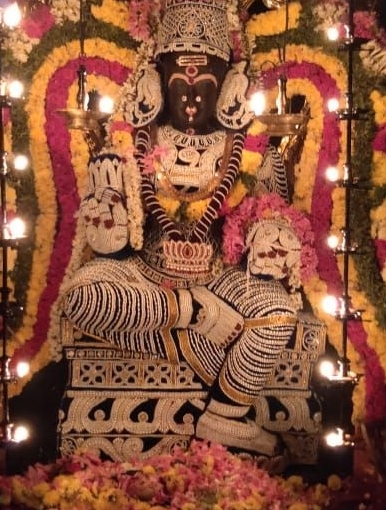
Hinduism and Taoism.

Way of the Celestial Masters
Image via Wikipedia

Hinduism is  not a view of Life, but a way of Life(Dr.Radha krishnan)

Principles and practices in Hinduism are based on individuals’ nature,taking into account the limitation of Human mind and an analysis of what has been attempted to learn about the Reality.

Taoism is presumed to be an off shoot of Buddhism for many of its concepts are found in Buddhism, which in turn is an offshoot of Hinduism..

The essential difference between Hinduism and Buddhism is that while Buddhism states that Change alone is permanent ,Hinduism postulates that Permanence alone exists(Advaita)

Things appear to be differentiated because of Nescience( at the individual level it called Avidya(wrong knowledge) at the micro level,the same is called Maya( nescience)

This is because of the limitation of the human mind ,conditioned as it is by Space and Time.

Reality is one ,with out Name and Form;it is beyond Attributes;It is Indescribable(Avaktavyam)

It appears to manifest itself in the world of name and Form because of our nescience.

True nature of Reality can be realized by various paths.

Similarities between Hinduism and Taoism are  listed here below.(Taoism principles are in brackets)

Brahman is the First Cause and it pervades the Universe.(Tao is the first-cause of the universe. It is a force that flows through all life.)

Individual goal is to Realize Self(A believer’s goal is to harmonize themselves with the Tao.)

While the Reality(Brahman) is devoid of qualities of Name and Form, worship of individual Gods  are permitted, as human mind can not operate in a vacuum.This is considered as the first step.Once this process is gone through, the individual realizes the Brahman without the Attributes.(The priesthood views the many gods as manifestations of the one Dao, “which could not be represented as an image or a particular thing.” The concept of a personified deity is foreign to them, as is the concept of the creation of the universe. Thus, they do not pray as Christians do; there is no God to hear the prayers or to act upon them. They seek answers to life’s problems through inner meditation and outer observation.)

Time is Cyclic.Please read my post on Time for details.(Time is cyclical, not linear as in Western thinking).

Health is of primary importance as the Brahman resides in it.Any practice that hurts the body is to shunned.Such practices are called Asura Thavam(penance) _Srimad Bhagavad Gita.

(Taoists strongly promote health and vitality.)

We have five organs of perception, namely,eyes,ears,nose,mouth,skin;

Five organs of perceiving acts,seeing,hearing,smelling,tasting and tactile sensations.

Five elements earth,water,fire,air and ether’;

Five elements that are called thanmaatraas,that is the basis through which the five elements are functioning.(Five main organs and orifices of the body correspond to the five parts of the sky: water, fire, wood, metal and earth.)

Each one has Prana,the Life force which has to be regulated.(Each person must nurture the Ch’i (air, breath) that has been given to them.)

http://www.religioustolerance.org/taoism2.htm

AfrikaansAlbanianArabicBelarusianBulgarianCatalanChineseCroatianCzechDanishDetect languageDutchEnglishEstonianFilipinoFinnishFrenchGalicianGermanGreekHaitian Creole ALPHAHebrewHindiHungarianIcelandicIndonesianIrishItalianJapaneseKoreanLatvianLithuanianMacedonianMalayMalteseNorwegianPersianPolishPortugueseRomanianRussianSerbianSlovakSlovenianSpanishSwahiliSwedishThaiTurkishUkrainianVietnameseWelshYiddishAfrikaansAlbanianArabicBelarusianBulgarianCatalanChineseCroatianCzechDanishDutchEnglishEstonianFilipinoFinnishFrenchGalicianGermanGreekHaitian Creole ALPHAHebrewHindiHungarianIcelandicIndonesianIrishItalianJapaneseKoreanLatvianLithuanianMacedonianMalayMalteseNorwegianPersianPolishPortugueseRomanianRussianSerbianSlovakSlovenianSpanishSwahiliSwedishThaiTurkishUkrainianVietnameseWelshYiddish 

Detect language » Hungarian
AfrikaansAlbanianArabicBelarusianBulgarianCatalanChineseCroatianCzechDanishDetect languageDutchEnglishEstonianFilipinoFinnishFrenchGalicianGermanGreekHaitian Creole ALPHAHebrewHindiHungarianIcelandicIndonesianIrishItalianJapaneseKoreanLatvianLithuanianMacedonianMalayMalteseNorwegianPersianPolishPortugueseRomanianRussianSerbianSlovakSlovenianSpanishSwahiliSwedishThaiTurkishUkrainianVietnameseWelshYiddishAfrikaansAlbanianArabicBelarusianBulgarianCatalanChineseCroatianCzechDanishDutchEnglishEstonianFilipinoFinnishFrenchGalicianGermanGreekHaitian Creole ALPHAHebrewHindiHungarianIcelandicIndonesianIrishItalianJapaneseKoreanLatvianLithuanianMacedonianMalayMalteseNorwegianPersianPolishPortugueseRomanianRussianSerbianSlovakSlovenianSpanishSwahiliSwedishThaiTurkishUkrainianVietnameseWelshYiddish 

Detect language » Hungarian
AfrikaansAlbanianArabicBelarusianBulgarianCatalanChineseCroatianCzechDanishDetect languageDutchEnglishEstonianFilipinoFinnishFrenchGalicianGermanGreekHaitian Creole ALPHAHebrewHindiHungarianIcelandicIndonesianIrishItalianJapaneseKoreanLatvianLithuanianMacedonianMalayMalteseNorwegianPersianPolishPortugueseRomanianRussianSerbianSlovakSlovenianSpanishSwahiliSwedishThaiTurkishUkrainianVietnameseWelshYiddishAfrikaansAlbanianArabicBelarusianBulgarianCatalanChineseCroatianCzechDanishDutchEnglishEstonianFilipinoFinnishFrenchGalicianGermanGreekHaitian Creole ALPHAHebrewHindiHungarianIcelandicIndonesianIrishItalianJapaneseKoreanLatvianLithuanianMacedonianMalayMalteseNorwegianPersianPolishPortugueseRomanianRussianSerbianSlovakSlovenianSpanishSwahiliSwedishThaiTurkishUkrainianVietnameseWelshYiddish 

Detect language » Hungarian
AfrikaansAlbanianArabicBelarusianBulgarianCatalanChineseCroatianCzechDanishDetect languageDutchEnglishEstonianFilipinoFinnishFrenchGalicianGermanGreekHaitian Creole ALPHAHebrewHindiHungarianIcelandicIndonesianIrishItalianJapaneseKoreanLatvianLithuanianMacedonianMalayMalteseNorwegianPersianPolishPortugueseRomanianRussianSerbianSlovakSlovenianSpanishSwahiliSwedishThaiTurkishUkrainianVietnameseWelshYiddishAfrikaansAlbanianArabicBelarusianBulgarianCatalanChineseCroatianCzechDanishDutchEnglishEstonianFilipinoFinnishFrenchGalicianGermanGreekHaitian Creole ALPHAHebrewHindiHungarianIcelandicIndonesianIrishItalianJapaneseKoreanLatvianLithuanianMacedonianMalayMalteseNorwegianPersianPolishPortugueseRomanianRussianSerbianSlovakSlovenianSpanishSwahiliSwedishThaiTurkishUkrainianVietnameseWelshYiddish

Detect language » Hungarian

Comments

3 responses to “Hinduism and Taoism.”

  1. Ramanis blog Avatar

    Shall refer and write in detail

  2. Brenda Nelson Avatar
    Brenda Nelson

    What does Taoism say about women or The Feminine?

    1. Ramanis blog Avatar

      I have not studied Taoism deeply. Regards.

Leave a Reply

More posts

Discover more from Ramanisblog

Subscribe now to keep reading and get access to the full archive.

Continue reading