
If people who read my post ‘Christians posing as Brahmins, new method of Conversion’ are struck with the idea to be original, they are wrong.
Their predecessor,not only posed as a Brahmin from Rome, he also wore the sacred thread,Upaveeda.
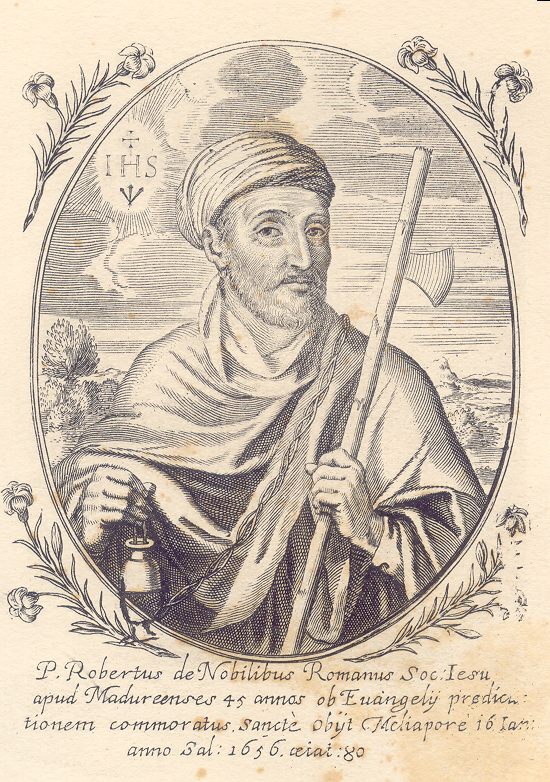
He had the Upaveeda sanctioned be a Pope!
He wore Sandal paste on his forehead, wooden sandals on his feet, had a Kudil(Asrama in Sanskrit)
He learnt Tamil and wrote Thembavani, a Tamil work on the Life of Christ.
He propagated that the Bible was the Lost Veda.
The gentleman, who is venerated b the ilks of frauds like Karunanidhi is none other than Robert De Nobili and his work on Jesus was a compulsory
portion from standard Ten (4 Form as it was called when I studied, some 45 Years back, it was still there when my son studied some 15 Years back)
Roman Brahmin!
The man who laid the foundation of inculturation was the Italian priest Robert de Nobili (1577-1656). He learnt Sanskrit and Tamil, wore saffron robes, sacred thread (attached with a small Cross!) and sandal mark on forehead and called himself a ‘Roman Brahmin’. He set up an “Ashram” in Madurai, became a vegetarian and used “Pathukas” (wooden footwear ). He claimed the Bible was the “Lost Veda”, the “Jesuit Veda” revealed by God, and was considerably successful in harvesting souls. Fortunately for Tamil Nadu, his European masters were not happy with his inculturation methods and subjected him to an enquiry which forced him to shift to other places like Trichy and Salem. Finally he settled in a small house in Santhome, Madras, and died in 1656. ..
talian Munivar!
The next Italian missionary, Constantine Joseph Beschi (1680-1746), called himself Veeramaamunivar (Veer-Maha-Munivar) to pretend he was a great lover of Tamil. Outwardly conducting himself like a Hindu Sanyasi, he took care of the conversion business in the districts of Madurai and Thanjavur. His work on a biography of St. Joseph, Thembaavani, was hyped as a great work and projected as equivalent to Kambar’s Ramayana!
Even now it is propagated that impressed with the beauty and richness of Kamba Ramayana, Beschi wanted to create a similar Christian work and hence came out with Thembaavani. It benefitted Christianity by establishing St. Joseph in Tamil Nadu. He then came out with another work, Paramartha Guruvum avarin Seedarkalum (Paramartha Guru and his Disciples), to ridicule our centuries old ‘Guru-Sishya Parampara.’ This “Munivar”, who denigrated our Guru-Sishya Parampara, was honoured by Dravidian racists who installed a statue of him on Marina Beach.4
German Iyer!
In the same period, a German missionary Barthalomaus Ziegenbalg (1683-1719) also worked in Tamil Nadu and called himself Ziegenbalg Iyer. This Protestant priest landed in Tranquebar (Tharangampaadi) in 1706 and worked with a Danish company which was the first to bring German printing machines to Tamil Nadu. He printed the first Tamil Bible (New Testament). Even while indulging in conversions, he often quarrelled with the Danish authorities who put him in jail for some time. He was the first to stoke anti-Brahmanism by creating a hatred for Brahmins among other communities. As he fell sick often, he died at the age of 36 in 1719, leaving behind two Churches, a training institute for converted Indian priests, and 250 converts in Tranquebar. 5
Italian Iyer
Next in the list of Christian Priests who “served” the cause of inculturation was another ‘Iyer’ – G.U. Pope (1820-1907) or ‘Pope Iyer.’ He translated a few Tamil literary works such as Thiruvaachakam, Thirukkural and Naaladiyaar, and said he could find the teachings of Apostle St. Paul and St. Francis of Assisi in Sri Maanickavaachakar’s Thiruvaachakam; innocent Tamil scholars felt elated at his ‘graciousness’.
Even some Tamil Saivite Mutts felt proud at G.U. Pope’s statement. Tamil scholar Muthukumaraswamy, who has in-depth knowledge on Saiva Siddhanta, demolishes this myth, citing Pope’s own statement, “In the whole legendary history of this sage … there stands out a real historical character, which seems to be a mixture of that of St. Paul and of St. Francis of Assisi. Under other circumstances what an apostle of the East might have become,” as evidence of Pope’s sarcasm and disdain. He exposes the mindset of G.U. Pope who states that a Religious Guru from the East would not have attained a spiritual level beyond this in order to undermine the spiritual greatness of Sage Maanickavaachakar.
Dr. Muthukumaraswamy quotes another instance where G.U. Pope ridicules murti worship or vigraha aradana: “G.U. Pope says that a person who attains a higher level of spiritualism also indulges in Murti worship and rustic rituals, which go totally against his level of spiritualism.” 6
There is another concocted story about G.U. Pope in Tamil Nadu which says that Pope wanted the statement, “Ingu oru Thamizh Maanavan urangukiraan” (A Tamil student is sleeping here) sculpted on his cemetery and that the statement is still present there on his cemetery. But those who have gone to the cemetery have confirmed that there was no such statement written on his cemetery except the ones from the Bible.
Born in Montepulciano, Tuscany in September 1577, Roberto de Nobili arrived in Goa in western India on May 20, 1605. It is probable that he met here Fr Thomas Stephens, SJ, who had arrived in Goa in 1579, and was probably in the process of composing his Khristapurana.[1]
After a short stay in Cochin in Kerala, he took up residence in Madurai in Tamil Nadu in November 1606. He soon called himself a “teacher of wisdom” (தத்துவ போதகர்), and began to dress like a Sannyasin. Claiming noble parentage he approached high-caste people, and eagerly engaged in dialogue with Hindu scholars about the truths of Christianity.
De Nobili mastered Sanskrit, Telugu and Tamil languages and literature, with the help of his teacher, Shivadharma. As he expounded the Christian doctrine in Tamil he coined several words to communicate his message. He used the word “kovil” (கோவில்) for a place of worship, “arul” (அருள்) and “prasadam” (பிரசாதம்) for grace, “guru” (குரு) for priest or teacher, “Vedam” (வேதம்) for the Bible, “poosai” (பூசை) for Mass, etc.
He adopted also local Indian customs, such as shaving one’s head and keeping only a tiny tuft. He wore a white dhoti and wooden sandals, to don the look of a sanyasin. Another symbol he embraced was the wearing of a three-stringed thread across the chest. He interpreted the three-stringed thread as representing the Holy Trinity, Father, Son and Holy Spirit.
He was one of the first Europeans to gain a deep understanding of Sanskrit and Tamil. He composed Catechisms, apologetic works and philosophic discourses in Tamil, and contributed greatly to the development of modern Tamil prose writing.
His method raised a fierce controversy among his fellow Jesuits and with the Archbishop of Goa Cristóvão de Sá e Lisboa. The dispute was settled by Pope Gregory XV with the Constitution Romanæ Sedis Antistes issued on 31 January 1623. The customs of the three-stringed thread, the tuft, the use of sandalwood paste on the forefront and baths were allowed, inasmuch they did not imply any superstitious ritual. The Pope invited also the Indian neophytes to overcome their caste sensitivity and their despisal of the pariahs.
Citation.
http://en.wikipedia.org/wiki/Roberto_de_Nobili


