The sanctum of Thirupathi Venakateswara, Balaji contains the Idol of Lord Venkateswara and two more Idols of Srinivasa.
Such is the imposing and divine presence of Lord Balaji with His stunning looks, we often miss what else is present in His Sanctum!
Vishnu’s Discus.gif
There are three idols of Lord Balaji, Srinivasa.
They are,
replica of Sanctum Sanctorum(Garba Griha) of Tirumala Venkateswara Temple depicting SriDevi BhuDevi Sametha Malayappa Swamy-Left, Lord Venkateswara Main Deity(Dhruva beram)-Center, Bhoga Srinivasa-Center bottom, Ugra Srinivasa, Sita Lakshmana Sametha Sri Rama, Sri Krishna, Rukhmini- Right. Image credit wiki
1.Sri Bhoga Srinivasa,
2) Ugra Srinivasa,
Legend has it that fire broke out in the village destroying houses during Brahmotsavam at Tirumala in the 14th century A.D. When prayers were offered to the God, a@ vision appeared to a devotee with a message from Lord Srinivasa himself. With the change in times, the Ugra Srinivasa idol could no longer remain the processibon idol and a new idol would be found as utsava murti (Malayappa swami). The Ugra Srinivasa idol is no longer brought out of the temple after sunrise and it is believed that sunrays touching the idol would spark fire in the temple complex.
3) Koluvu Srinivasa,
4) Sri Malayappa,
5) Sri Krishna,
6)Srirama, Sita, Lakshmana and Sugreeva and
7) Sri Chakrattalvar. ‘
It is rare to find seven idols in a Garbha Gruha.
Three of Srinivasa are found.
Srinivasa is an Avatar of Vishnu.
Vishnu,though according to functions is Kshatria,because He protects like a father,the term Vishnu is from Jishnu,meaning one who supports,The Vishnu Purana is classified as Sattvic , not Rajasic as protection is the function of a King with Compassion,Kshama,the ability to forgive.
Yet in Thirupati we find Bhoga Srinivasa given the first place.
Bhoga means enjoyment.
In Srinivasa avatar ,His specific purpose has been to shower Kshama and Blessings and He enjoys it.
Hence Bhoga Srinivasa gets the priority.
Ugra,Srinivasa represents His aspect of unforgiving anger.
Many are not aware of this aspect of Lod Balaji,Srinivasa.
As much as He is known for His munificence,He does not forgive a forget a slight nor goes any of the dues to Him by the Devotees,uncollected.
If one has dues to Him ,like a vow taken to visit Thirupati or forgets to offer money if one has taken a vow to do so.
Normally the signal he is not pleased with you in fulfilling your vow to Him, is your getting inexplicable stomach ailments.
The solution is to fulfill your vow.
Then, as a Father He would ignore your omission and shower you with His Grace.
This,I have experienced personally and also from others.
These do not have any scientific or even religious explanation.
Period.
As to me ,if my issue is resolved it is more than enough, I do not waste my time how and why the problem is solved.
Not very rational,
Isn’t it?
That is way the things are.
‘Koluvu Srnivasa is Utsava Murthy.
I am researching into the presence of Rama,Sita,Sugreeva and Chakkarathalvar in the Sanctum.
They,in my opinion, have a historical connection.
Shall write.
‘
Bhoga Srinivasa Murti:
Sri Bhoga Srinivasa Idol is a true copy of the Dhruva Bera(Main Deity) except that the Sanku and Chakra are permanently fixed in the case of Bhoga Srinivasa. Sri Bhoga Srinivasa gets Abhishekam every morning unlike the Dhruva Bera to which Abhishekam is performed only on Fridays.
Ekanta Seva is performed to Sri Bhoga Srinivasa. During Ekanta Seva, Sri Bhoga Srinivasa is placed in a Silver Cradle in the Sayana Madapam and offered milk to Sri Bhoga Srinivasa. Sandalwood paste is also offered to him every night. Ekanta Seva is performed to Sri Bhoga Srinivasa for all months in a year except Dhanurmasam in which Ekanta Seva is performed to Sri Krishna.
This idol is made of Silver and was consecrated by the donar, the Pallava Queen, Samavai in 966A.D. The donor’s consecration is recorded in an Epigraph on the northern wall of the Temple Prakaram which is perhaps the earliest inscription in the temple.
Koluvu Srinivasa or Bali Bera:
Every day after the morning Thomala Seva, a darbar called Koluvu is held in the Tirumamani Mantapam where the deity is brought and is seated in a silver chair with a gold umbrella above him. This idol officiates for the main idol during this function and hence his name is Koluvu Srinivasa.
He is akin to the guardian deity and supervises the temple household, and keeps himself posted with all the affairs and revenue of the temple. The Panchangam or the Calendar of the day is also read out before Koluvu Srinivasa Every Day.
Sri Malayappa or Utsava Murthi:
The first mention of this deity under the name “Malai Kuniya Ninra Perumal” is found in an Epigraph about the year 1339AD. The idol is in a Standing Pose and is a replica of the Dhruva Bera(Main Deity). The two upper arms hold the Sanku and Chakra, the lower right arm is in the Varada hasta pose and the left arm in Katyavalambite pose. This image has a very rich treasury of precious gems and jewels made of Platinum and Gold.
The idol of Lord Malayappa is about three feet height and stands on a lotus pedestal on a platform about 14inch height. To right is the idol of Sridevi about 30inch height. Sridevi left hand is in the Kataka hasta pose, the right is in the Gajakarna pose. To left is the idol of Bhudevi which is in standind pose. Bhudevi left hand is in the Gajakarna pose, the right is in the Kataka hasta pose.
In the order of preferences the idols that represents the Dhruva Bera’
Description of Thirupathi Balaji’S Grabha Gruha is from the following link and quoted portions are from this source.
There are quite a few ancient temples of India which are in good shape.
Some of them have been assigned dates before Christ,BC,though reluctantly despite strong evidence that they belong to much earlier times.
Please check my articles on 5000 years old temples of India.
The Thiruvannamalai temple,Tamil Nadu is dated 3.94 Billion years,Tirupati 2100 million years and Jwalapuram, Cuddapah,Telengana, India is 74,000 years old……….
There are some more ancient temples like the Pundarikaksha Temple,Thiruvellarai, near Sriranagam and Srirangamtemple Tamil Nadu.
There are many more and I shall be writing about them.
The Ananta Padmanabhaswamy temple at Thiruvananthapuram,Kerala is one such ancient temple where the presiding deity is Lord Vishnu in his form as the Infinite one in yoga Nidra.
The temple has also been one of the richest temple in India, where billions worth of gold and ornaments have been found sealed in an underground vault and the court had appointed a committee to evaluate the riches.
This temple is referred to in the Puranas and Tamil Classics of the Sangam era.
What is now Kerala was a part of Tamil Chera Kingdom.
Chera kings also enriches the temple and this dynasty goes back to thousands of years.
However the temple and the city has been dated to around late first century BC.
This is way off the mark.
The Tamil epic Silappadikarama, written by Ilangao Adigal, brother of the Chera king mentions this temple and also details the Thiruvananthapuram temple .
Silappadikaram describes the city as golden city and the temple as one which was made of gold.
Same description is found in the Puranas.
Poompuhar,Tamil Nadu where most of the action of Silappadikaram takes place has been found off the sea and it has been proved that the people of Poompuhar had extensive trade with the Greeks, among others.
And now Poompuhar has been dated some 20,000 years back!
As Silappadikaram speaks of Thiruvananthapuram and Anantha Padmanabhaswamy temple, these two should have existed before the events narrated in Silapadikaram.
As Poompuhar is dated 20,000 years ago, it is reasonable to state that Thiruvananthapuram and Padmanabhaswamy temple date back to 20,000 years.
‘
Silappadikaram has been dated to likely belong to the beginning of Common era.
The incidence of Kovalan Madhavi and Kannagi took place in the same period as the poet who wrote the Tamil Epic was the brother of the Chera King Cheran Senguttuvan.
However the recent finding placed these dates to 11000 years back!
Padmanabha in ananthasayanam,Thiruvanathapuram temple
So it is logical to arrive at the conclusion that the Silappadikaram Town was in existence around 11000 CE and for a rich language as Tamil to develop, from a dialect, colloquial form and then to literary ,it requires minimum 5000 Years.
And Tamil quotes Ithihasas ,Ramayana and Mahabharata and the Vedas.
That should place these Ithihasas earlier .
Hence based on this evidence available now, Tamil should be at least 16000 years old and the Sanskrit Puranas earlier.
Please read my Post Million Year Old Tamil quotes Vedas and they quote Tamil.
But we are assigning Tamil Sangam at 5 BC and Rig veda at 5000 BC!…
..
The date of Poompuhar artifact was arrived at and verified by Glenn Milne Sea Level changes.
The place is called Poompuhar. It lies on southeast India’s Coromandel coast facing the Bay of Bengal between modern Tamil Nadu and Sri Lanka. Its immediate offshore area has been the subject of marine archaeological investigations by India’s National Institute of Oceanography since the 1980’s — and numerous non-controversial finds of man-made structures dated between the third century AD and the third century BC have been made in the “inter-tidal zone” close to shore at depths down to 6 feet (approximately 2 metres).
These finds of structures in shallow water (some so shallow that they are exposed at low tide) have been quite widely written-up in the archaeological literature. But for some reason other discoveries that the NIO has made in deeper water off Poompuhar have attracted no attention at all. Most notably these other discoveries include a second completely separate group of structures fully three miles from the Poompuhar shore in water that is more than 70 feet (23 metres) deep. The lack of interest is surprising because to anyone with even minimal knowledge of post-glacial sea-level rise their depth of submergence is – or should be – highly anomalous. Indeed according to Glenn Milne’s sea-level data the land on which these structures were built last stood above water at the end of the Ice Age more than 11,000 years ago.
Is it a coincidence that there are ancient Tamil flood myths that speak of a great kingdom that once existed in this area called Kumari Kandam that was swallowed up by the sea? Amazingly the myths put a date of 11,600 years ago on these events — the same timeframe given by Plato for the end of Atlantis in another ocean.
Like the cities in the Gulf of Cambay the underwater structures three miles offshore of Poompuhar were first identified by an instrument called sidescan sonar that profiles the seabed. One structure in particular was singled out for investigation and was explored by divers from India’s National Institute of Oceanography in 1991 and 1993. Although they were not at that time aware of the implications of its depth of submergence — i.e. that it is at least 11,500 years old — the 1991 study confirms that it is man-made and describes it as:
a horse-shoe-shaped object, its height being one to two metres. A few stone blocks were found in the one-metre wide arm. The distance between the two arms in 20 metres. Whether the object is a shrine or some other man-made structure now at 23 metres [70 feet] depth remains to be examined in the next field season.
The 1993 study refines the measurements:
The structure of U-shape was located at a water depth of 23 metres which is about 5 kilometres off shore. The total peripheral length of the object is 85 metres while the distance between the two arms is 13 metres and the maximum height is 2 metres Divers observed growth of thick marine organism on the structure, but in some sections a few courses of masonry were noted.
Graham Hancock is an advocate of this theory and I subscribe to this as this has more science to back it up.
Padmanabhaswamy temple is located in Thiruvananthapuram, Kerala, India. The temple is built in an intricate fusion of the indigenous Kerala style and the Dravidian style (kovil) of architecture associated with the temples located in the neighboring state of Tamil Nadu, featuring high walls, and a 16th-century Gopuram. While the Moolasthanam of the temple is the Ananthapuram Temple in Kasargod, architecturally to some extent, the temple is a replica of the Adikesava Perumal temple located in Kanyakumari District. It is the richest Hindu temple in the world.In terms of gold assets and precious stones, it is by far the wealthiest institution and place of worship of any kind in the recorded history of the world, with an estimated $22 billion worth of gold and jewels stored in underground vaults (not accounting for historical value). At the time of writing, only 5 of the 8 underground vaults had been opened and explored.
The principal deity Vishnu is enshrined in the “Anantha Shayanam” posture, the eternal yogic sleep on the serpent Adisheshan……
Several extant Hindu Texts like the Brahma Purana, Matsya Purana, Varaha Purana, Skanda Purana, Padma Purana, Vayu Purana, Bhagavata Purana and the Mahabharata mention this shrine. The Temple has been referred to in the (only recorded) Sangam Period of literature between 500 B.C and 300 A.D several times. Many conventional historians and scholars are of the opinion that one of the names that the Temple had – “The Golden Temple” – literally was in cognizance of the fact that the Temple was already unimaginably wealthy by that point. Many extant pieces of Sangam Tamil literature and poetry, and even the later works of Ninth Century poet-saints like Nammalwar, refer to the Temple and even the city as having walls of pure gold. At some places, both the Temple and the entire city are often eulogized even as being made of gold, and the Temple as Heaven.
The temple is one of the 108 principal Divya Desams (“Holy Abodes”) in Vaishnavism, and is glorified in the Divya Prabandha,. The Divya Prabandha glorifies this shrine as being among the 13 Divya Desam in Malai Nadu (corresponding to present-day Kerala and some adjoining areas). The 8th century Alvar Nammalvar sang the glories of Padmanabha. The Ananthapuram Temple in Kasargod is believed to be the ‘Moolasthanam’ of the Temple.
The sage Vilvamangalathu Swamiyar, who resided near Ananthapuram Temple in Kasargod District, prayed to Lord Vishnu for his darshan or “auspicious sight”. The Lord is believed to have come in the guise of a little boy who was mischievous. The boy defiled the Idol which was kept for Puja. The sage became enraged at this and chased away the boy, who disappeared. After a long search, when he was walking on the banks of Arabian Sea, he heard a pulaya lady threatening her child that she would throw him in Ananthankadu. The moment the Swami heard the word Ananthankadu he was delighted. He proceeded to Ananthankadu based on the directions of the lady of whom he enquired. The Sage reached Ananthankadu searching for the boy. There he saw the boy merging into an Iluppa tree (Indian Butter Tree). The tree fell down and became Anantha Sayana Moorti (Vishnu reclining on the celestial snake Anantha). But the edifice that the Lord assumed was of an extraordinarily large size, with His head at Thiruvallom, navel at Thiruvananthapuram, and lotus-feet at Thrippadapuram (Thrippappur), making him some eight miles in length. The Sage requested the Lord to shrink to a smaller proportion that would be thrice the length of his staff. Immediately the Lord shrank to the form of the Idol that is seen at present in the Temple. But even then many Iluppa trees obstructed a complete vision of the Lord. The Sage saw the Lord in three parts – thirumukham, thiruvudal and thrippadam. Swami prayed to Padmanabha to be forgiven. The Swami offered Rice Kanji and Uppumanga (salted mango pieces) in a coconut shell to the Perumal which he obtained from the pulaya woman. The spot where the Sage had darsan of the Lord belonged to Koopakkara Potti and Karuva Potti. With the assistance of the reigning King and some Brahmin households a Temple was constructed. Koopakkara Potti was made the Tantri of the Temple. The Ananthankadu Nagaraja Temple still exists to the north west of the Padmanabhaswamy Temple. The Samadhi (final resting place) of the Swamiyar exists to the west of the Padmanabha Temple. A Krishna Temple was built over the Samadhi. This Temple, known as Vilvamangalam Sri Krishna Swami Temple, belongs to Thrissur Naduvil Madhom’..
‘A treasure trove of gold and silver jewelry, coins and precious stones said to be worth billions of dollars has been found in a Hindu temple in southern India, officials said.
The valuables have an estimated preliminary worth of over 500 billion rupees ($11.2 billion), said Kerala Chief Secretary K. Jayakumar, catapulting the temple into the league of India’s richest temples.
The thousands of necklaces, coins and precious stones have been kept in at least five underground vaults at the Sree Padmanabhaswamy Temple which is renowned for its intricate sculptures.
“We are yet to open one more secret chamber which has not been opened for nearly 140 years,” Jayakumar told AFP.
The actual value of the treasure haul can be ascertained only after it is examined by the archaeological department, said Jayakumar.
The temple, dedicated to Hindu lord Vishnu, was built hundreds of years ago by the king of Travancore and donations by devotees have been kept in the temple’s vaults since.
A necklace found on Thursday was 18 feet (six metres) long. Thousands of gold coins have also been found.
Since India achieved independence from Britain in 1947, a trust managed by descendants of the Travancore royal family has controlled the temple.
But India’s Supreme Court recently ordered that the temple be managed by the state to ensure the security of valuables at the shrine.
Until now, the Thirupathy temple in southern Andhra Pradesh state was believed to be India’s richest temple with offerings from devotees worth 320 billion rupees.
The revelation about the huge riches in the Padmanabhaswamy temple has forced police to sharply step install security cameras and alarms.
General conception i that Kempe Gowda established Bangalore around 1537 CE.
‘A succession of South Indian dynasties, the Western Gangas, the Cholas and the Hoysalas, ruled the present region of Bangalore until in 1537 CE, Kempé Gowdā – a feudal ruler under the Vijayanagara Empire – established a mud fort considered to be the foundation of modern Bangalore.’
Yet we find a 7000 year old Temple in Malleshwaram and another Someshwara Temple in Madivala,Bangalore.
Bangalore, hence, must be older than what is believed.
The Western Ganga Dynasty, called Mel(west) Gangar find reference in Tamil literature of the period of Rajaraja Chola, who built the Thanjavur Big Temple in Tamil Nadu and Rajendra Chola, his son who built the Gangai Konda Cholapuram, Tamil Nadu.
Western Ganga dynasty ruled Karnataka and lasted from about 350 to 1000 AD.
Later came the Cholas and Hoysalas.
However my research indicates Karnataka to be much older, considering that Lord Rama’s brother in Law Rishyasrunga lived in Sringeri.
And there are references to Karnataka region in ancient Tamil literature.
I shall be writing on this shortly.
While going through Indian History from Indian sources, including the Purana and Tamil Literature( I unfortunately know only Tamil and Sanskrit;wish I have learnt more Indian languages), a curious fact emerges.
Though King fought for supremacy with each other, common people remained close together, except during wars.
There were marriages between people regions belonging to different regions.
The Kings to married from other dynasties.
Rajendra helped his nephew Rajaraja defeat Vijayaditya. His armies defeated Vijayadiya in Vengi and Jayasimha in the battle of Maski.
The village Kadugodi, Whitefield was built during the period of Rajendra Chola.
‘Kadugodi (ಕಾಡುಗೋಡಿ IPA: [Kāḍugōḍi]), known as Kadugudi was founded by the great Cholas Dynasty. It is located in Whitefield, Bangalore in the state of Karnataka. Kadugodi comes from “kadu” & “Gudi” meaning “temple in a forest” in Kannada.’
Also the ‘KaShivishwanatha Temple (Built in the period of Cholas Dynasty) recently it has been re constructed. 2. Sree RamanjanEya temple (one of the oldest temple) 3. Shiva temple (another Oldest temple)’
Cholas Dynasty’s Inscriptions dating from 1043AD exists in Kadugodi, from the period of Rajendra Chola I, which describes the construction of the Pattanduru Lake, and Ganesh, Durga and Kshetrapaala temples by Chola chieftain Raja Raja Velan son of Permadi Gavunda.
Due to misinformation and doctored history, we feel we belong to different states.
The Sanatana Dharma culture permeated the whole Fabric of India.
Yes.
We did and do speak different languages but we are one as a Bharatvanshi, united by our common culture.
Someswara Temple,Old Madiwala,Bangalore. The temple is said to be a Chola period structure, making it one among Bangalore’s oldest. The earliest record dates to 1247 AD.source.By Eshwar.om at English Wikipedia, CC BY-SA 3.0, https://commons.wikimedia.org/w/index.php?curid=42152193
One can find evidence of this if one observes the practices followed in each state of India.
I have written about a 7000 year old Shiva Temple in Malleswaram, Bangalore.
We have one more Shiva temple which is 800 years old.
‘Non-Bangaloreans perhaps conjure up images of silk when they hear these words. Almost certainly, an 800-year-old temple is not what you would associate with that bustling junction… which makes the Someshwara temple one of IT city’s best kept secrets.
The temple is in old Madivala, a place where shops and houses open out onto narrow lanes that twist this way and that, and where children still play cricket in the bylanes. And while traffic-induced chaos reigns supreme at the Silk Board junction, peace and quiet hold sway at the Someswhara temple a mere kilometre away.
The stone temple is said to be a Chola period temple, making it one among Bangalore’s oldest. And there is ample proof of its antiquity. Large portions of its outer walls are covered with inscriptions in Tamil and Grantha (an old script used to write Sanskrit) characters, attesting to the temple’s age. The earliest record dates to 1247 AD and refers to lands donated “below the big tank of Vengalur” by a resident of ‘Veppur’ (modern-day Begur). Other inscriptions seem to have followed in quick succession, recording grants made during the reigns of Hoysala king Ballala III and Chola king Rajendra. One record, from 1365, mentions a land grant at Tamaraikkirai (meaning ‘the banks of the lotus pond’ in Tamil). Epigraphy expert H S Gopala Rao, Secretary of the Karnataka Itihasa Academy, points out that this is the old name for what we today know as Tavarekere.
Apart from its obvious age, the Madivala area may have much else to boast about. Gopala Rao mentions how inscriptions have been found elsewhere in Bangalore which suggest that the illustrious Krishnadevaraya, the most famous king of the Vijayanagar empire, himself spent some time in Madivala.
Today, though, there are no trappings of royalty, either in Madivala or in the Someshwara temple. The temple underwent extensive renovations five years ago, but as Gopala Rao says, fortunately, the inscriptions were largely unharmed. The temple’s outer walls that carry the inscriptions and also idols of various gods including Ganesha, Durga and Vishnu, remain unaltered.
Inside, apart from shiny new flooring, the garba griha and artha mantapa were untouched. These inner chambers still remain small and darkened spaces that encourage a personal and intimate communion with the Lord.
Apart from four carved pillars, the artha mantapa has a large and elegantly proportioned granite Nandi facing the linga. Behind the Nandi, the eastern wall of the temple has a small opening that is directly in line with the linga.
In the days before Madivala was engulfed in buildings, the sun’s rays entered through this small opening to illuminate the linga. According to the priest, K Achyuta Rao, the temple’s deity is a Swayambhu linga, i.e., it is said to have manifested itself without any human agency.
This refreshingly quiet and serene temple remains open for worship from 7:30 to 11:00 in the mornings and from 5:30 to 8:30 in the evenings. ‘
‘The Someshware temple at Madivala is one of Bangalore’s oldest, dating back to the Chola period. There are a number of Tamil and Grantha inscriptions on the outer walls of the temple. The oldest of these inscriptions dates to 1247 AD talks about a land grants “below the big tank of Vengalur” by a Veppur (modern Begur) resident. Other inscriptions also talk about other land grants including those done during the reigns of Ballala III and Rajendra Chola. Another instrciption dated 1365 talks about land grand at Tamaraikkirai (which translates to ‘lotus pond bank’ in Tamil, and according to HS Gopala Rao, Secretary of the Karnataka Itihasa Academy refers to the present day Tavarekere suburb
Old Madiwala Sri Someshwara Temple located in Bangalore city (also Bengaluru) is dedicated to the deity Someshwara (the Hindu god Shiva). It is one among the oldest temples in the city and dates back to the Chola Empire period.The temple belongs to the early 12th century.(1247 AD).
The temple houses a “Swayambu” Shiva lingam in it Sanctum Sanctorum (Shiva lingam formed by natural Rock Formation). But unlike other ancient temples in Bangalore, this temple is in good shape and cared well by people around. This shows the real strength people have in protecting our heritage without outside help. It is very powerful and Ancienttemple.
The Somnath temple, First Jyotir Linga Kshetra of Shiva.
It is located at Longitude https://tools.wmflabs.org/geohack/geohack.php?pagename=Somnath_temple¶ms=20_53_16.9_N_70_24_5.0_E_type:landmark_region:IN
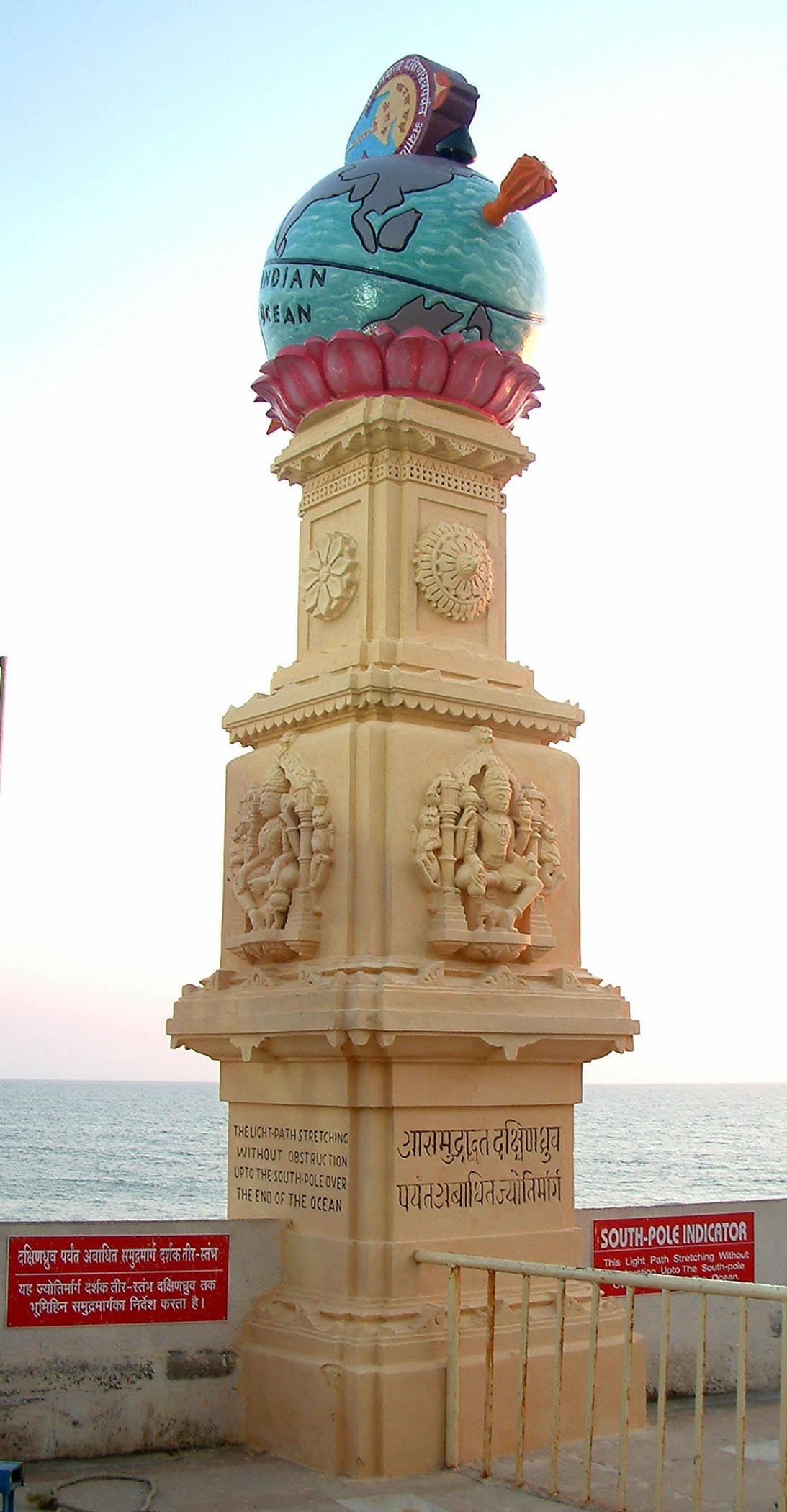
The temple is situated at such a place that there is no land in a straight line between Somnath seashore until Antarctica, such an inscription inSanskrit is found on the Bāṇastambha (Sanskrit: बाणस्तम्भ, lit. arrow pillar) erected on the sea-protection wall. The Bāṇastambha mentions that it stands at a point on the Indian landmass that is the first point on land in the north to the South Pole at that particular longitude.
Banasthamba, Arrow Pillar at Somnath Temple
I had also written that Shiva is mentioned only in the passing in the Vedas but is referred to constantly in Tamil Literature calling Shiva as The Unborn Elder and He is recorded as having founded the Tamil language with Subrahmanya.
Somnath temple situated at the seashore of the Arabian ocean on the western corner of Indian subcontinent in Gujarat State. This pilgrimage is one of the oldest and finds its reference in the earliest texts like Skandpuran, Shreemad Bhagavat, Shivpuran etc. The hymn from Rig-Veda quoted below mention the Bhagvan Someshwar along with the immense pilgrimage like Gangaji, Yamunaji and Eastward Saraswati. This signifies the ancient value of this Tirthdham.
According to legend, Som, the Moon God constructed the Somnath Temple from gold, Ravan made it from silver, Lord Krishna made the temple from wood and King Bhimdev of Anhilwad made the temple from stone.
Som erected the temple out of admiration afterLord Shiva cured his disease that was caused by Som’s father-in-law Daksha Prajapati’s curse. Daksha Prajapati had cursed Som as he was charmed by Rohini and was not giving adequate attention to his other 26 wives who were all girls of Prajapti. It is accepted that Lord Brahma advised Som to construct the temple to respect Lord Shiva.
The Somnath Temple is the seventh temple constructed to honour Lord Somnath, who was famous called Bhairaveshwar, Shravanikehswar and Shrilingeshwar, in Sat Yug, Treta Yug and Dwapar Yug separately.
As per Shiv Mahapuran, once Brahma and Vishnu had an dispute in terms of superiority of creation. To test them, Shiva pierced the three worlds as a huge endless pillar of light, the jyotirlinga.Vishnu and Brahma divide their ways to downwards and upwards correspondingly to find the end of the light in either direction. Brahma lied that he found out the end, while Vishnu accepted his defeat. Shiva appeared as a second pillar of light and cursed Brahma that he would have no place in ceremonies while Vishnu would be worshipped till the end of time without end. The jyotirlinga is the supreme partless truth, out of which Shiva partly appears. The jyothirlinga shrines thus are places where Shiva appeared as a blistering column of light. Originally there were supposed to be 64 jyothirlingas while 12 of them are considered to be very auspicious and sacred. Each of the twelve jyothirlinga sites takes the name of the presiding deity – each considered diverse manifestation of Shiva. At all these places, the primary image is lingam demonstrating the beginningless and endless Stambha pillar, symbolizing the never-ending nature of Shiva. The twelve jyothirlinga are Somnath in Gujarat, Mallikarjuna at Srisailam in Andra Pradesh, Mahakaleswar at Ujjain in Madhya Pradesh, Omkareshwar in Madhya Pradesh, Kedarnath in Himalayas, Bhimashankar in Maharastra, Viswanath at Varanasi in Uttar Pradesh, Triambakeshwar in Maharastra, Vaidyanath Jyotirlinga, Deogarh in Deoghar, Jharkhand, Nageswar at Dwarka in Gujarat, Rameshwar at Rameswaram in Tamil Nadu and Grishneshwar at Aurangabad in Maharastra.
The seond somnath temple was built and replaced first on same location around 649 CE by Vallabhi Yadava kings in Gujrat. The temple was ruined by Muslim king Mahmud Ghazni in 1024, who raided the temple from the thar desert. It was again built by Gujjar Paramara King Bhoj and the Solanki king Bhimadev I of Anhilwara during 1026 to 1042. The wooden temple design was changed by Kumarpal, who made the temple by stone.
The temple was again destroyed by army of Allauddin Khilji on 1296. Gujrat Raja Karan was conquered and forced to flee by Allauddin Khilji. According to Taj-ul-Ma’sir of Hasan Nizami, the Sultan boasted that “fifty thousand infidels were dispatched to hell by the sword” and “more than twenty thousand slaves, and cattle beyond all calculation fell into the hands of the victors”. Somnath temple was re-created by his son Khengar sometime between 1326 and 1351.
Somnath Temple Live Darshan: 6.00am to 9.00pm
Aarti : 7.00 am, 12.00 pm and 7.00 pm
The Jay Somnath Sound and Light Show : 8.00 pm to 9.00 pm Do not miss it if you are in Somnath during the evening hours.
How to reach Somnath Temple
By Flight
Nearby airport to Somnath is Diu, which is 90 km away from Somnath city. This airport is connected to Mumbai only. International travellers have to get connecting flights from Mumbai international airport, which is at a distance of 890 km from Somnath. Mumbai is well linked with all main cities in India and many cities in abroad.
By Train
Somnath is well connected to other major cities of the country via regular trains.
By Bus
You can easily get regular buses to Somnath from other main cities of the country.
By <a href=”//commons.wikimedia.org/w/index.php?title=User:Admishra&action=edit&redlink=1″ class=”new” title=”User:Admishra (page does not exist)”>Admishra</a> – <span class=”int-own-work” lang=”en”>Own work</span>, Public Domain, https://commons.wikimedia.org/w/index.php?curid=7730687




You must be logged in to post a comment.