Tag: Religion

  • Understanding Panchadakshari in Soundaryalahari

    Understanding Panchadakshari in Soundaryalahari

    Panchadasakhari as explained in Sree Soundaryalahari is provided here in audio format, Live from one of my classes with my student’s consent.

    Kaadhi Vidya Soundaryalahari 32

    Consists of fifteen akṣaras.

    The three sets of letters ka, ye, ee, la [first four] Vaak Bhava Koota

    Ha, sa, ka, ha, la [second five] Kamaraja Koota,Manmatha Koota

    Sa, ka, la [third three] Sakthi Koota.

    Total 12 letters , with these, add in the end of each set hreem;ka, ye, ee, la, hreem- Ha, sa, ka, ha, la, hreem-Sa, ka, la, hreem.

    Panca Dasa akshari maha-mantra called “kaadi vidya” for which the first letter is ‘ka’ is referred indirectly. There are three parts for this called ‘kootaas’.The first is called vaaghbhava kootam for which the mantra is ka, ye, ee, la, hreem;This shines with brilliance of the pralaya kaala agni, starts from mooladhaara and reaches anaahata.The second is called kaamaraaja kootam for which the mantra is ha, sa, ka, ha, la, hreem;This possesses the brilliance of crores of suns, starts from anaahata and reaches aajnaa-cakra.The third is called sakti kootam for which the mantra is sa,ka, la, hreem;This shines with crores of candraprakaasa, starts from aajnaa cakra and widens through to the middle of lalata or forehead.

    Aatmavidyaa mahaavidyaa sreevidyaa kaamasevitaaSree Shodasaakshari Vidyaa trikootaa kaamakotikaa.

    Haadi vidyaa :

    -Sowbhaagya vardhini of the Kaivalyaasrama refers  thus –

    ‘This sloka also refers to lopaamudraa vidyaa called Haadi vidyaa and And also to durvaasa vidyaa referred by the trayodasa akshari mantra.Lopaamudraa vidya – or haadi vidyaa – Ha sa ka la hreem ha sa ka ha la hreem sa ka la hreemDurvaasa vidyaa or trayodasa akshari [13 letters] mantraHa sa ka la ha sa ka ha la sa ka la hreem.’

    More to follow.

    Sree Lalithambika in Suvasini Pooja in Secunderabad


    शिवशक्तिः कामः क्षितिरथ रविश्शीतकिरणः
    स्मरो हंसश्शक्रस्तदनु च परामारहरयः।
    अमी हृल्लेखाभिस्तिसृभिरवसानेषु घटिताः
    भजन्ते वर्णास्ते तव जननि नामावयवताम्॥

    śivaśaktiḥ kāmaḥ kṣitiratha raviśśītakiraṇaḥ
    smaro haṁsaśśakrastadanu ca parāmāraharayaḥ |
    amī hṛllekhābhistisṛbhiravasāneṣu ghaṭitāḥ
    bhajante varṇāste tava janani nāmāvayavatām ||

    śivaḥ – Śiva; śaktiḥ – Śakti; kāmaḥ – Manmatha (Cupid); kṣitiḥ – the Earth; atha – then; raviḥ –  Sun; śītakiraṇaḥ – cool rays of Moon; smara – Manmatha (Cupid); haṁsaḥ – swan; śakra – Indra; tad anu ca – once again; parā – Brahmā; māra – Manmatha (Cupid); harayaḥ – Viṣṇu; amī – these (syllables); hṛllekhābhiḥ tisṛbhiḥ – with three hrīṁ-s (ह्रीं); avasāneṣu – at the end; ghaṭitā- connected with; bhajante – worshipping; varṇaḥ te – these syllables of Yours; tava – Yours; janani – Mother; nāma avayavatām – being part of Your names or the parts of your body in Saguna Upasana or the Attributes in Nirguna Aradhana .

    Aghora Pasupatha Homa Evil Eye Protection Mukthi

    Removal of Evil eye, Protection from forces that hinder Spiritual development. Protection from Black magic,Animals. Increases self confidence and self assurance. Clarity of thought.. Above all,Mukthi and Gnana are facilitated.

    Rig Veda Inflenced Civilizations Outside India

    Date of Rig veda in Ramanisblog According to Ramanisblog, the date of the Rig Veda is subject to considerable debate, with modern scholarly estimates generally ranging between 2000 BCE to 1000 BCE[1]. However, Ramanisblog highlights that Hindu tradition considers the Vedas to be timeless and without a specific beginning[1]. Perspectives on Rig Veda Dating Ramanisblog…

    Navavarana Pooja 1 Guru Stuthi

    Following in the Ai Generated transcript of the Navavarana Pooja Mantras . Recorded and sent to my Shishyas. This is being made public so that this secret knowledge is not lost to posterity. Those who want to be initiated may contact me through mail at ramanan50@gmail.com. Also they can contact through the comment column. If…
  • Understanding Saguna and Nirguna Brahman in Hinduism

    Understanding Saguna and Nirguna Brahman in Hinduism

    Introduction To Nirguna Saguna Sahasranama Aradhana.

    Saguna means “with attributes.” Nirguna means “without attributes.” “Saguna Brahman” describes a God with (tangible) attributes. The term “Nirguna Brahman” describes a God with no (tangible) attributes.

    One with Attributes, qualities,Saguna.The other Nirguna, without Attributes,Nirguna.The western thought explores the Universe through what is outside,the perceived.It is necessary to have something in us to perceive .For all we know, there may be things out there and if one does not se it or perceive it, one may never know it, aware of it.Awareness, which is the rudiment of Knowledge,, needs two things.That which is to one known and that which knows or is aware.‘We have the Mind as an instrument.We know things through the Mind.If the Mind is absent or dysfunctional, we will not know things out there or may not know them as they are.Hinduism makes further distinction.Mind is what interprets sensations and the Data received.The sensations or Data is received is through the Brain, which is just like a CPU, just receives.The job of sorting them out, collating adding value judgements is reserved for the Mind.The classification and addition of value judgments is by the Chitta that directs the mind.The Chitta is based on Human Dispositions.The dispositions of individuals vary.So what is out there varies .So logically what we perceive is not what IS but what we perceive as what IS.So Reality expresses itself in the way we want to perceive it.This is the reason why many Gods and Goddesses are found in Hinduism.Without accommodating the Mind to perceive by providing it with a Target, we can not know what is outside.Therefore knowing the limitations of the Mind, Hinduism prescribes different systems of worship.The target of worship may be an Idol, Symbol.Once the Mind gets focussed on this, it evolves to comprehend the Ultimate Reality without Attribute, Brahman.These procedures are like gradually moving from LKG to Ph.d.Once you obtain Ph.d , LKG seems to be irrational and look unnecessary.But without it, you could not have reached Ph.d level.Yet there are individuals who are equipped with dispositions to do Ph.d, that is to understand Reality without Attributes, Nirguna Brhaman.One Like Ramana MaharishiAdi Shankaracharya has provided a Stotra addressed to Nirguna Brahman which explains these.One may notice that all the Sahasranamas, Vishnu and Lalitha Sahasranamas have Saguna and Nirguna Brahma upasanas embedded in them.Lalitha Sahsranama has organised this better by allotting separate portions,like Saguna Aradhana, Nirguna Aradhana and the identification of Shiva and Shakthi in the same Text.

    Exploring Nithya Devathas in Sri Vidya

    Nithya Devathas in Sri Vidya Nithya Devathas, often revered within the Sri Vidya tradition, embody various divine forms that are essential for spiritual growth and understanding. The concept of Nithya Devathas emphasizes the importance of worshipping these deities to achieve higher levels of consciousness and fulfillment. Importance of Nithya Devathas Nithya Devathas in Practice Conclusion…

    Durga Sapthasathi Chapter 12: Power of Chanting

    Sree Durga Sapthasathi,Devi Mahatmiya is the most powerful Mantra of Durga. Palasruthi or the benefits of chanting is listed in the chant above. I shall be uploading all the Slokas and meaning . May Goddess Abhirami and Lalithambika Bless us All. You may download from ध्यानंविध्युद्धाम समप्रभां मृगपति स्कन्ध स्थितां भीषणां।कन्याभिः करवाल खेट विलसद्दस्ताभि रासेवितांहस्तैश्चक्र…

    Brahman

    Brahman, a key concept in Hinduism, is the ultimate, unchanging reality beyond the physical world. It is described as omnipresent, infinite, and eternal. The concept of Brahman encompasses both Saguna (with attributes) and Nirguna (without attributes) manifestations. Saguna Brahman represents a God with tangible attributes, while Nirguna Brahman represents a God without tangible attributes. Understanding and realizing Brahman is central to various forms of Hindu worship and philosophical inquiry.

    In Hindu philosophy, the human mind plays a crucial role in perceiving and interpreting the external world. According to Hindu thought, the mind interprets sensations and data received from the external world, with the brain acting as a receiver. However, it is the mind that processes and adds value judgments to this information through the faculty known as Chitta, which is influenced by individual dispositions.

    Recognizing the limitations of the human mind, Hinduism prescribes various approaches to worship and spiritual practice. Different systems of worship are intended to gradually lead the mind from focusing on tangible forms, such as idols or symbols, to comprehending the ultimate reality without attributes, the Nirguna Brahman. This gradual progression is likened to the educational journey from kindergarten to obtaining a Ph.D. Individuals with predispositions for understanding the reality without attributes, like Ramana Maharishi and Adi Shankaracharya, are rare yet exemplify this profound understanding.

    It is notable that Hindu scriptures, such as the Vishnu and Lalitha Sahasranamas, incorporate both Saguna and Nirguna aspects of Brahman worship. Lalitha Sahasranama, in particular, comprehensively organizes these aspects by allocating separate sections for Saguna and Nirguna worship, acknowledging the interplay of Shiva and Shakti within the same text.

    In summary, the concept of Brahman in Hinduism encompasses both Saguna and Nirguna manifestations, reflecting the profound understanding of ultimate reality and the methods to realize it.

    Related Articles

  • 108 Suvasini Pooja 15 April Sainikpuri Vijaya Ganapathi Temple

    All Suvasinis are welcome.

    Contact Number in the Invite Below


    Invite for 108 Suvasini Pooja

    Suvasini is also a Marathi term of courtesy for a woman whose husband is alive, or for a woman of good residence. It can also mean “soft spoken”, “nice girl”, or “well-spoken”. 

    Suvasini Pooja is a ritual that takes place during Sharad Navratri. It is also known as Kumari Pooja. 

    ,

    Devi Upasna on Ramanisblog.in

    If you’re looking to delve into the sacred practice of Devi Upasna, Ramanisblog.in is your gateway to insightful content on Indian religious traditions. The website extensively covers a wide array of topics, including the revered Suvasini Pooja and Devdhis.

    Ramanisblog.in hosts a variety of resources, including a notable PDF titled “Homa List PDF”, encompassing essential rituals such as the Suvasini and Kannika Pooja. Diving deep into the rich tapestry of Indian culture, the blog sheds light on the significance and intricacies of Devi Upasna and related spiritual practices.

    With its comprehensive coverage of ritualistic worship, symbolism, and cultural context, Ramanisblog.in serves as a valuable platform for enthusiasts and practitioners alike to explore the profound realm of Devi Upasna.

    The Srividya Upasna is a sacred and intricate practice that holds great significance in the realm of Tantra and Hindu spirituality. It encompasses the worship of the divine mother, Lalita Tripurasundari, and involves intricate rituals, mantras, and meditative techniques. This profound form of worship is steeped in symbolism and seeks to awaken the practitioner’s spiritual consciousness through the devotion to the divine feminine.

    Srividya Upasna is revered for its esoteric teachings and its focus on the unity of Shiva and Shakti, representing the cosmic principles of consciousness and energy. Practitioners of Srividya Upasna often undergo rigorous initiation and guidance from a qualified guru to immerse themselves in this profound spiritual practice.

    If you’re eager to explore the depths of Srividya Upasna, consider seeking guidance from knowledgeable practitioners or resources that delve into the intricate facets of this revered spiritual tradition. It’s a journey that requires deep reverence, commitment, and a yearning for spiritual awakening.


    I have provided an overview of Srividya Upasna, emphasizing its significance in Hindu spirituality and the profound devotion involved. If you need more specific details or a different approach, feel free to ask!

    Navavarana in Srividya Upasna

    The term “Navavarana” refers to a sacred and intricate aspect of Srividya Upasna, a profound practice central to the realm of Tantra and Hindu spirituality. In the context of Srividya Upasna, Navavarana pertains to the worship of the divine mother, Lalita Tripurasundari, through a structured ritual framework comprising nine enclosures or layers of worship.

    These nine enclosures, or “avarana,” symbolically represent the layers of consciousness and energy within the practitioner, offering a transformative journey towards spiritual realization and transcendence. Each avarana is associated with specific deities, yantras (geometrical diagrams), mantras (sacred chants), and symbolic representations, collectively weaving a tapestry of profound spiritual significance.

    The worship within Navavarana involves the recitation of esoteric mantras, visualization of divine forms, and meditative immersion into the sacred geometries of the yantras, culminating in the awakening of spiritual energies and the expansion of consciousness. This intricate and reverential practice is often undertaken under the guidance of a qualified guru, signifying a deep commitment to spiritual evolution and the profound teachings of Srividya Upasna.

    Exploring the depths of Navavarana in Srividya Upasna unveils a profound journey of spiritual elevation, symbolizing the union of Shiva and Shakti, and the awakening of the practitioner’s divine potential. Delving into the nuances of each avarana and embracing the transformative power of these sacred rituals can lead to a heightened understanding of consciousness, energy, and the divine feminine within the rich tapestry of Hindu spirituality.

    https://ramanisblog.in/2014/09/16/navavarana-pooja-procedure-mantras-part-1/

    Sree Matre Namaha  Devi Instructions -Lalithambika Temple Complex Brief

    The temple area is over 100,000 sft with 17 sannidhis of which 12 sannidhis are part of the first 2 phases of the project.The temple is located just 30 minutes from Kurnool and 2.5 hours from Hyderabad airport, 2 km from the revered Jogulamba Shaktipeetha, which is one of 18 maha shakti Peethas .The temple…

    Understanding Panchadakshari in Soundaryalahari

    The audio content discusses Panchadashari from Sree Soundaryalahari, highlighting the Kaadhi Vidya Soundaryalahari 32, which consists of fifteen akṣaras divided into three kootas. Each koota has specific mantras related to energy and enlightenment. Additional references to Haadi Vidya and Durvaasa Vidya are also included.

    Blog

    Welcome to a world of limitless possibilities, where the journey is as exhilarating as the destination, and where every moment is an opportunity to make your mark on the canvas of existence. The only limit is the extent of your imagination.


    https://ramanisblog.in/2023/09/01/the-sri-vidya-article-i-did-not-write-how-it-came-into-being/

  • Kristhu Bhagvatham Christ Life Sanskrit, Beware Attempt At Legitimacy

    Kristhu Bhagvatham Christ Life Sanskrit, Beware Attempt At Legitimacy

    Indians must remember that their history was distorted under the name of Secularism and misinformation and disinformation about Hinduism was being promoted and is continuing even now.

    Christianity and Islam believe in numbers.

    They have different approaches.

    Islam, the method of Sword.

    Christianity is subtle while converting Hindus.

    They,

    • Offer inducement, cash, kinds and both,
    • Offer their services solicitiously at the time of personal grief or one is low financially or emotionally and exploit,
      Opening educational institutions and subtly inject Christianity,
    • Offer their solace at the time of bereavement in the family, they have groups watching obituary columns, wait for non Hindu deaths and send out letters- when my brother expired in August 2017 I received communication from a Christian group offering to come to our home to comfort us!
    • Another method is to seek legitimacy by claiming that Christ was predicted in Hindu Puranas, Christianity is a form of Hinduism,
    • Jesus was a Yogi,
    • Jesus learnt Yoga in Kashmir and the Tomb of Christ is in Kashmir,
    • Calling themselves Brahmins and convert Hindus,
    • Prepared Christ Suprabath and Christ Sahasranama.

    I have refuted these in my articles and some of them can be found as related posts

    I have noticed that Christians have published a Christ Bhagavatham on the lines of Indian Purana Bhagavatham.

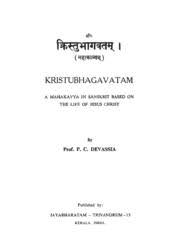
    Kristhu Bhagavatham is in Sanskrit with thirty three cantos following the Epic Grammar of Sanskrit Mahakavyas.

    And many prominent Hindus have appreciated the effort, hardly realising that this piece can be quoted as authentic even to date Christ, by manipulating timeliness by some self styled researcher!

    I have noticed that this piece is being spoken as a Mahakavyas and is gaining legitimacy.

    Sahitya Academy has awarded this work..

    Unless we record that this work as an attempt at converting Hindus, by writing in Sanskrit, History in the not too distant future would record Kristhu Bhagavatham as the Nineteenth Purana or a Upa Puran.

    I am recording this now here digitally that this Kristhu Kaavya is an attempt to seek legitimacy among Hindus to convert them.

    In fact, this method of conversion is taking place now.

    Kristubhagavatam: A Mahakavya in Sanskrit based on the life of Jesus Christ (Sanskrit: क्रिस्तुभागवतम्; Kristubhāgavatam or Kristu-Bhāgavatam) is a Sanskrit epic poem on the life of Jesus Christcomposed by P. C. Devassia (1906–2006), a Sanskrit scholar and poet from Kerala, India. For composing the Kristubhagavatam, Devassia won several awards, including the Sahitya Akademi Award for Sanskrit (1980). Composed in 1976 and first published in 1977, the poem consists of 33 cantos and over 1600 verses. As a mahakavya, it represents the most prestigious genre of Sanskrit epic poetry, characterized by ornate and elaborate descriptions


    On the one hand, Christ is a historical figure, and I must narrate his life objectively; on the other hand, a Sanskrit Mahakavya must conform to certain norms laid down by Sanskrit rhetoricians. These norms require free play of the imagination. This is often incompatible with objective narrative. I did not fancy the idea of translating the Bible into Sanskrit. I wanted my work to be really a Mahakavya, a literary piece, which anyone conversant with Sanskrit language should be able to read and enjoy. I have taken as my guide Fulton Oursler, who, in his “The Greatest Story Ever Told“, tells the story of Christ and fills in the details left out in the gospels by means of his fertile imagination.

    ..

    Look how he imitates Valmiki in prologue?

    Revolting.

    In his foreword, V. Raghavan wrote that the first efforts of the Christian missionaries to produce Christian literature in Sanskrit resulted in “translations of the Bible, which were all miserable.”:ii In contrast the Kristubhagavatam is the first major Sanskrit poem on the “whole life of Christ,” and Devassia “follows all the norms and practices of the Mahakavya, but does not indulge in too many figures or descriptions…. The style is simple and clear, endowed as it is with the Gunas of ‘Prasada‘ and ‘Saukumarya.’[3]:2[8]Furthermore,

    Not only the incidents, the miracles, etc. are faithfully given, but also the famous sayings of Christ… are incorporated in appropriate terms. [There is also] inclusion of apt analogies and comparisons with personalities and situations in the two Sanskrit Epics, the Ramayana and the Mahabharata, as also in the Puranas, and occasionally with some well-known happenings in modern India, like the killing of Gandhiji…. No effort is spent to make the poem over-coloured or loaded with displays of learning or skill: it is always simple and straightforward, in the much valued ‘Vaidarbhi’

    style.

    Raghavan added that in Devassia’s state of Kerala, “where Sanskrit and Malayalam have blended into a homogeneous amalagam, the community of Sanskritists is a commonwealth of Hindus, Christians and Muslims…. one finds here an Indian approach and an Indian presentation of the life of Christ

    ..

    the sonority of Sanskrit gives a fresh morning splendour and resonance to Jesus’ divine ministry. Mary held Joseph’s hand as Arundhati did Vasishtha’s; Just as Vasudevahid his son Krishna in Nanda’s house, so did Joseph take Jesus to Egypt for his safety; Lazarus’ sisters embraced him as he emerged out of his tomb, even as Devayani embraced Kacha as he revived after death…. in betraying Jesus with a kiss, wasn’t Judasanticipating Godse who was to kill the Mahatma after first saluting him? The similes come naturally, and rather bring out the basic unity of texture that binds all human history

    In summary, K. R. Srinivasa Iyengar concluded that the Kristubhagavatam is…

    …a double demonstration, firstly that Sanskrit is by no means a ‘dead language’ but is very much and gloriously alive; and secondly, that Jesus is not the Christians’ Messiah alone, but one of the pathfinders, one of the redeemers, of humanity as a whole. His message of Love has a permanent and potent significance for all mankind.

    How gullible these people who have heaped encomiums on a piece meant to destroy your religion?

    One’s finger blinding one’s own eye!

    Reference and Citation.

    https://en.m.wikipedia.org/wiki/Kristubhagavatam