Tag: Tamil History

  • Yonaguni Ruins Remains of Lemuria Tamils?

    The world we find in maps of today

    Yonaguni.image.
    Yonaguni ruins

    was not the same in ancient times.

    When I say ancient,I mean older by more than between 50,000 to 💯 000 years.

    The vast difference between the time frame mentioned is because of the inadequacy of Carbon dating method in determining objects which are over fifty thousand years old or more.

    And the use of other Scientific tools like Tectonic shift,ocean floor mapping,Strata analysis, infrared dating of Rocks, verification of Geogyphs,geoglyphology.

    When one finds ancient ruins around the world ,each of them quite far off from the other,the legends and literature of divergent cultures having some thing in common,the seacoasts,

    the unearthing of archeological finds of similar nature,one can not but wonder whether these were related!

    Description of Nazca Lines,Peru,in Sundarakanda of Ramayan,

    Astabhuja Devi Mexico,

    Siva Temple in China

    Siva Temple in central America,

    Hanuman , Makaratdwaja in Honduras,

    Narada mountain in Russia,

    City built by Pradyumna Krishna’s son in Port Barzhyn,Russia,

    Shiva’s Trinetra Dance in Australia,

    Boomerang,a Tamil weapon in Australia,

    Cooke’s Island described in Sundarakanda,

    Shiva’s City in Antarctica……..

    Tamil references to three floods,

    References in Tamil classics on Krishna,Rama,

    Rama’s name in Sumerian Kings’List,

    The antiquity of Tamils,

    The Civilisation of MU,

    Civilization of Lemuria,

    Lemuria being the home of Tamils,230 Million Years old,

    Recent excavation of Poompuhar, which is dated around 11,000 years old,

    Presence of Kasyspa in New Zealand,

    ….

    All these point to a civilization having been present in ancient times,which covered the world,

    Yonaguni.image

    Arechological Find Yonaguni,Japan image credit.Courtesy of http://www.yonaguni.ws

    The land of Atlantis being referred to in ancient Indian texts,..

    Now evidence of this civilisation in Japan.

    (Curiously it is very difficult to find the origin of Japanese people.)

    And if we go through the ancient continents, Pangaea,Rodina,and ancient oceans like Tethys ocean,one can find the floods mentioned in Puranas,Tamil classics are validated.

    And further the Fist Man Manu,as stated in the ancient texts,was from Dravida Desa and he meditated near Madagascar.

    The ruins of Poompuhar and of the remains of Yonaguni,Japan seems to have similarities.

    Above is Poompuhar ruins.

    Image below Poompuhar Remains


    References to ancient root races also point to the fact that ancient landmass existed somewhere near the northwest of Australia.

    https://ramanan50-wordpress-com.cdn.ampproject.org/v/s/ramanan50.wordpress.com/2017/08/01/seven-pehistoric-root-raceslemuriaatlantis-sanatana-dharma-details/amp/?amp_js_v=a2&_gsa=1&usqp=mq331AQHCAFYAYABAQ%3D%3D#referrer=https%3A%2F%2Fwww.google.com&_tf=From%20%251%24s&ampshare=https%3A%2F%2Framanan50.wordpress.com%2F2017%2F08%2F01%2Fseven-pehistoric-root-raceslemuriaatlantis-sanatana-dharma-details%2F

    Read the report.

    According to Kimura, the Yonaguni monument appears to depict carvings of animals and people as well as the remnants of a carved face, which he compares to the Moai heads on Easter Island. At the end of the last ice age, Yonaguni would have been connected to what is now mainland China. It is likely that the fate of the civilization that built the Yonaguni pyramid, was sealed by a massive tectonic event that triggered a tsunami and subsequent sea level rise.

    Since the end of the last Ice Age, sea levels have risen some 40 meters, causing drastic changes in topography and lending credibility to the theory that there may have been cities or even continents that disappeared into the sea. Based on stalactite found in caves near the ruins, Kimura has calculated the Yonaguni pyramid to be at least 6,000 years old when it sank, with the potential to be up to 10,000 years old including the time prior to flooding. The oldest recorded flooding event at Yonaguni occurred in the late 1700s, during which a tsunami ravaged the island with 130 foot waves. This combination of sea level rise and catastrophic climatic events were likely the cause of this ancient city’s demise….

    An interesting discovery has been made when looking at the orientation of the angles in the Yonaguni ruins. One researcher believes that the radial lines, when extended out from the ruins, might potentially outline a territory in the Pacific. This theory employs geoglyphology, or the study of coded maps and messaging in ancient geoglyphs, and has drawn out the radial lines of the Yonaguni ruins. The Faram Research Foundation’s work shows lines that depict a map very similar to the territory sought after by Japan during WWII.

    The area extends from Yonaguni and the South China Sea, up to the tip of Alaska’s archipelago, down to Hawaii and back over encompassing Indonesia and Burma (Myanmar). This territory, some believe, could be that which was occupied by the lost continent of Mu, a lost civilization larger and older than Atlantis.

    THE LOST CONTINENT OF MU

    The lost civilization of Mu, is thought to have spanned a large swath of the Pacific Ocean. Reaching from the Philippines Sea all the way to Easter Island, Mu would have encompassed most of the small islands in the mid-Pacific, including Guam, Fiji, Christmas Island, Midway and Hawaii. The conception of Mu was first proposed by Augustus LePlongeon in the 19th century who was the first explorer to photographically document the ancient Mayan city of Chichen Itza. It was there that he supposedly learned of the lost continent of Mu through his translation of the ancient Mayan Troano Codex.

    Reference and citation.

    https://www.gaia.com/article/yonaguni-monument-may-hold-key-to-the-sunken-civilization#.XAtCoKOaqTY.link

    # For details on the references I have mentioned here, please Google search term+ramanan50 ,as providing more Links slows down speed of the site.

  • Lord Krishna Dynasty Ruled From Thiruvananthapuram, Vizhinjam?

    The history of India is not what we are taught in text books.

    The Dates are deliberately pushed forward to give Christianity an edge in terms of antiquity.

    Ramayana, Mahabharata,Tamil classics are dated at ridiculously later dates.

    Ramayana is dismissed as Myth,Rig Veda ,acknowledged as the oldest literary work,is dated around 5000 BC!

    Archeological finds push these dates back, especially the finding of,

    Poompuhar,Tamil Nadu,11000 years,

    Tamil site near Chennai, India,A million years,

    Adichanallur,Anbil plates,Keezhadi,to cite a few.

    Based on the available evidence these

    could be dated at least 11000 years back.

    And we have Tamil classics,Sangam Literature.

    Tamil classics refer to Ramayana, Mahabharata and Lord Krishna repeatedly.

    Early Tamil Chera King,Udhiyan Cheralaathan fed the Kaurava and Pandava armies during the Mahabharata war.

    Madurai Meenakshi’s father Makaratdwaja,also called Saranga fought along side the Pandavas in the Mahabharata war.

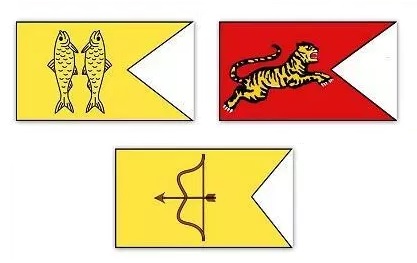
    The Three Crowned Kings of Tamilakam trace their origin to Solar and Lunar Dynasties.

    Lord Rama belonged to Ikshvsku Dynasty,the Solar Dynasty.

    His ancestor,Manu,the first human,was from South India.

    He moved to Ayodhya with his son Ikshvsku, because of a Tsunami in the South of Vindhya Mountains.

    Ikshvaku founded the Solar Dynasty,Surya Vamsa.

    Mani’s daughter,Ila,who was left in the South founded the Lunar Dynasty,Chandra Vamsa.

    The Tamil kings belonged to one of these two dynasties.

    The origin of the ancient Tamil kings is interesting.

    Chola inscriptions refer Cholas to be of Solar Dynasty of Lord Rama and Cholas state they belong to Kashyap Gotra.

    Of of the three crowned kings,Moovendar,Pandyas are reported to be more ancient.

    So are the Cheras.

    Chera and Pandya took part in Mahabharata war.

    Then we have the daughter of Manu,Ila,who founded the Luna Dynasty.

    Ila Dynasty spread throughout the world,Ailas.

    Sri Lanka,which was a part of India in those ancient times was the centre of this Kingdom.

    So we have these two dynasties spread throughout the world.

    Atlantis legends mention Rama kingdom and Sumerian Kings’ List mention Dasaratha,Rama and Bharatha.

    There is one more Dynasty which has gone unnoticed.

    The Ila.

    This Dynasty,with evidence surfacing now,seems to have co existed with the Tamilakam Moovendar and could have preceded them.

    They were called Ay Dynasty and they ruled from Vizhinjam,now called Thiruvananthapuram, Kerala.

    I have written earlier that Padmanabha Swamy temple, Kerala is about 25000 years old.

    Ay in Tamil means mother.

    It could denote the Ila Dynasty.

    Ay in Tamizh means Mother.

    The Ay Dynasty ruled from from Vizhinjam.

    The had a special relationship with Lord Krishna and Krishna was their family deity.

    Ayar in Tamil means Yadava,the community Lord Krishna belongs to.

    Taking into consideration that Krishna Married a Pandyan princess and had his daughter Married to a Pandyan princess,it is possible and more than probable that the offspring of Krishna’s daughter ruled from Vizhinjam, Thiruvananthapuram.

    Another important line of chieftains of Tamil Nadu during the sangam period with whom krishna was intimately associated was the Ay. The were known to call krishna as their god.Krishna is accepted as their chief god by the Ay.

    Reference.

    https://en.m.wikipedia.org/wiki/Ay_kingdom

    Vizhinjam dates back to the rule of the Ay dynasty. Circa 850 AD – 1400 AD, the region was the scene of many battles between the Chera dynasty(Kulasekhara) and the Cholas, and Vizhinjam, the then capital, was sacked by the Cholas.

    When the kings of the Ay dynasty shifted their capital to Vizhinjam, they built a fort dating to the eighth or ninth century. A preliminary investigation by a team of archaeologist under Dr. Ajit Kumar, University of Kerala, has revealed the fort might have originally been 800 m² in area. The fort’s wall can be found on the northern and western (seaside) parts and has been constructed using large boulders set in mud mortar. The wall, with a wide base, tapers on its way up. Even now this part of Vizhinjam is known as Kottapuram, (“Kotta” in Malayalam means Fort. According to Dr. Ajit, one important clue in dating the fort is that the walls have no battlements or `loop holes’ (holes to place cannons in). This is typical of early forts, he says. Another complex of walls, near the present Our Lady of Good Voyage Church, probably relates to the Portuguese period.

    https://en.m.wikipedia.org/wiki/Vizhinjam

  • Oldest Temple Construction Dravida? History of Temple Construction 2

    Oldest Temple Construction Dravida? History of Temple Construction 2

    Vedas are four

    Rig,

    Yajur,

    Sama and Atharva.

    In addition to this there are six more,Vedanga,Limbs of the Vedas.

    They are,
    Siksha,Vyakarana,Chandas,Niruktha, Jyothisha and Kalpa.

    None of these relate to Temple construction.

    This is in tune with the Vedic approach of Reality being Abstract .

    Each Veda has Anugrahamani on this subject.

    To explain the meaning of the Vedas there is a special Group called Niruktham.

    There are six sub texts of the Vedas called Vedangas.

    They are Siksha,Vyakarana,Chandas,NirukthamJyothisham and kalpa.

    https://www.google.co.in/amp/s/ramanan50.wordpress.com/2014/03/01/veda-sutras-vedangas-details/amp/

    However,the Puranas and Smritis refer to temple construction.

    It may be noted that the Smritis do not have the same authority as Vedas.

    Smritis are traditions being followed.

    In case of conflict between Veda and Smritis,Vedas are the deciding authority.

    One may find references to Temple building in Puranas.

    Also how to construct divine images.

    Agni Purana describes methods of constructing Shiva Lingam.

    Puranas are ancient history and as such they are facts and they are not the final authority.

    However they are sign posts for Righteous Living

    So the concept of Temples is not a part of Vedas.

    This ,as mentioned in my earlier article,is a later Concept.

    And this concept seems to have been of Dravidian origin.

    The earliest temple of Murugan is found in Saluvarkuppam, Pondicherry,India.

    It is dated around Fourth century BC.

    The Guruvayur temple of Lord Krishna was built by a Chola king.

    The Temple is constructed B.C 3000(Around 5000 years oldest Temple) According to legends, the deity worshipped here is more than 5000 years old. But there are no historical records to establish it. In the 14th century, “Kokasandesam” (a Tamil literary work), references to a place called Kuruvayur are made. As early as the 16th century (fifty years after Narayaniyamwas composed) many references to Kuruvayur are seen’

    https://www.google.co.in/amp/s/ramanan50.wordpress.com/2015/05/14/guruvayurappan-temple-built-by-pandya-king-5000-years/amp/

    And the temples of South India seem to be more ancient and are of different architecture.

    Shiva worship in Tamil seems to have preceded the Vedas.

    (This is a contentious issue as it is difficult to say which language , Sanskrit or Tamil,is more ancient.)

    Thiruvananthapuram ,Abode of Shiva is 3.94 Billion years old.

    Tirupati is 2100 Million Years old.

    The worship of Vedic deities are found in ancient Tamil literature.

    The Tamils classified Land into five Regions.

    Kurinji,Mountaneous Region,God Murugan,

    Marutham, Paddy fields,Indra.

    Mullai,Forest land, Vishnu,Maayon,

    Neydhal,Seashore,God Varuna and Paalai,Desert,God Kotravai,Durga.

    One finds these in the oldest Tamil work available, Tholkappiyam,A book on Tamil Grammar.

    So the concept of Personal God’s are present both in Sanskrit and Tamil

    Curiously,Shiva is not mentioned in Tholkappiyam as God of a specific land area!

    This point made me arrive at the hypothesis that Shiva was a human being and that He was the First to Realize Brahman through Vaasi Yoga!

    Temple description abounds in Tamil literature.

    Silappadikaram,one of the Five Tamil Epics mentions this.

    Temple for Kotravai and Indra.

    Now Poompuhar remains are dated to be 11000 Years ago!

    Now on the find of the material being dated 11000 Years sets the Tamil History and the Sanatana Dharma back at least by 20,000 years.

    But the Tamil Sangams are dated at

    “that the first two of which were held in cities since “taken by the sea”, and the third of which was held during the 5th century BC in the present-day city of Madurai.'(wiki).

    Silappadikaram has been dated to likely belong to the beginning of Common era.

    https://www.google.co.in/amp/s/ramanan50.wordpress.com/2015/03/02/poompuhar-find-sets-tamilhinduism-by-atleast-20000-years/amp/

    References of temples in Silappadikaram.

    They also stop at a temple where “Aiyai, goddess of hunters” is being worshiped.
    When leaving the city of Puhar, Kannagi and Kovalan pass by “the great Vishnu temple”, “seven Buddhist Viharas”, and “wandering Jain monks” (26) all within close proximity to each other showing the obvious acceptance of multiplicity. At the time of Kannagi and Kovalan “Brahmanism (Hinduism), Jainism, and Buddhism – were at the time harmoniously coexisting in the south” (Adigal VIII).

    http://www.mahavidya.ca/2010/06/07/the-silappadikaram/

    Description: This is one of the 2 Shivastalams in the ancient Chola seashore capital of of Poompuhaar, a popular tourist destination, the other one beingTiruchaaikkadu.. Pallavaneeswaram is the 10th in the series of Tevara Stalangal on the northern banks of the river Kaveri in the Chola region of Tamilnadu. Temples in existence in Puhaar have been mentioned in the ancient Tamil work, Silappadikaaram. This is a shrine at the confluence of the Kaveri with the ocean. Poompuhaar was once a hoary port of the Cholas and is now a tourist attraction. The remnants of Puhar are seen under the ocean. Kovalan and Kannaki of Silappatikaram are said to have been born here.The Temple: This is a small temple with a 5 tiered Rajagopuram and a single prakaram. A Pallava king’s association with the temple lends the name.

    chrome-distiller://6b468200-c919-4364-9b11-16065dc98c2e/?time=22615665&url=http%3A%2F%2Fwww.templenet.com%2FTamilnadu%2Fs087.html

    Join 4,576 other subscribers
  • Second Great Tamil Tsunami 13000 BC Chera Dynasty Silappadikaaram 9600 BC?

    Second Great Tamil Tsunami 13000 BC Chera Dynasty Silappadikaaram 9600 BC?

    I had written on Human migration stating that History of India stretches back to 1.5Million years in the light of archeological finds .

    The site at Attirampakkam,Chennai,Tamil Nadu us dated at 1.5 million years.

    Bhimbedka in North India,Edakkal cave paintings are dated 75000 years and about 100,000 years respectively.

    Then Thiruvannamalai,India is dated around 3.94 Bikkion years.

    Jwalapuram,near Cuddapah in Andhra,India is dated around 74,000 years.

    There are many more ancient sites than Ramayana and Mahabharata.

    (I have written on these sites.)

    Acheulian stone tools which is about 1.51 million years old, have been discovered in Chennai near Attirampakkam. These stones were found by researchers from the Chennai-based Sharma Centre for Heritage Education.

    The discovery indicates that early humans (hominins), used these tools. The tools are much older than those found in Europe. These tools are also found in several countries in South Asia, including India, Nepal, and Pakistan.

    More than hundreds of different tools have been discovered from the Attirampakkam site. The most common ones are hand-axes, cleavers and small flakes. The stone axes are elongated teardrop or ovate-shaped with bifacial symmetry.

    Unlike the hand-axes, the cleavers have broad cutting edges.

    https://www.newsreporter.in/million-years-old-acheulian-tools-were-found-in-chennai

    The fact that Lemuria existed and migration took place from the south of present India gets strengthened.

    • . 60,000 BCE – 32,768 BCE
      Human habitation of India.
    • 5,500 BCE
      Cotton cultivation begins in India.
    • c. 5,000 BCE – c. 1,500 BCE
      The Indus Valley (or Harappan) Civilization.
    • c. 5,000 BCE
      Evidence of religious practices in the Indus Valley.

    https://ramanisblog.in/2018/04/05/india-1-5-million-years-old-first-human-migration-from-southern-coast-india/

    Poompuhar,the famous port of Chola kings has been found and it is dated around 11,500 ago.

    Taking into consideration the advanced construction of the remains found in Poompuhar and the richness of the Tamil language as revealed and found in Silappadikaaram,one of the Five Epics of Tamil indicate that the Tamil language should have been in existence at least five thousand years earlier.

    This is a conservative estimate.

    References to Tamil,Tamil kings are found in Sanskrit texts including Ramayana and Mahabharata.

    Poompuhar evidence.

    Most notably these other discoveries include a second completely separate group of structures fully three miles from the Poompuhar shore in water that is more than 70 feet (23 metres) deep. The lack of interest is surprising because to anyone with even minimal knowledge of post-glacial sea-level rise their depth of submergence is – or should be – highly anomalous. Indeed according to Glenn Milne’s sea-level data the land on which these structures were built last stood above water at the end of the Ice Age more than 11,000 years ago.

    Is it a coincidence that there are ancient Tamil flood myths that speak of a great kingdom that once existed in this area called Kumari Kandam that was swallowed up by the sea? Amazingly the myths put a date of 11,600 years ago on these events — the same timeframe given by Plato for the end of Atlantis in another ocean.

    https://ramanisblog.in/2015/03/02/poompuhar-find-sets-tamilhinduism-by-atleast-20000-years/

    Ilango Adigal who wrote Silappadikaram was the younger brother of the Chera king Cheran Senguttuvan.

    The happenings in Silappadikaaram took place during the lifetime of these two.

    Therefore,both Ilango Adigal,Cheran Senguttavan may be anti- dated from the present Third century BC, to 11600 CE.

    And the Tsunami of Sangam priod,the Second one,which Silappadikaaram mentions must be earlier to 15,000 years ago.

    Will be writing on the First Tsunami and the second in detail.

    And the Chera dynasty to around 11,600 years ago.

    I had written earlier with the available evidence then about the Kings List of Tamil Nadu.

    This now stands revised.

    Chera Kings List.

    Udiyancheralatan
    Antuvancheral
    Imayavaramban Nedun-Cheralatan (56–115 AD)
    Cheran Chenkutuvan (from 115)
    Palyanai Sel-Kelu Kuttuvan (115–130)
    Poraiyan Kadungo (from 115)
    Kalankai-Kanni Narmudi Cheral (115–140)
    Vel-Kelu Kuttuvan (130–185)
    Selvak-Kadungo (131–155)
    Adukotpattu Cheralatan (140–178)
    Kuttuvan Irumporai (178–185)
    Tagadur Erinda Perumcheral (185–201)
    Yanaikat-sey Mantaran Cheral (201–241)
    Ilamcheral Irumporai (241–257)
    Perumkadungo (257–287)
    Ilamkadungo (287–317)

    Kanaikkal Irumborai(367-397).

    That there were two Tsunamis mentioned in Tamil literature.The first Tsunami devoured the Thenmadurai ,in Lemuria.

    The second one consumed Kapadapuram.

    This is mentioned in Silappadikaaram thus.

    வடிவே லெறிந்த வான்பகை பொறாது

    பஃறுளி யாற்றுடன் பன்மலை யடுக்கத்துக்

    குமரிக் கோடுங் கொடுங்கடல் கொள்ள

    – நாடு காண் காதை.

    The Tsunam devoured The river Pahruli and Kanyakumari,which was near the montain range.

    Ilango Adigal’s Grandfather was Udiyan Cheralaathan and he was the first known king of Chera dynasty.(with available evidence now)

    So we can date Silappadikaram,Ilango Adigal around to 9600 BC and Tsunami around 13,000 BC.

  • Million Year Tamil site Near Chennai Ramani’s blog Info on Archeology,  Now in Nature Magazine

    Million Year Tamil site Near Chennai Ramani’s blog Info on Archeology, Now in Nature Magazine

    I have been writing on the antiquity of Sanatana Dharma and Tamil and that they are between Thirty thousand to a Million years old.

    This I have been researching for the past nine years and have published articles based on credible sources from around the world, from different languages, archeoanthropology, archaeology, Astronomy, Infrared dating, Plate tectonics, World literature, Etymology, Cultural similarities between various races, customs.

    Some of the recovered stone tips, such as the one seen in the upper right of this image, have narrower bottom portions called tangs. Tangs would have made it easier to attach the points to handles, aiding in spear-making. PHOTOGRAPH BY SHARMA CENTRE FOR HERITAGE EDUCATION, India. Image
    Some of the recovered stone tips, such as the one seen in the upper right of this image, have narrower bottom portions called tangs. Tangs would have made it easier to attach the points to handles, aiding in spear-making. PHOTOGRAPH BY SHARMA CENTRE FOR HERITAGE EDUCATION, INDIA

    The present date assigned to Rig Veda is 5114 BC and Tamil about 3000 BC. This, I found to be incorrect and based on my research from credible sources I suggested that Tamil is one Million years old and Vedas, as they are quoted by ancient Tamil, was earlier to Tamil. But the Vedas quite Tamil!

    So I took the position that both Tamil and Vedas are so old that it is impossible for me to find out which one was earlier :Both of them are at least million years old.

    Despite research by scholars, both from India and abroad, efforts have been made by the influential to suppress the evidence or call these studies as unscientific.

    I have a follower of this blog, who is an archaeologist who was denied permission to dig at Kurukshetra, because she was following a lead from me to find artifacts from Kurukshetra which would yield proof for Mahabharatha War. When I talked to the gentleman at Delhi, who was with the archeology department, who incidentally is a follower of Ramani’s blog, told me that he has oral instructions not to permit archaeological studies which might yield evidence that might be older than 5000Years!

    However thanks to Internet, one can not easily hide facts for long. A finding by archaeologists indicating the Antiquity of Tamil was not made available or publicised. Thanks to Internet, information can not be suppressed. The information was published in the Science in 2011

    . Lamenting this I wrote an article three years ago about the study by a team of archeologists on a site near Chennai about the antiquity of Tamils. Now the findings of these archaeologists have been published in Nature, the prestigious magazine for research. Here it is. ‘

    The discovery, described in Nature on Wednesday, pushes back the start of what’s called the Middle Paleolithic culture in the region by more than a hundred thousand years. That, in turn, could reshape how scientists view the global spread of hominins—humans and their ancient relatives—before modern humans migrated out of Africa some 60,000 years ago.

    Stone tools found in South India

    The new evidence suggests that a Middle Palaeolithic culture was present in India around 385,000 years ago — roughly the same time that it is known to have developed in Africa and in Europe. Middle Palaeolithic period is considered an Millionimportant

    cultural phase associated with modern humans and Neanderthals as well as other archaic hominins. Stone tools of this period are used by scientists as proxy for studies of early human behaviour.

    The prehistoric stone tools excavated from Attirampakkam village about 60 kilometers from Chennai push back the period when populations with a Middle Palaeolithic culture may have inhabited India. The new study appeared in international scientific journal Nature on Wednesday. (31 January, 2018.)

    http://www.firstpost.com/tech/news-analysis/ancient-stone-age-tools-found-in-tamil-nadu-suggest-reframing-of-out-of-africa-theories-4329961.html/amp

    Research paper Link in Nature https://www.nature.com/articles/nature25444.epdf?referrer_access_token=SekmVmbJtzBMrNuXXh_UVtRgN0jAjWel9jnR3ZoTv0NJ7TiKM5a9H3w098XWhhWBtLzjXFhaUZSKMeMqZ6ROTnAqKt5lvdWtt1JKb3O3R4qKq_tp-KPZhhmRcacgZ8pNbuK4ZsHqOcF9nlk5YUFLiQYeRkRM8dXm30aO5uRBXkpILGUYY7yr3XUzUokupc15&tracking_referrer=news.nationalgeographic.com

    Springer Nature wants researchers to share content easily and legally. Our Springer Nature SharedIt content-sharing initiative means that links to view-only, full-text subscription research articles can be posted anywhere – including on social media platforms, author websites and in institutional repositories – so researchers can share research with colleagues and general audiences.

    http://www.springernature.com/gp/researchers/sharedit

    ‘ My article on this, three years ago. ‘

    I posted an article that the Tamils lived around 74,000 years ago and that too near Chennai.

    I forgot to provide the Link.

    Scroll down for Video.

    This led to the speculation that I have been providing information not backed up by facts.

    Readers of this site know well that I never post information without evidence nor providing information without authentic links.

    I forgot in the above case.

    Million year old Tamil site near Chennai.Million year old Tamil site near Chennai.

    Skeptics who were /are critical of my research may criticise Nature now..