Tag: Mathematics in Hindusim

  • Mathematical Concepts In Vedas Sulaba Sutras

    Mathematical Concepts In Vedas Sulaba Sutras

    This article is in continuation of my articles on history of Mathematics. In my earlier articles, I had presented an overview of History of Mathematics and how ancient references and works of Indians are ignored while those that came later were recognised; List of Mathematicians before Christ; Twenty Nine Sutras of Mathematics; Concept of Infinity and Nothing.In the present article let me explore more, especially advanced Mathematical Concepts in Vedas.

    For the Twenty Nine Sutras of Vedic Mathematics, criticism is that it is not actually found in the Vedic Texts and it is only ‘Tricks of Vedic Thought ‘ The system works and nobody has refuted it.So if these Sutras were tricks and how come they work? If it is misinterpretation, then the Inventor should have been awarded the Nobel Prize for Mathematics!

    Vedic Mathematics in Sulaba Sutras.
    Sulaba Sutras of Kathyayana.

    Before attempting to understand Indian Concepts, including metaphysics, Science,the student should remember that Vedas are Spiritual in Nature; they give importance to Ontology and Self Realisation and what we call as Scientific knowledge which is useful for day to day life is regarded as lower knowledge,Apara Vidya.The practical applications of Scientific thoughts can be found in Vedic Practices,like designing a an Altar for Yagnya; the velocity of Light in the description of Surya: the movement of the Sun in the Galaxy and Universe in Sisumara Chakra; the Milky way galaxy in Vishnu’s description; Mitochondrial Pairs on Chamaka; Astronomy and Cosmology in Purana;Large numbers,Very small numbers in Astronomical texts of India;Of Nothing and Infinity in Nadadiya Suktha.And there is more.So one should read carefully,nay they are to be studied,not Read.And Vedas have sub texts or Limbs. They are called Vedangas. These contain information that is needed to lead life. These texts also contain scientific truths.

    Let us look at some Vedic Concepts in Mathematics. I have quoted from sources like Wikipedia and the sources for Wiki articles.Wiki sources have been verified by me and am providing references in this article.

    Several Mathematicians and Historians mention that the earliest of the texts were written beginning in 800 BCE by Vedic Hindus based on compilations of an oral tradition dating back to 2000 BCE.
    Datta, Bibhutibhusan (1931). “On the Origin of the Hindu Terms for “Root””. The American Mathematical Monthly. 38 (7): 371–376. doi:10.2307/2300909. ISSN 0002-9890. JSTOR 2300909.

    The Vedic civilization originated in India bears the literary evidence of Indian culture, literature, astronomy and mathematics. Written in Vedic Sanskrit the Vedic works, Vedas and Vedangas (and later Sulbasutras) are primarily religious in content, but embody a large amount of astronomical knowledge and hence a significant knowledge of mathematics. Some chronological confusion exists with regards to the appearance of the Vedic civilization. S Kak states in a very recent work that the time period for the Vedic religion stretches back potentially as far as 8000BC and definitely 4000BC. It is also worthwhile briefly noting the astronomy of the Vedic period which, given very basic measuring devices (in many cases just the naked eye), gave surprisingly accurate values for various astronomical quantities. These include the relative size of the planets the distance of the earth from the sun, the length of the day, and the length of the year. Some of Vedic works are:

    • All four arithmetical operators (addition, subtraction, multiplication and division).
    • A definite system for denoting any number up to 1055 and existence of zero.
    • Prime numbers.

    Among the other works mentioned, mathematical material of considerable interest is found:

    • Arithmetical sequences, the decreasing sequence 99, 88, … , 11 is found in the Atharva-Veda.
    • Pythagoras’s theorem, geometric, constructional, algebraic and computational aspects known. A rule found in the Satapatha Brahmana gives a rule, which implies knowledge of the Pythagorean theorem, and similar implications are found in the Taittiriya Samhita.
    • Fractions, found in one (or more) of the Samhitas.
    • Equations, 972x2 = 972 + m for example, found in one of the Samhitas. Sites Google

    Sulba Sutras

    The Shulba Sutras or Śulbasūtras ( rope”) are sutra texts belonging to the Śrauta ritual and containing geometry related to fire-altar construction.

    They are the only sources of knowledge of Indian mathematics from the Vedic period. Unique fire-altar shapes were associated with unique gifts from the Gods. For instance, “he who desires heaven is to construct a fire-altar in the form of a falcon”; “a fire-altar in the form of a tortoise is to be constructed by one desiring to win the world of Brahman” and “those who wish to destroy existing and future enemies should construct a fire-altar in the form of a rhombus”….The four major Shulba Sutras, which are mathematically the most significant, are those attributed to Baudhayana, Manava, Apastamba and Katyayana.Their language is late Vedic Sanskrit, pointing to a composition roughly during the 1st millennium BCE. The oldest is the sutra attributed to Baudhayana, possibly compiled around 800 BCE to 500 BCE. Pingree says that the Apastamba is likely the next oldest; he places the Katyayana and the Manava third and fourth chronologically, on the basis of apparent borrowings. According to Plofker, the Katyayana was composed after “the great grammatical codification of Sanskrit by Pāṇini in probably the mid-fourth century BCE”, but she places the Manava in the same period as the Baudhayana…There are multiple commentaries for each of the Shulba Sutras, but these were written long after the original works. The commentary of Sundararāja on the Apastamba, for example, comes from the late 15th century CE and the commentary of Dvārakãnātha on the Baudhayana appears to borrow from Sundararāja.According to Staal, certain aspects of the tradition described in the Shulba Sutras would have been “transmitted orally”, and he points to places in southern India where the fire-altar ritual is still practiced and an oral tradition preserved. The fire-altar tradition largely died out in India, however, and Plofker warns that those pockets where the practice remains may reflect a later Vedic revival rather than an unbroken tradition. Archaeological evidence of the altar constructions described in the Shulba Sutras is sparse. A large falcon-shaped fire altar (śyenaciti), dating to the second century BCE, was found in the excavations by G. R. Sharma at Kausambi, but this altar does not conform to the dimensions prescribed by the Shulba Sutras..

    References and citations. https://en.m.wikipedia.org/wiki/Shulba_Sutras

    1. Plofker (2007), p. 387, “Certain shapes and sizes of fire-altars were associated with particular gifts that the sacrificer desired from the gods: ‘he who desires heaven is to construct a fire-altar in the form of a falcon’; ‘a fire-altar in the form of a tortoise is to be constructed by one desiring to win the world of Brahman’; ‘those who wish to destroy existing and future enemies should construct a fire-altar in the form of a rhombus’ [Sen and Bag 1983, 86, 98, 111].”
    2. a b c Plofker (2007), p. 387
    3. a b Pingree (1981), p. 4
    4. a b Plofker (2009), p.18
    5. ^ Plofker (2009), p. 11
    6. ^ Pingree (1981), p. 6
    7. ^ Delire (2009), p. 50
    8. ^ Staal (1999), p. 111
    9. ^ Plofker (2009), p 19.
    10. ^ Bürk (1901), p. 554
    11. ^ Heath (1925), p. 362
    12. ^ “Square Roots of Sulbha Sutras”. pi.math.cornell.edu. Retrieved 2020-05-24.
    13. ^ Datta, Bibhutibhusan (1931). “On the Origin of the Hindu Terms for “Root””. The American Mathematical Monthly38 (7): 371–376. doi:10.2307/2300909. ISSN 0002-9890. JSTOR 2300909.
    14. ^ Gupta (1997), p. 154
    15. ^ Staal (1999), pp. 106, 109–110
    16. ^ Seidenberg (1978)
    17. ^ van der Waerden (1983)
    18. ^ Van der Waerden, Barten L (1983). Geometry and Algebra in Ancient Civilizations. Springer Verlag. p. 12. ISBN 0387121595.
    19. ^ Joseph, George Gheverghese (1997). “What Is a Square Root? A Study of Geometrical Representation in Different Mathematical Traditions”. Mathematics in School26 (3): 4–9. ISSN 0305-7259. JSTOR 30215281.
    20. ^ Boyer (1991), p. 207, “We find rules for the construction of right angles by means of triples of cords the lengths of which form Pythagorean triages, such as 3, 4, and 5, or 5, 12, and 13, or 8, 15, and 17, or 12, 35, and 37. However all of these triads are easily derived from the old Babylonian rule; hence, Mesopotamian influence in the Sulvasutras is not unlikely. Aspastamba knew that the square on the diagonal of a rectangle is equal to the sum of the squares on the two adjacent sides, but this form of the Pythagorean theorem also may have been derived from Mesopotamia. … So conjectural are the origin and period of the Sulbasutras that we cannot tell whether or not the rules are related to early Egyptian surveying or to the later Greek problem of altar doubling. They are variously dated within an interval of almost a thousand years stretching from the eighth century B.C. to the second century of our era.”
    21. ^ Krishnan, K S (2019). Origin of Vedas, Chapter 5. Notion Press. ISBN 978-1645879800.
    22. ^ Seidenberg (1983), p. 121
    23. ^ Pingree (1981), p. 5
    24. ^ Plofker (2009), p. 17
    25. ^ Thibaut (1875), pp. 232–238
    26. ^ Plofker (2007), pp. 388–389
    27. ^ Boyer (1991), p. 207
    28. ^ Joseph, G.G. (2000). The Crest of the Peacock: The Non-European Roots of Mathematics. Princeton University Press. p. 229ISBN 
    29. ^ Thibaut (1875), pp. 243–246
    30. a b Plofker (2007), pp. 388-391
    31. a b c Plofker (2007), p. 391
    32. ^ Plofker (2007), p. 392, 
    , ,

    Join 4,576 other subscribers
  • History Of Mathematics Preface Bakshali Manuscript

    History Of Mathematics Preface Bakshali Manuscript

    I have been searching for some information relating to mathematics and I came across Bakshali manuscript . It is in Sanskrit and dated at AD 224–383/ 885–993 (proposed carbon-dates, recently disputed on methodological grounds: Plofker et al.) It’s script is Sharada and is said to have been in vogue in what is now Kashmir.I was curious because one finds advanced mathematics and scientific concepts in ancient Sanskrit literature, including the Eighteen Puran and Ithihasas, not to speak of Vedas. One finds advanced mathematics concepts in Chamaka of Sri Rudra. Maths DNA Mitochondrial Base Pairs In Chamakam Rudram Obviously, an attempt to bypass Indian history is at work.I pursued my search. I found references first to Greeks,Romans then to Sumeria and Mesapotamia.

    The earliest mathematical texts available are from Mesopotamia and Egypt – Plimpton 322 (Babylonian c. 2000 – 1900 BC), the Rhind Mathematical Papyrus (Egyptian c. 1800 BC) and the Moscow Mathematical Papyrus (Egyptian c. 1890 BC). All of these texts mention the so-called Pythagorean triples, so, by inference, the Pythagorean theorem seems to be the most ancient and widespread mathematical development after basic arithmetic and geometry.

    Babylonian.

    The Babylonian mathematical tablet Plimpton 322, dated to 1800 BC.. image.
    The Babylonian mathematical tablet Plimpton 322, dated to 1800 BC.

    Babylonian mathematics refers to any mathematics of the peoples of Mesopotamia (modern Iraq) from the days of the early Sumerians through the Hellenistic period almost to the dawn of Christianity. The majority of Babylonian mathematical work comes from two widely separated periods: The first few hundred years of the second millennium BC (Old Babylonian period), and the last few centuries of the first millennium BC (Seleucid period). It is named Babylonian mathematics due to the central role of Babylon as a place of study. Later under the Arab Empire, Mesopotamia, especially Baghdad, once again became an important center of study for Islamic mathematics.

    Egypt

    The most extensive Egyptian mathematical text is the Rhind papyrus (sometimes also called the Ahmes Papyrus after its author), dated to c. 1650 BC but likely a copy of an older document from the Middle Kingdom of about 2000–1800 BC.

    Source. History of Mathematics

    Bakshali Manuscript

    The manuscript is a compendium of rules and illustrative examples. Each example is stated as a problem, the solution is described, and it is verified that the problem has been solved. The sample problems are in verse and the commentary is in prose associated with calculations. The problems involve arithmetic, algebra and geometry, including mensuration. The topics covered include fractions, square roots, arithmetic and geometric progressions, solutions of simple equations, simultaneous linear equations, quadratic equations and indeterminate equations of the second degree……The manuscript is written in an earlier form of Śāradā script, a script which is known for having been in use mainly from the 8th to the 12th century in the northwestern part of South Asia, such as Kashmir and neighbouring regions. The language of the manuscript,[a] though intended to be Sanskrit, was significantly influenced in its phonetics and morphology by a local dialect or dialects, and some of the resultant linguistic peculiarities of the text are shared with Buddhist Hybrid Sanskrit. The overlying dialects, though sharing affinities with Apabhraṃśa and with Old Kashmiri, have not been identified precisely. It is probable that most of the rules and examples had been originally composed in Sanskrit,

    Wikipedia on Bakshali Manuscript

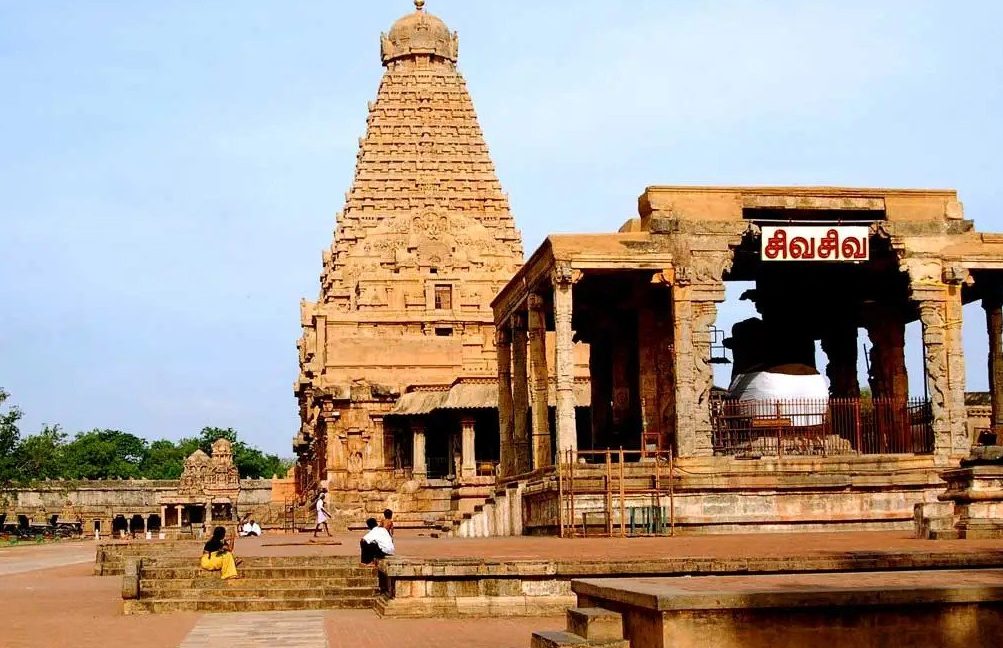
    Clever at obfuscation and misleading. At one stroke mathematics of India is relegated to Third century to 9 Century AD The people who have started this canard with high sounding research names and authors do not seem to be aware of what a common man knows in India knows. That is the Structure of Temples in India. You find Temples of India, especially in South India,being not only a place of worship but architectural marvels. Not only that; we have temples where the Sun’s rays fall at a spot on a fixed time, date; temple where one finds inverted image as in a pinhole camera; intricately carved sculptures which could not have been possible without technology. Without going into all these, simple fact is that one of the best example of Chozha architecture is Thanjavur Big Temple, Thanjavur, Tamilnadu, India.And this was built by Rajaraja Chozha during 1064 – 1084. The construction of the temple,where Eighty Ton monolith stone is kept atop the temple; the fact that the temple tower’s shadow falls only within its base; it’s intricate carvings would not have been possible without highly advanced mathematics.

    So, I delved deep into Sanskrit and Texts. I find references to Vedic mathematics by Kathyayana and Bodhayana; then to Aryabhatta and Varahamihira. Then in Chamaka of Sri Rudram.

    I thought it fit to check on the Tamil texts first before getting into Sanskrit because I had already written some articles on Mathematics in Sanskrit ,like the one on Fibanocchi Numbers,Value Of Pi To 31 Decimal Places In Krishna Stuthi.

    Binomial Triangle Computer Binary System By Pingala

    I shall explore further about mathematics in Tamil texts.

    Join 4,576 other subscribers

    ,
  • Maths DNA Mitochondrial Base Pairs In Chamakam Rudram

    Maths DNA Mitochondrial Base Pairs In Chamakam Rudram

    Sri Rudram is a powerful Mantra, where Lord Shiva is worshiped in his aspect as Rudra.

    This is probably the only one Hymn of the Vedas where Shiva is directly mentioned , though in secret, while Hymns on Agni, Varuna,Narayana, Vishnu .. are many.

    I have written on this in a separate Post.

    The Portion Rudram praises  Rudra and in Chamakam the devotee asks Rudra for everything a Human being could wish for.

    There are many ways of chanting the Rudra, depending on intonation(Gana) and the results vary for each.

    And there are different types of conduction of Sri Rudram, in terms of how many people, and how much each one chants at the same time.

    This also determines the result of the Rudra Upasna.

    Worshippers of Lord Siva recite Rudram with 11 sections followed by Chamakam with 11 sections as a routine prayer every day. This is called the daily nyasam or mode of worship. In the Rudram part, the devotee pays repeated obeisance to Lord Siva and prays for his blessings for human well being. But on special occasions, the number of times the recitation is done is increased.

    In Rudra Ekadasi, Rudram is recited 11 times and Chamakam is recited once. After Rudram is recited once, one section or anuvaka ofChamakam is recited in order.

    In Laghurudram, Rudra Ekadasi is done 11 times, that is, Rudram is recited 112  or 121 times and Chamakam is recited 11 times.

         In Maharudram, 11 Laghurudrams are recited; that is, Rudram is recited 113 = 1331 times and Chamakam 112 = 121 times.

    In Atirudram, 11 Maharudrams are recited; that is, Rudram is recited 114 = 14641 times and Chamakam is recited 113 = 1331 times.

    The Chamakam mentions completely the ideal of human happiness and defines in the highest degree the desires to be fulfilled without delimiting those to be asked for or to be granted..

    DNA and Mathematics in Sri Rudram.

    In the Chamakam, in anuvakas or sections 1 to10, the devotee prays for almost everything needed for human happiness and specifies each item.  But in the 11th anuvaka or 11th section of Chamakam, the devotee prays for the desired things not specifically but in terms of numbers, first in terms of odd numbers from 1 to 33 and later in multiples of 4 from 4 to 48, as follows:

    Eka cha me, thisrascha may, pancha cha may, sapta cha may, Ekadasa cha may, trayodasa cha may, panchadasa cha may, saptadasa cha may, Navadasa cha may, ek trimshatis cha may, trayovimshatis cha may, Panchavimshatis cha may, saptavimshatis cha may, navavimshatis cha may, Ekatrimshatis cha may, trayatrimshatis cha may, panchatrimshatis cha may, Chatasras cha may, ashtou cha may, dwadasa cha may, shodasa cha may, Vimsatis cha may, chaturvimshatis cha may, ashtavimshatis cha may, Dwathrimashatis cha may, shatstrimshas cha may, chatvarimshas cha may, Chatuschatvarimshas cha may, ashtachatvarimshas cha may”
    which means:

    “Let these be granted to me. One, three, five, seven, nine, eleven, thirteen, seventeen, nineteen, twenty one, twenty three, twenty five, twenty seven, twenty nine, thirty one and thirty three as also four, eight, twelve, sixteen, twenty, twenty four, twenty eight, thirty two, thirty six, forty, forty four and forty eight”.

    Traditional scholars and pandits explain the significance of these numbers as follows:

    ODD NUMBERS:

    1 = Nature or Prakriti

    3 = The three gunas, namely sattwa, rajas and tamas

    5 = The five mahabhutas, or the five basic elements, that is, prithvi, ap, tejas, vayu and akasha, (earth, water, energy or agni or fire, wind and space).

    7 = The five sensory organs and the mind and intellect

    9 = The nine openings in the human body, called the navadwaras.

    11 = The ten pranas and the Sushumna nadi

    13 = Thirteen Devas

    15 = The nadis or nerve centres in the human body

    17 = The limbs of the human body

    19 = Medicinal herbs

    21 = Important vulnerable parts of the body

    23 = Devas controlling serious diseases

    25 = Apsaras in heaven

    27 = Gandharvas

    29 = Vidyut Devas

    31 = Worlds

    33 = Devas

    MULTIPLES OF FOUR:

    4 = The four ideals of human life, namely dharma, artha, kama and moksha,

    (righteous way of life, wealth, desire, and salvation)

    8 = The four Vedas and the four upavedas

    12 = Six vedangas and six shastras.

    16 = Knowledge to be obtained from God

    20 = The Mahabhutas

    24 = The number of letters in the Gayatri metre

    28 = The number of letters in the Ushnik metre

    32 = The number of letters in the Anushtup metre

    36 = The number of letters in the Brihati metre

    40 = The number of letters in the Pankti metre

    44 = The number of letters in the Trushtup metre

    48 = The number of letters in the Jagati metre

       According to Dr Sasidharan, these numbers represent a polymer chain of molecules that form apa or water that enables evolution of life and intelligence, and apa is nothing but the nitrogenous base pairs of the DNA.   The numbers 1 to 33 represent the 33000 base pairs of mitochondrial base pairs of DNA.  The numbers 4 to 48 represent the 48 million nuclear bases of DNA.  The two sets of DNA bases combine to provide sustenance of human wellbeing and onward evolution of human life.  When the devotee prays for the blessing of these numbers, actually he is praying for bestowing on him all these DNA bases which conduce to sustenance of human wellbeing and happiness.

    Citations.

    Sri.S.Balasubramanian.

    https://sites.google.com/site/mathematicsmiscellany/mathematics-in-chamakam

  • Hinduism Is Mathematics Fibonacci Golden Ratio In Meru

    Philosophical enquiry needs an  analytic  Mathematical Mind.

    One would notice that most of the Great Philosophers of the world have also been great Mathematicians.

    Rene Descartes, Leibniz,Spinoza,Siddhas of India,Pingala, Arya Bhatta, Varaha Mihira….

    It is easy for a Mathematician to understand Nature which is mathematically constructed.

    Every atom to an elephant is made mathematically.

    There is Uniformity and Rhythm in Nature.

    This applies to actions and reactions.

    The term Rta is dealt separately in Hinduism.

    This means order.

    Please read my post on this.

    Another point in Hinduism is what is in Macrocosm is in Microcosm and vice versa.

    What is found in the Universe is found in Man.

    For example,

    The ratio 1:1.618 is a golden ratio which is found all over the cosmos. Stick out your forefinger. The ratio from the first two bones is 1:1.618. Now the ratio between the 2nd middle bone and the third bone terminating at the knuckle is also 1:1.618.  The ration from your navel to top of your head and bottom of your feet is also 1:1.618

    This is called the Fibonacci Ratio.

    Fibonacci Ratio in Leaves

    Arrangements of the leaves

    Fibonacci Ration in Leaves.Image.jpg
    Fibonacci Ration in Leaves.

    Also, many plants show the Fibonacci numbers in the arrangements of the leaves around their stems. If we look down on a plant, the leaves are often arranged so that leaves above do not hide leaves below. This means that each gets a good share of the sunlight and catches the most rain to channel down to the roots as it runs down the leaf to the stem.
    The computer generated ray-traced picture here is created by my brother, Brian.

    Leaves per turn

    The Fibonacci numbers occur when counting both the number of times we go around the stem, going from leaf to leaf, as well as counting the leaves we meet until we encounter a leaf directly above the starting one.

    If we count in the other direction, we get a different number of turns for the same number of leaves.

    The number of turns in each direction and the number of leaves met are three consecutive Fibonacci numbers!

    Fibonacci Number in Mount Meru


    Mount Meru is an actual and sacred mountain in Tanzania/Arctic, it is also the name given to the Fibonacci series in the Maatraameru (Mountain of Cadence) written by Pingala in the Chhandah-shastra (Art of Prosody) around 450 BC. In this writing, it was organized as a pyramid, today known as Pascal’s triangle, like this:

    Mount Meru In Numbers.photot.jpg
    Mount Meru In Numbers

    Kubera was revered as the chief of the Guhyakas and was the ‘king of kings’, the ‘god’ and ‘guardian of the North’. The word Guhyakas comes from the word ‘godha’ (root gudh or guh), meaning chameleon – a dragon-serpent. It seems that in Hindu mythology, ‘god’ is a ‘naga’ or ‘dragon serpent’ who lives at the top of Mount Meru and hides a golden treasure.

    Thus we find that God is associated in ancient Hindu mythology with the infinite and irrational golden ratio at the center of a Fibonacci spiral symbolized as a mountain, pyramid or perhaps an infinite spiraling vortex (like the Hindu Schwass-tika). Further reading on the subject describes Mt. Meru as home to all of the gods, closely resembling the Biblical concept of a heaven paved with gold.

    As one last note, in Vedic astrology, Kubera’s golden treasure is guarded by Shukra, which is the Hindu name for the planet Venus. Shukra is then celebrated in a specific month in the Hindu calendar called JyeshTha, corresponding to May-June.

    One would find he same in Carnatic Music and Bharata Natya.

    More to follow.

    Citation.

    Journal of the American Oriental Society, Volume 33 by E. W. Hopkins, 1918.

    2. The Golden Mean and the Physics of Aesthetics, Subhash Kak, Archive of Physics: physics/0411195, 2004

    http://www.hinduism.co.za/anahata.htm#Fibonacci Fingers?