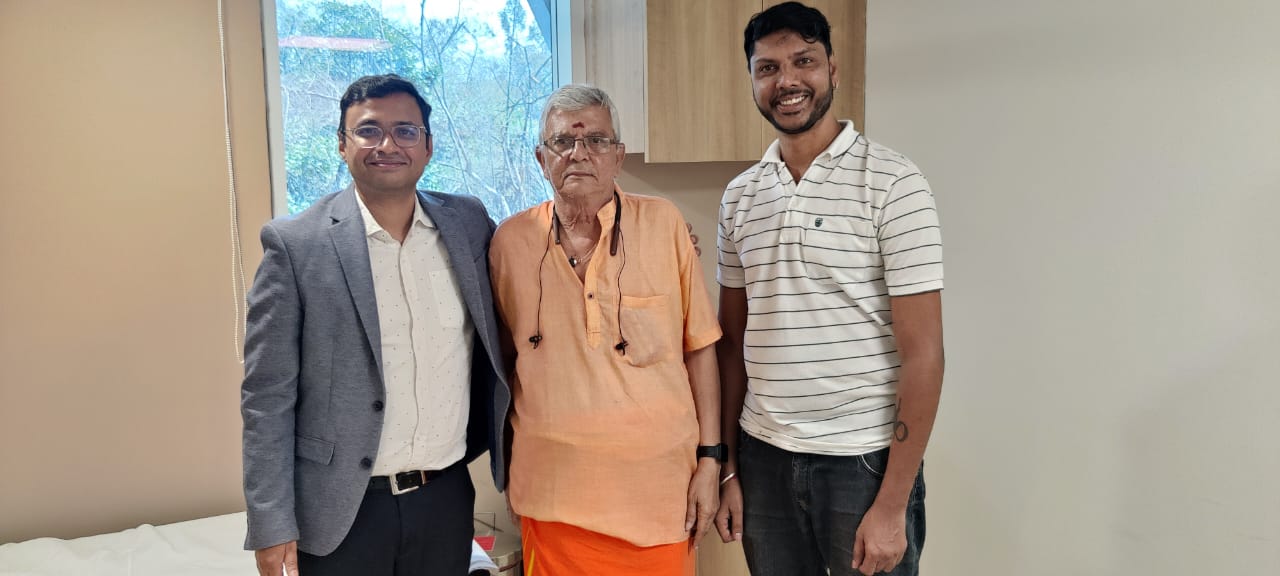
Recently ,I had the misfortune of interacting with a Surgeon(Oncology), in connection with a Lesion in the abdominal region.
It was as seen in the CF Scan,nestling in the cramped space between the Kidney,Pancreas and the Spleen.
This was detected incidentally when we consulted a Physician for weight loss,occasional fever and persistent dry Cough.
Initially Blood Test was taken.The hemoglobin was low at 9.5 with ESR reading at 148.
As this indicates serious disease,we had a CAT scan and Ultra Sound done and followed it up with a visit to a Renal Specialist who directed us to a Renal Surgeon.
As I was disturbed by the flippant attitude of the Renal Surgeon, I decided to check the internet in detail on the symptoms and disease( I have a fair knowledge of medicine).
Though the indications were not serious , they have the portent of some thing serious, Cancer.
Meanwhile a relative of us who is an Ophthalmologist suggested we Consult an Endocrinologist and move to a Multi Speciality Hospital for Surgery.
We landed in a multi Specialty Hospital and by mistake met the Lymphoma specialist.
The Doctor straight away assumed Lymphoma and scared the life out of us.
Since the surgical procedure is a foregone conclusion,I decided that we Consult an Oncologist Surgeon as he would be in a better position to remove the Lesion if it were to turn out to be malignant.
The Oncologist suggested Open Surgery,discarding Laproscopic Surgery and Robotic Surgery as the Lesion was too big -10 cm and it was nestling among kidney,Pancreas and Spleen.
We had a discussion about further tests to be carried out before Surgical procedure.
To cut the narrative short, we had the Surgery done ,the Lesion turned out to be benign(375 gm) and the patient is recovering well.
At times I found that the Doctor seemed to be disturbed at my suggestions as he might have felt that I was questioning his abilities, but I made it clear to him that we would be offering suggestions and the final Call would be his,no questions asked.
He was relieved.
The point I am trying to make is that though we may be anxious and have some knowledge of medicine through internet or other wise , we must understand that the Doctor is a Professional and leave the decision making to him with out pressurizing him.
About 30 years back we never knew what our ailments were. excepting the symptoms and we were taking the instructions of the doctor to the letter.
Believe me, we were better off in terms of cure, no anxieties.
But. now technology has advanced and we have access to information.
We should know when to stop as the pressure on the Doctors are tremendous because they have to keep up with the pressure exerted by the patients or relatives.
Added to this specter of being dragged into Court for misdiagnosis /wrong procedure,
Ultimately he is responsible.
Also Medicine, despite its advancements, still works on gut feeling of the Doctor and is an art.
Duties and Obligations of a Doctor.
Duties and obligations of doctors are enlisted in ordinary laws of the land and various Codes of Medical Ethics and Declarations – Indian and International, which are :
(i) Code of Medical Ethics of Medical Council of India ;
(ii) Hippocratic Oath ;
(iii) Declaration of Geneva ;
(iv) Declaration of Helsinki;
(v) International Code of Medical Ethics ;
(vi) Government of India Guidelines for Sterilization.
These Codes and Declarations are being printed in the Appendices. On the basis of these various Codes of Ethics and Declarations, the duties can be summarised as under –
1. Duties to Patient.
2. Duties to Public.
3. Duties towards Law Enforcers.
4. Duties not to violate Professional Ethics.
5. Duties not to do anything illegal or hide illegal acts.
6. Duties to each other.
1.Duties to Patient –These are : Standard Care, Providing Information to the Patient /Attendant , Consent for Treatment, and Emergency Care.
(A)Standard Care –This means application of the principles of standard care which an average person takes while doing similar job in a similar situation :
1. Due care and diligence of a prudent Doctor.
2. Standard, suitable, equipment in good repair.
3. Standard assistants : Where a senior doctor delegates a task to a junior doctor or paramedical staff, he must assure himself that the assistant is sufficiently competent and experienced to do the job, and fulfills the prescribed qualifications.
4. Non-standard drug is a poison by definition.
5. Standard procedure and indicated treatment and surgery.
6. Standard premises, e.g. Nursing Home, Hospital , must comply with all laws applicable as imposed by the State and these must be registered wherever required.
7. Standard proper reference to appropriate specialist.
8. Standard proper record keeping for treatment given,surgery done, X-ray and pathological reports.
9. Standard of not to experiment with patient ( SeeDeclaration of Helsinki in Appendix IV).
10. Anticipation of standard risks of complications and preventive actions taken in time.
11. Observe punctuality in consultation.
(B)Duty to provide information to patient / attendant
1. Regarding necessity of treatment.
2. Alternative modalities of treatment.
3. Risks of pursuing the treatment, including inherent complications of drugs, investigations, procedure,surgery etc.
4. Regarding duration of treatment.
5. Regarding prognosis. Do not exaggerate nor minimizethe gravity of patient’s condition.
6. Regarding expenses and break-up thereof.
The following issues may complicate or negatively affect the doctor-patient relationship if not taken properly into consideration.
Physician superiority
The physician may be viewed as superior to the patient, because the physician has the knowledge and credentials, and is most often the one that is on home ground.
The physician-patient relationship is also complicated by the patient’s suffering (patient derives from the Latin patior, “suffer”) and limited ability to relieve it on his/her own, potentially resulting in a state of desperation and dependency on the physician.
A physician should at least be aware of these disparities in order to establish rapport and optimize communication with the patient. It may be further beneficial for the doctor-patient relationship to have a form of shared care with patient empowerment to take a major degree of responsibility for her or his care.
[edit]Benefiting or pleasing
A dilemma may arise in situations where determining the most efficient treatment, or encountering avoidance of treatment, creates a disagreement between the physician and the patient, for any number of reasons. In such cases, the physician needs strategies for presenting unfavorable treatment options or unwelcome information in such a way that minimizes strain on the doctor-patient relationship while benefiting the patient’s overall physical health and best interests.
Formal or casual
There may be differences in opinion between the doctor and patient in how formal or casual the doctor-patient relationship should be.
For instance, according to a Scottish study,[1] patients want to be addressed by their first name more often than is currently the case. In this study, most of the patients either liked (223) or did not mind (175) being called by their first names. Only 77 disliked it, most of whom were aged over 65.[1] On the other hand, most patients don’t want to call the doctor by his or her first name.[1]
Some familiarity with the doctor generally makes it easier for patients to talk about intimate issues such as sexual subjects, but for some patients, a very high degree of familiarity may make the patient reluctant to reveal such intimate issues.[2]
Transitional care
Transitions of patients between health care practitioners may decrease the quality of care in the time it takes to reestablish proper doctor-patient relationships. Generally, the doctor-patient relationship is facilitated by continuity of care in regard to attending personnel. Special strategies of integrated care may be required where multiple health care providers are involved, including horizontal integration(linking similar levels of care, e.g. multiprofessional teams) and vertical integration (linking different levels of care, e.g. primary, secondary and tertiary care).[3]
[edit]Other people present
An example of where other people present in a doctor-patient encounter may influence their communication is one or more parents present at a minor‘s visit to a doctor. These may provide psychological support for the patient, but in some cases it may compromise the doctor-patient confidentiality and inhibit the patient from disclosing uncomfortable or intimate subjects.
When visiting a health provider about sexual issues, having both partners of a couple present is often necessary, and is typically a good thing, but may also prevent the disclosure of certain subjects, and, according to one report, increases the stress level.[2]
http://en.wikipedia.org/wiki/Doctor-patient_relationship#Issues
Related articles
- Interpreter Code of Ethics (milenasahakian.wordpress.com)